How Do You Practice Evening Angel Meditation Before Sleep?
Review the day early in the evening, leave one worry on paper, and close with a short night prayer that asks God's angels to keep watch
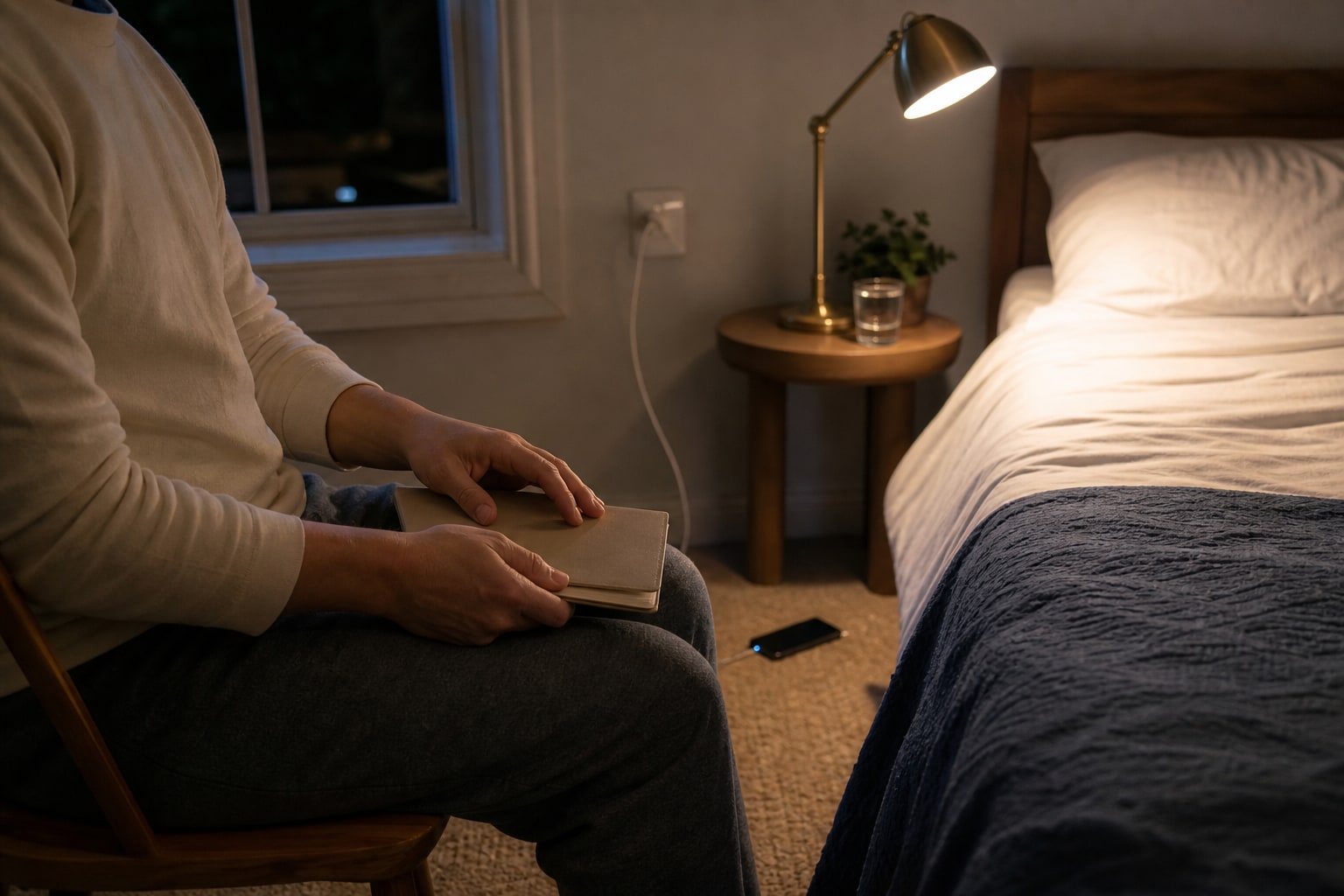
Evening angel meditation is a short end-of-day practice that reviews the day, puts one unfinished worry on paper, and closes with a prayer asking God's angels to keep watch through the night.
It is a devotional habit, and its aim is a calmer close to the day, not a sign or a promised outcome.
Each piece has an older source. Ignatius of Loyola's examen reviews the day with thanks, Catholic and Anglican Night Prayer asks that holy angels dwell with those who sleep, and the Jewish Bedtime Shema places Michael, Gabriel, Uriel, and Raphael around the bed.
The timing comes from sleep research. Studies of bedtime worry suggest the review works better well before sleep, which leaves only a brief prayer for the bedside.
Quick Facts
- Two sittings
- About 15 minutes of review after dinner, then a few minutes of prayer at bedside
- Traditional night texts
- Angel of God, the Compline collect "Visit this place, O Lord," and the Bedtime Shema
- Angels in the Bedtime Shema
- Michael at the right, Gabriel at the left, Uriel in front, Raphael behind
- Sleep evidence
- In one lab study, a specific five-minute to-do list cut time to fall asleep by about 9 minutes
- Awake after 20 minutes
- Sleep specialists advise getting up for a quiet, low-light activity
- Leave out
- Dream requests, sign testing, and long confession at the pillow
What are the steps of evening angel meditation?
The practice has two sittings. The first is a short written review at a table after dinner, and the second is a prayer of a few minutes in a chair beside the bed.
Splitting it keeps honest review and sleep from competing for the same half hour.
The times below are practical suggestions, since no tradition fixes them.
One evening, two sittings
- Give thanks
- Input
- A notebook page, about two hours before bed
- Action
- Name one specific good thing from the day
- Result
- The review opens with thanks, as the examen does
- Name one worry
- Input
- The concern most likely to return at bedtime
- Action
- Write it in one line, with its next small step beside it
- Result
- The worry now has a plan and a time
- Fold the page
- Input
- The finished sheet
- Action
- Fold it in half and set it on the nightstand without rereading it
- Result
- Memory no longer has to hold the concern
- Pray at bedside
- Input
- A chair, a low lamp, the phone in another room
- Action
- Say one traditional night prayer slowly, once
- Result
- The night is placed in God's keeping
- Close
- Input
- One short release line
- Action
- Say it, turn off the lamp, and get into bed
- Result
- Getting into bed marks the end of the practice
If the worry comes back after lights-out, the folded page answers it. It is written down, and it already has a next step.
Nothing in the sequence asks for a vision, a feeling of presence, or a dream.
A night that ends in ordinary sleep has done what the practice is for.
Which angels and prayers belong to traditional night prayer?
Three prayer traditions give the bedside sitting its words, and each places the angels differently.
The Jewish Bedtime Shema (Keri'at Shema al Hamita) names four angels: "at my right [hand] Michael, at my left [hand] Gabriel, before me Uriel, behind me Raphael."
Above the head it places the Presence of God, so the angels stand around the sleeper while the prayer stays addressed to God.
The same liturgy opens with a release that suits the end of a day. The reader forgives "anyone who has angered me, or sinned against me," before blessing God, who "causes the fetters of sleep to fall upon my eyes."
In Catholic practice, the General Instruction of the Liturgy of the Hours calls Night Prayer (Compline) "the last prayer of the day, said before retiring" and says an examination of conscience "may suitably follow" its opening verse.
On Sunday nights its psalm is Psalm 91, which speaks of angels guarding the one who trusts God.
Anglican Compline in the 1979 Book of Common Prayer ends with a collect that asks God to "visit this place" and "let your holy angels dwell with us to preserve us in peace." Its antiphon for the Nunc Dimittis asks, "Guide us waking, O Lord, and guard us sleeping."
| Tradition | Night text | Where angels appear | What the prayer asks |
|---|---|---|---|
| Jewish | Bedtime Shema | Michael, Gabriel, Uriel, and Raphael on four sides, with God's Presence above | Forgiveness for the day, sleep in peace, and waking in peace |
| Catholic | Night Prayer (Compline) | Psalm 91 on Sunday nights | Trust through the night, after a brief examination of conscience |
| Anglican | Compline, Book of Common Prayer (1979) | Closing collect: "let your holy angels dwell with us" | Peace for the household while it sleeps |
| Catholic devotion | Angel of God (Angele Dei) | The guardian angel, addressed directly | To "light and guard, to rule and guide" |
The difference matters when you choose words. In the Shema and Compline, the prayer speaks to God and names angels as God's watchers, while the Angel of God prayer speaks to the guardian angel directly.
None of these texts asks an angel for a message or a sign. They ask for keeping and peace, which is why they fit a practice meant to end the day.
How does the examen fit the end of the day?
The examen supplies the review, and its source is precise. In the Spiritual Exercises, in the section numbered 43 in modern editions, Ignatius of Loyola sets out five points for the general examen.
They are: give thanks for benefits received, ask grace to know one's sins, review the day "hour by hour, or period by period," ask pardon, and resolve to amend.
According to IgnatianSpirituality.com, Ignatius required Jesuits to make the examen twice daily, at noon and at the end of the day.
Modern Jesuit versions narrow the third point. The five steps taught on IgnatianSpirituality.com include "Choose one feature of the day and pray from it" and end with "Look toward tomorrow."
That narrower form is the better fit for evening. A full account of thoughts, words, and deeds can start the planning that keeps people awake, which is one more reason to hold the review at the table rather than at the pillow.
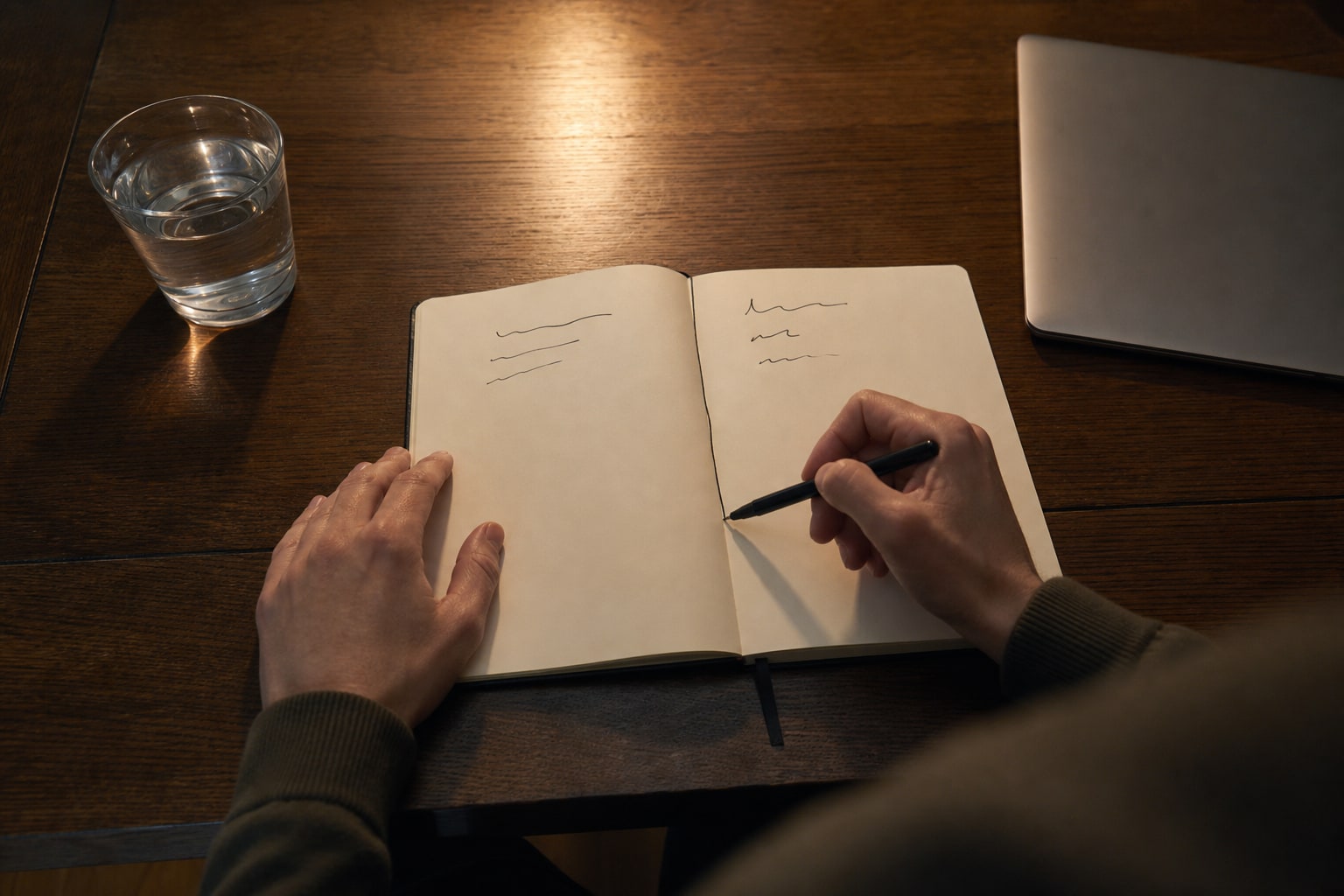
A workable page has two columns. On the left goes one gift from the day, named concretely, such as a colleague who covered a shift or a phone call that went better than feared.
On the right goes one concern with its next step. "Mom's test results: call the clinic at 9 a.m." holds the worry and the plan in a single line.
One entry of thanks is enough here, and a longer gratitude journaling habit can sit at another time of day.
Ignatius put thanks first so that the review starts from what went right, not so that the list keeps growing.
The fourth and fifth points, pardon and amendment, still belong. Name one thing to repair and write the repair as tomorrow's first step, instead of replaying the conversation in bed.
Why write the worry down before bed?
Sleep researchers have tested whether putting an unfinished concern on paper helps people fall asleep, and the answer so far is a qualified yes.
In a 2006 study of 33 college students with insomnia symptoms, Carney and Waters had one group write each worry with a possible next step for five evenings. This "constructive worry" group reported less mental arousal before sleep than a group that only recorded its worries.
Their instructions also set the timing. Do the exercise in the early evening, at least two hours before bed, then fold the sheet and leave it on the nightstand.
If worry starts at bedtime, the instructions say to remind yourself that you already dealt with the problem "when you were at your problem solving best."
The folded sheet in this practice comes straight from that step.
In 2018, Michael Scullin and colleagues at Baylor University asked 57 healthy adults aged 18 to 30 to write for five minutes at bedtime in a sleep lab.
Those who wrote a to-do list for the coming days fell asleep in about 16 minutes on average, against about 25 minutes for those who listed tasks already finished.
Detail mattered too. The more specific the to-do list, the faster its writer fell asleep, while longer lists of completed tasks showed the opposite trend.
What the writing studies support
The research supports the timing and the writing. It says nothing about angels or prayer.
What the evidence supports
- Write the next step
Pairing a worry with a possible step lowered pre-sleep arousal more than recording the worry alone (Carney and Waters, 2006).
- Look forward, briefly
A specific five-minute to-do list shortened time to fall asleep compared with reviewing finished tasks (Scullin and colleagues, 2018).
What remains limited
- Small samples
Both studies used a few dozen young adults, so the results are a starting point rather than a settled rule.
- Not an insomnia treatment
Scullin's participants had no sleep disorder, and the authors call for trials in people with insomnia.
- No spiritual claim
Neither study tested prayer, and neither can show that an angel is present or helping.
For the evening practice, the lesson is practical. Write forward rather than backward, keep it short, and finish it before the bedroom, so the prayer that follows has no planning left to carry.
What can you say at bedside to hand over the night?
A brief, fixed prayer works best at bedside, because the familiar words themselves signal the end. A traditional text said the same way each night does this better than a new composition.
The Angel of God prayer published by the USCCB asks the guardian angel to be at one's side "ever this day." A common bedtime variant says "ever this night," a small change that turns a morning prayer into a night prayer.
If you pray the Bedtime Shema, its angel verse already does this work. Other readers can borrow its order, naming God first and then asking that God's angels keep watch, so the prayer stays addressed where its source addressed it.
After the traditional text, one short release line can close the sitting. Choose the line that matches what the day left open:
- For unfinished work: "It is written down, and it can wait until morning."
- For someone you worry about: "I place them in God's care for tonight."
- For a hurt from the day: "I forgive what I can tonight and will look at the rest tomorrow."
- For uncertainty: "I do not need the answer before I sleep."
Say the line once, then turn off the lamp. Repeating it until you feel calm turns it into a test of whether it worked.
Keep the same words for at least a week. A line you know by heart takes no effort to recall, while a new script each night keeps the mind busy composing.
The Hamapil blessing, which goes back to the Talmud (Berakhot 60b), asks, "Let my thoughts not terrify me."
People have prayed against racing thoughts at bedtime for well over a thousand years, and a short fixed prayer is how the tradition answered them.
What if evening prayer keeps you awake?
Move the part that wakes you, not the whole practice. For most people the trouble starts in the review, because naming a concern invites solving it.
Match the change to the problem
Change the timing or the content before adding more prayer.
Return to bed when sleepy; skip the phone
Keep only the fixed prayer at bedside
Keep one gift and one next step
Leave threat language out of the bedside prayer
Rest does not have to prove anything
The 20-minute advice comes from the American Academy of Sleep Medicine.
Its healthy sleep habits also include a relaxing bedtime routine, using the bed only for sleep and sex, and turning off electronic devices at least 30 minutes before bedtime.
That last point matters for anyone who prays from an app. A printed card, or a prayer already known by heart, removes the screen from the final half hour.
When fear is the main problem, deal with it before the last hour. A protection prayer said earlier, together with a real step such as locking a door or calling someone, leaves less for the bedside prayer to carry.
If sleeplessness lasts for weeks, talk with a doctor or sleep specialist. A prayer routine can make bedtime calmer, but it cannot treat insomnia.
Is evening angel meditation the same as praying for an angel dream?
No. Asking sleep to deliver a dream, sign, or visit is dream incubation, and it keeps the original question open all night.
The traditional night prayers above ask for keeping and peace. Evening meditation follows them, so once the prayer is said the night owes you nothing further.
Setting an intention for dreams is a different before-sleep practice with its own cautions. Keeping it apart from the day-closing review means a dreamless night does not feel like a failed prayer.
If a vivid dream does come, write it down after waking and look at it in daylight. Dream journaling works better in the morning than rereading the entry at the next bedtime.
How can you tell the practice is helping?
Judge it by what happens after the lamp goes off. A warm feeling during prayer is pleasant, but the useful signs come at lights-out and the next morning.
Over a week, look for plain changes. You stop reaching for the folded page, the same worry returns less often or for shorter stretches, and in the morning you can start the next step you wrote.
Sleep varies from night to night, so compare whole weeks rather than grading each evening.
If the practice is not helping after a fair trial, shorten it, since the bedside prayer alone is still a complete practice.
Morning is the natural partner. Where the evening sets something down, a morning meditation chooses one thing to carry into the day, and the next step on the folded sheet can be that thing.
Frequently Asked Questions
What prayer can you say to your guardian angel at night?
Many Catholics say the Angel of God prayer with "this night" in place of "this day." Compline in the Book of Common Prayer offers a collect asking God to "let your holy angels dwell with us to preserve us in peace."
Which four angels are named in the Jewish bedtime prayer?
The Bedtime Shema names Michael at the right, Gabriel at the left, Uriel in front, and Raphael behind, with God's Presence above the head. The prayer itself is addressed to God.
How long should evening angel meditation take?
About 15 minutes for the early review and a few minutes at bedside suits many people. Carney and Waters suggest doing the written worry exercise at least two hours before bed.
Should you meditate in bed?
A chair beside the bed usually works better. The American Academy of Sleep Medicine advises using the bed only for sleep and sex, so getting into bed can mark the end of the practice.
Can you use the examen if you are not Catholic?
Yes. The examen comes from Ignatius of Loyola, but its steps of thanks, review, and looking toward tomorrow can be adapted to other faiths, leaving out language that does not fit your own.
What if you fall asleep during the prayer?
Then the practice has done its job. The traditional night prayers ask for rest, so drifting off partway through is not a failure.
Sources
- (1548). The Spiritual Exercises, Method for Making the General Examen (no. 43). Christian Classics Ethereal Library. Link
- . The Daily Examen. Loyola Press. Link
- . Keri'at Shema al Hamita (Bedtime Shema), paragraphs 1, 2, and 24. Sefaria. Link
- . Bedtime Shema. My Jewish Learning. Link
- (1971). General Instruction of the Liturgy of the Hours, nos. 84-88. Divine Office. Link
- (1979). An Order for Compline, Book of Common Prayer. BCP Online. Link
- . Prayer to Your Guardian Angel. USCCB. Link
- (2006). Effects of a Structured Problem-Solving Procedure on Pre-Sleep Cognitive Arousal in College Students With Insomnia. Behavioral Sleep Medicine 4(1), 13-28. Link
- (2006). Constructive Worry Instructions. Worksheet, drcolleencarney.com. Link
- (2018). The Effects of Bedtime Writing on Difficulty Falling Asleep: A Polysomnographic Study Comparing To-Do Lists and Completed Activity Lists. Journal of Experimental Psychology: General 147(1), 139-146. Link
- . Healthy Sleep Habits. Sleep Education. Link
About Our Editorial Process
Every KnowTheAngels guide separates calculation method, tradition context, and personal reflection. We cite where interpretations come from, present more than one view, and never present symbolic reading as prediction.
Read our editorial policy