What Does the Name Metatron Mean, and Where Might It Come From?
A name-origin guide to the most debated angel name in Jewish mystical tradition, its competing etymologies, and why it breaks the standard Hebrew pattern
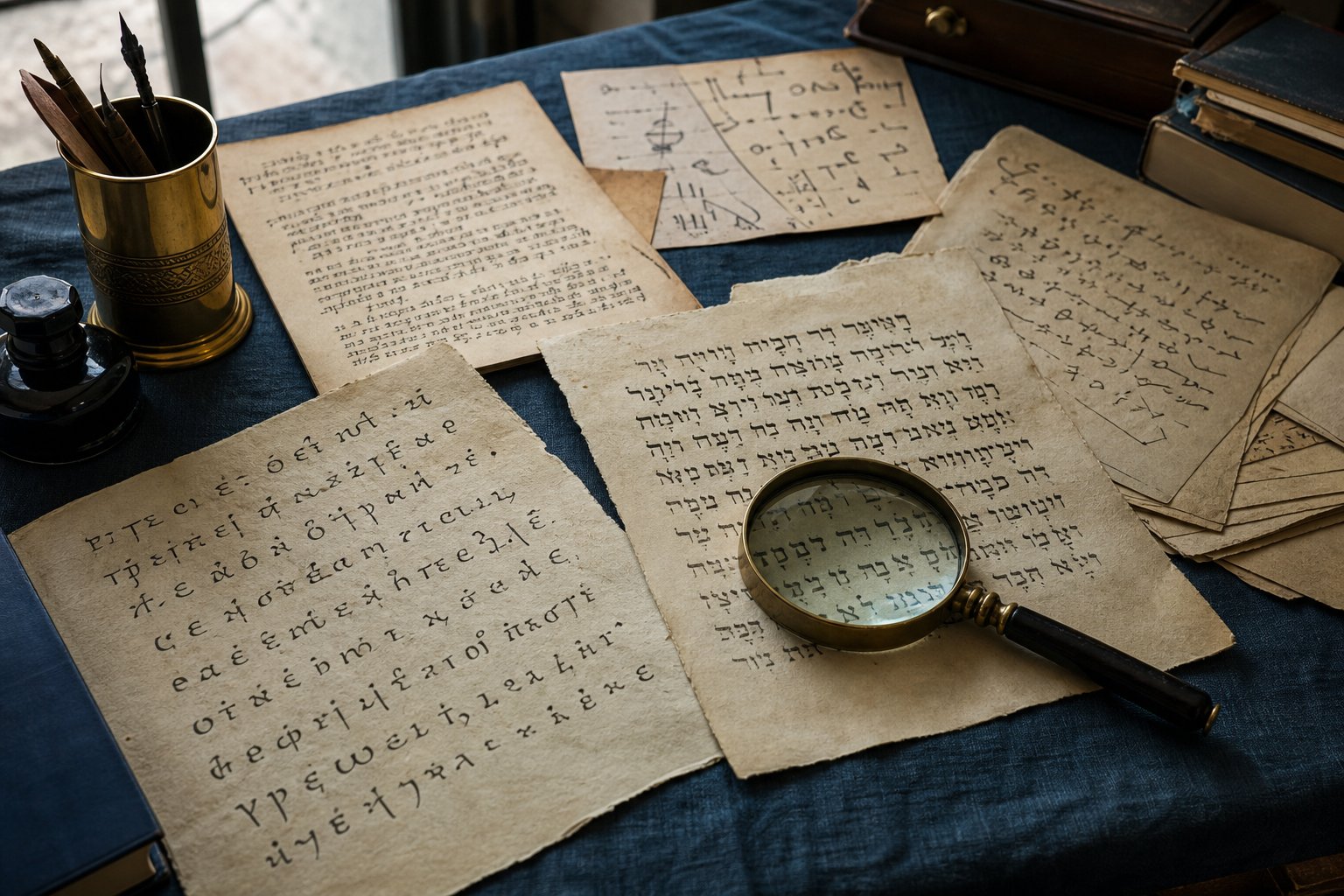
Metatron is one of the most recognized angel names in contemporary spirituality, but it is also the hardest to translate.
Every other major angel name in Jewish tradition follows a transparent Hebrew formula: Gavri-el means "God is my strength," Micha-el asks "Who is like God?"
Metatron follows none of those rules.
The etymology has resisted a century of scholarly effort, with proposals spanning Greek, Latin, Hebrew, and Aramaic, and the disagreement itself reveals how unusual the name is within Jewish angelology.
Its earliest attestations belong to Hekhalot and Merkavah mystical texts, which places it in a different source category from the angel names that appear in scripture.
Quick Facts
- Name origin
- Disputed. At least five scholarly proposals exist, with no consensus.
- Leading theories
- Greek metathronos (beside the throne), Latin metator (guide/surveyor), Hebrew/Aramaic transformations
- Naming pattern
- Does NOT follow the Hebrew theophoric -el suffix (unlike Gabriel, Michael, Raphael, Uriel)
- Earliest source
- Hekhalot and Merkavah mystical literature, especially 3 Enoch (Sefer Hekhalot)
- Biblical status
- Not named in any canonical biblical text (Hebrew Bible, New Testament, or Qur'an)
- Traditional identification
- The patriarch Enoch transformed into an angelic being, per 3 Enoch 3-15
Five proposed origins, with no settled winner
No single etymology has won. That sentence is the honest starting point for anyone asking what Metatron means, because the scholarly literature contains at least five distinct proposals.
The most frequently cited theory derives Metatron from the Greek metathronos, meaning "one who stands beside the throne" or "one who shares the throne." Gershom Scholem, the founding figure of modern Kabbalah scholarship, discussed this proposal seriously while noting its phonological difficulties.
A second theory connects the name to the Latin metator, a Roman military term for a surveyor, advance guard, or one who measures out a camp. Hugo Odeberg, who published the critical edition of 3 Enoch in 1928, considered this possibility alongside several others.
A third cluster of proposals looks for a Hebrew or Aramaic root. Some scholars have suggested matara ("keeper of the watch"), while others point to the Aramaic matatron as a loanword adaptation.
| Theory | Source language | Proposed meaning | Key difficulty |
|---|---|---|---|
| Metathronos | Greek | One beside/behind the throne | The Greek compound is not independently attested |
| Metator | Latin | Guide, surveyor, or advance measurer | Latin loanwords are rare in Hekhalot literature |
| Matara / Matatron | Hebrew / Aramaic | Keeper of the watch or guard | The derivation path is reconstructed, not documented |
| Mithra + -on suffix | Persian via Greek | Connection to the Persian deity Mithra | Highly speculative with thin textual evidence |
| Syncretic compound | Mixed | A deliberate coinage blending multiple languages | Unfalsifiable without documentary proof |
The honest position, shared by most specialists who have reviewed the evidence, is that the question remains open. Each theory explains part of the phonology or part of the semantic field, but none explains both without requiring unverifiable assumptions.
The missing -el suffix is evidence about the problem
The -el suffix that ends Gabriel, Michael, Raphael, and Uriel is a theophoric element meaning "God" in Hebrew. It makes each name a theological statement: "God is my strength," "Who is like God?," "God heals."
Metatron does not carry this suffix. That absence places the name outside the standard Hebrew angel-naming convention and signals a different linguistic origin.
Some scholars have used this absence as evidence that the name entered Jewish tradition from Greek or Latin rather than emerging from within Hebrew itself. Others argue that the non-Hebrew form was intentional, marking Metatron as categorically distinct from the biblical angels whose names declare a relationship to God through the -el compound.
The structural difference changes what kind of question the name answers. A theophoric -el name tells the reader something about God, while Metatron's name appears to describe a function, a position, or a relationship to a structure.
The name enters the record in late antique Jewish mystical texts
The earliest secure references to Metatron by name appear in the Hekhalot literature, a body of Jewish mystical texts concerned with heavenly ascent, throne-room visions, and angelic hierarchies. These texts are generally dated between the third and seventh centuries CE, though their precise dating remains debated.
3 Enoch, also called Sefer Hekhalot ("Book of the Heavenly Palaces"), provides the most detailed account. In chapters 3 through 15, the text narrates how the patriarch Enoch was taken up to heaven and transformed into the angel Metatron, receiving a throne, a crown, and seventy names.
The Babylonian Talmud mentions Metatron in two passages. Hagigah 15a describes the heretic Elisha ben Abuya seeing Metatron seated in heaven and concluding that there must be "two powers."
That Talmudic caution is significant. The rabbis who preserved the Metatron tradition also placed limits on it, making clear that Metatron's exalted status should not be confused with independent divine authority.
Later kabbalistic literature, especially the Zohar (thirteenth century), continued to develop the Metatron tradition. It linked the name to Shekhinah imagery, divine presence, and the angelic hierarchy in ways that moved well beyond the Hekhalot framework.
Genesis, 1 Enoch, and 3 Enoch show how the identity accumulated
Genesis 5:24 says that Enoch "walked with God, and he was not, for God took him." That verse is the biblical seed, but it says nothing about angels, thrones, or the name Metatron.
1 Enoch (the Book of Enoch), composed between the third century BCE and the first century CE, expanded Enoch into a visionary who received heavenly knowledge. The text does not use the name Metatron.
Only in 3 Enoch does the equation become explicit: "This Enoch, whom the Holy One, blessed be He, took from among the inhabitants of the earth and raised to the height to serve as prince and ruler over the ministering angels, is Metatron." The name arrives late, attached to a figure built by progressive interpretation over roughly a thousand years.
That chronology matters for understanding the name because it shows that Metatron was not a label waiting for a figure. The figure was constructed first through layers of Enochic expansion, and the name was applied afterward.
Canonical absence sets the boundary for the title archangel
The traditional archangel lists in Judaism, Christianity, and Islam draw from canonical scripture. Michael and Gabriel appear in the Hebrew Bible, while the Book of Tobit supplies Raphael.
Metatron's absence from those texts is not an oversight. The canonical lists were closed before the Hekhalot authors composed the works that gave Metatron a name and a role, so there was no mechanism for the figure to enter the lists retroactively.
Modern spiritual writing often lists Metatron alongside Michael, Gabriel, Raphael, and Uriel as though they share equal canonical standing. That framing is misleading because the four traditional archangels derive from texts that mainstream religious communities accepted as authoritative.
The distinction is not a ranking but a source-category difference. Calling Metatron an archangel is common in contemporary usage, and the archangel Metatron profile covers that tradition in detail.
Understanding this boundary helps readers evaluate claims about Metatron with the right calibration. A sentence beginning "The Bible says Metatron" has already gone wrong, because the name arrived centuries after any biblical author was writing.
Three claims that outrun the surviving sources
The most damaging error is presenting one etymology as settled. Websites that state "Metatron means 'one who guards'" or "Metatron means 'throne beside God'" without qualification are converting a genuine scholarly dispute into false certainty.
A second frequent error is placing Metatron in the same source category as Michael and Gabriel. Popular angel lists present all three names side by side, which obscures a gap of several centuries between their earliest written appearances.
The Enoch passages in the biblical canon mention neither the name nor the angelic transformation. That detail entered the tradition only when 3 Enoch and related texts were composed, roughly a thousand years after Genesis.
A third error is conflating the name with sacred geometry. The phrase "Metatron's Cube" refers to a geometric figure that became associated with the name in modern esoteric and New Age contexts, not an ancient attribute of the angel from the symbolic pattern tradition.
Scholem favored the Greek metathronos theory, but acknowledged its phonological problems remain unresolved
First attestation is Hekhalot literature, roughly 3rd-7th century CE
Unlike Gabriel, Michael, Raphael, Uriel
Metatron's Cube is a modern association, not a historical attribute
Each of these errors collapses a boundary that the primary sources keep visible: between competing theories, between canonical and mystical literature, and between ancient tradition and modern association.
Modern recognition exceeds Metatron's canonical footprint
Metatron occupies an unusual position: extremely high public recognition combined with extremely low canonical standing. Gabriel and Michael are canonical in three major Abrahamic traditions, while Metatron is canonical in none.
That gap between popularity and canonical status is itself the most distinctive feature of the name. Metatron became widely known through modern angel card decks, sacred geometry books, and internet spirituality rather than through liturgy, hymnody, or scriptural translation.
Within the study of Jewish mysticism, Metatron has received sustained academic interest since Odeberg's 1928 edition of 3 Enoch. Scholem, Idel, Orlov, and Alexander have all devoted significant analysis to the figure and the name.
A reader arriving from Hebrew angel-name lists expects a transparent compound with a clear meaning. Metatron refuses that expectation, and the refusal is the beginning of understanding the name rather than an obstacle to it.
| Name | Canonical source | Primary recognition path |
|---|---|---|
| Gabriel (Gavri'el / Jibril) | Daniel, Luke, Qur'an | Liturgy, scripture translation, art |
| Michael (Mikha'el / Mikail) | Daniel, Jude, Revelation, Qur'an | Liturgy, military patronage, art |
| Raphael (Rapha'el) | Tobit (Catholic/Orthodox canon) | Healing tradition, devotional art |
| Metatron | None (3 Enoch, Hekhalot literature) | Modern spirituality, sacred geometry, internet |
| Sandalphon | None (Hekhalot literature) | Paired with Metatron in modern angel lists |
Frequently Asked Questions
What does the name Metatron mean?
The etymology is genuinely disputed. Leading theories include the Greek metathronos (one beside the throne), the Latin metator (guide or surveyor), and several Hebrew-Aramaic candidates.
No single proposal has secured scholarly consensus.
Is Metatron mentioned in the Bible?
Metatron is not named in any canonical biblical text. The name first appears in Jewish Hekhalot and Merkavah mystical literature, especially 3 Enoch, which was composed centuries after the biblical canon closed.
Why does Metatron not end in -el like Gabriel and Michael?
The -el suffix is a Hebrew theophoric element meaning God. Its absence from Metatron suggests the name entered Jewish tradition from a non-Hebrew source, though which source remains debated.
Is Metatron the same as Enoch?
3 Enoch explicitly identifies Metatron as the transformed patriarch Enoch, but this identification belongs to later mystical tradition. Genesis 5:24 says God "took" Enoch but does not mention angels, thrones, or the name Metatron.
Sources
- (1928). 3 Enoch, or The Hebrew Book of Enoch. Cambridge University Press
- (1960). Jewish Gnosticism, Merkabah Mysticism, and Talmudic Tradition. Jewish Theological Seminary
- (1983). 3 (Hebrew Apocalypse of) Enoch. The Old Testament Pseudepigrapha, Vol. 1 (Doubleday)
- (2005). The Enoch-Metatron Tradition. Mohr Siebeck
- (1967). A Dictionary of Angels, Including the Fallen Angels. Free Press
- (canonical). Enoch walked with God; then he was no more, because God took him. Hebrew Bible
About Our Editorial Process
Every KnowTheAngels guide separates calculation method, tradition context, and personal reflection. We cite where interpretations come from, present more than one view, and never present symbolic reading as prediction.
Read our editorial policy