What Is the Archangels Choir, and How Does It Fit the Angelic Hierarchy?
Two New Testament verses, one rank in Pseudo-Dionysius, and lists of named archangels that run from one to eight
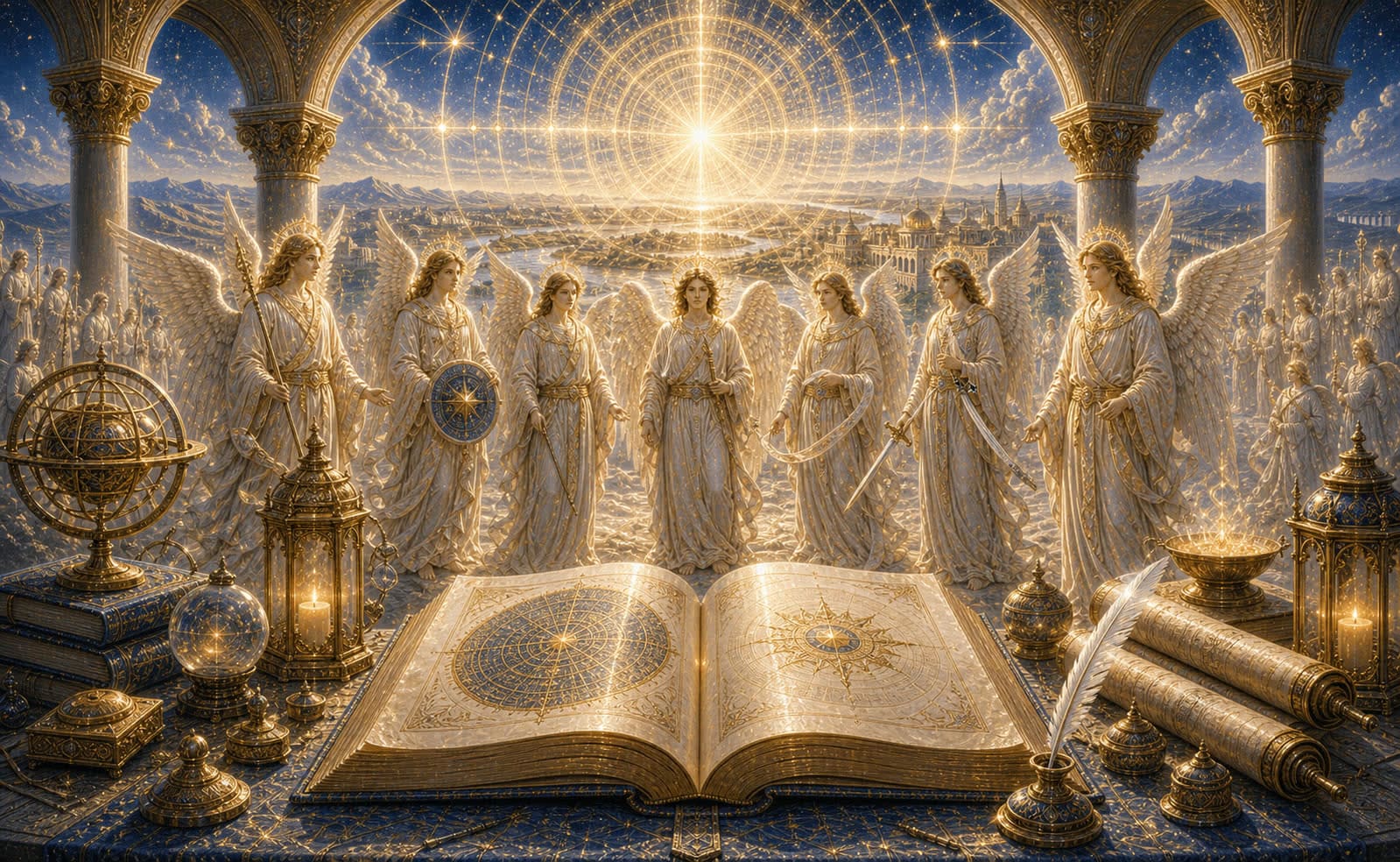
Archangels are the eighth of the nine choirs of angels in Christian tradition, one rank above the angels and one below the principalities. The order was set out around 500 CE in The Celestial Hierarchy by Pseudo-Dionysius, probably a Syrian monk who wrote under the name of Paul's Athenian convert (Acts 17:34), and Gregory the Great and Thomas Aquinas kept the archangels in the same place.
The rank is younger than the word. Scripture gives the title to one named angel, Michael in Jude 9, and mentions "the archangel's call" in 1 Thessalonians 4:16 without naming anyone.
The choir, and the lists of three, four, seven or eight named archangels, come from later theology, liturgy, and Jewish writings outside the Bible, and those sources do not agree with one another.
Quick Facts
- Rank
- Eighth of nine choirs; the middle order of the lowest triad
- Ranked by
- Pseudo-Dionysius, Celestial Hierarchy 6 and 9 (c. 500 CE)
- Greek word
- Archangelos, "chief messenger"
- Bible uses of the word
- 1 Thessalonians 4:16 and Jude 9; also 2 Esdras 4:36 in the Apocrypha
- Office
- Passes messages from the principalities to the angels (Dionysius); announces the greatest things (Gregory)
- Named archangels
- From one (Protestant Bible) to seven at the Orthodox feast of November 8, or eight when Jeremiel is counted
What does archangel mean, and where does the Bible use the word?
Archangel comes from the Greek archangelos, built from arch- (chief, first) and angelos (messenger), so the word means chief messenger. Latin borrowed it as archangelus, and English took it from the Latin.
The New Testament uses it twice. In 1 Thessalonians 4:16 the Lord descends "with a cry of command, with the archangel's call and with the sound of God's trumpet" (NRSVUE), and Paul names no one.
Jude 9 says that "the archangel Michael disputed with the devil and argued about the body of Moses," which makes Michael the only angel the New Testament calls an archangel.
The Hebrew Bible has no word for archangel. Its nearest idea is rank among princes: Daniel 10:13 calls Michael "one of the chief princes," and Daniel 12:1 calls him "the great prince."
Gabriel, the other angel Daniel names, is given no title at all (Daniel 8:16; 9:21).
| Passage | What the text says | Is anyone called an archangel? |
|---|---|---|
| 1 Thessalonians 4:16 | "The archangel's call" sounds as the Lord descends | Yes, but the archangel is unnamed |
| Jude 9 | Michael disputes with the devil over the body of Moses | Yes, Michael |
| Daniel 10:13; 12:1 | Michael is "one of the chief princes" and "the great prince" | No; his title is prince |
| Tobit 12:15 | Raphael is "one of the seven angels who stand ready and enter before the glory of the Lord" | No; he is one of seven angels |
| Revelation 8:2 | "The seven angels who stand before God" receive seven trumpets | No; the seven are unnamed |
| 2 Esdras 4:36 | "The archangel Jeremiel" answers Ezra (the KJV reads Uriel) | Yes, in a book outside the Catholic and Protestant canons |
Taken together, these passages use archangel as a title for one figure or one voice. None of them describes a group of archangels, gives them a rank, or places them between other orders.
Raphael is often called an archangel on the strength of Tobit 12:15, but Tobit calls him one of seven angels, and Revelation's seven are angels too. Those two verses later supplied the number seven for archangel lists.
How did archangels become one of the nine choirs of angels?
The choir comes from The Celestial Hierarchy of Pseudo-Dionysius. He wrote that scripture gives the heavenly beings nine names, which his teacher divided into "three threefold Orders" (chapter 6): seraphim, cherubim and thrones in the first, dominions, virtues and powers in the second, and principalities, archangels and angels in the third.
The nine names come from different places. Seraphim appear in Isaiah 6 and cherubim throughout the Hebrew Bible, while thrones, dominions, principalities, powers and virtues come from Paul's lists of heavenly powers in Colossians 1:16 and Ephesians 1:21, where the Greek word behind virtues is dynamis.
Angel and archangel are the two remaining biblical words. None of those passages ranks the names against each other, so the order itself is Dionysius's work.
The result gave archangels a standing they never had in scripture. In Jude the word is a title for Michael; in Dionysius it names a whole order of beings, and he names none of its members.

Why are archangels ranked second from the bottom?
In Dionysius the lowest triad carries God's messages toward people, and the archangels are its middle order. Chapter 9 says the order of archangels "belongs alike to the most holy Principalities and to the holy Angels": it shares the principalities' leadership and the angels' work as messengers, "receiving hierarchically the Divine illuminations from the first powers, and announcing the same to the Angels," and through the angels to people.
The prefix arch- therefore makes the archangels chiefs over one order only. They lead the angels below them and receive what they pass on from the principalities, with six more orders above those.
Aquinas explained the arrangement with examples from choir singing and war: the principalities are the leaders, like "precentors" and "generals," the angels "simply execute what is to be done," and the archangels "hold a middle place" (Summa I, q.108, a.6).
Gregory the Great ordered the nine differently. He moved the principalities up between the dominions and the powers and put the virtues directly above the archangels, a difference Aquinas records (Summa I, q.108, a.6, reply 4).
Both lists still put archangels eighth.
| Position | Pseudo-Dionysius (Celestial Hierarchy 6-9) | Gregory the Great (Homily 34 on the Gospels) |
|---|---|---|
| Seventh | Principalities | Virtues |
| Eighth | Archangels | Archangels |
| Ninth | Angels | Angels |
In Dionysius's account the orders nearest to people rank lowest, and the archangels reach people through the angels below them, which is why a name that sounds like the highest kind of angel belongs to the second-lowest order in both schemes.
What is the difference between an angel and an archangel?
In the theology of the choirs the difference lies in the task, and both are the same kind of being. Gregory the Great wrote that "the word 'angel' denotes a function rather than a nature," and he divided the two orders by the weight of what they announce: "Those who deliver messages of lesser importance are called angels; and those who proclaim messages of supreme importance are called archangels."
Aquinas drew the line through guardianship. Guarding a single person "belongs to the lowest order of the angels," because it "seems to be the least of the angelic offices," while guarding the human race belongs to the principalities "or perhaps to the Archangels, whom we call the angel princes" (Summa I, q.113, a.3).
In his scheme a personal guardian angel belongs to the choir below the archangels.
Dionysius adds a rule about names that explains everyday usage. Every heavenly being can be called an angel, because each one passes divine light downward, but a lower order is never called by a higher order's name (Celestial Hierarchy 5).
An archangel is therefore also an angel, while an angel of the ninth choir is never an archangel.
Are Michael, Gabriel and Raphael members of the archangels choir?
Gregory the Great made the link explicit. In the homily quoted above he argues that "not merely an angel but the archangel Gabriel was sent to the Virgin Mary," because the message was the greatest of all, and he explains the three names: Michael is "Who is like God," Gabriel "The Strength of God," and Raphael "God's Remedy."
The passage is the second reading in the Catholic Office of Readings on September 29, the feast the three share, so Catholics meet the link between the named figures and the eighth choir in the liturgy.
The Celestial Hierarchy itself says little about named angels. Its one mention of Michael, in chapter 9, calls him "Ruler of the Jewish people" in a passage about the angels set over nations, without placing him in any order.
Gregory's placement did not settle Michael's rank. The Catholic Encyclopedia records that Basil and other Greek Fathers set Michael over all the angels, that other writers made him prince of the seraphim, and that Aquinas made him "the prince of the last and lowest choir, the angels."
Calling Michael an archangel, as Jude does, therefore leaves open whether he belongs to the eighth order or stands above all nine.
How many archangels are there?
No source gives a number for the choir. Dionysius and Gregory describe an order and never count its members, and Catholic Answers states that how many archangels exist beyond the named three "is unknown."
The numbers people quote are lists of named archangels, and they run from one to eight depending on the tradition.
| Tradition or text | Named archangels | Basis |
|---|---|---|
| Protestant Bible (66 books) | Michael; Gabriel is named but never given the title | Jude 9; Daniel 8:16; Luke 1:19 |
| Catholic Church | Michael, Gabriel, Raphael | The three angel names in the Catholic Bible; the Directory on Popular Piety (2001, no. 217) discourages naming others |
| 1 Enoch 20 | Uriel, Raphael, Raguel, Michael, Saraqael, Gabriel, Remiel | "The holy angels who watch"; the Greek copy has seven names, the Ethiopic six |
| 1 Enoch 40:9 | Michael, Raphael, Gabriel, Phanuel | Four "presences" on the four sides of God |
| Rabbinic midrash | Michael, Gabriel, Uriel, Raphael | Numbers Rabbah 2:10: four angels around God's throne |
| Eastern Orthodox | Michael with Gabriel, Raphael, Uriel, Selaphiel, Jehudiel and Barachiel, with Jeremiel sometimes counted as an eighth | The Synaxis of the Archangel Michael and the Other Bodiless Powers, November 8 |
| Islam | Jibril, Mikail, Israfil, and the angel of death | The Qur'an names Jibril and Mikail (2:98); the list of four is later tradition |
The number seven comes from "the seven angels who stand before God" in Tobit 12:15 and Revelation 8:2 and from the seven names in 1 Enoch 20, and churches that fill in seven names draw the last four from different sources.
The Catholic three follow the canon. Michael, Gabriel and Raphael are the only angel names in the Catholic Bible, and a Roman synod in 745 rejected the other names, Uriel and Raguel among them, that a preacher named Aldebert had used in his prayers.
Rabbinic Judaism has no rank called archangels. Maimonides lists ten ranks of angels, from the chayyot at the top to the ishim at the bottom, and none of them is archangels (Mishneh Torah, Foundations of the Torah 2:7); the four angels of the midrash are grouped by their place around the throne.
Modern angel books add further names that appear on none of these lists.
Jophiel first appears in a Targum and the Zohar and reached those books through Agrippa's occult tables of 1533. Chamuel comes from a 1635 poem by Thomas Heywood and from the Summit Lighthouse's twentieth-century teaching on seven rays, and neither name has a place in the nine choirs.
Frequently Asked Questions
Are archangels higher than angels?
Yes, by one rank. Pseudo-Dionysius, Gregory the Great and Aquinas all place the archangels eighth of nine, directly above the angels and below the other seven orders, from the principalities or virtues up to the seraphim.
Who is the archangel in 1 Thessalonians 4:16?
Paul does not say. Many readers assume Michael because Jude 9 gives him the same title, and Jehovah's Witnesses cite the verse when they identify Michael with Christ, but the verse itself names no one.
Who leads the archangels?
No early source names a head of the order. Jude 9 calls Michael the archangel and Orthodox services call him chief commander of the heavenly hosts, but neither makes him head of the eighth choir in the Dionysian sense.
Are the seven angels in Revelation archangels?
Revelation 8:2 calls them "the seven angels who stand before God" and gives them trumpets, with no names and no title of archangel. Later writers often identify them with the seven of Tobit 12:15 and 1 Enoch 20, and those identifications are the source of the seven-archangel lists.
Sources
- (2021). 1 Thessalonians 4:16; Jude 9; Daniel 8:16, 9:21, 10:13, 12:1; Tobit 12:15; Revelation 8:2; 2 Esdras 4:36. Bible Gateway. Link
- (1611). 2 Esdras 4:36 ("Uriel the archangel"). King James Bible Online. Link
- (1897). The Celestial Hierarchy, chapters 5, 6 and 9. tertullian.org. Link
- (c. 1265-1268). Summa Theologiae I, q.108, aa.5-6. New Advent. Link
- (c. 1265-1268). Summa Theologiae I, q.113, a.3. New Advent. Link
- (c. 591). Homilies on the Gospels 34.8-9, second reading of the Office of Readings for September 29. Crossroads Initiative. Link
- (1907). Angels (Gregory the Great's nine orders; uses of the word archangel). The Catholic Encyclopedia, vol. 1. Link
- (1911). St. Michael the Archangel (views on Michael's rank). The Catholic Encyclopedia, vol. 10. Link
- (1917). The Book of Enoch, chapters 20 and 40. Wikisource. Link
- . Bamidbar (Numbers) Rabbah 2:10. Sefaria. Link
- (c. 1180). Mishneh Torah, Foundations of the Torah 2:7. Sefaria. Link
- . Synaxis of the Archangel Michael and the Other Bodiless Powers (November 8). OCA Lives of the Saints. Link
- (2001). Directory on Popular Piety and the Liturgy, no. 217. The Holy See. Link
- (1940). The Letters of Saint Boniface, Acts of the Roman Synod of October 25, 745. Columbia University Press. Link
- (7th century CE). Surah al-Baqarah 2:97-98 (Jibril and Mikail named). Quran.com. Link
- . How Many Archangels Are There?. Catholic Answers Q&A. Link
About Our Editorial Process
Every KnowTheAngels guide separates calculation method, tradition context, and personal reflection. We cite where interpretations come from, present more than one view, and never present symbolic reading as prediction.
Read our editorial policy