What Does Seeing Angel Number 33 Mean, and How Is It Interpreted?
Why an encountered 33, a calculated master number and a religious count support different kinds of interpretation

Seeing angel number 33 is often interpreted through the Master Teacher label: expression joined to care in Hans Decoz's account. Joanne Walmsley attaches an Ascended Masters interpretation to the same sequence, while Cheiro treats the compound differently.
A sighting does not calculate your Life Path.
The familiar Christian association with Jesus's age also needs its own explanation, because an approximate age and a series of festivals do not supply an exact birthday. The distinctions matter when a description of teaching or service starts sounding like a demand to take responsibility for somebody else.
Quick Facts
- Digit total
- 3 + 3 = 6
- Decoz's label
- Master Teacher, with conditions for chart use
- Cheiro's compound
- 33 takes the interpretation of 24 in his system
- Modern spiritual association
- Ascended Masters in Walmsley's 33 entry
- Religious context
- Traditional age of Jesus; explicit years of David's Jerusalem reign
- Clock input
- :33 is the minute field; a full time contains other digits
Does seeing 33 make it a master number?
A 33 on a receipt, door or screen is an encountered sequence. Master Number 33 is a status assigned by a numerological method to a result in a chart, so the visible numeral and the chart label are different claims.
The arithmetic is straightforward: 3 + 3 = 6.
Preserving 33 rather than reducing it is an additional rule, not a property of addition. Decoz gives a condition for a Life Path 33 involving another master number; his rule does not turn every incidental 33 into a master-number result.
| Observed sequence | Digit sum | Single-digit root | What the comparison establishes |
|---|---|---|---|
| 3 | 3 | 3 | One digit, without a repetition |
| 33 | 3 + 3 = 6 | 6 | Two repeated 3s |
| 333 | 3 + 3 + 3 = 9 | 9 | Three repeated 3s, not the same reduced value |
| 3333 | 3 + 3 + 3 + 3 = 12 | 3 | Four repeated 3s; 1 + 2 returns to 3 |
The repeated digit stays 3 while the reduced value moves through 3, 6 and 9. That is why a repeating-threes comparison needs both the observed sequence and its calculation, rather than one meaning assigned to every run of 3s.
Even a birth-date sum can reach 33 without settling its chart status.
For September 11, 1993, adding every written digit gives 9 + 1 + 1 + 1 + 9 + 9 + 3 = 33. A component method that preserves 11 and 22 instead gives month 9, day 11 and year 1 + 9 + 9 + 3 = 22, followed by 9 + 11 + 22 = 42.
Both totals reduce to 6, but only the first route passes through 33. This example does not assign a master number to the date; it shows why the Life Path calculator method and the rule for retaining a total have to accompany the result.
Your age, address or receipt number is not the birth-date input in that calculation. The chart-specific interpretation belongs to the method that produced it, rather than to any appearance of the same two digits.
What does the Master Teacher label actually describe?
Decoz's Master Teacher combines the expressive 3 with the teaching and caregiving associations of 6. The relationship is about expression reaching another person in a form that helps them understand or learn, rather than communication being impressive for its own sake.
Teaching, on that interpretation, involves a recipient.
A clear explanation of a sewing technique serves a different purpose from a display of the finished work. In the first case, the recipient can see where the needle enters and repeat the stitch; in the second, they may admire the result without learning how to make it.
The distinction develops the label without assuming that someone who sees 33 has been appointed a teacher. Decoz's symbolism supplies the association, while the example supplies an ordinary way to understand the difference between expression and instruction.
| Source or method | Treatment of 33 | What remains unestablished |
|---|---|---|
| Decoz's master-number account | Master Teacher, tied to expression and care; conditional chart treatment | That an encountered 33 is a qualifying chart result |
| Ordinary digit reduction | 3 + 3 = 6 | A personality, vocation or future event |
| Cheiro's compound-number account | 33 has no independent potency and takes the meaning of 24 | Universal agreement with the Master Teacher interpretation |
Cheiro's entry gives 33 the interpretation of compound 24, including favorable associations with help and love. That makes the reduction and the compound reading separate layers: a common total of 6 does not require two authors to attach identical descriptions to every number reaching it.
The title also has a history within particular numerology schools.
Catherine Yronwode's annotated bibliography distinguishes Balliett's treatment of 11 and 22 from Ariel Yvon Taylor's inclusion of 33 in Numerology Made Plain, whose revised edition she lists in 1930. This documents a difference between those treatments; it does not establish a year when all numerologists accepted 33.
Calling 33 a master number therefore identifies a convention, not a level of human worth. A Life Path 6 result does not make someone less capable of teaching, and a 33 label does not establish qualifications or entitle someone to direct other people.
Do Ascended Masters interpretations establish a message?
Joanne Walmsley's 2011 entry associates 33 with Ascended Masters offering assistance. Doreen Virtue's earlier number-sequence excerpt assigns that association to 333 and also refers to patterns of 3s, so the connection is broader than a unique message attached only to 33.
These writings are evidence of what their authors believed.
They do not independently establish that a spiritual being caused a particular sighting. Repetition across related writers can show that an interpretation circulated, but repeating a claim does not verify the claimed visitor or assistance.
The two sources also do different work from the Master Teacher label. A numerological account relates expression and care through digits; an Ascended Masters account proposes a spiritual source of support.
Walmsley further describes positive changes or projects as worthwhile and assisted. That is a promise within her spiritual interpretation, rather than evidence that a particular project has funding, an available collaborator or permission to proceed.
If you associate a sighting with encouragement, the concrete support still has its own source: somebody agreed to help, a resource became available or a problem was resolved. The numeral alone does not establish any of those events.
Why is 33 associated with Jesus and David?
Jesus's traditional age of 33 at the crucifixion is an estimate built from Gospel clues, rather than an exact age supplied by those passages. Luke 3:23 describes him as about thirty when his ministry begins, and John mentions Passovers at three points during the ministry.
The clues used in the traditional age estimate
- Luke 3:23An approximate starting age
The wording is about thirty, not an exact birthday or a dated age record.
- John 2:13A Passover near the beginning of the account
This is the first of the three cited festival references.
- John 6:4Another Passover approaches
An annual festival supplies a chronology clue, not an age statement.
- John 11:55The Passover near the final events
The three references support a multi-year ministry; they do not specify an exact age at death.
Three annual occasions have two intervals between the first and the third. Counting festivals therefore does not, by itself, authorize the shortcut of taking an exact 30 and adding exactly three years.
The starting age is approximate, and the cited festivals do not specify where a birthday falls in relation to each event. The traditional 33 can carry devotional significance without becoming a precise biographical measurement derived from those clues alone.
David's 33 is a different kind of count.
Second Samuel 5:5 gives thirty-three years for his reign in Jerusalem, after seven years and six months in Hebron. First Kings 2:11 likewise distinguishes seven years in Hebron from thirty-three in Jerusalem in its account of a forty-year reign.
The summaries use different precision for the Hebron period, but both give 33 for Jerusalem. That agreement concerns the duration of a reign in a location, rather than a symbolic instruction attached to any sighting of 33.
The unit is years of rule in a named place, not David's age or the number of spiritual messages he received. Keeping the location and unit preserves what the passage actually states.
Neither the Gospel age clues nor David's reign supplies the modern Master Teacher label or an Ascended Masters interpretation. Those associations have separate owners, even when a devotional reader finds the shared numeral personally meaningful.
A verse or chapter numbered 33 is also a locator. Its subject comes from the passage itself, rather than from the number assigned to that part of the text.
33 in love, twin-flame beliefs and teaching at work
A love reading built from Decoz's 3-and-6 association concerns communication and care. It does not reveal your partner's feelings or establish that you are responsible for managing their life.
Help can be welcomed, assumed or unwanted.
Suppose your partner asks for help preparing for a presentation. Rehearsing the opening together answers that request, while rewriting the whole presentation without agreement changes whose work it is and whose decisions control it.
The number does not resolve that difference; the request and the recipient's response do. This is where the teaching association becomes concrete: an explanation can increase someone's ability without taking over their task.
In twin-flame beliefs, a repeated number may be interpreted through a proposed spiritual bond or separation. Neither Walmsley's 33 message nor Decoz's chart label establishes a particular partner, reunion date or reciprocal feeling, so this reading cannot substitute for what the other person actually communicates.
| Situation | Evidence of useful help | What the numeral cannot decide |
|---|---|---|
| A partner asks for support | The help matches the request and leaves the person able to decide | Whether unrequested intervention is welcome |
| A colleague needs to learn a task | They can explain or perform it after the demonstration | Whether every later task becomes the teacher's responsibility |
| A role expands to ongoing care | The scope, time and agreement are explicit | How much unpaid time someone must provide |
At work, the Master Teacher association is more specific than a prediction of promotion. It concerns whether knowledge becomes understandable and usable by somebody else.
In a hypothetical handover, an experienced employee demonstrates a task, lets a colleague repeat it and identifies the step that still causes confusion. Finishing the colleague's work instead may meet today's deadline while leaving tomorrow's task dependent on the same experienced person.
A completed task and a completed transfer of knowledge are different outcomes.
There is also a limit to what the source's demanding language can justify. Decoz's emphasis on the commitment associated with a master number does not establish that taking unlimited responsibility, leaving a job or risking all your resources is a necessary response to seeing 33.
For a proposed training role, scheduled teaching time and a defined handover explain its cost better than a number sighting. The relevant questions are what the learner can do afterward and which responsibilities remain with the employer or team, rather than whether you have fulfilled a spiritual obligation.
What does :33 tell you about repeated sightings?
The minute field :33 appears once during every hour on an ordinary digital clock. Across a complete 24-hour day, that is 24 displayed minutes out of 1,440, or one in sixty.
This describes the display, not the chance that you personally will notice it.
The one-in-sixty proportion would apply to a uniformly timed glance at that minute field. Glances tied to a train departure, work break or habitual reminder are not uniform, and repeated views of the same display are not automatically separate coincidences.
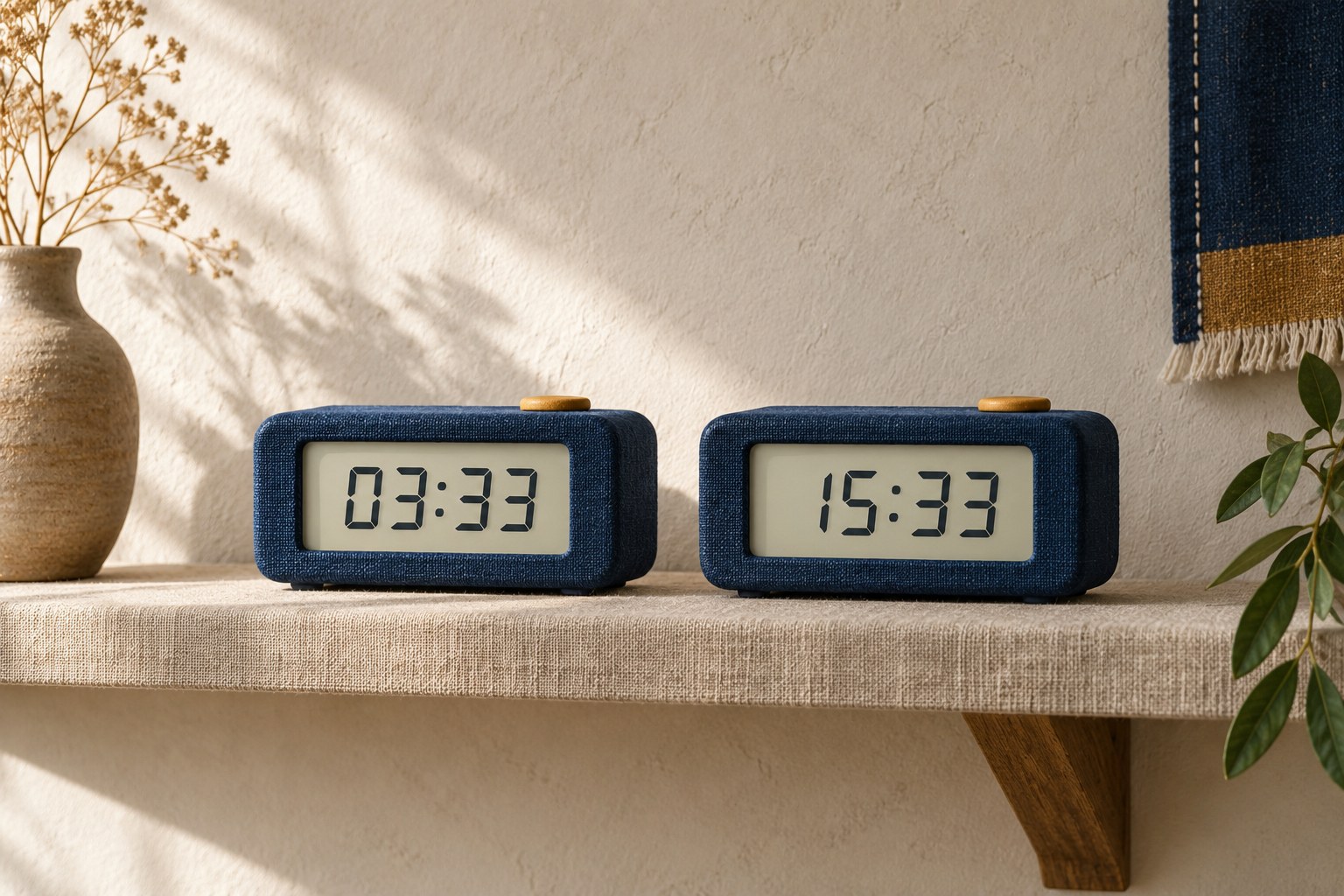
The input changes when the hour is included
3 + 3 = 6; the hour has been excluded.
0 + 3 + 3 + 3 = 9.
1 + 5 + 3 + 3 = 12; 1 + 2 = 3.
On a 12-hour clock, both times can be written 3:33 with a separate morning or afternoon marker. That visible string differs from 15:33, which explains why a 3:33 interpretation needs its own input convention rather than being imported unchanged into every occurrence of :33.
A sighting's ordinary setting can explain why it repeats.
Passing the same house numbered 33 each day repeats one address; seeing 33 twice on a receipt may repeat an item count and its matching total. These observations have different causes from encountering the numeral in otherwise unrelated settings, and none has a frequency that can be estimated without knowing the opportunities to see it.
Johansen and Osman's work on coincidence judgments concerns how people connect surprising repetitions with possible causes. It does not identify an angelic cause for this numeral, and an unusual-looking pattern alone does not settle that question.
Frequently Asked Questions
Is 33 a Masonic number?
The Scottish Rite has a 33-degree structure, which gives 33 a particular Masonic association. That is a count within an institutional tradition; it does not establish that a sighting came from Freemasonry or that a numerological Master Teacher result has the same origin.
Sources
- (n.d.). Master Number 33. World Numerology (the Master Teacher; 33 in the Life Path). Link
- (n.d.). Books About Numerology and Number Divination: Annotated Bibliography. Annotated bibliography: Balliett and Ariel Yvon Taylor entries; Taylor revised edition listed as 1930. No claim of universal adoption.. Link
- (1926). Cheiro's Book of Numbers. The Book of Numbers, London, 1926 (date from Yronwode's bibliography); compound numbers 24 and 33 on p. 83 of the Taraporevala reprint scanned on archive.org. Link
- (1611). Luke 3:23; John 2:13, 6:4, 11:55; 2 Samuel 5:5; 1 Kings 2:11. KJV named Gospel locators for age/festival clues; linked endpoint contains David's Jerusalem and Hebron reign counts (2 Samuel 5:4-5).. Link
- (2026). Chronology of Jesus. Age-at-death and duration-of-ministry discussion; traditional estimate and Johannine Passover clues, not an exact 33 age record.. Link
- (2011). Angel Number 33. Sacred Scribes, 2011, entry33: Ascended Masters association and project-assistance claim.. Link
- (2008). Number Sequences from the Angels. Spirit Library, posted August 18, 2008, an excerpt from Healing with the Angels (entries for 333 and mixed 3s). Link
- (2020). Coincidence judgment in causal reasoning: How coincidental is this?. Cognitive Psychology 120: 101290, doi:10.1016/j.cogpsych.2020.101290; existing PubMed abstract evidence on coincidence judgments, not proof of a spiritual cause.. Link
- (2026). Scottish Rite. 33-degree structure; used for the institutional count, not current membership requirements.. Link
About Our Editorial Process
Every KnowTheAngels guide separates calculation method, tradition context, and personal reflection. We cite where interpretations come from, present more than one view, and never present symbolic reading as prediction.
Read our editorial policy