What Does Seeing Angel Number 22 Mean, and How Is It Interpreted?
The Master Builder label borrowed for sightings, the structure of 22-letter texts, and the sources that give 22 a cautionary meaning
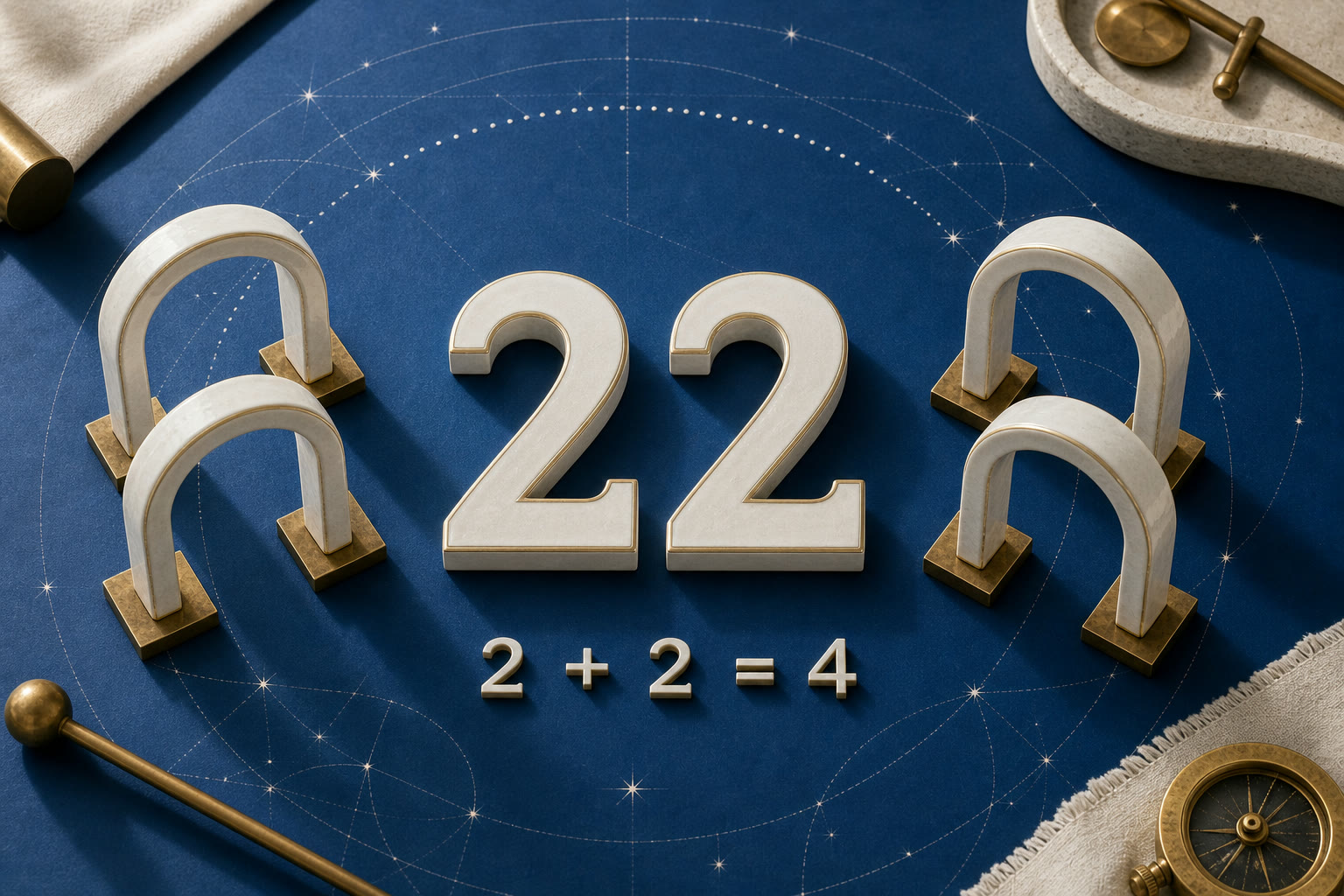
A receipt or clock showing 22 provides an observed number, not a birth-date calculation. Its Master Builder interpretation comes from a modern spiritual use of a chart label, which has a specific source and a limited claim.
The other prominent associations require different explanations: Psalm 119 uses 22 alphabetic groups, while Bullinger and Cheiro attach caution to the number through their own interpretive systems.
Quick Facts
- Sighting and chart
- An observed 22 is not a calculated Life Path 22
- Reduced arithmetic
- 2 + 2 = 4; 2 x 11 = 22
- Psalm 119 structure
- 22 alphabetic groups x 8 verses = 176
- Competing accounts
- Master Builder optimism differs from Bullinger's and Cheiro's caution
- 24-hour exposure
- 83 distinct HH:MM minute intervals show 22 as a complete field
Why is a sighted 22 called the Master Builder?
Hans Decoz describes Master Number 22 as combining the insight attributed to 11 with the practical, methodical character of 4. The arithmetic beneath that comparison is 2 + 2 = 4, while the master-number convention preserves 22 at specified points in a chart.
The retained number and its reduced root are consequently two layers of one numerological interpretation.
Decoz's description concerns a chart result; it does not calculate a person's abilities from a receipt, address or clock display.
Joanne Walmsley's June 2011 angel-number entry carries the Master Builder label into an interpretation of seeing 22. She associates the sighting with accomplishment and diligent work, making that transfer explicit in a modern spiritual source.
A sighting is not a Life Path calculation. A birth-date method can produce Life Path 22, whereas a displayed 22 supplies no birth-date input at all.
| Interpretation | Input or operation | What it describes |
|---|---|---|
| Master Number 22 | A chart calculation retained at 22 | Decoz's combination of 11-style insight and 4-style practicality |
| Angel number 22 | An observed 22 | Walmsley's symbolic borrowing of the Master Builder label |
| Reduced root 4 | 2 + 2 = 4 | The digit sum; not proof that a chart contains 22 |
Compared with Master Number 11, Decoz emphasizes practical construction in his description of 22.
The multiplication 2 x 11 = 22 does not establish that an observer has twice another person's intuition or talent.
That distinction also separates 22 from an ordinary Life Path 4 result. The shared root explains a relationship between interpretations, but it does not authorize promoting every four-reducing total to master status.
What do 22 Hebrew letters actually explain?
The Hebrew alphabet's 22 letters supply an organizing structure in Psalm 119. The psalm has 176 verses arranged in 22 groups of eight, with each group built around the next letter of the alphabet.
Within a group, the verses begin with the same Hebrew letter.
An English translation can preserve the group headings while losing the repeated initial letters, so the acrostic may be less obvious to someone reading only the translation.
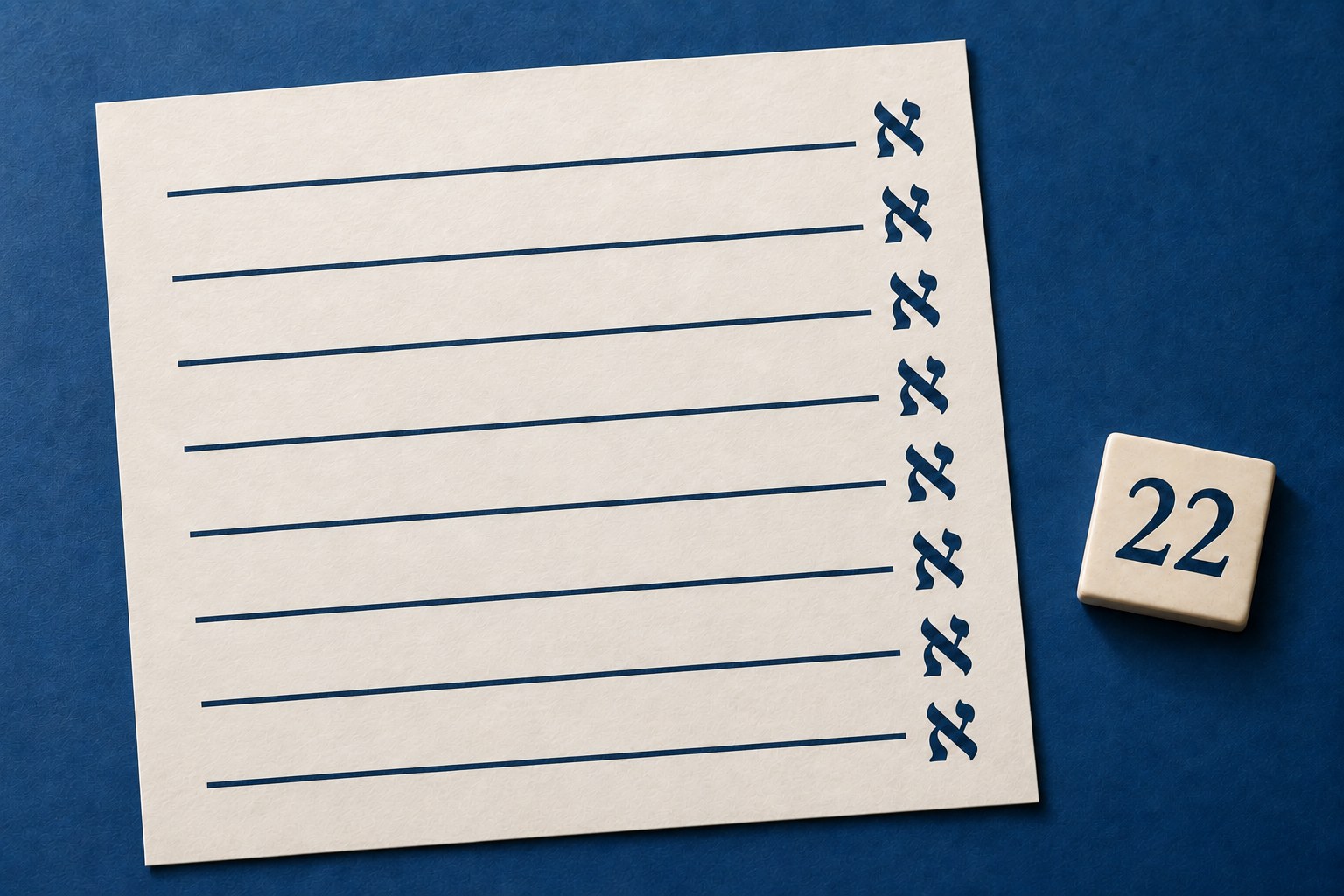
The eight-line grouping makes the alphabet visible in the poem's form. The count explains how the psalm is organized; it does not make every occurrence of 22 a quotation from the psalm.
Sefer Yetzirah uses a different structure: 32 paths associated with ten sefirot and 22 letters. Its classification divides the letters into three mothers, seven doubles and twelve simples.
Two texts, two organizing relationships
Alphabetic groups organize verses; the repeated letter begins each verse in its group.
Sefirot and letters form different categories; 22 is the letter count.
The shared alphabet count does not make these texts interchangeable. One presents a poetic acrostic, while the other assigns letters a role in a Jewish cosmological account.
Neither count demonstrates that the modern Master Builder label descended from these structures. The cited evidence shows what 22 counts in each text, without establishing a historical chain into angel-number practice.
Is 22 lucky in the Bible, or a cautionary compound?
E. W. Bullinger treats 22 as twice 11 in Number in Scripture. His symbolic system associates 11 with disorder and reads the doubled value as an intensification, which differs sharply from the Master Builder's favorable reputation.
Bullinger points to the 22-year reigns of Jeroboam and Ahab, given in 1 Kings 14:20 and 1 Kings 16:29.
Those verses supply reign lengths; Bullinger supplies the interpretation of the number.
A count in a biblical passage and a commentator's rule are different kinds of statement. The two kings' reigns do not identify a message sent to someone who notices 22 today.
Revelation's 22 chapters provide another count, but a chapter total is not a verse declaring 22 lucky or unlucky.
It cannot settle a dispute between modern numerology and Bullinger's commentary.
Cheiro's Book of Numbers gives compound 22 a cautionary picture of someone blinded by other people's folly and burdened by mistakes. His warning concerns illusion and mistaken judgment, rather than the practical potential described in Decoz's chart profile.
These are genuinely different interpretations, not independent confirmations of one hidden message. A favorable reading and a warning reading cannot jointly prove that a particular person's project will succeed if they follow a prescribed plan.
22 in love, twin flame claims, career and money
Walmsley's association with diligent work can support a reflective reading about effort, but it does not identify a relationship's future. Two people making a shared arrangement provide evidence of cooperation; the number alone cannot show that both have agreed.
Decoz's contrast between a large vision and practical method makes the difference between imagining a wedding and agreeing on shared responsibilities relevant to a 22 reading.
The example applies the Master Builder metaphor; it does not establish whether a relationship is suitable or whether it will last.
Twin flame claims involve another belief framework, including claims about separation and reunion. The Decoz profile and the cited compound 22 entry do not supply evidence of another person's intentions or a date when they will return.
For career questions, the scale implied by Master Builder can exceed what a project has resources to deliver. Decoz makes practicality part of his favorable account, so an ambitious title without an achievable task would leave that part of the metaphor unresolved.
Cheiro's caution can be read as a theme about mistaken judgment, but a 22 sighting cannot establish that a colleague is deceptive.
A number interpretation provides no factual accusation against a person.
Money decisions similarly require evidence about the transaction, including its price, obligations and uncertainties. 22 supplies no expected return, so a favorable numerological label cannot establish that a purchase or investment will pay off.
An ambitious project can require cooperation without its number of participants matching the written digits. Treating the two 2s as proof that exactly two people are destined to build something together adds a claim that neither the arithmetic nor these source descriptions establishes.
How do 222, 2222 and 22:22 change the calculation?
A single 2 already has root 2, whereas 22 requires the sum 2 + 2 = 4.
Adding another 2 changes the digit sum as well as the written length. Angel number 222 sums to 6.
Angel number 2222 sums to 8.
The time 22:22 also contains four 2s, so its full digit sum is 8. Treating each half as 22 is a separate, partial reading, not a whole-display root of 4.
A 24-hour clock makes 22 unusually available as a complete hour field. With a continuously displayed HH:MM clock, 22 occupies that field for sixty minute intervals from 22:00 through 22:59.
| Display convention | Where 22 appears as a complete field | Distinct minute intervals |
|---|---|---|
| 12-hour HH:MM | Minute 22 in each of 24 hours | 24 |
| 24-hour HH:MM | Hour 22 for 60 minutes; minute 22 in 23 other hours | 83 |
| Overlap at 22:22 | Hour and minute field both contain 22 | Counted once, not twice |
The 83 total is 60 + 23, because 22:22 already falls inside the hour counted as 22. This is a count of display intervals, not a probability that a reader will look at the clock during one of them.
On a 12-hour display, the same evening moment appears as 10:22 PM rather than 22:22.
The changed notation changes the visible digit sum even though the underlying time has not changed.
Raymond Nickerson's 1998 review describes confirmation bias as a tendency to seek or interpret evidence in ways that favor existing beliefs. That concept can explain why remembered matches are incomplete evidence for an extraordinary pattern, without diagnosing an individual reader.
Sources
- (n.d.). Master Number 22: The Master Builder. World Numerology. Link
- (2011). Angel Number 22. Sacred Scribes, June 28, 2011. Link
- (2026). Psalm 119. Wikipedia (176 verses in 22 stanzas, one per Hebrew letter). Link
- (2026). Sefer Yetzirah. Wikipedia (the 32 paths; three mothers, seven doubles, twelve simple letters; disputed dating). Link
- (1894). Number in Scripture: Its Supernatural Design and Spiritual Significance, part II, "Twenty-two". Eyre & Spottiswoode, London, 1894; online text at levendwater.org. Link
- (1611). 1 Kings 14:20; 1 Kings 16:29; Revelation 22. Bible text via bible-api.com (KJV). Link
- (1926). Cheiro's Book of Numbers. The Book of Numbers, London, 1926 (date from Yronwode's bibliography); compound number 22 on pp. 82-83 of the Taraporevala reprint scanned on archive.org. Link
- (1998). Confirmation Bias: A Ubiquitous Phenomenon in Many Guises. Review of General Psychology 2(2): 175-220. Link
About Our Editorial Process
Every KnowTheAngels guide separates calculation method, tradition context, and personal reflection. We cite where interpretations come from, present more than one view, and never present symbolic reading as prediction.
Read our editorial policy