Why Does Angel Number 31 Have Conflicting Meanings?
The 31/4 calculation, Cheiro's isolated compound, the Hebrew name El and the difference between Proverbs 31 and a personal sighting

The main disagreement about 31 is between methods, not between two versions of the same message. Adding 3 and 1 produces 4, but a compound-number writer can retain 31 and assign it a separate interpretation.
Cheiro's entry stresses isolation and unfavorable material prospects. Modern angel-number writing can instead connect the digit profiles of communication, initiative and steady effort with creative plans or conversations.
Those associations explain why the same number attracts different readings. They do not establish the order in which events will happen in your life.
The biblical links need another distinction: El totals 31 under Hebrew letter values, while the 31 in Proverbs 31 identifies a chapter. Neither is a biblical instruction about encountering the numeral on a clock or calendar.
Quick Facts
- Digit sum
- 3 + 1 = 4
- Compound reading
- Cheiro interprets 31 separately from its root 4
- Digit reversal
- 13 also reduces to 4; the sum supplies no event sequence
- Hebrew letter total
- El: aleph 1 + lamed 30 = 31
- Proverbs passage
- Chapter 31; verses 10-31 form a 22-line acrostic
- Calendar appearances
- Seven Gregorian months have a 31st day
How does 31 reduce to 4, and what does digit order change?
Thirty-one has the digit sum 3 + 1 = 4. That calculation is part of digit-reduction numerology; its result is exact even when writers disagree about the symbolism assigned to the digits.
Numerology.com associates 3 with communication and creative expression, 1 with independence and initiative, and 4 with practicality and disciplined work. These are profiles within a modern numerological system, rather than measured properties of everyone who encounters those digits.
The distinction matters when 31 is described as speaking before acting. The calculation contains no rule about event order: 3 + 1 and 1 + 3 have the same result.
Decimal notation does distinguish thirty-one from thirteen, because the tens and ones positions change. Turning those positions into a sequence of conversations and actions requires a writer's additional interpretation, which the sum itself cannot supply.
| Input | Arithmetic | What the result establishes |
|---|---|---|
| 31 | 3 + 1 = 4 | The root is 4; the original compound is 31 |
| 13 | 1 + 3 = 4 | The same root, with the decimal places reversed |
| 22 | 2 + 2 = 4 | A root of 4 if reduced; some chart methods retain master number 22 |
| 40 | 4 + 0 = 4 | Another compound reaching 4; zero does not add to the sum |
Hans Decoz identifies 11, 22 and 33 as master numbers in his modern chart convention. Thirty-one is not on that list, and retaining 22 in a chart calculation does not make every sighting of a root-4 number a master-number result.
His karmic-debt list names 13, 14, 16 and 19, rather than 31. Reversing 13 therefore preserves the digit sum without preserving that chart label; a shared root does not make the compounds interchangeable.
Angel number 30 reaches 3, whereas 31 reaches 4 and 32 reaches 5. Those arithmetic differences are clear; a claim that the three numbers describe successive stages of one plan needs separate support.
If you were born on the 31st, the day alone also adds to 4 under a day-reduction method. A Life Path calculation uses the complete birth date, so that birthday fact cannot establish your Life Path or describe someone who merely notices 31.
Why did Cheiro call 31 unfavorable for material success?
In the compound-number section of Cheiro's Book of Numbers, 31 refers back to 30 but describes a person who is even more self-contained and isolated. The entry on page 84 calls it "not a fortunate number from a worldly or material standpoint," and the entry for 40 repeats the meaning of 31.
Cheiro's verdict belongs to his particular compound-number system. Keeping the compound preserves a reading that would disappear if every total were immediately replaced by its single-digit root.
That is why a practical or dependable profile for 4 cannot cancel the unfavorable entry for 31. The two claims operate at different levels, and the apparent contradiction remains when the authors assign different meanings to those levels.
Modern writer Blair Andrews presents 31 through creative energy, plans and a conversation that has been avoided. That treatment provides an attributed modern interpretation, rather than evidence that the older isolation reading secretly means the same thing.
A documented interpretation and an unproven outcome
What the evidence supports
- A specific compound entry
Cheiro gives 31 an isolated and materially unfavorable reading.
- Modern digit profiles
Expression, initiative and effort are associations supplied by another numerological framework.
What remains limited
- Luck and events
These sources do not demonstrate that encountering 31 changes your luck.
- An individual outcome
The root-4 calculation cannot predict a promotion, a loss or another person's decision.
Why does Bullinger connect 31 with the Hebrew name El?
E. W. Bullinger's Number in Scripture connects thirty-one with El, a Hebrew name of God. In the letter-value method he uses, aleph has the value 1 and lamed has the value 30, giving a total of 31.
The Hebrew spelling is אל, read from right to left: aleph comes first, followed by lamed.
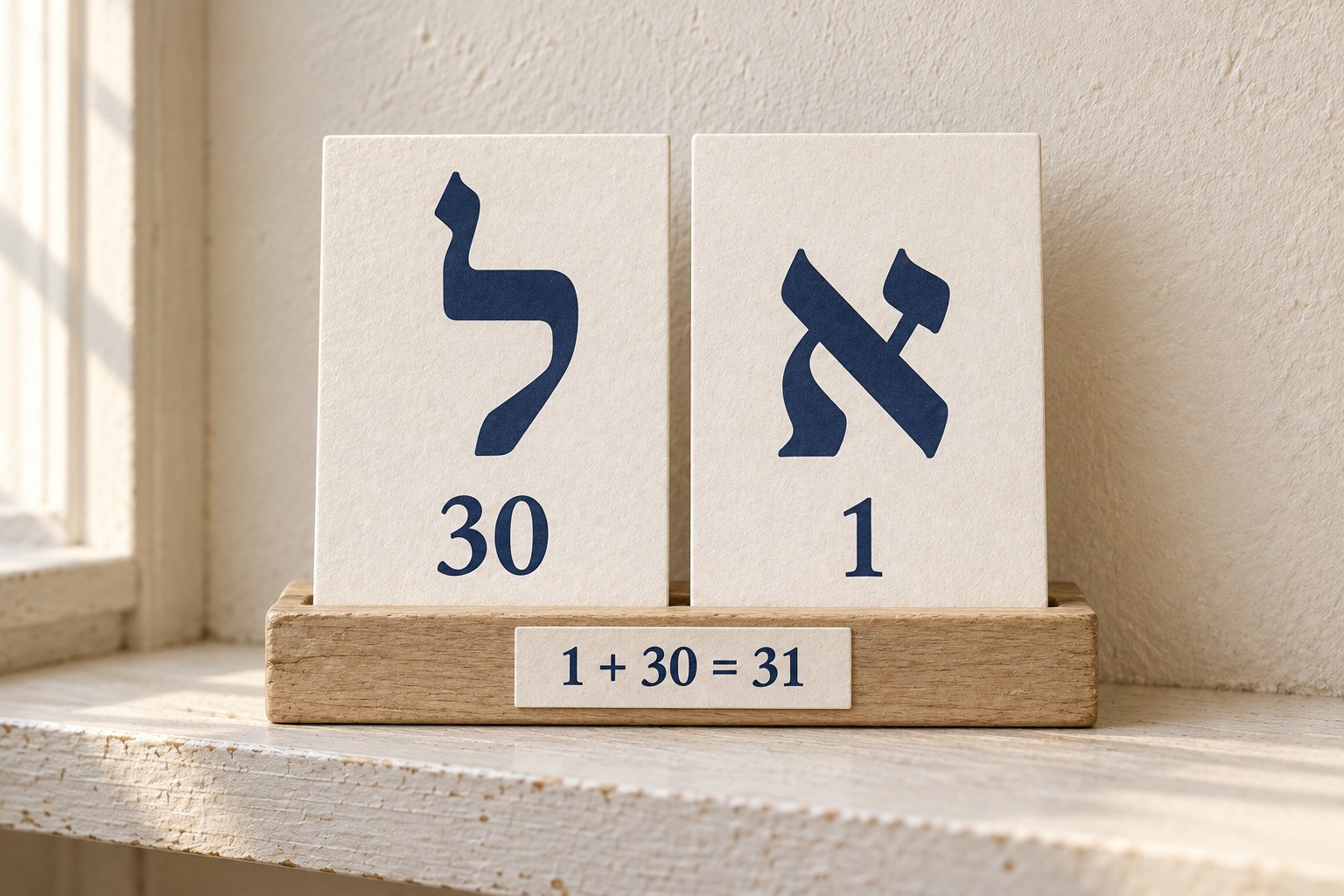
Bullinger interprets this correspondence in terms of deity. The spelling supplies the letter total, while the claim that the total carries that theological significance remains Bullinger's interpretation.
This is gematria, a calculation tied to the values of letters, rather than the same operation as adding the decimal digits 3 and 1. Reducing the resulting 31 to 4 introduces a further numerological operation that is not needed to spell El.
The correspondence is also spelling-dependent. The English letters in "God" do not acquire the Hebrew values of aleph and lamed simply because the words can refer to the same subject.
Seeing 31 on a bill therefore does not reproduce Bullinger's calculation. The bill supplies a numeral; the calculation begins with a particular Hebrew word, and a personal sighting does not supply that textual relationship.
Does Proverbs 31 give the number a biblical message?
Proverbs 31 supplies a chapter reference, not a biblical explanation of angel number 31. Its best-known passage, verses 10 through 31, praises the eshet chayil, often translated as a woman of valor.
That passage is an alphabetical acrostic: successive lines begin with successive letters of the Hebrew alphabet. The span contains 31 - 10 + 1 = 22 verses, so its meaningful alphabetic count is twenty-two even though the chapter label is thirty-one.
| Reference or count | What is being counted | Why the distinction matters |
|---|---|---|
| Chapter 31 | The chapter's position in Proverbs | A locator identifies where the passage is found |
| Verses 10-31 | The beginning and ending verse labels | The endpoint 31 does not make this a 31-line poem |
| 22 acrostic lines | The inclusive verse span and alphabetic sequence | The structure belongs to the poem itself |
The chapter divisions familiar in modern Bibles come from a later numbering system, commonly associated with Stephen Langton in the early thirteenth century. A connection based on the label "chapter 31" therefore has a different history from the words and poetic structure of the passage.
Jewish Friday-night practice also gives this poem a life outside number interpretation: eshet chayil is customarily sung at the Shabbat table. That devotional setting concerns the poem, rather than a rule that its chapter number identifies an angelic sign.
If Proverbs 31 is the passage you have in mind, its content and acrostic explain what the reference points to. Linking a sighting of 31 with that passage is a personal devotional association, not a statement the passage makes about repeated numerals.
What can 31 mean for love and a promise that keeps restarting?
In Andrews's modern reading, 31 can bring attention to a conversation that has been avoided. That interpretation concerns something still unsaid, so it does not support a universal claim that the number always describes a promise already made.
The difference changes the relationship question. A conversation that has not happened lacks an agreement; a conversation that has happened may have produced an agreement, a refusal or a request for more time.
A sighting of 31 cannot tell you which of those responses your partner has given.
For example, saying that you want to live together expresses your intention. It becomes a shared plan only if the other person agrees, and the budget or moving date then belongs to that actual agreement rather than to the digits of 31.
An apology has another kind of follow-through: the behavior named in it may change, or the same problem may recur. A recurring promise supplies information about what has happened between you; the number does not establish why the promise restarted or whether it should continue.
A weekly routine can support one agreement, while a single repair or a clear decision can settle another. Nothing in 3 + 1 = 4 requires every relationship commitment to become a weekly task or to be completed within a fixed number of days.
A twin-flame interpretation adds still another belief about the relationship. Neither that label nor a declaration of a bond establishes the other person's consent, a reunion date or a future choice.
The supported distinction is between an attributed symbolic reading and what the two people have actually agreed. Your partner's words and conduct answer the follow-through question more directly than an encounter with 31.
Does seeing 31 predict career progress or money?
Cheiro's materially unfavorable 31 and Numerology.com's diligent 4 offer different symbolic assessments. Neither assessment supplies the facts needed to determine whether a particular proposal will be accepted or paid for.
A hypothetical creative proposal shows the gap. Describing the idea is one event, an employer or client accepting it is another, and a funded assignment adds resources and terms that the first announcement did not contain.
Reducing the number 31 does not reveal whether those later events occurred.
The structure association can describe why an accepted assignment still needs delivery arrangements. A promised article, for example, remains a proposal until its scope and acceptance are settled; after acceptance, completion depends on the agreed work rather than a numerological deadline.
Life Path 4 applies the root-4 profile to a number calculated from a full birth date. Noticing 31 beside a work document does not produce that chart result or turn its traditional profile into your lifelong career trait.
A project repeatedly announced without approval can lack a viable opportunity rather than personal discipline. Another project can have approval but lack time or resources, so the same visible delay has different explanations that a sighting cannot distinguish.
For money questions, a symbolic warning is not a forecast. Actual payment terms, income and expenses determine what the proposed work involves; no source cited here establishes that 31 brings a gain, a loss or a reason to commit money.
Why does 31 recur on calendars and clocks?
January, March, May, July, August, October and December each contain a 31st day. In those months, 31 is already a recurring endpoint for dates, reminders and month-end records.
October 31 and December 31 also have familiar calendar associations with Halloween and New Year's Eve. Those dated occasions explain why the numeral can recur in notices and conversation without requiring an additional spiritual cause.
A clock supplies a different input: the minute :31 occurs in every hour. The same minute can therefore appear within many complete timestamps, which do not all have the digit sum of the standalone number 31.

| What you noticed | If this is the chosen input | Digit sum |
|---|---|---|
| Standalone 31 | The two digits 3 and 1 | 4 |
| 03:31 | All four displayed digits | 0 + 3 + 3 + 1 = 7 |
| 13:31 | All four displayed digits | 1 + 3 + 3 + 1 = 8 |
| A date ending in day 31 | The day alone; month and year excluded | 4 for that day-only calculation |
The clock roots differ because the input differs, not because the minute has changed. A method using the whole display needs to say so; a method using only the minute cannot present its result as the root of the complete time.
The American Psychological Association defines selective attention as concentrating on some stimuli while others remain in the background. Once 31 is personally relevant, noticing it more readily is an ordinary explanation for a stronger impression of recurrence.
That definition does not diagnose your experience or establish how often you encountered the number. A familiar calendar, a fixed record number and a personally salient clock minute can create quite different kinds of repetition.
A number journal can preserve the setting and full display, so the 31st of a month is not silently counted as the same input as 03:31. A record containing only selected sightings lacks the unrecorded alternatives, however, and cannot prove angel contact or determine the probability of the pattern.
Sources
- (n.d.). Number 3 Meaning in Numerology. Numerology.com. Link
- (n.d.). Number 1 Meaning in Numerology. Numerology.com. Link
- (n.d.). Number 4 Meaning in Numerology. Numerology.com. Link
- (n.d.). Angel Number 31 Meaning: Creative Energy With a Clear Plan. Numerologist.com. Link
- (n.d.). Master Numbers 11, 22, 33. World Numerology. Link
- (n.d.). Karmic Debt Numbers. World Numerology. Link
- (n.d.). Cheiro's Book of Numbers, revised edition: compound entries 31 and 40, p. 84. Herbert Jenkins; scanned text at Internet Archive. Link
- (1921). Number in Scripture: Its Supernatural Design and Spiritual Significance, 4th edition, part II, entry for thirty-one. Eyre & Spottiswoode, London (public-domain text). Link
- (n.d.). Proverbs 31 (structure, acrostic and Shabbat use). Wikipedia. Link
- (n.d.). Chapters and verses of the Bible (Stephen Langton's chapter divisions). Wikipedia. Link
- (2018). Selective attention. APA Dictionary of Psychology. Link
- (n.d.). 31 (number): months with 31 days. Wikipedia. Link
About Our Editorial Process
Every KnowTheAngels guide separates calculation method, tradition context, and personal reflection. We cite where interpretations come from, present more than one view, and never present symbolic reading as prediction.
Read our editorial policy