What Does Angel Number 40 Mean in Numerology and Biblical Context?
Forty as four tens, a root of 4, competing readings of zero, and biblical periods whose units and purposes matter

Forty contains four tens and no units. Adding its written digits produces 4, but that reduction does not explain why numerology writers disagree about the zero. Hans Decoz and Joanne Walmsley amplify the qualities they assign to 4; Blair Andrews instead describes a foundation losing its supports. Cheiro reaches a different reading through his compound-number list.
Rainfall, a journey, wilderness years and post-resurrection teaching all involve forty, yet they describe different events. If you encounter 40 while waiting for a partner or finishing a project, neither the digit sum nor those passages sets your deadline.
Quick Facts
- Decimal value
- 4 tens + 0 units = 40
- Digit sum
- 4 + 0 = 4; zero contributes nothing to this addition
- Zero interpretations
- Decoz/Walmsley: amplification; Andrews: a foundation test
- Compound-number reading
- Cheiro assigns 40 the meaning of 31
- Biblical units
- Forty days and forty years describe different periods and purposes
- Clock input
- Minute 40 reduces to 4; the full display 04:40 reduces to 8
How can 40 equal four tens and still reduce to 4?
The zero in 40 holds the units position. The 4 therefore represents four tens: 4 × 10 + 0 = 40. In digit-reduction numerology, the operation changes to 4 + 0 = 4, discarding the place values and retaining the sum. Zero matters to the decimal value even though it adds nothing to that sum.
That distinction explains why multiplying a number by ten can leave its digit root unchanged. Both 40 and 400 reduce to 4, while their ordinary values differ by a factor of ten. Calling 40 a stronger or weaker 4 adds a symbolic rule; multiplication itself establishes magnitude, not a character trait or a spiritual message.
| Written number | Decimal quantity | Digit reduction |
|---|---|---|
| 4 | Four units | 4 |
| 40 | Four tens, zero units | 4 + 0 = 4 |
| 44 | Four tens, four units | 4 + 4 = 8 |
| 400 | Four hundreds, zero tens and units | 4 + 0 + 0 = 4 |
Angel number 44 repeats the digit and has a root of 8. Forty instead has one 4 and a zero, so a doubled-digit interpretation cannot simply be transferred to it. Numbers 13, 22, 31 and 40 all have digits adding to 4, but sharing that sum does not make their compound interpretations identical; a method that preserves master number 22 also keeps a distinction that ordinary reduction removes.
A Life Path 4 requires a calculation from your birth date. A clock minute, address or age of 40 supplies a different input, even when its digits add to the same result. Forty cannot be a day-of-month Birthday Number because no calendar month has a fortieth day.
Does the zero amplify 40, test it, or mean something else?
Decoz describes 4 through dependability, productivity, punctuality and obedience. His essay on zero adds an amplification rule: zero has no character profile of its own but raises the qualities of the neighboring digit. Applied to 40, that rule produces a heightened 4 profile. It does not establish that your current work is sound merely because you notice the number.
Walmsley’s July 2011 entry gives 40 a devotional meaning, encouraging continued effort and associating the 4 with archangels. Her zero magnifies the surrounding number’s energies. The reassurance belongs to her angel-number interpretation; the multiplication analogy does not verify angelic contact or measure the quality of a project.
Andrews rejects amplification in the Numerologist.com entry and calls 40 the “mirror-test of a foundation.” In her account, zero leaves space around the 4 and exposes whether a structure can stand without its usual supports. This is a competing symbolic explanation, rather than another step in the calculation 4 + 0.
| Source and locator | Interpretation of 40 | What supports the reading |
|---|---|---|
| Decoz, Power of Nothing | A higher octave of the digit 4 | His general symbolic rule for zero beside a digit |
| Walmsley, Angel Number 40 (2011) | Encouragement for effort already under way | Her devotional reading of 4 and amplifying zero |
| Andrews, Angel Number 40 | A foundation exposed when supports fall away | Her explicit rejection of the amplifier rule |
| Cheiro, chapter XIII, entries 31 and 40 | Self-containment, isolation and unfavorable material fortune | His instruction to give 40 the meaning of 31 |
Cheiro does not explain 40 through Andrews’ rule about zero. His entry points to angel number 31, whose compound profile emphasizes isolation and poor prospects from a worldly standpoint. The two readings can sound similar because both describe standing apart, but they reach that idea through different methods. Cheiro’s list is older than the modern angel-number entries and is not a record of what a sighting foretells.
This disagreement also answers whether 40 is lucky. Walmsley’s encouragement and Cheiro’s unfavorable compound judgment point in different directions; the root of 4 cannot decide between them. Your actual resources, relationships and work results remain information that neither symbolic description supplies.
What do forty days and forty years count in the Bible?
Genesis 7:12 counts forty days and nights of rain. Genesis 8:6 describes Noah opening the ark’s window at the end of another stated forty-day interval in the later narrative. Putting the verses into one row as “forty days of rain, then the window opens” erases that distinction and makes the rainfall duration stand for the whole flood account.
| Passage | What forty counts | What the passage describes |
|---|---|---|
| Genesis 7:12; 8:6 | Days of rain; a separately located forty-day interval | Rainfall and the later opening of the ark’s window are different events |
| Exodus 24:18; 31:18 | Forty days and nights on the mountain | Moses’ stay and the giving of the covenant tablets |
| Numbers 14:34; Deuteronomy 8:2 | Forty wilderness years, related to the spies’ forty days | A year-for-day judgment and a period of humbling and testing |
| 1 Kings 19:8 | Forty days and nights of travel | Elijah’s journey to Horeb |
| Jonah 3:4, 10 | Forty days in the announced warning | Nineveh responds, and the threatened destruction does not occur |
| Matthew 4:2 | Forty days and nights of fasting | Jesus’ wilderness fast in the temptation narrative |
| Acts 1:3 | Forty days of appearances after the resurrection | Jesus speaks about the kingdom of God |
Deuteronomy 8:2 expressly connects the wilderness years with humbling and testing. Numbers 14:34 connects years to the days spent spying out the land. That relationship is stated inside the narrative; it does not create a general conversion rule by which a day becomes a year whenever you see 40.
The other passages prevent “testing with a guaranteed ending” from becoming the meaning of every forty. Jonah’s warning names a threatened event, yet Jonah 3:10 records that God relents. Acts 1:3 describes appearances and teaching, not a new punishment or a failed foundation. The repeated duration does not erase those different purposes.
E. W. Bullinger’s entry “Forty” in Number in Scripture groups many examples under probation, trial and chastisement. He also assigns symbolic meanings to the factors: 5 × 8 for grace and renewal, and 4 × 10 for enlarged dominion. Those factor pairs both equal 40, but the meanings of grace, renewal and dominion come from his theological commentary. They are not conclusions that multiplication alone can produce.
A biblical analogy can explain why someone associates forty with endurance, preparation or testing. It cannot identify which event in your life corresponds to a passage, or establish when that event ends. The original story supplies its actors, unit and purpose; an isolated numeral supplies none of them.
Why does Lent use forty days?
The forty of Lent belongs to a church observance. Herbert Thurston’s Catholic Encyclopedia article explains the Latin quadragesima, “fortieth,” through the Greek tessarakoste. It traces the Greek term to the fifth canon of the Council of Nicaea in 325, while noting uncertainty about whether that usage named a feast rather than a season.
Thurston identifies the examples of Moses, Elijah and Christ as major influences on the later forty-day fast. That gives the observance a documented scriptural connection without proving that every detail of a modern Lenten calendar was settled at Nicaea. A shared word and a shared number are narrower evidence than a complete history of the practice.
Lent therefore differs from an unplanned encounter with 40. Its calendar and religious purpose belong to the observance, whereas a receipt, address or clock reading has no such liturgical role. This historical connection does not prescribe a forty-day fast, a relationship trial or a schedule for a personal revelation.
Does seeing 40 set a waiting period in love?
Seeing 40 does not set forty days until a reunion, commitment or separation ends. The deadline would come from an agreement, travel schedule or other known circumstance. A biblical story about forty days cannot establish what your partner intends or turn silence into a promised return.
Andrews’ question about whether a relationship survives an ordinary week directs attention to repeated responsibilities rather than an exceptional romantic moment. In that symbolic reading, the relevant information is who keeps contact, shares tasks and follows through. Cheiro’s isolation theme has a different origin and cannot diagnose one partner as absent or disloyal.
For example, a forty-day work trip can explain a known stretch apart. An agreed return date and contact arrangement describe what you both expect during that interval. A forty-day separation with no agreed contact or decision has the same length but different information: reaching day forty would not, by itself, settle whether either person wants to continue.
What gives a waiting period its meaning?
What the evidence supports
- A shared arrangement
A stated purpose, agreed contact and a date describe what both people have accepted.
- A known event
Travel or another scheduled commitment may explain the length independently of the number.
What remains limited
- A number alone
A sighting supplies no consent, return promise or reason to prolong a wait.
- A twin-flame interpretation
The label cannot establish another person’s intentions or a reunion date.
A twin-flame reading that predicts reunion after forty days turns a borrowed scriptural duration into a claim about another person. Personal symbolism may accompany your experience of waiting, but the relationship’s terms still depend on what the two people actually agree.
What does a forty-hour plan reveal about work?
Forty hours can describe an actual allocation of time. In a hypothetical project, twenty-four hours of production, eight of coordination and eight of review exhaust a forty-hour allowance. The total describes capacity; it does not say whether the finished work meets its requirements.
| Task | Reserved time | Purpose |
|---|---|---|
| Production | 24 hours | Create the agreed deliverable |
| Coordination | 8 hours | Resolve dependencies and requested changes |
| Review | 8 hours | Test the deliverable against acceptance requirements |
| Total | 40 hours | Complete the planned allocation |
An additional eight-hour request brings the workload to forty-eight hours unless something else changes. If you absorb it inside the original forty, it displaces eight hours already assigned, such as the entire review allowance. A claim that 40 amplifies diligence does not supply those missing hours or establish that skipping review is harmless.
This is where the sources’ work themes have a concrete limit. Walmsley offers encouragement to continue; Andrews asks whether a foundation holds without rescue. The project example makes those ideas assessable through an actual schedule: repeated emergency overtime may conceal an allocation that cannot support the agreed output. The number is not a forecast of a reward for enduring it.
A career change can involve the same distinction when training occupies hours that were previously available for paid work or family responsibilities. Your course timetable and the work it requires explain the commitment. Neither Cheiro’s unfavorable compound reading nor a positive modern interpretation can calculate your costs or predict whether the transition succeeds.
A money-related sighting of 40 also needs its unit. Forty dollars on an invoice describes a charge, while forty hours describes time; sharing a numeral does not make them evidence of the same outcome. The work and payment terms supply the relationship between the quantities.
Why does 40 recur on clocks, birthdays and schedules?
The minute 40 returns once in every hour on a digital clock. A fortieth birthday, an anniversary and a schedule totaling forty hours create other ordinary occasions to notice the numeral. The APA definition of selective attention describes awareness concentrating on some stimuli while others are ignored; a personally meaningful number can receive more attention without occurring more often.
| Input being interpreted | Digit calculation | Result |
|---|---|---|
| Minute field 40 | 4 + 0 | 4 |
| Complete display 04:00 | 0 + 4 + 0 + 0 | 4 |
| Complete display 04:40 | 0 + 4 + 4 + 0 | 8 |
| Complete display 14:40 | 1 + 4 + 4 + 0 | 9 |
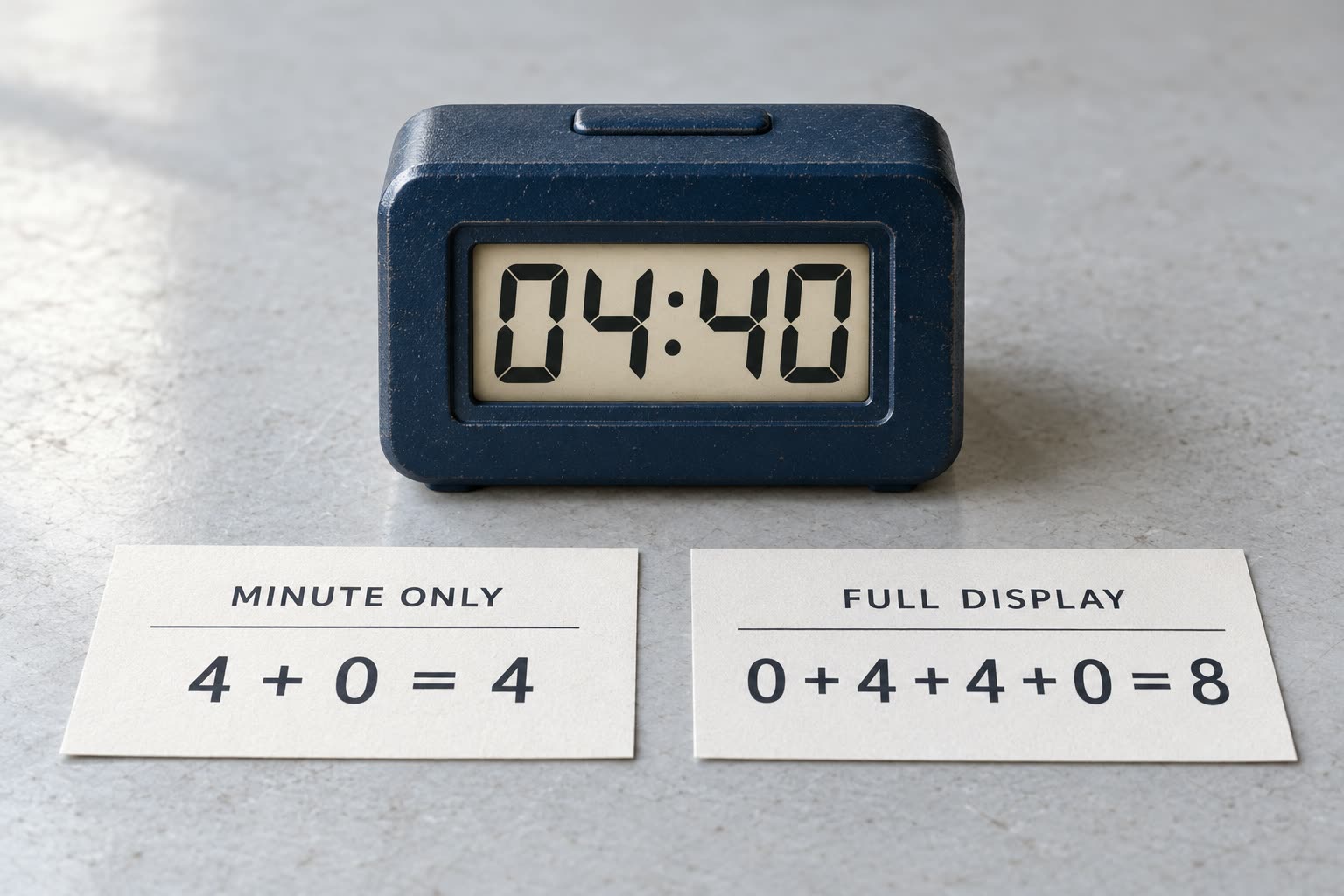
Reading the minute field alone and reading the whole timestamp are two different choices of input. Neither is a universal angel-number rule, and a time-based interpretation also needs the clock format you actually saw. Changing a display from 04:40 to 4:40 leaves this sum unchanged because the removed leading digit was zero, while changing the hour can change the result.
The setting supplies information the numeral lacks
The hour matters if all displayed digits are being reduced.
Age differs from the day and full date used in birth-date numerology.
Hours, days and years describe different commitments.
A number journal preserves where and when you noticed 40, including routine sightings with no obvious connection to a decision. Keeping those ordinary occurrences alongside emotionally striking ones avoids selecting only examples that already fit a foundation or waiting-period story. A repeated setting can explain exposure, but the record still cannot demonstrate a fixed message or a forty-day countdown.
Frequently Asked Questions
What does 40 mean spiritually?
Walmsley reads 40 as encouragement for continued effort, while Andrews interprets its zero as a test of a foundation. Decoz supplies a broader zero-amplification rule and Cheiro a separate compound judgment. Biblical forty-day and forty-year periods have their own actors, units and purposes; they do not settle which modern interpretation applies to you.
Is 40 a lucky number?
Cheiro assigns 40 the unfavorable material prospects of 31; Walmsley’s modern entry is encouraging. These are competing symbolic judgments, and 4 + 0 = 4 cannot establish a likelihood of good or bad luck.
How does 40 differ from 44?
Forty has four tens and zero units, with the digit sum 4. Forty-four repeats the 4 and has the sum 8. A source may give each a compound meaning, but repetition and arithmetic alone do not establish greater spiritual strength.
Does seeing 40 mean a forty-day wait is coming?
A sighting supplies no start date, unit or predicted event. Biblical periods and Lent derive their timing from a narrative or observance. A personal waiting period needs an actual circumstance or agreement to explain its length.
Is 40 a twin-flame reunion number?
No evidence in the cited passages or calculation establishes a reunion date. A twin-flame interpretation is a modern spiritual reading, and it cannot determine whether another person will return.
Sources
- (n.d.). Numerology Meaning of Number 4 (characteristics of 4). World Numerology. Link
- (n.d.). Numerology and the Power of Nothing (zero and the higher-octave analogy). World Numerology. Link
- (2011). Angel Number 40 (posted July 2, 2011). Sacred Scribes Angel Numbers. Link
- (2026). Angel Number 40: The Foundation Beside the Mirror (published March 22, 2023, updated May 21, 2026). Numerologist.com. Link
- (n.d.). Cheiro's Book of Numbers, chapter XIII: compound numbers 30, 31 and 40 (pp. 83-84). Herbert Jenkins; scanned text at Internet Archive. Link
- (1921). Number in Scripture, 4th edition, part II, entry Forty. Eyre & Spottiswoode, London; scanned text at Internet Archive. Link
- (1611). Genesis 7:12, 8:6; Exodus 24:18, 31:18; Numbers 14:34, 32:13; Deuteronomy 8:2; 1 Kings 19:8; Jonah 3:4, 3:10; Matthew 4:2; Acts 1:3. BibleGateway. Link
- (1910). Lent (origin of the word; duration of the fast). The Catholic Encyclopedia, vol. 9, via New Advent. Link
- (n.d.). Selective attention. APA Dictionary of Psychology. Link
About Our Editorial Process
Every KnowTheAngels guide separates calculation method, tradition context, and personal reflection. We cite where interpretations come from, present more than one view, and never present symbolic reading as prediction.
Read our editorial policy