What Does Angel Number 34 Mean for Creativity, Structure, and Reflection?
Creativity and discipline in modern readings, the shared sum of 34 and 43, and the limits of a promised reward
Angel number 34 is associated with creativity and practical effort in the contemporary readings of Joanne Walmsley and Blair Andrews. Their interpretations draw on the visible digits 3 and 4, while adding those digits gives 7, commonly associated with inquiry in modern numerology.
Those are three different associations, not evidence that your life must pass through three stages. A sighting of 34 cannot establish that an unfinished project will succeed or that another person will return.
The distinction becomes clearer beside 43: the order of the digits changes, but their sum does not. The creative work, relationship or display where you noticed them supplies information that neither number contains.
Quick Facts
- Modern 34 reading
- Walmsley: creative effort; Andrews: creativity meeting discipline
- Addition
- 3 + 4 = 7; no intermediate life stages are calculated
- Reversal to 43
- Different place values, same digits and same sum
- The 7 association
- Inquiry in numerology; Chariot symbolism in Andrews’ reading
- Reward claim
- A source interpretation, not a demonstrated outcome
- Relevant evidence
- The complete observation, actual work results and agreed relationship behavior
What the 3, 4 and 7 in 34 actually describe
Walmsley’s Sacred Scribes entry brings 3’s creativity and communication together with 4’s practical effort. Andrews’ Numerologist.com article develops a similar pairing through the image of a maker meeting a builder.
In those readings, an imaginative idea and a reliable way of producing it belong together.
Neither author’s metaphor changes the arithmetic: adding 3 and 4 produces one result, 7.
| Part of the reading | Named source or operation | What it establishes |
|---|---|---|
| Visible 3 | Walmsley and Andrews: creative expression | A symbolic theme for the digit, not proof of your personality |
| Visible 4 | Walmsley and Andrews: practical effort or discipline | A second symbolic theme, not a deadline or obligation |
| Root 7 | 3 + 4 = 7; Numerology.com describes inquiry | The sum and a separately attributed numerological profile |
| Whole 34 | An author combines the two visible digits | An interpretation whose meaning can differ between writers |
Reduction removes the digit order: 4 + 3 also gives 7. It does not calculate when creativity appears, how long discipline takes or whether reflection happens after the work is finished.
Numerology.com presents number 7 as analytical and interested in discovering truth. Bringing that profile into a reading of 34 adds an interpretive layer; it does not turn 7 into a compulsory final review.
A calculated chart result has a different input from a number you happen to see. For example, adding every digit of March 4, 1998 gives 3 + 4 + 1 + 9 + 9 + 8 = 34, then 3 + 4 = 7.
Reducing that date’s month, day and year separately instead gives 3 + 4 + 9 = 16, then 1 + 6 = 7. The root agrees, but the intermediate total differs.
That example shows why a Life Path 7 calculation needs its date and method stated. Seeing 34 on a receipt supplies neither a birth date nor a chart position, even though both can be discussed within numerology.
34 and 43: reversed digits, identical sum
The ordinary numerical difference is place value: 34 contains three tens and four ones, while 43 contains four tens and three ones. Moving the digits changes the amount by nine; adding them discards that difference.
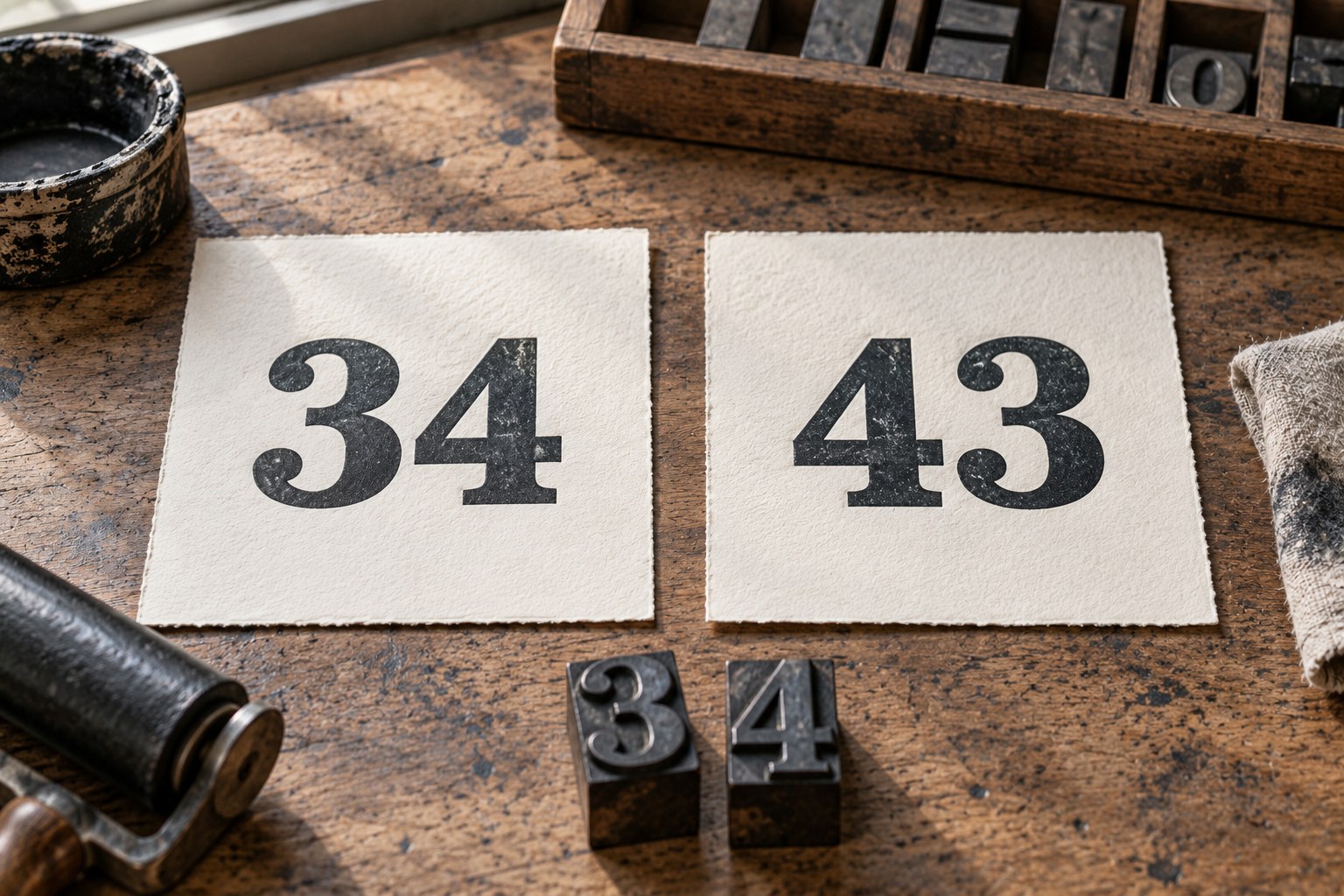
Andrews gives the reversal a biographical meaning. His 34 is a creative person who develops discipline, whereas his 43 is a disciplined person discovering creative expression.
That contrast explains his interpretation, not a universal difference between people who see the two numbers. Digit order and life order are separate claims.
Two orders, two kinds of information
The 3 occupies the tens position; its place contributes thirty.
The 4 occupies the tens position; its place contributes forty.
3 + 4 and 4 + 3 agree; addition does not retain a before-and-after story.
The change in personal emphasis is the author’s symbolic reading.
In an actual project, creativity and structure can alternate. A fixed print size may shape the first design, and a later sketch may reveal that the planned format needs changing.
There is no reason to postpone evaluation until a supposed 7 stage: a failed first sample can expose a problem before a routine is established.
Seeing both 34 and 43 therefore cannot decide whether you have too little discipline or too little freedom. Andrews’ contrast may describe a question already present in your work, but the unfinished task and its constraints reveal which problem actually exists.
Creative rewards and the Chariot are different claims
Walmsley connects additional effort on creative endeavors with long-term rewards. Astrology.com makes a stronger money claim, associating 34 with good luck and financial stability.
Those promises predict an outcome that the sighting and digit sum cannot demonstrate.
Andrews also connects the reduced 7 with the Chariot in Tarot, using victory rather than luck as his theme. This is his combination of numerology and Tarot symbolism; adding 3 and 4 does not select a card or establish a future victory.
Numerology.com’s analytical 7 answers a different question about the number’s symbolic character. The two readings can coexist as interpretations without becoming independent evidence that your effort will pay off.
What supports the reading, and what remains unknown
What the evidence supports
- Creative-effort theme
Walmsley and Andrews connect the visible digits with creativity and discipline.
- Exact reduction
3 + 4 gives 7, regardless of the order in which the digits are added.
- Named symbolic comparison
Andrews brings Chariot victory into his interpretation of 7.
What remains limited
- Future income
No sighting, digit sum or Tarot association supplies a selling price, customer or cost.
- Success through effort
More practice may change the work; the quality and result still need observation.
- Universal sequence
Neither the arithmetic nor the agreement between modern writers establishes three required life stages.
A hypothetical creative commission makes the missing evidence visible. A payment of $120 against $90 in materials and fees leaves $30 before labor and any other costs.
If producing the same commission uses $120 in materials and fees, no amount remains to pay for the time spent making it. The number 34 has not changed, but the financial result has.
A completed piece, an improved skill and a profitable sale are also different rewards. Someone may finish an excellent book that has not yet found a buyer, or earn money on a routine job that teaches little.
The word reward leaves those distinct outcomes unspecified.
The same boundary applies to a lucky-number reading. A pleasing association with 34 is compatible with enjoying the number; it does not establish better odds, guaranteed income or approval for a costly commitment.
When structure helps a 34 creative project
The creativity-and-discipline pairing attributed to 34 becomes concrete when a structure solves a particular production problem. A schedule can reserve time for a draft, but it cannot establish that the draft answers its audience’s question.
A quality criterion supplies the missing distinction: an instruction card succeeds when its intended reader can follow it, not merely when the printer produces twelve copies.
Suppose you have two hours to prepare twelve illustrated cards. Spending the first hour making twelve finished layouts leaves little time to discover that the text is too small.
One readable sample can expose that problem earlier, while the remaining time permits a correction before all twelve copies are made. This example explains a reason for a prototype, without deriving a required procedure from 3, 4 or 7.
| Problem already observed | Structure with a reason | Evidence that it helped |
|---|---|---|
| No time is reserved for the work | A bounded session with a feasible deliverable | A draft exists without displacing an essential commitment |
| Many copies repeat the same flaw | One sample judged against the intended use | The text is readable and the revision reaches later copies |
| The brief changes after every version | An agreed scope and a way to approve changes | The client and maker know what the next version must contain |
| A commission costs more than it earns | Price and cost records including time | The proposed terms pay for the actual work |
Discipline can also preserve an unsuitable routine. Completing the same flawed design every morning increases output while repeating the defect.
In that situation, a change to the brief or format matters more than a longer schedule. The creative part of the association is not permission to ignore costs; the structured part is not a reason to keep every existing rule.
A maker can agree to deliver a sample, but cannot promise a client’s approval or a colleague’s unpaid time.
A workable agreement names the deliverable and the resources each person has actually offered. The number does not grant authority over someone else’s schedule.
For a career change, these distinctions separate interest from an offer. A completed sample may show what you can produce, while a written offer establishes pay, hours and responsibilities.
Seeing 34 answers neither question. Its modern creativity-and-discipline theme may fit the transition, but the sample and terms carry the evidence for it.
Love, reliability and a promised twin-flame return
In a relationship reading of 34, creativity and practical effort can describe expression and reliability. Astrology.com extends the two digits into twin-flame partner roles, assigning creativity to one person and organization to the other.
A sighting does not identify which partner holds either role.
Real partners may share or exchange them.
An affectionate message and a kept plan provide different information about a relationship. The message expresses feeling; the plan shows whether an agreement was carried out.
They need not arrive in the order of the printed digits. Someone can communicate warmly while being unreliable, or keep every practical arrangement while avoiding an important conversation.
After a disagreement, an apology can name the harm clearly without settling what will change. An agreement about notifying each other before cancelling a plan makes the proposed change more specific.
Repeated cancellations without notice leave that agreement unfulfilled, even when the messages remain affectionate. That conclusion follows from what happened between the people, not from reducing 34 to 7.
Reliability also changes with circumstances. A partner working an extra shift may have less time available, while both people may still agree on a realistic way to stay in contact.
A rigid demand for identical availability would overlook that change. A numerical label does not make one person responsible for all communication or entitled to the other’s time.
Angel numbers in love can give language to a concern, but cannot supply mutual consent.
A routine supports the relationship only when both people can participate and discuss it without being pressured.
For a twin-flame separation or hoped-for reunion, neither 34 nor its reversal 43 establishes that contact will resume. A private belief that the connection is meaningful does not reveal the other person’s intentions.
An invitation, a reply and an agreed plan are observable steps toward renewed contact. A request for no contact remains a boundary even if the number keeps appearing.
The distinction prevents a symbolic story from deciding responsibility in advance. No one becomes the designated fixer, the less spiritual partner or the person who must wait because a writer assigned a role to a digit.
Seeing 34 and 43 without losing the rest of the observation
A price of 34.43 contains both digit pairs, but it is still one amount with a unit. Treating its first pair as one message and its second as another changes the observation before any interpretation begins.
The same issue occurs with clocks. The minute label 34 is a selected part of the display, while the hour contributes additional digits to a whole-clock reduction.
| Observation | Digits actually selected | Result and boundary |
|---|---|---|
| Standalone 34 | 3 and 4 | 3 + 4 = 7; this is a reading of the isolated numeral |
| 04:34 as a whole clock | 0, 4, 3 and 4 | Sum11, then root2; minute34 alone still sums to7 |
| 15:34 as a whole clock | 1, 5, 3 and 4 | Sum13, then root4; a different hour changes the whole result |
| Price34.43 | 3, 4, 4 and 3 if all printed digits are added | Sum14, then root5; price and numeral selection must be stated |
| Page34 beside page43 | Two separately numbered pages | Each digit sum is7; their contents are not inferred from those sums |
At 04:34, adding only the minute and adding the full display are two different operations.
A comparison between 34 and 43 becomes clearer when it retains the price, page, time or other context where each appeared.
Selective attention, in the APA Dictionary’s definition, concerns attending to some stimuli while others are excluded. That definition allows an ordinary explanation for why certain numerals receive your attention, but does not establish that 34 has objectively become more frequent.
A run of memorable sightings also leaves the other numbers you encountered uncounted. Without comparable observations, there is no basis for a claim about how unusual the frequency is.
An optional number journal can preserve the complete observation: the display, its unit, the surrounding event and the interpretation you considered. Keeping interpretation separate from what was seen makes later differences visible.
For example, a note might record a receipt total of 34.43 and a concern about an unfinished commission. A later sale belongs in a separate result entry; it was not already present in the receipt.
This approach to recurring numbers leaves room for a personally meaningful association without claiming that an unfinished project caused the sightings. It also prevents repeated 34 or 43 from becoming a deadline, a promise of payment or evidence of another person’s decision.
Frequently Asked Questions
Can 34 be my Birthday Number?
There is no day 34 in a civil-calendar month. A total of 34 reached by adding a full birth date belongs to the stated date-calculation method; it is different from a Birthday Number based on the day of the month.
Does 34 mean my creative work has divine approval?
Walmsley and Andrews give 34 a positive creativity-and-effort interpretation. Neither the sighting nor 3 + 4 = 7 verifies divine approval, and the proposed work still has its own effects on the people, time and resources involved.
Sources
- (2011). Angel Number 34 (entry 34; creativity, effort and long-term rewards). Sacred Scribes Angel Numbers. Link
- (2026). Angel Number 34: When the Maker Meets the Builder (34/43 comparison and the 7/Chariot reading). Numerologist.com. Link
- (n.d.). Number 7 Meaning in Numerology (analytical and truth-seeking profile). Numerology.com. Link
- (n.d.). 34 Angel Number Meaning (love, twin-flame roles and money sections). Astrology.com. Link
- (n.d.). Selective attention (definition). APA Dictionary of Psychology. Link
About Our Editorial Process
Every KnowTheAngels guide separates calculation method, tradition context, and personal reflection. We cite where interpretations come from, present more than one view, and never present symbolic reading as prediction.
Read our editorial policy