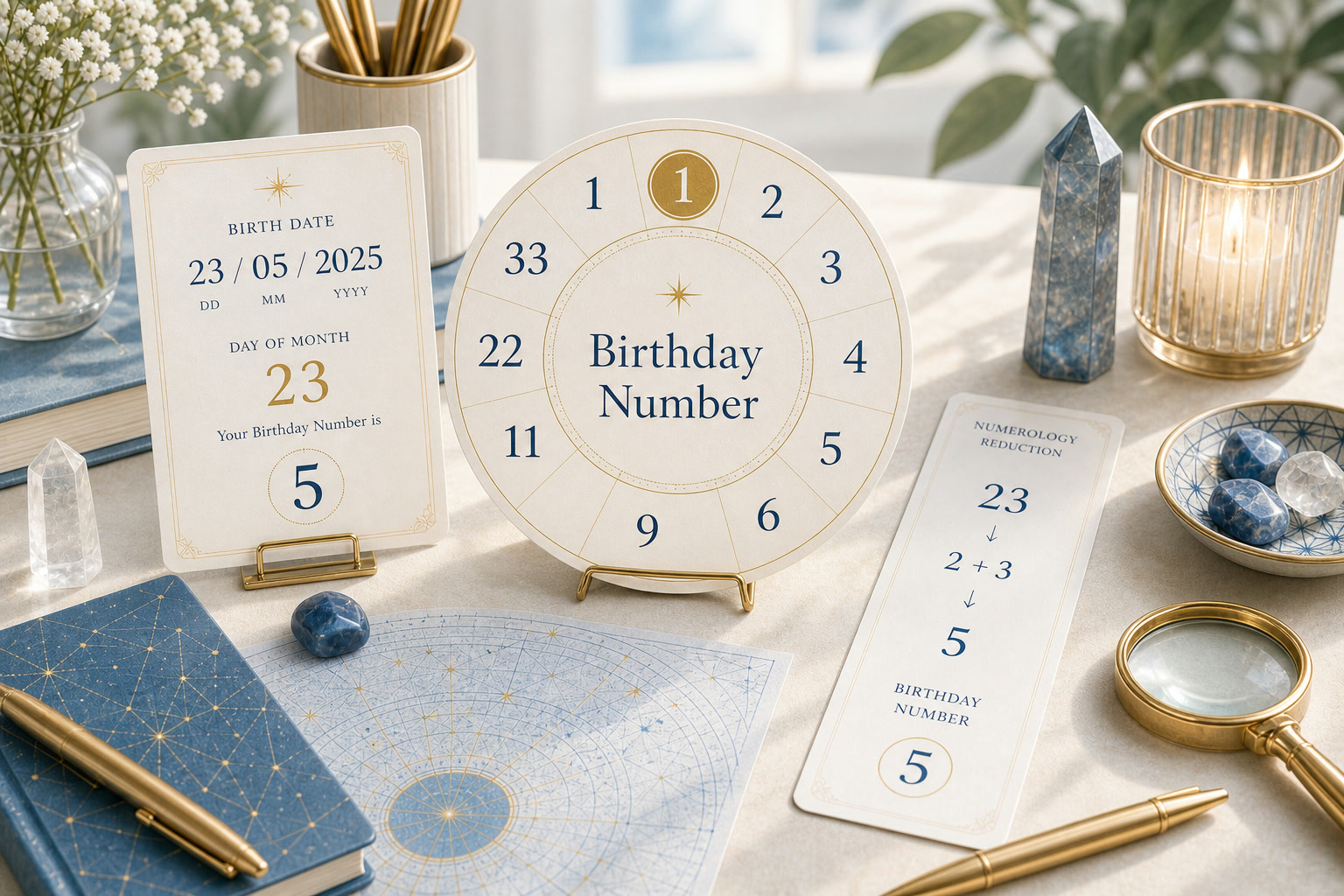
Birthday Number Calculator
Begin with the calculator. The sections that follow explain the method, limits, and next reading once you have a result.Calculate your birthday number
Enter the birth day value to isolate the birthday-number lane, the reduction path, and the follow-up profile that best matches the result.
Start with the calculator
Enter the inputs before moving into the longer interpretation. That keeps the result, method, and cautions in the right order.
How to read the result
Use the page in sequence: calculate, review the method, then choose the one follow-up that matches your result.
- Enter the inputs and run the calculator.
- Compare the result with the interpretation sections below.
- Choose one relevant follow-up article instead of bouncing between unrelated pages.
A dedicated chart-role tool that isolates the birthday-number lane without collapsing the broader chart into one date value
Use this tool when you want a narrow note about the birth day alone. It highlights one fixed chart role, not the whole chart and not the same question as life path.
A strong birthday-number page shows the birth-day extraction and reduction path, then keeps the interpretation smaller than the full numerology chart.
Table of Contents (6 sections)
Birthday Number Calculator is a day-of-birth numerology tool that isolates the birth day and nothing else. Someone born on March 14 and someone born on October 14 share the same birthday-number input, even though their wider charts may be completely different.
That narrowness is the value of the tool. Use the birthday number as one fixed chart role, not as a substitute for life path, name calculation, or timing cycles.
Birthday number isolates the day on purpose
Birthday number is the day-only lane of the chart. It uses the day of birth and nothing else, so month and year stay outside the calculation even when they matter somewhere else.
That is why someone born on March 14 and someone born on October 14 share the same birthday-number input. Their life-path result may differ, but this tool is not reading the whole date.
The guide is useful because it stays small. It answers one chart-role question: what does the birth-day value add beside the wider chart?
- Day only. The calculation starts from 1 through 31, not from the full birth date.
- Rule still matters. Compound and master-day handling can change the interpretation lane.
- Narrow scope. The result is one fixed chart role, not a whole identity reading.
The angel name generator comparison marks a different tool family: symbolic naming prompts instead of the timed or calculated lane used in Birthday Number Calculator.
A reader born on the 30th does not need the month to know the input, but they do need the source rule that decides whether 30 is discussed as a compound cue before reducing to 3. That is what separates a method page from a quick lookup.
Keep the original day visible after reduction
Birthday-number pages get thin when they show only the final reduced digit. The original day is part of the evidence because 6, 15, and 24 can all reduce to 6 through different visible paths.
That visible path keeps the article from turning into a lookup table. The final reduced number can be shared, but the reading should still show how the reader got there.
The same issue appears with 1, 10, 19, and 28. A final 1 can be direct, move through 10, move through 19, or move through 28 before returning to initiative language.
This is not decoration. The original day is the source fact, and the reduced digit is the interpreted result.
Hide the source fact and every 6, 7, or 1 starts sounding the same.
That table changes interpretation. The reader can keep the final number and still see why the calculation got there.
The same rule applies to other shared reductions: the 1st, 10th, 19th, and 28th can all land on 1, but they do not begin from the same birthday evidence. Leave this section able to name both the original day and the final number before asking what the result means.
Master days and compound days need a stated rule first
The 11th, 22nd, and sometimes the 29th create a method question before they create a meaning question. Some systems preserve master forms, and some reduce immediately.
A careful birthday-number result says which rule is being used before interpretation begins. If the method preserves 22, the reader is studying a different lane than a method that immediately turns 22 into 4.
The 29th is the useful stress test. One method may discuss 29 through 11 and then 2, while a stricter reduction method may move straight toward 2.
Readers need to know which rule produced the answer.
Different numerology traditions do not preserve the same forms, so the article names the rule instead of pretending there is one universal birthday-number meaning. That makes disagreement between calculators readable.
This section belongs here because birthday number is one of the places where a small method choice can change the result a lot. The reading can show that choice instead of hiding it behind confident meaning language.
Compound-day language is one reason birthday number should not be treated as a simple lookup table. The same birthday can be discussed differently depending on whether the selected method preserves or reduces special forms.
The reader value is confidence in the method. If the rule is visible, disagreement between systems becomes understandable instead of feeling like a contradiction.
A reader comparing systems can use this section as a check: if two calculators disagree, first ask whether they preserved or reduced a compound day before assuming one answer is simply wrong. For broader source context, keep this beside numerology basics rather than treating one calculator output as final.
What the birth-day role adds beside life path and expression
Birthday number is fixed like life path, but it is smaller. It reads the day emphasis, not the full birth-date pattern and not the spelling of a name.
That makes it a useful comparison lane. If life path gives the broad frame and expression number gives the visible-name role, birthday number can name one recurring emphasis inside the chart without pretending to govern the whole thing.
This is why a birthday result can feel familiar without being complete. It may explain one recurring emphasis, but it cannot explain why two people born on the same day of different months may still live very different life-path patterns.
The clean comparison is with expression number and the full numerology chart. Those readings use more inputs, so the birthday-number result stays smaller.
After this section, readers should know whether they need a narrow day-role answer or a broader chart answer. If they need the broader answer, this calculator can point elsewhere rather than stretch.
The application stays modest: keep the birthday result beside life path and expression, then ask what the single day adds that those wider lanes do not already explain.
Know what this day-based guide cannot answer
A birthday number cannot answer timing, name, or repeated-sighting questions. Those all use different inputs and should not be pulled into the same result.
This is not a disclaimer added for safety. It is the method.
If the input changes from a day value to a calendar cycle, spelling, or sighting pattern, the article has left birthday number.
A clear boundary also protects the reader from over-reading coincidence. Seeing the birth day on a clock or receipt may feel noticeable, but the fixed birthday-number tool is not the same as a repeated-number sighting method.
- Not timing. A personal year changes with the calendar, while birthday number stays fixed.
- Not spelling. A name calculation reads letters, not a day value.
- Not sightings. An angel number calculator answers a repeated-number question, not a fixed chart-role question.
- Not the whole chart. Month, year, and name lanes still matter elsewhere.
This section changes the next decision by preventing tool drift. If the question changes, the method can change with it.
For example, a reader asking about this month should move to a personal-month lane, while a reader asking about a public date should keep the number of the day separate from the fixed birthday role.
Use the birthday result as a small chart note before widening the claim
The best use of the birthday result is a narrow review prompt before widening it into identity language. A grounded note has three parts: the original day, the reduction path, and one reason the day-role emphasis feels relevant beside the wider chart.
For someone born on the 7th, the note may stay simple. For someone born on the 16th, the note should keep 1+6 visible before using 7 language.
That small discipline stops the result from becoming a generic reduced-digit reading.
A second example shows the same discipline from another angle. Someone born on the 31st can record 3+1=4, then ask what the original 31 adds before treating the result exactly like the 4th, 13th, or 22nd.
The practical boundary is plain: write one sentence about the birthday lane, then one sentence about the wider chart. If both sentences say the same thing, the reader has probably stretched the birthday result too far.
The next step is comparison, not expansion. Put the birthday result beside life path, expression number, or a full-chart result and ask what this one day-role adds that the other lane does not.
That final question is intentionally modest. It keeps the birthday calculator useful as one fixed chart role while leaving bigger identity, timing, and name questions to the tools that actually use those inputs.
A small comparison habit helps here too. Put the birth-day note beside one wider chart note and ask whether the day value is adding something new or simply echoing a broader pattern that another guide already explains better.
The final check is simple: if the reader can no longer explain why only the day was used, the interpretation has become broader than the calculator.
That review step keeps the tool useful. It gives the reader one focused application without letting a small chart role swallow the rest of the chart.
Reader Resources
Review the FAQ, source trail, authorship notes, and related readings before moving to another interpretation.
Questions and sourcing
Move from interpretation into evidence by resolving common questions first, then checking the source trail that supports the page.
Frequently Asked Questions
What does a birthday number calculator use?
It uses the birth day value only. Month and year are outside this calculation, which is why it differs from life path.
Is birthday number the same as life path?
No. Birthday number isolates the day of birth, while life path uses the full birth date: month, day, and year.
Do original day numbers matter after reduction?
Yes. The final reduced digit matters, but the original day and reduction path should stay visible because 6, 15, and 24 can all reduce to 6 differently.
Can birthday number replace a full numerology chart?
No. It is one fixed chart role. The wider chart still needs life path, name-based lanes, and timing lanes when those questions are relevant.
Hans Decoz (2001). Numerology: Key to Your Inner Self. Avery Publishing
Matthew Oliver Goodwin (1981). Numerology: The Complete Guide. Newcastle Publishing
Britannica Editors (2026). Numerology. Encyclopaedia Britannica
Updates and authorship
The maintenance record and human editorial context stay together before related reading.
May 18, 2026: Added this birthday number calculator guide to clarify the method, limits, and next-step reading path.
Elena has studied comparative religion and angel traditions for over 12 years. She focuses on making spiritual concepts accessible without flattening the traditions behind them.
Continue through the library
Use these adjacent guides to compare the surrounding traditions, methods, or symbols without losing the article's main question.