What Does Angel Number 52 Mean for Change and Partnership?
Why modern writers connect 52 with change and partnership, how Cheiro reads it differently, and what the biblical counts actually describe
Angel number 52 is associated with change and partnership in modern spiritual readings.
Joanne Walmsley emphasizes approaching changes; Blair Andrews describes independence meeting companionship. Their interpretations give meaning to the digits, but neither is a prediction established by the calculation 5 + 2 = 7.
Older sources complicate that hopeful answer. Cheiro assigns 52 an unfavorable compound meaning, and the biblical passages containing fifty-two describe the duration of a building project and a reign.
These differences explain why one account calls 52 encouraging while another calls it unlucky.
Quick Facts
- Digit sum
- 5 + 2 = 7; reversing the digits gives the same sum
- Contemporary interpretations
- Walmsley emphasizes change; Andrews emphasizes companionship
- Cheiro's entry
- 52 refers to 43, which he associates with upheaval
- Comparison with 25
- Same reduction; different entries in Cheiro's compound list
- Biblical occurrences
- Jerusalem's wall: 52 days; Uzziah's reign: 52 years
- Predictive limit
- The number does not establish another person's intentions or a future outcome
How do 5, 2 and the total 7 become a meaning for 52?
The calculation has one step: 5 + 2 = 7.
Numerology.com associates 5 with freedom and change, 2 with cooperation and mediation, and 7 with analysis and introspection. Those are symbolic associations assigned to the digits.
Addition produces the total; it does not establish that a change must happen before a partnership.
| Part of 52 | Numerology.com association | What the distinction means |
|---|---|---|
| 5 | Freedom, change, adaptability | An association with the first digit, not a date for an event |
| 2 | Cooperation, partnership, mediation | An association with the second digit, not evidence of a particular partner |
| 5 + 2 = 7 | Analysis and introspection for 7 | The sum is arithmetic; the meaning assigned to 7 belongs to numerology |
In her July 2011 entry, Joanne Walmsley presents 52 as encouragement concerning approaching life changes.
Blair Andrews gives it a more particular story: an independent person meets a companion, and the meeting brings understanding. Andrews uses the order of 5 and 2 to tell that story.
It is one author's interpretation, rather than a rule shared by every account of 52.
The distinction matters when applying the reading to an actual relationship.
Nothing in 5 + 2 identifies who made a decision first, whether a partner was consulted, or whether a new person will arrive. Assigning those details to the digits adds a story that the calculation itself cannot supply.
Why do 52 and 25 share a root but differ in Cheiro's list?
Reversing 52 gives 25, and 2 + 5 still equals 7. A reading based only on the reduced number therefore cannot distinguish them.
The same first-step sum also belongs to 16, 34, 43, 61 and 70. Other numbers reach 7 after more than one addition, so a shared root does not make every compound entry identical.
Cheiro's Book of Numbers preserves the compound before reduction. His entry for 52 says, "Has the same meaning as 43."
The entry for 43 associates the number with upheaval, conflict and frustrated plans. His entry for 25 instead describes strength gained through experience.
The contrast between 52 and 25 in this system comes from those separate entries, not from a different addition rule.
That is why descriptions of 52 as lucky can clash with older compound-number accounts. Walmsley's encouraging interpretation and Cheiro's adverse one are different symbolic judgments.
Cheiro's entry documents his belief; it supplies no demonstrated causal link between seeing 52 and experiencing a setback. Its warning is not evidence that a reader is in danger.
Fifty-two also closes Cheiro's numbered list of compounds. In explaining his stopping point, he connects 5 times 9, or 45, with an added 7 to make 52, then links 52 to the weeks of a year.
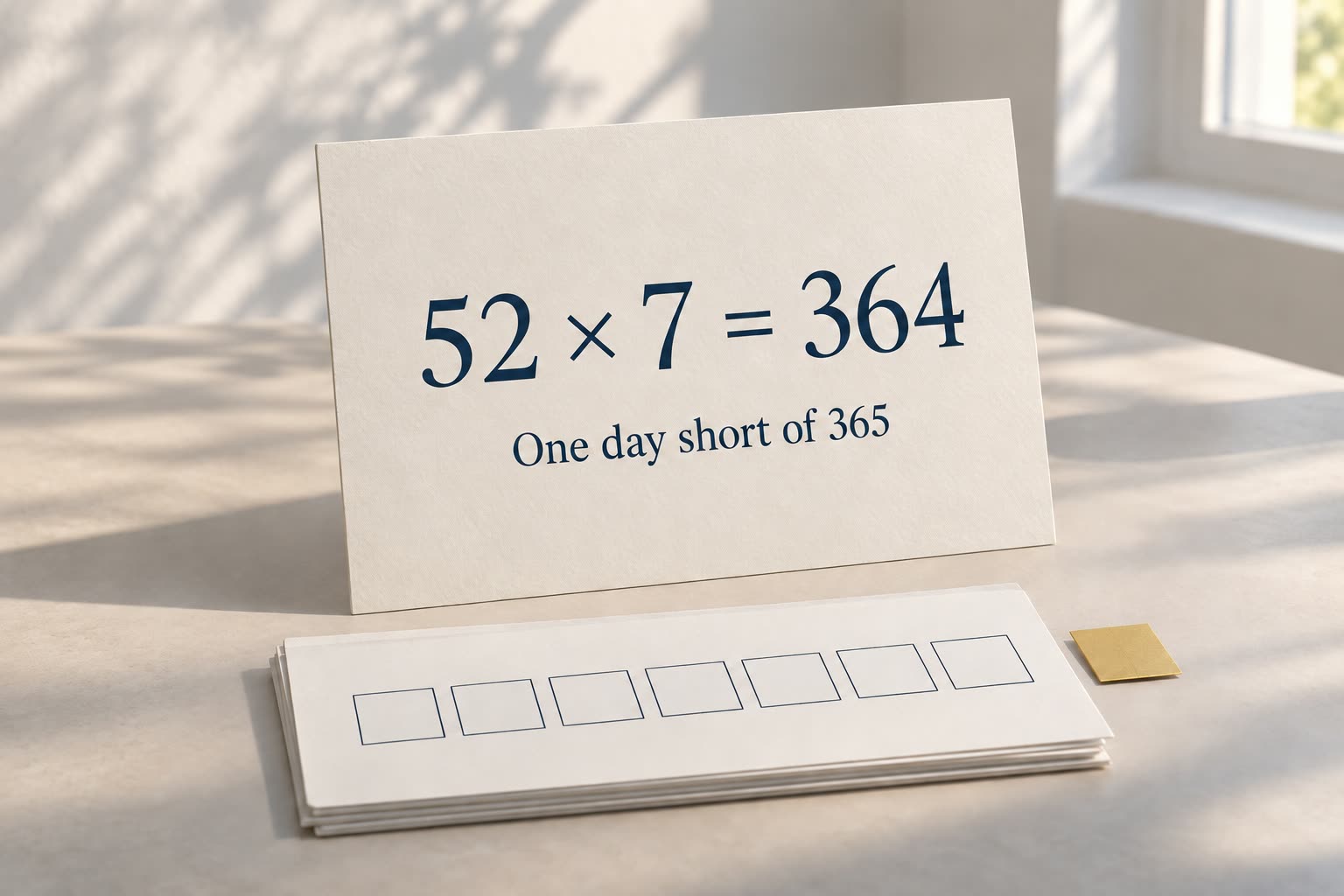
That calendar analogy is approximate: 52 times 7 is 364, leaving one day in a 365-day year and two in a leap year. It explains his chosen endpoint without making 52 a complete mathematical account of the year.
A number above 52 therefore has no separate entry in that particular list.
This says something about the organization of Cheiro's system, not about whether later writers may assign meanings to larger numbers. Modern angel-number pages and his compound dictionary answer through different conventions.
What do Nehemiah and Uzziah's reign tell us about 52 in the Bible?
Nehemiah 6:15 records that Jerusalem's wall was completed in fifty-two days. The next verse connects that achievement with God's help: the surrounding enemies recognize that the work has been accomplished with divine aid.
The account has religious meaning, but it does not assign a recurring angel message to the digits 5 and 2. Its subject is the completed wall.
Second Chronicles 26:3 gives Uzziah a reign of fifty-two years in Jerusalem; 2 Kings 15:1-2 records the same duration under the name Azariah.
A reign and a building project use the same number to measure very different periods. Neither passage teaches that someone who repeatedly notices 52 will repeat those events or receive the same outcome.
E. W. Bullinger adds a separate interpretation in the chapter on thirteen in Number in Scripture. He treats multiples of 13 as signs of rebellion and reads 52 as 4 times 13.
His examples include a count of fifty-two Hebrew letters in Genesis 1:2 and Uzziah's reign.
This multiplication belongs to Bullinger's argument; it is not an explanation given alongside the number in Nehemiah or Chronicles.
There is also a timing problem in Bullinger's description of Uzziah. He places the king's apostasy after a reign of fifty-two years.
Chronicles 26:16-21 places the incense offering and the resulting skin disease before Uzziah's death, with Jotham governing during his father's remaining lifetime. The passage does not date the offense to a fifty-third year.
Bullinger's wording should therefore not be repeated as the biblical chronology.
Astrology.com describes a biblical meaning for 52 in terms of faith and divine guidance without naming a supporting verse.
Nehemiah does provide a context of faith, but its explanation concerns this particular work and its completion. Extending that context into a universal meaning for every appearance of 52 requires an additional interpretation.
Does seeing 52 say anything about love or a twin-flame reunion?
Andrews's companionship reading makes 52 a symbol of a connection that develops alongside independence. Astrology.com emphasizes harmony between partners and openness to a relationship for single readers.
These accounts can explain the hopeful language attached to 52 in love readings, but they do not establish that a particular person wants a relationship.
The difference becomes especially consequential after a separation. Astrology.com's twin-flame paragraph connects 52 with openness to change and movement toward union.
That is a spiritual expectation in the article, not information supplied by the absent partner. Seeing 52 on a receipt does not change what the other person has said about contact or reconciliation.
For example, two people might notice 52 while discussing whether to live together. Their conversation establishes that a shared plan exists; the sighting does not establish whether they agree on it.
Someone who has received no invitation to reconnect has a different situation, even if the same number appears. Neither the partnership association of 2 nor the introspection association of 7 supplies the missing answer.
No number justifies continued contact that another person has refused. A reflective interpretation remains optional and cannot turn a refusal into consent.
What can a 52 career reading actually tell you about an opportunity?
Astrology.com's career reading for 52 encourages trust in new opportunities and links effort with achieving a desired result. It does not give a calculation for choosing between jobs or forecasting income.
The partnership association of 2 cannot determine whether an offer needs another person's agreement; that depends on the arrangement itself.
The distinction is concrete in a job offer. A higher weekly rate may accompany fewer paid weeks, fewer hours or different duties.
For a hypothetical offer paying 500 units a week for exactly 52 paid weeks, the annual total is 26,000 units. A contract with fewer paid weeks changes that total.
Here 52 contributes to a calculation because the offer supplies a unit and a payment schedule.
Noticing 52 elsewhere supplies none of those terms.
Someone may find encouragement in the change-and-partnership symbolism, but the offer's written conditions are what make the opportunity comparable with another one. A symbolic reading cannot establish that persistence will produce a particular salary, promotion or business result.
Why might 52 keep appearing in calendars, plans and everyday life?
Fifty-two has an ordinary reason to appear in annual plans, weekly challenges and subscription descriptions: a year contains 52 complete weeks plus one or two days. That convention creates repeated exposure.
Opening the same 52-week planner each morning produces repeated sightings of one fixed label, rather than separate new occurrences of the number.
Attention can also affect which numbers register. The APA Dictionary of Psychology defines selective attention as focusing on some stimuli while others receive less attention.
Once 52 has become personally interesting, noticing it more readily is a possible explanation. That definition alone cannot establish the cause of any one person's experience.
The missing information is often how many opportunities there were to notice any number.
Three sightings among hundreds of receipts, labels and pages are a different observation from three sightings in a setting with very few numbers. An account that records only the memorable matches cannot show how unusual they were.
A number journal can preserve the setting, whether the same object appeared again, and which other numbers were present. That record separates an observation from the meaning later attached to it.
It can make a pattern easier to describe, but it cannot by itself demonstrate an angelic sender or predict what happens next.
Frequently Asked Questions
Why does adding 5 and 2 give 7 a role in the reading?
Digit reduction gives 5 + 2 = 7. Numerology.com associates 7 with analysis and introspection, which adds a symbolic layer to a reading of 52.
The sum is calculable; the associated qualities come from numerology.
Why is 52 described as both encouraging and unlucky?
The descriptions come from different sources. Walmsley presents 52 as encouragement about change, while Cheiro assigns it the adverse meaning of 43.
Neither interpretation demonstrates that noticing the number causes good or bad events.
Does 52 mean the same thing as its reversal, 25?
Both reduce to 7, so addition alone cannot distinguish them. Cheiro gives the compounds different entries: 52 refers to 43, whereas 25 concerns strength gained through experience.
A digit-order story adds an interpretation beyond the sum.
Does Nehemiah's fifty-two-day project give 52 a spiritual meaning?
Nehemiah 6:15-16 presents the completed wall as work accomplished with God's help. It records fifty-two days as the duration, without teaching a meaning for repeatedly seeing 52.
A devotional connection to the story is an interpretation, not a prediction contained in the number.
Can 52 confirm that a separated partner will return?
No.
A twin-flame reading cannot reveal someone else's intentions. A number sighting supplies no agreement to resume a relationship or contact.
Sources
- (n.d.). Number 5 Meaning in Numerology. Numerology.com. Link
- (n.d.). Number 2 Meaning in Numerology. Numerology.com. Link
- (n.d.). Number 7 Meaning in Numerology. Numerology.com. Link
- (2011). Angel Number 52 (posted July 12, 2011). Sacred Scribes Angel Numbers. Link
- (2023). Angel Number 52 Meaning: The Partnership That Frees You; The Reverse of 25 and The Reduction to 7 (updated May 21, 2026). Numerologist.com. Link
- (n.d.). Cheiro's Book of Numbers: the compound numbers 43 to 52, the note that closes the list, and the 45 + 7 = 52 weeks passage. Herbert Jenkins, London; scanned text at Internet Archive. Link
- (1921). Number in Scripture: Its Supernatural Design and Spiritual Significance, 4th edition: the chapter on thirteen (Genesis 1:2 counted at 52 letters; Uzziah after 52 years as 4 × 13). Eyre & Spottiswoode, London (public-domain text). Link
- (1611). Nehemiah 6:15-16: the wall completed in fifty-two days and the response of its opponents. BibleGateway. Link
- (1611). 2 Chronicles 26:3, 16-21 and 2 Kings 15:1-2. BibleGateway. Link
- (n.d.). 52 Angel Number Meaning; Love and Relationships, Money and Career, Twin Flame, and Biblical Meaning sections. Astrology.com. Link
- (2018). Selective attention. APA Dictionary of Psychology. Link
About Our Editorial Process
Every KnowTheAngels guide separates calculation method, tradition context, and personal reflection. We cite where interpretations come from, present more than one view, and never present symbolic reading as prediction.
Read our editorial policy