What Does Angel Number 25 Mean for Partnership and Reflection?
The root 7, the square of five, and the difference between a symbolic reading and a timetable for your life
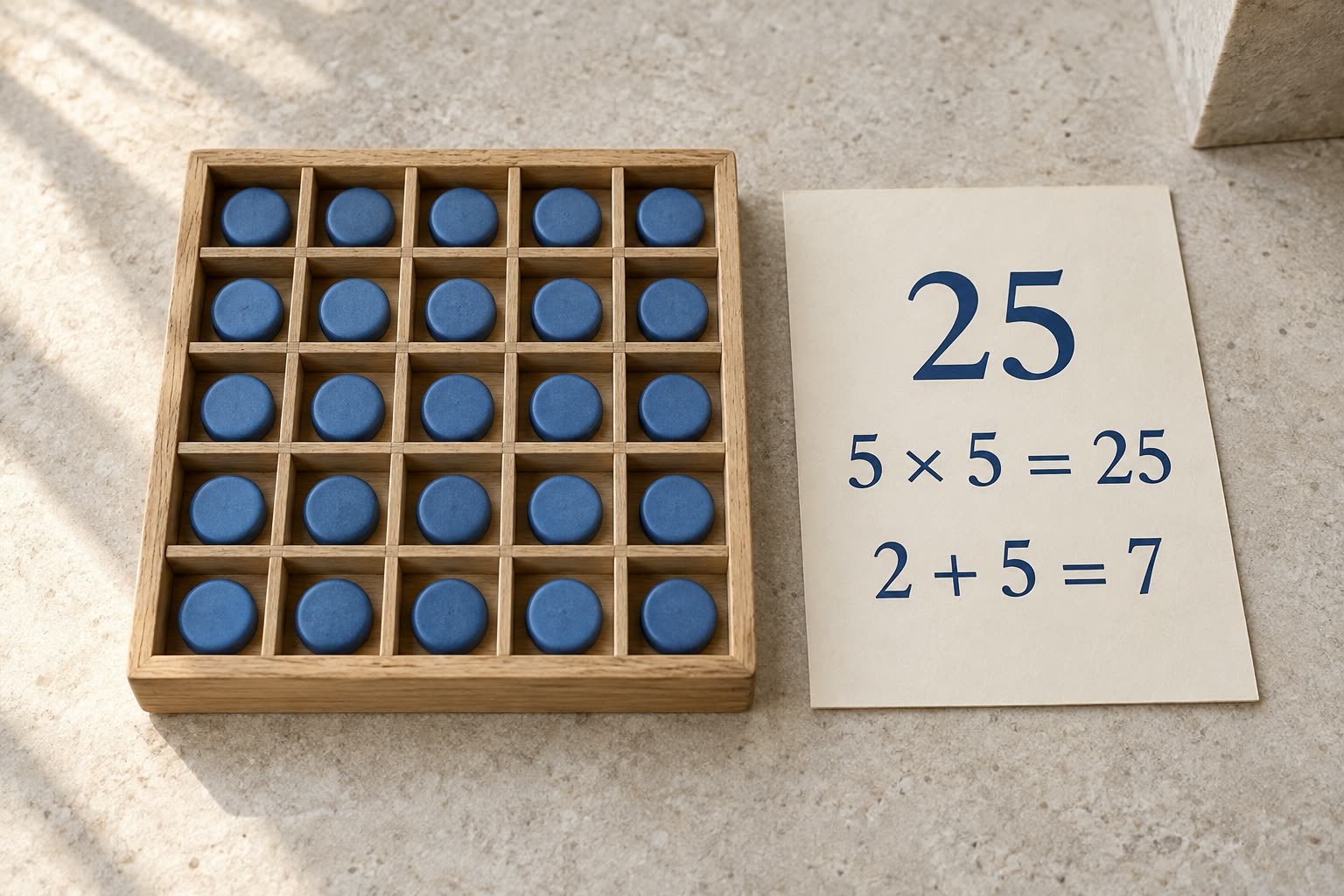
Angel number 25 is associated with partnership, change and reflection in contemporary numerology writing. Blair Andrews at Numerologist.com gives 2 the themes of partnership and trust, 5 those of change and freedom, and their sum 7 those of understanding and depth.
That interpretation depends on adding the digits: 2 + 5 = 7. Other writers begin with 25 as five squared or treat it as a compound number with its own meaning.
The differences matter when a reading becomes advice about a relationship, a job or an important birthday: the sources are explaining different things.
Quick Facts
- Digit sum
- 2 + 5 = 7
- Reversal
- 52 has the same digit sum
- Square
- 5 × 5 = 25
- Cheiro's emphasis
- Experience and observation
- Biblical passage
- Levitical service from age 25: Numbers 8:24
How 25 reaches 7, and what reversing it changes
Adding the digits of 25 produces 7 in one step. The calculation is certain; assigning reflection or spiritual understanding to that result belongs to numerology.
Numerology.com describes 2 through cooperation, 5 through freedom and change, and 7 through analysis and introspection. Together, these associations explain the vocabulary behind contemporary readings of 25.
Andrews combines those themes in his interpretation, but arithmetic does not specify that two people must undergo a change and then spend time alone.
| Approach | What happens to 25 | What the result establishes |
|---|---|---|
| Digit addition | 2 + 5 = 7 | A reduced total of 7; the meaning of 7 comes from an interpretive system |
| Digit reversal | 25 becomes 52; 5 + 2 = 7 | The same sum with a different written order |
| Multiplication | 5 × 5 = 25 | A square of five, including an array of 25 positions |
| Compound interpretation | 25 is read as a whole number | A source-specific entry, such as Cheiro's account of experience |
Reversing 25 to 52 leaves the sum unchanged because addition does not depend on order. A reading that puts partnership before change for 25, but change before partnership for 52, adds a story about sequence to the calculation.
That story can function as a personal metaphor, but the sum cannot show which event comes first.
The symbolism of angel number 7 explains the reduced-number layer without preserving everything a writer says about 25. Reduction groups numbers together: 16 also reaches 7, so a root by itself cannot identify a unique situation in someone's life.
Is 25 lucky? Cheiro ties it to experience
Cheiro's entry for 25 in chapter XIII of Cheiro's Book of Numbers emphasizes strength gained through experience and observation of people and events.
He calls it “not deemed exactly 'lucky'” and connects eventual success with struggles earlier in life. In his account, any favorable outcome depends on a history of learning rather than effortless good fortune.
That distinction is lost when 25 is described simply as a lucky sign. Cheiro's entry does not promise that seeing the number will bring success, nor does it calculate the probability of a future event.
His compound-number reading also differs from deriving reflection through 2 + 5 = 7: the entry gives 25 an interpretation directly.
Cheiro assigns the same meaning to 34, which also reduces to 7. That shared interpretation limits claims that every two-digit number has a completely unique message, even within his own system.
A reader can recognize experience as a theme in this historical numerology without treating hardship as necessary, deserved or a guarantee of later reward.
Five squared: why Bullinger and Agrippa disagree
Writing 25 as 5 × 5 leads away from digit reduction. Both E. W. Bullinger and Heinrich Cornelius Agrippa discuss relationships involving five and twenty-five, but their symbolic conclusions differ.
In the entry for twenty-five in Number in Scripture, Bullinger calls it the square of five and develops his association of five with grace. This is his Christian numerical interpretation, not a definition supplied by a biblical verse.
Agrippa's Three Books of Occult Philosophy, book II, chapter 22, assigns a five-by-five numerical table to Mars. Its 25 cells contain the integers 1 through 25, arranged so that each row, column and main diagonal totals 65.
All the entries together total 325: there are five rows, each adding to 65.
The 25 therefore counts positions in the square, while 65 is its line total and 325 its overall total. None of those operations reduces the digits of 25 to 7.
Agrippa connects the table with planetary talismans and claims effects involving war or discord under different conditions. Those are claims within his occult philosophy; the arithmetic of the table does not establish their efficacy.
Bullinger's grace and Agrippa's Mars cannot be combined into a historical consensus about 25. Their interpretations depend on distinct religious and occult frameworks, even where the same square-of-five relationship appears.
This comparison explains why a search for 25 can return reflection, grace and martial symbolism without any of those words being a result of arithmetic alone.
Why do Levites begin at 25 in Numbers 8:24?
Numbers 8:24 names twenty-five as the age from which Levites enter service connected with the tabernacle. Numbers 4:3 gives thirty as the starting age for the Kohathite service described there.
The difference between those ages is the interpretive question. The passages concern a particular group's duties, rather than a universal spiritual milestone for everyone who turns 25.
Rashi's commentary on Numbers 8:24 explains the five-year interval as preparation: at twenty-five a Levite begins learning the service, and at thirty he performs it. Rashi cites Sifrei Bamidbar and Chullin 24a for this reading.
The training explanation belongs to the commentary; Numbers 8:24 itself gives the age without spelling out a five-year apprenticeship.
Keeping that distinction visible preserves what each source contributes. The verse supplies an age for Levitical service, while the rabbinic explanation reconciles it with the later starting age in Numbers 4.
Bullinger's square-of-five interpretation addresses a different question again: what symbolism he assigns to a number. It does not replace the narrative and legal setting of these passages.
A person approaching their twenty-fifth birthday may find the idea of preparation meaningful by analogy. The text gives no basis for requiring a modern reader to begin a vocation at 25, finish training at 30 or interpret repeated sightings as a calling.
Partnership and change: reading 25 in love and work
The partnership association of 2 gives contemporary readings of 25 a relationship theme, while the change association of 5 brings questions of freedom into that interpretation. Neither association identifies a particular partner or reveals their intentions.
For example, a couple considering a move may already be discussing a tension between a shared commitment and one person's wish for change. A reading of 25 can name that tension as a metaphor, but it cannot decide where the couple should live.
The reflection associated with root 7 adds a theme of understanding the situation. It does not prescribe separation, silence or a fixed period of private thought.
A twin-flame interpretation adds another modern belief framework to the number. Seeing 25 cannot confirm a destined bond or provide evidence that someone who has ended contact wants a reunion.
At work, the same partnership-and-change themes might describe joining a new team or adjusting to a different role. These are examples of applying the symbolism to known circumstances, not events the number predicts.
Cheiro's emphasis on experience may resonate with someone learning unfamiliar duties, but it cannot show whether a job offer is suitable. Pay, responsibilities, hours and the person's circumstances supply information that a number sighting does not.
There is also no calculation here that turns 25 into a forecast of income or investment returns.
The distinction is practical: a metaphor can help someone describe what they are experiencing, while a decision about another person or a job still depends on facts about that situation.
Seeing 25 on dates, prices and everyday objects
The number 25 has ordinary reasons to recur: the twenty-fifth day of a month, a 25 percent discount, or the value printed on a US quarter. Repeated appearances can reflect how dates, prices and money are organized.
The APA Dictionary describes selective attention as concentrating on some stimuli while overlooking others. Once 25 matters to someone, increased notice is one possible explanation for finding it more often.
That possibility does not establish the cause of every sighting, and a few memorable examples cannot settle whether the number's actual frequency has changed.
A number journal can preserve the setting of an observation instead of relying only on memory. An entry that says “25 on the same bus route each morning” contains different information from a list of apparently unrelated sightings.
Recording only the occasions when 25 appears still leaves out all the occasions when it does not. Without that wider context, the record cannot establish that the number occurs unusually often.
A personal spiritual interpretation may remain meaningful as a belief, but dates, prices and repeated observations do not verify an angelic sender or a promised outcome.
Frequently Asked Questions
Does being born on the 25th make my Life Path number 7?
The day number 25 reduces to 7, but a Life Path calculation uses the full birth date. Sharing a reduced day number does not establish the same Life Path.
Is age 25 a spiritual deadline in the Bible?
Numbers 8:24 concerns Levites and tabernacle service. Rashi's later explanation describes their preparation, not a deadline for every person's vocation or spiritual development.
Can 25 and 52 mean exactly the same thing?
They have the same digit sum, 7. An author may assign different compound meanings or read their order differently, so agreement at the arithmetic level does not require agreement at the symbolic level.
Does seeing 25 mean good luck is coming?
Cheiro's reading emphasizes experience and observation rather than effortless luck. Neither that historical interpretation nor repeated sightings establishes a prediction about your next event.
Sources
- (2026). Angel Number 25: Where Reflection Meets the Crossroads (updated May 10, 2026). Numerologist.com. Link
- . The Number 2 in Numerology. Numerology.com. Link
- . The Number 5 in Numerology. Numerology.com. Link
- . The Number 7 in Numerology. Numerology.com. Link
- . Cheiro's Book of Numbers, chapter XIII, the compound numbers 23 to 42. Herbert Jenkins, London; Indian edition, D. B. Taraporevala Sons, Bombay. Link
- (1921). Number in Scripture: Its Supernatural Design and Spiritual Significance, 4th edition, part II, entries for twenty-two to twenty-five. Eyre & Spottiswoode, London (public-domain text). Link
- (1533). Three Books of Occult Philosophy, book II, chapter 22, Of the tables of the Planets (1651 English translation). Esoteric Archives. Link
- (1611). Numbers 8:24; Numbers 4:3. BibleGateway. Link
- (11th century). Rashi on Numbers 8:24 (citing Sifrei Bamidbar 62 and Chullin 24a). Sefaria. Link
- (2018). Selective attention. APA Dictionary of Psychology. Link
About Our Editorial Process
Every KnowTheAngels guide separates calculation method, tradition context, and personal reflection. We cite where interpretations come from, present more than one view, and never present symbolic reading as prediction.
Read our editorial policy