What Does Angel Number 51 Mean for Change and Responsibility?
How 5 + 1 becomes 6, why Cheiro gives 51 a warrior meaning, and how biblical book counts and Psalm numbering change the answer
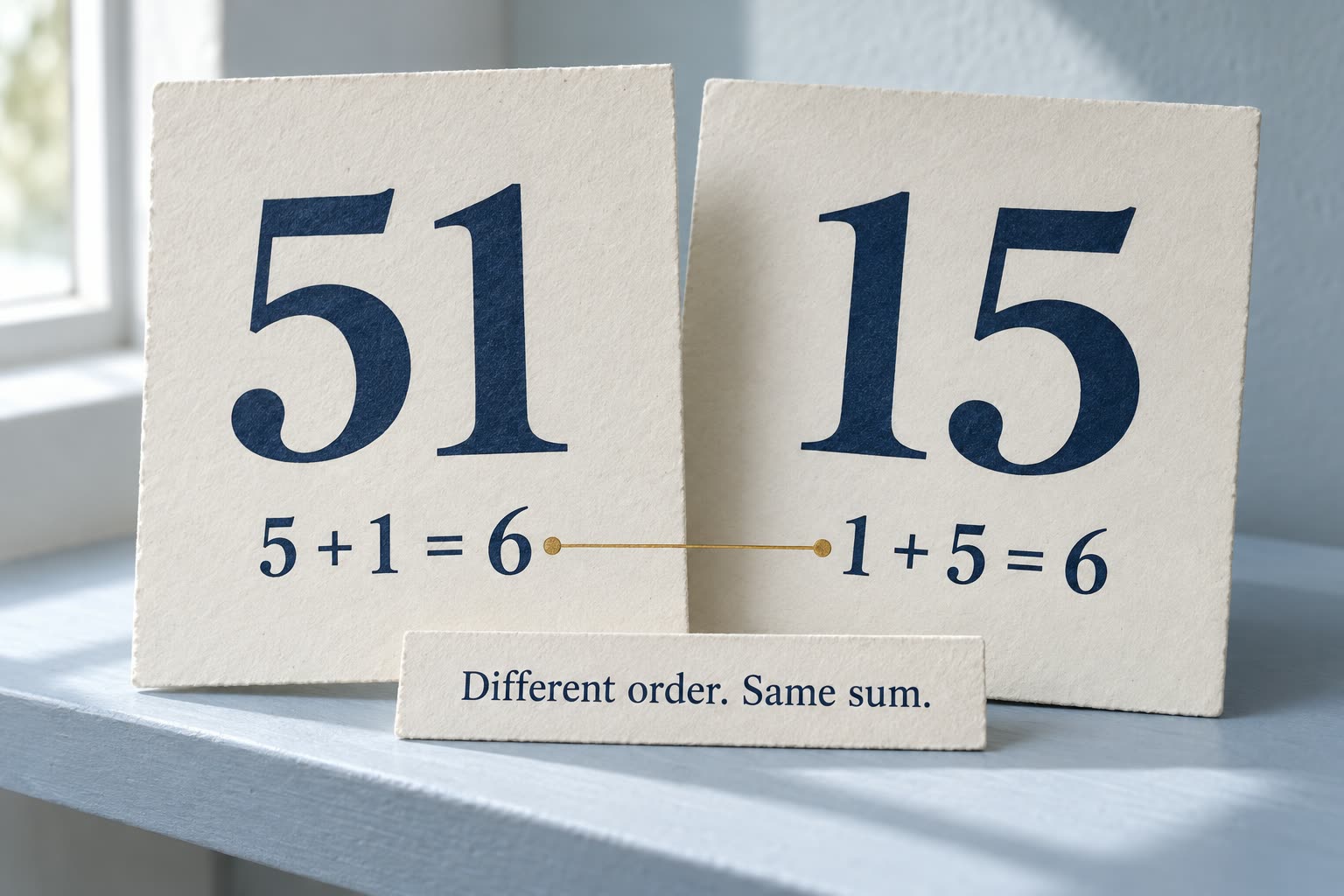
Angel number 51 is associated with change, initiative and responsibility in modern numerology. Numerology.com supplies those associations for 5, 1 and their sum, 6; Blair Andrews develops them into a story about choosing commitment.
That story belongs to its author. The addition 5 + 1 = 6 does not establish that someone must settle down, accept a job or take responsibility for another person.
Older sources give 51 quite different meanings, including Cheiro's warrior forecast and E. W. Bullinger's count of biblical books. Their methods explain why a single number can receive conflicting spiritual readings.
Quick Facts
- Sum and reversal
- 5 + 1 = 6; 1 + 5 gives the same result
- Modern associations
- Numerology.com: change for 5, independence for 1, care for 6
- Compound-number reading
- Cheiro gives 51 its own warrior entry
- Bullinger's total
- 24 Old Testament books + 27 New Testament books = 51
- Psalm reference
- Psalm 51, the Miserere, is also numbered 50
- What a sighting cannot establish
- A commitment, promotion or future event
Why does 51 reduce to 6, and what changes when it becomes 15?
The calculation is 5 + 1 = 6.
Numerology.com describes 5 through freedom and change, 1 through independence and beginnings, and 6 through care and service. Adding the digits produces a total; assigning qualities to that total is a further interpretive step.
Blair Andrews gives 51 a commitment story: a previously independent person finds something worth staying to build. The image of a traveller repairing a roof illustrates that author's interpretation.
It is not a general numerological law that movement must come before commitment.
Reversing the digits gives 15, and 1 + 5 still equals 6.
Addition treats these two digits the same in either order, so the result cannot establish which event happens first. Andrews contrasts the two numbers through different stories about freedom and commitment; that difference comes from the reading, not from the sum.
Other two-digit numbers also have a digit sum of 6: 24, 33, 42 and 60. The shared arithmetic does not make every compound-number interpretation identical.
A writer who assigns a special meaning to the visible 51 is using information that reduction discards: the original number and its written order.
Why did Cheiro call 51 the warrior, and is it lucky?
Cheiro's Book of Numbers gives 51 an independent entry on page 85. He associates it with a warrior and forecasts rapid advancement, especially for military or naval life and leadership.
The same entry also predicts enemies and danger, including assassination. These are Cheiro's predictions, not evidence that a reader who sees 51 faces a threat.
The entry stands out within the closing part of his compound list. Numbers 44 through 50 mostly direct the reader to earlier entries, while 52 sends the reader back to 43.
Fifty-one therefore receives a separate interpretation where its immediate neighbors often receive a cross-reference.
His compound-number system retains a total before reducing it to a single digit. That lets a compound carry an interpretation beyond the qualities assigned to its root.
The modern association of 6 with care consequently does not explain or cancel Cheiro's warrior forecast; the two accounts use different interpretive conventions.
Calling 51 lucky selects only the favorable half of Cheiro's entry. Calling it dangerous treats his unfavorable forecast as an established fact.
The entry documents a historical numerological belief, but it does not demonstrate that the number causes either outcome.
How did Bullinger count 51 biblical books when other Bibles have 66 or 73?
E. W. Bullinger calls 51 a number of divine revelation in Number in Scripture. His stated calculation adds 24 books for the Old Testament to 27 for the New Testament.
The result depends on the book count he accepts. It is a total for that reckoning, rather than the number of books printed in every Christian Bible.
The United States Conference of Catholic Bishops explains that Protestant Bibles count 39 Old Testament books and Catholic Bibles count 46. Both have 27 New Testament books.
Those counts produce different totals even though the New Testament part of the addition stays the same.
| Reckoning | Old Testament count | New Testament count | Total |
|---|---|---|---|
| Bullinger's stated reckoning | 24 | 27 | 51 |
| Protestant Bible | 39 | 27 | 66 |
| Catholic Bible | 46 | 27 | 73 |
The Catholic and Protestant difference includes books such as Tobit, Judith and Sirach, which the USCCB identifies among the deuterocanonical books. Some differences between biblical totals therefore concern which books a tradition includes, rather than an arithmetic disagreement.
Bullinger's chosen 24-book reckoning is another convention to identify before assigning meaning to the resulting 51.
There are two distinct steps in his argument: choosing which books to count as separate units, then treating their total as spiritually significant. The first explains how he reaches 51; the second is his theological interpretation.
Changing the total does not make one community's scripture less sacred to it, and Bullinger's addition cannot settle differences between biblical canons.
Does Psalm 51 teach a meaning for seeing the number?
Psalm 51 is the Miserere, a prayer of repentance. Its superscription connects it with David and Nathan after David's involvement with Bathsheba.
The prayer asks God for mercy, cleansing and renewal; its meaning comes from those words and their religious context.
In the USCCB text, the request for a clean heart appears at verse 12. Later, verse 19 presents a contrite heart as the offering the speaker brings.
Those passages explain what repentance involves within the prayer. They do not instruct someone who notices 51 on a clock to read it as a personal angel message.
The same prayer is also numbered 50. John Paul II's general audience of 8 May 2002 names it Psalm 50[51] and describes its use at Friday Morning Prayer.
The double label matters: a reader can encounter the same prayer under either number without changing its subject.
A devotional association with this psalm can concern confession or renewal. That association depends on recalling the prayer; it does not follow from adding 5 and 1.
Bullinger's 51-book total and the number attached to this psalm also refer to different things: one counts a collection, while the other identifies a text within a collection.
Does 51 mean settling down in love or committing to a new job?
Andrews's interpretation emphasizes choosing a lasting commitment after independence. It can explain why settling down appears in modern discussions of 51, but it cannot establish that this is the right decision for a particular relationship.
Another person's willingness to commit remains information that a number sighting cannot provide.
Consider a hypothetical couple discussing living together. A conversation about where to live and how to share the home tells them what each person wants; noticing 51 during that conversation adds no answer from either partner.
A shared plan exists only if both have agreed to it.
The same distinction applies to a twin-flame reunion claim. A hopeful interpretation cannot reveal an absent partner's intentions or turn a refusal of contact into consent.
No number justifies continuing contact that someone has refused.
For work, the contrast between Cheiro's advancement forecast and the modern responsibility association is especially important. Neither supplies the duties, authority or conditions of a proposed role.
For example, a promotion might add a job title while leaving decision-making authority with the same manager. Its actual terms determine what changes, regardless of whether 51 appears when the offer arrives.
A person may privately associate 51 with choosing work they want to sustain. That reflection expresses a preference; it does not verify the offer or predict success in it.
The responsibilities belong to the role and its agreements, not to a duty imposed by the digits.
Why might 51 keep appearing while a decision is on your mind?
A clock displays minute 51 once in each hour. Looking at the same time each day can therefore produce repeated sightings through an ordinary routine.
A fixed page number or address can recur for the same reason: several encounters may all refer to one unchanged label.
The APA Dictionary describes selective attention as focusing on some stimuli while paying less attention to others. Once a number matters to someone, increased notice is one possible explanation for its apparent frequency.
That general concept does not establish the cause of any particular person's experience.
A number journal can record the time, object and circumstances of each sighting, including whether the same object appeared again. Recording other numbers seen in the same settings gives the matches some context.
Five sightings among many numbered objects tell a different story from five observations in a setting containing almost none.
The record may reveal a routine or show that the available observations are too limited to explain the pattern. It cannot by itself identify an angelic sender.
A personal spiritual interpretation and an account of where the number appeared answer different questions.
Frequently Asked Questions
Can 51 and 15 have different meanings if both add up to 6?
Yes, when an author interprets the original compounds as well as the sum. The different meaning then comes from that interpretive method; 5 + 1 and 1 + 5 produce the same arithmetic result.
Does Cheiro's warning about 51 mean I am in danger?
The warning is part of Cheiro's historical compound-number forecast. His entry does not demonstrate that seeing 51 causes danger or identifies a threat to a particular reader.
Is 51 the number of books in every Bible?
No. Bullinger uses 24 + 27 to reach 51.
The USCCB gives 39 + 27 for Protestant Bibles and 46 + 27 for Catholic Bibles, producing totals of 66 and 73.
Does a reference to Psalm 50 contradict one to Psalm 51?
The Miserere can be identified as Psalm 50[51], as in John Paul II's 8 May 2002 audience. The different labels identify the same prayer rather than two conflicting angel-number messages.
Can the responsibility associated with 6 require me to stay in a relationship?
No. A numerological association cannot establish consent or create an obligation to remain with someone.
A relationship decision concerns the people involved and their actual circumstances.
Sources
- (n.d.). Number 5 Meaning in Numerology. Numerology.com. Link
- (n.d.). Number 1 Meaning in Numerology. Numerology.com. Link
- (n.d.). Number 6 Meaning in Numerology. Numerology.com. Link
- (2023). Angel Number 51 Meaning: The Freedom That Was Pointing Somewhere (updated May 21, 2026), opening and The Lo Shu Reversal. Numerologist.com. Link
- (n.d.). Cheiro's Book of Numbers: compound numbers 44 to 52 (p. 85). Herbert Jenkins; scanned text at Internet Archive. Link
- (1921). Number in Scripture: Its Supernatural Design and Spiritual Significance, 4th edition, part II, entry for fifty-one. Eyre & Spottiswoode, London (public-domain text). Link
- (2018). Selective attention. APA Dictionary of Psychology. Link
- (n.d.). Questions about the Bible: the difference between Catholic and Protestant Bibles. USCCB. Link
- (2011). Psalm 51: superscription, verses 3-19 and accompanying notes. USCCB. Link
- (2002). General Audience, May 8: Psalm 50[51], paragraphs 1 and 3. The Holy See. Link
About Our Editorial Process
Every KnowTheAngels guide separates calculation method, tradition context, and personal reflection. We cite where interpretations come from, present more than one view, and never present symbolic reading as prediction.
Read our editorial policy