What Does Angel Number 64 Mean, and Why Is 10 Part of Its Reading?
Why some writers keep the intermediate 10, how Andrews connects it with caregiving, and where financial and relationship promises exceed the calculation

The intermediate 10 is what makes some interpretations of angel number 64 more elaborate than a direct reading of its final root, 1. Keeping that step allows a writer to discuss a compound-number symbol before applying the familiar new-beginning association.
Andrews uses the wheel image to describe people whose long-standing caring roles are changing. The calculation supplies the numbers; the account of caregiving supplies a particular human meaning.
That distinction matters when the interpretation is applied to an actual family, relationship or job, because a sum cannot establish that a role has run its course.
Quick Facts
- First calculation
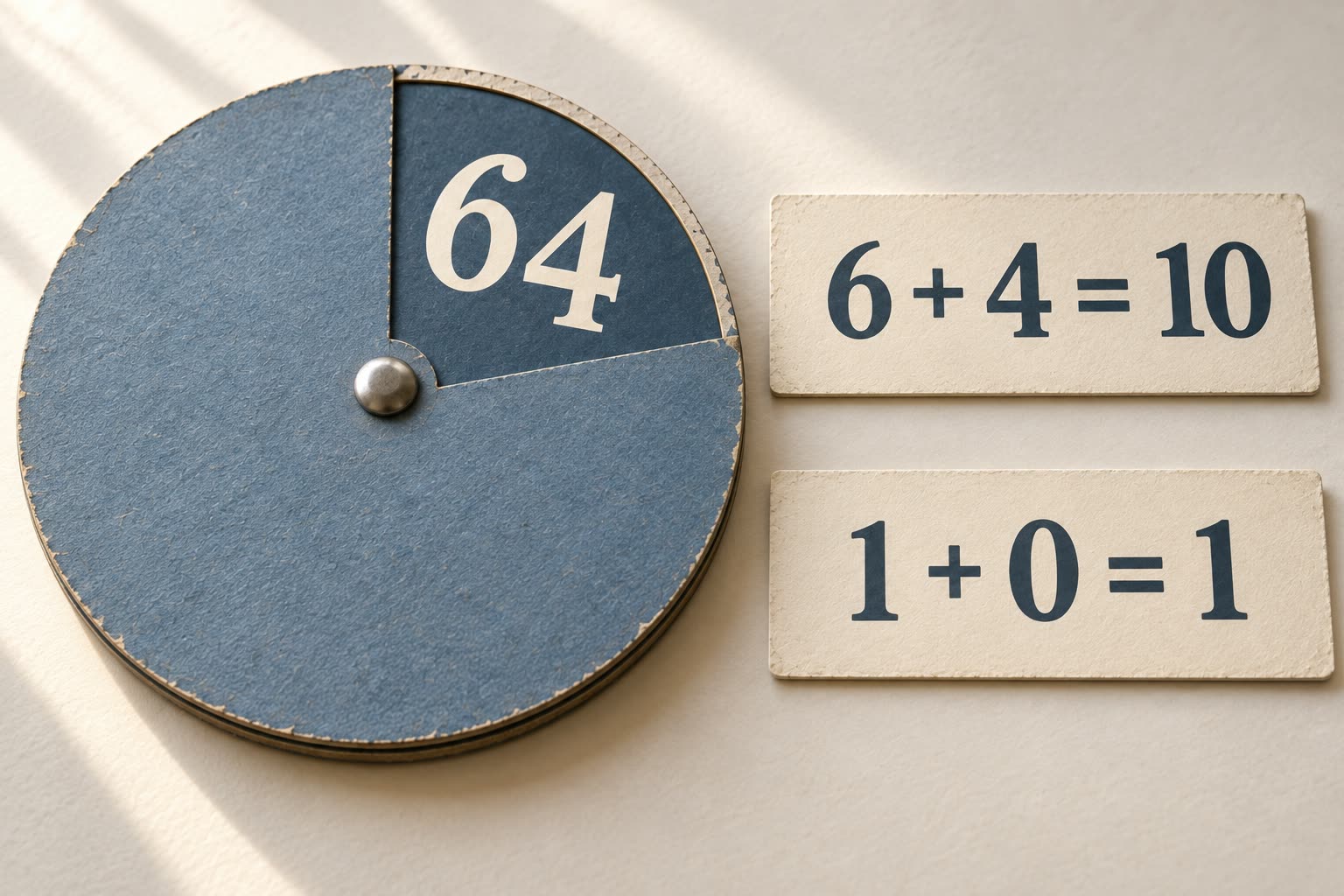
- 6 + 4 = 10
- Final root
- 1 + 0 = 1
- Cheiro's symbol for 10
- Wheel of Fortune
- Andrews' application
- A changing or completed caregiving role
- The reversed 46
- The same intermediate 10 and final 1
- Census references
- Numbers 26:25 and 26:43 contain 64,300 and 64,400
Why a reading of 64 may pause at 10 before reaching 1
Adding the digits of 64 produces 10, so single-digit reduction needs a second addition. The final result is 1, while 10 remains an observable intermediate value.
The reduction, with its intermediate value preserved
Each step uses the digits of the preceding number.
- Start with 64
- Input
- 6 and 4
- Action
- Add 6 + 4
- Result
- 10
- Reduce the intermediate 10
- Input
- 1 and 0
- Action
- Add 1 + 0
- Result
- 1
Cheiro's Book of Numbers gives 10 the symbol of the Wheel of Fortune and associates it with honor, faith, self-confidence, rise and fall. That is a meaning attached to 10 in his compound-number scheme.
Andrews applies a different emphasis to the image: a complete turn of a caregiving cycle. In this reading, the 1 then represents a beginning after that turn.
| Source or method | What it supplies |
|---|---|
| Digit reduction | The intermediate 10 and final 1 |
| Cheiro's entry for 10 | A wheel image emphasizing changing fortune |
| Andrews' reading of 64 | An application to a person's changing caring role |
| Tarot numbering | Wheel of Fortune X and Magician I in the cited deck tradition |
The shared wheel image connects the interpretations without making them identical. Cheiro's rise-and-fall symbolism does not itself specify caregiving, a completed responsibility or a next activity.
His compound list ends at 52.
Citing his entry for 10 is therefore different from claiming that he wrote an entry for 64. The connection runs through a calculation and a later author's interpretation of its intermediate result.
The same caution applies to the tarot comparison. Card numbers X and I can supply imagery, but adding digits is not a card draw and does not establish a sequence of future events.
What Andrews means by a caregiving cycle in the 64 reading
Andrews addresses people who have organized a long period of life around caring for others. Examples in the article include a parent whose youngest child has graduated and an adult child whose care for an aging parent has ended.
Numerology.com's descriptions supply part of the vocabulary: 6 emphasizes support and nurture, while 4 emphasizes stability, discipline and practical work. The final 1 contributes the association with independence and beginnings.
Andrews connects these ideas through a particular story about care, routines and a changing role.
| Circumstance in the reading | What may have changed | What is not established by 64 |
|---|---|---|
| A child graduates | One school-related routine has finished | That every family responsibility has ended |
| A long caring role ends | Time once organized around that role becomes available | What the person wants or is able to do next |
| A relationship enters a different stage | Some familiar arrangements may be renegotiated | That both people experience the change in the same way |
A finished routine and an entirely finished responsibility are different things. A parent may no longer arrange a school day while still providing other kinds of support.

Likewise, newly available time does not identify a person's preferred next step.
These distinctions keep Andrews' interpretation connected to its actual examples. They prevent the image of a full turn from becoming a claim that every person seeing 64 has completed their obligations.
The numeral also gives no reason to assign the next beginning to one person in particular. The carer, the person receiving care and other family members may have different circumstances.
The value of the interpretation lies in the story an author offers about a changing role, not in diagnosing the reader's emotions or setting the date of a change.
Does the 64 relationship reading imply reunion or equal roles?
A couple can change a routine without giving both partners identical responsibilities. The association of 1 with independence does not calculate how a household should divide its work.
For example, one partner may enjoy preparing meals while the other prefers managing transport. Whether that arrangement is welcome depends on their preferences and agreement, not on whether the task counts are equal.

An established routine can also continue after the circumstances that produced it have changed. Its continuation is an observable fact; whether either partner wants something different remains a separate question.
A relationship interpretation and a relationship outcome
What the evidence supports
- An attributed theme
Andrews connects 64 with changing caring roles and a new beginning.
What remains limited
- Mutual agreement
The digits do not show that both partners want a new arrangement.
- A promised reunion
A twin-flame reading cannot establish another person's feelings or future contact.
The cited Twin Flame Numbers article presents a reunion interpretation of 64. That claim belongs to the site's twin-flame framework and does not follow from 6 + 4 = 10.
A hoped-for return and a mutually desired relationship are different outcomes. Seeing 64 provides no reply from someone who has declined contact or asked for distance.
The same limit applies within an ongoing relationship: a personal symbolic reading cannot supply the other partner's agreement.
Work changes and money: two promises attached to 64
Andrews includes the example of someone whose long-standing company role has ended or lost its former weight. It extends the changing-role interpretation beyond family care to a working identity.
The example describes a situation that has happened; it does not make seeing 64 evidence that a dismissal or promotion is about to occur. A career change involves facts about the actual role, an offer or a decision that the numeral does not contain.
Walmsley's July 12, 2011 entry takes a different direction, offering reassurance about financial and material issues. She describes those concerns as being cared for by angels and universal energies.
| Interpretation | What it discusses | Information it does not provide |
|---|---|---|
| Andrews' work example | A person's response to a changed long-term role | An employer's plans or the terms of a new job |
| Walmsley's reassurance | Trust concerning financial and material worries | A specified payment, amount or due date |
A finished working role does not automatically produce the material support needed for whatever follows. Nor does the new-beginning association of 1 identify the source of that support.
The distinction is especially clear in a hypothetical project that has been completed but not yet paid for. Completion describes the work's status, while payment depends on a separate agreement and what has actually been received.

Financial-abundance interpretations sometimes join those ideas into a single hopeful message. The cited reassurance contains no evidence about a particular person's outstanding expense.
Cheiro's discussion of rise and fall under 10 adds another reason to preserve source ownership: it is not equivalent to a guarantee that the next turn must improve someone's finances.
What the reversal 46 and the biblical census totals can actually show
Forty-six and 64 use the same two digits and both pass through 10 to 1. Changing their order does not establish that one person's life began with a system while another person's began with care.
| Written form | Operation or context | What follows |
|---|---|---|
| 64 | 6 + 4 = 10; 1 + 0 = 1 | A reduction to 1 |
| 46 | 4 + 6 = 10; 1 + 0 = 1 | The same reduction |
| 64,300 | The Issachar census total in Numbers 26:25 | A count of sixty-four thousand three hundred |
| 64,400 | The Shuhamite census total in Numbers 26:43 | A different full count |
The biblical references are sometimes brought into discussions of 64 because their totals begin with those digits. They do not count sixty-four people, and the remaining digits are part of the quantities being reported.
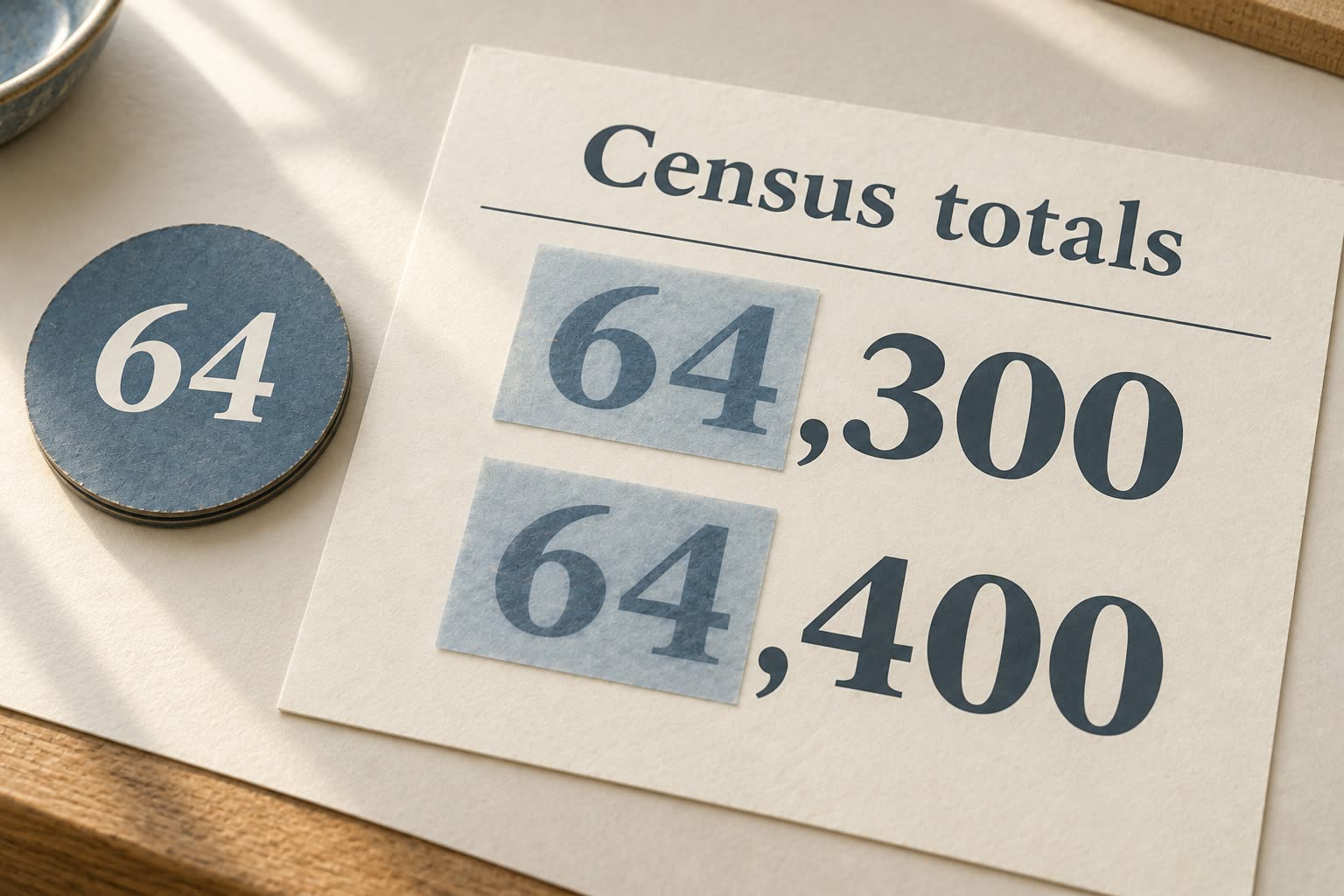
Removing the hundreds and thousands changes the number under discussion.
These passages therefore supply census context for 64,300 and 64,400, rather than an explanation of an angel number called 64. A meaning about caregiving or a new start would have to be supplied by a separate interpreter.
Bullinger's catalogue moves from fifty-one to sixty-five without a dedicated sixty-four entry. Its selection cannot turn the two census prefixes into a symbolic teaching.
The reversal and the census examples make related but different mistakes visible: reversing addends preserves a sum, while selecting a prefix discards part of a quantity.
Repeated 64s: a fixed address differs from changing figures
An address marked 64 remains the same when someone passes it each day. A total on a new receipt is produced by a different situation, even if the same digits appear.
Repeated exposure to the address can explain several sightings without requiring several independent coincidences. Counting the address once or counting every encounter gives different descriptions of the same routine.

The APA's account of selective attention describes concentrating on certain stimuli rather than others. It offers a possible explanation for why a number connected with a personal concern becomes easier to notice.
A number journal that preserves the setting can distinguish the repeated address from changing totals. It still records selected observations, with no complete count of other numbers or occasions when 64 did not appear.
That record cannot determine that a caring role has ended. The events and responsibilities in Andrews' interpretation have to be understood from the person's circumstances, rather than inferred from how often a label was noticed.
Frequently Asked Questions
Is the intermediate 10 a master number?
In the reduction used here, 10 continues to 1. The interpretation pauses at 10 for its compound symbolism, not because it is being preserved as 11, 22 or 33.
Does Cheiro give 64 its own Wheel of Fortune entry?
His cited entry assigns that symbol to 10, and his compound list ends at 52. Applying it to 64 uses the intermediate sum and an additional interpretive step.
Does repeatedly seeing 64 establish Life Path 1?
Life Path 1 is calculated from a birth date. Reducing a number seen elsewhere supplies a result from a different input.
Sources
- (n.d.). Number 6 Meaning in Numerology. Numerology.com. Link
- (n.d.). Number 4 Meaning in Numerology. Numerology.com. Link
- (n.d.). Number 1 Meaning in Numerology. Numerology.com. Link
- (2023). Angel Number 64: The Quiet Return of Your Own Life (published April 18, 2023; updated May 21, 2026). Numerologist.com. Link
- (2011). Angel Number 64 (posted July 12, 2011). Sacred Scribes Angel Numbers. Link
- (n.d.). Cheiro's Book of Numbers, chapter XIII, pp. 80-85: compound number 10 ("Wheel of Fortune") and the note closing the list at 52. Herbert Jenkins; D. B. Taraporevala Indian printing, scanned at Internet Archive. Link
- (2026). Wheel of Fortune (tarot card). Wikipedia. Link
- (2026). Rider-Waite Tarot (1909 publication; card numbering, including The Magician as I). Wikipedia. Link
- (n.d.). Meaning of Angel Number 64 for Twin Flames (cited as an example of the twin-flame claim). twinflamenumbers.com. Link
- (1611). Numbers 26:25 and 26:43 (census totals of 64,300 and 64,400). BibleGateway. Link
- (1921). Number in Scripture: Its Supernatural Design and Spiritual Significance, 4th edition, part II contents (entries for fifty-one and sixty-five, none for sixty-four). Eyre & Spottiswoode, London (public-domain text). Link
- (2018). Selective attention ("concentration on certain stimuli in the environment and not on others"). APA Dictionary of Psychology. Link
About Our Editorial Process
Every KnowTheAngels guide separates calculation method, tradition context, and personal reflection. We cite where interpretations come from, present more than one view, and never present symbolic reading as prediction.
Read our editorial policy