What Does 63 Mean? Angel Numbers, Roman Belief and Kabbalah
The modern gift-and-expression reading beside the Roman sixty-third year and the spelling of a divine name
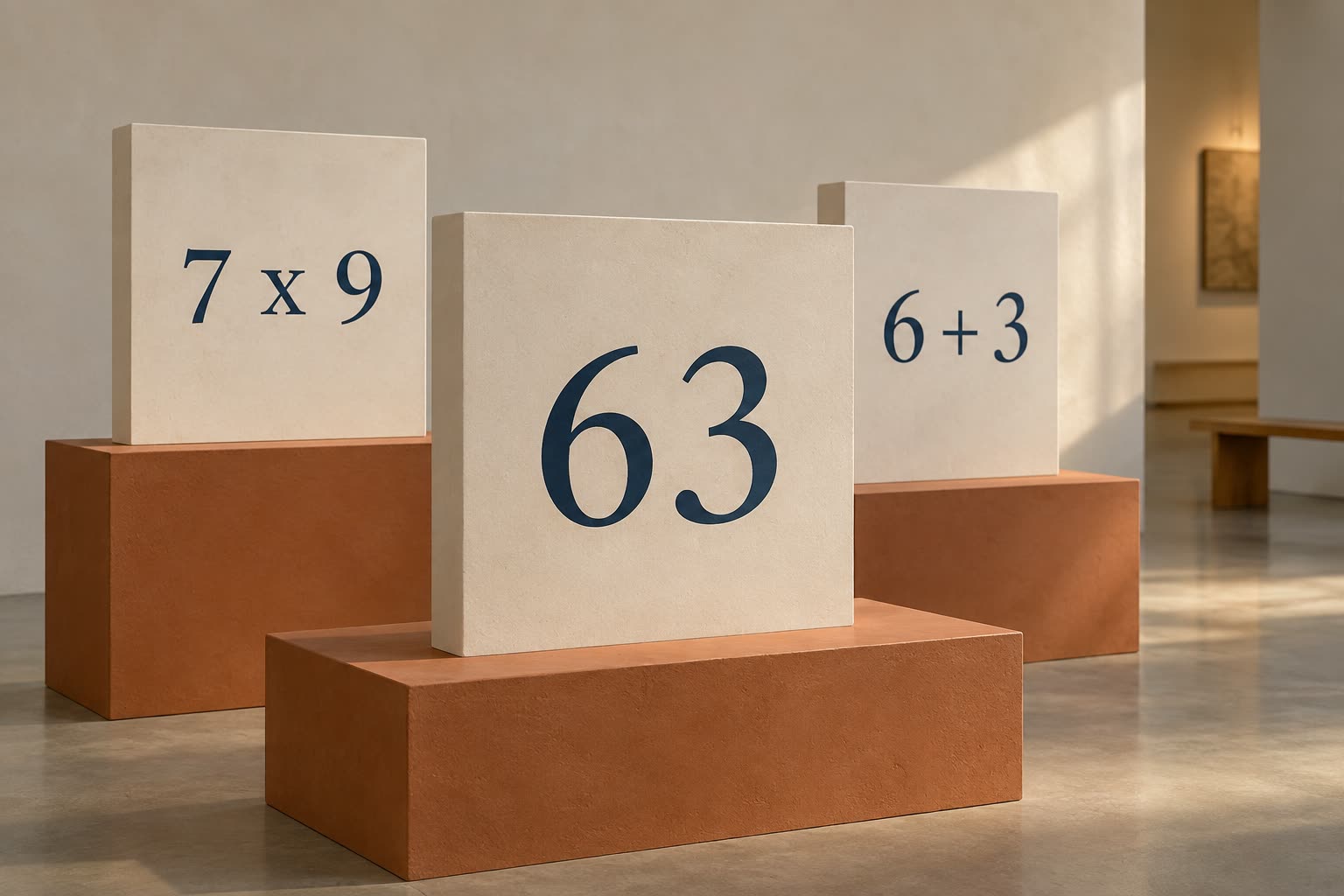
Sixty-three has several documented interpretations, but they begin with different objects. An angel-number writer considers its digits, a Roman author discusses a year of life, and a Kabbalistic calculation spells out letters of a divine name.
The repeated total can make these accounts look like independent support for one meaning. Their sources instead show why the input matters: a claim about an age does not become a prediction about a receipt, and a letter total is not a digit-reduction method.
Quick Facts
- Modern digit sum
- 6 + 3 = 9
- Roman age calculation
- 7 × 9 = 63
- Reversed digits
- 36 has the same sum
- Name-filling values
- 72, 63, 45 and 52 in the cited Judaica account
- Historical disagreement
- Censorinus questioned the special danger assigned to 63
Andrews' 63 reading: making a gift and releasing it
Andrews calls the creative theme of 63 "making-as-gift" and writes that "the proof of love is the willingness to release the work". This is an authored spiritual interpretation of care, expression and completion.
Vocabulary behind the modern reading
The idea can be illustrated by a family recipe book prepared as a gift. The maker has finished a particular object, while the recipient can cook from it, adapt a recipe or leave it unused.
Those are different stages in the life of the gift.
Finishing the book does not finish the relationship, and giving it does not determine how it will be received. That distinction gives content to the phrase completion without finality.
Nothing about the written order 6 then 3 establishes that every person seeing 63 has already given care and must now put it into words. The care-to-expression movement belongs to the interpretation, not to a timetable proved by the digits.
Was the sixty-third year unlucky? Roman writers disagreed
The Roman climacteric concerns a person's year of life. In Attic Nights 15.7, Aulus Gellius reports a belief that the sixty-third year brought particular danger to older people.
He also quotes a letter from Augustus to Gaius in which the emperor expresses relief at having escaped that climacteric. The letter matters as evidence that someone used the belief to interpret a birthday, rather than as evidence that the belief predicted an illness.
Censorinus presents the arithmetic behind the concern in De die natali 14.9-16. He reports an association of 7 with the body and 9 with the mind, making 63 significant because it contains both factors.
| Year | Calculation | Reason for comparison |
|---|---|---|
| 49 | 7 × 7 | Seven appears as a square |
| 63 | 7 × 9 | Seven and nine occur together |
| 81 | 9 × 9 | Nine appears as a square |
Censorinus does not simply endorse the most frightening interpretation. He judges the mixed product 63 weaker than the squared products 49 and 81, challenging the idea that it must be the most dangerous of the three.
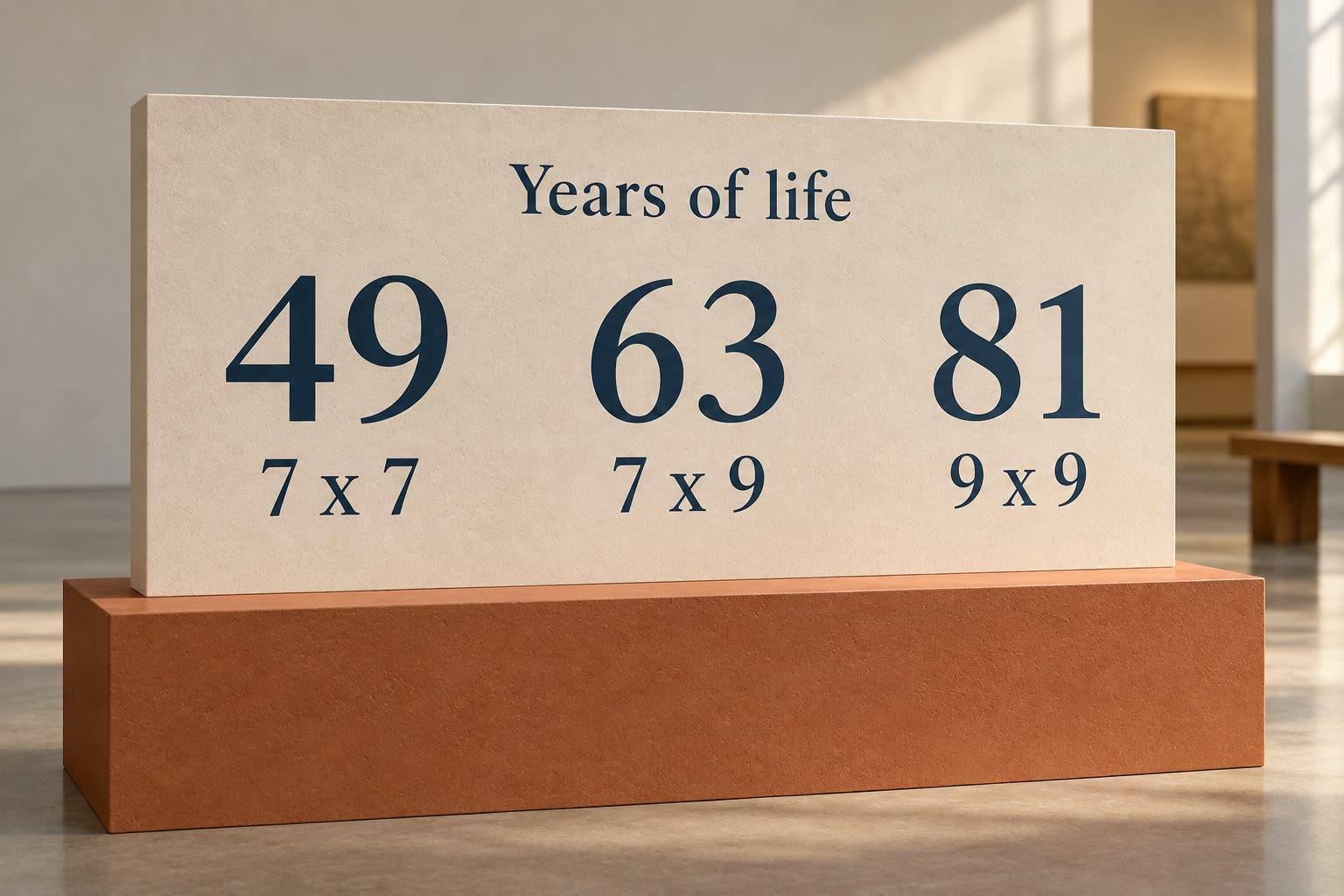
The disagreement shows that even writers who accepted significance in these numbers could rank the years differently.
There are two separate historical questions here: whether people feared age 63, and whether that fear was justified. The texts document the first; they do not supply a reliable estimate of anyone's present health risk.
The scope also matters for repeated sightings. A belief specifically about a year of life cannot be applied to room 63 or page 63 without adding a new claim.
Neither Gellius' report nor Censorinus' alternative ranking turns a numbered room into a warning.
How Kabbalistic letter filling can produce 63
The Kabbalistic use of 63 begins with the four-letter divine name, rather than with a six followed by a three. In the method called milui, or filling, the names of the letters are spelled out and the resulting letters are given numerical values.
Encyclopaedia Judaica's account of gematria lists 72, 63, 45 and 52 as values produced by different fillings. The variation depends on how the letters are spelled out, so the input is more detailed than the original four-letter form.
| Operation | Input | What determines the result |
|---|---|---|
| Decimal reduction | The written numeral 63 | Adding 6 and 3 gives 9 |
| Name filling | Spelled-out names of Hebrew letters | The selected spellings and letter values produce a total |
The Gal Einai table connects the 63 filling with Binah, the sefirah of understanding. It identifies the vav in that filling through the spelling vav, alef, vav.
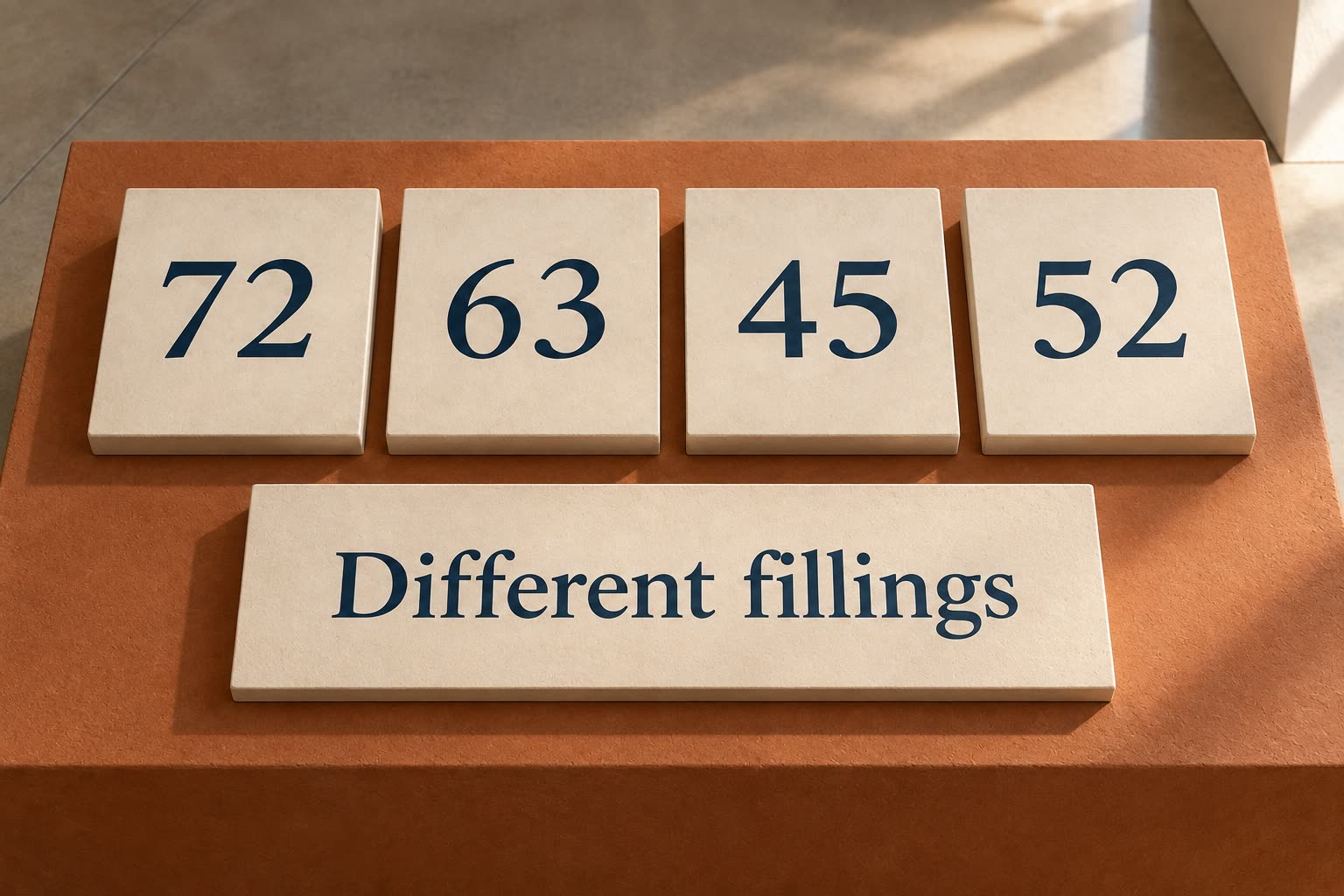
This is a tradition-specific association involving a particular form of a sacred name.
It does not follow that adding the digits of 63 explains Binah, or that an ordinary sighting of the numeral is an encounter with that name. Both claims would transfer an interpretation away from the written input that produced it.
The distinction also clarifies a comparison with 26. The numerical value of the unexpanded four-letter name and the value obtained by spelling out its letters are separate calculations, even though they concern the same name.
A reader can therefore recognize a documented religious use of 63 without merging Kabbalistic practice with a modern angel-number message.
Provision promises and biblical claims need their own sources
Walmsley's July 12, 2011 entry connects 63 with help in the material and financial aspects of daily life. She describes needs being met while a person serves a divine life purpose.
That promise is distinct from Andrews' interpretation of making a gift and releasing it. Creative generosity does not, by itself, identify a source of money or establish that a bill will be paid.
| Source | Claim being discussed | What the claim rests on |
|---|---|---|
| Andrews | Creative work offered and released | An authored gift-and-completion interpretation |
| Walmsley | Material needs being met | Spiritual reassurance in a 2011 entry |
| Astrology.com | Resurrection, renewal and divine justice | A biblical-meaning assertion without a passage in the cited claim |
Astrology.com's biblical wording does not identify a verse establishing those meanings for 63. The existence of biblical themes such as renewal is not enough to connect them to a particular numeral.
Bullinger's catalogue of significant numbers has no separate entry for sixty-three. Its use of 63 in counts expressed as 7 × 9 does not supply a general angel-number meaning either.
A count of occurrences and a promise about a reader's future are different claims, even when the count can be factored into symbolically important numbers.
For the biblical question, the available cited evidence does not establish 63 as a scriptural symbol of resurrection or guaranteed provision. The Kabbalistic filling discussed above has its own interpretive history and should not be used to fill that evidentiary gap.
63 and 36: equal digit sums do not reverse a life story
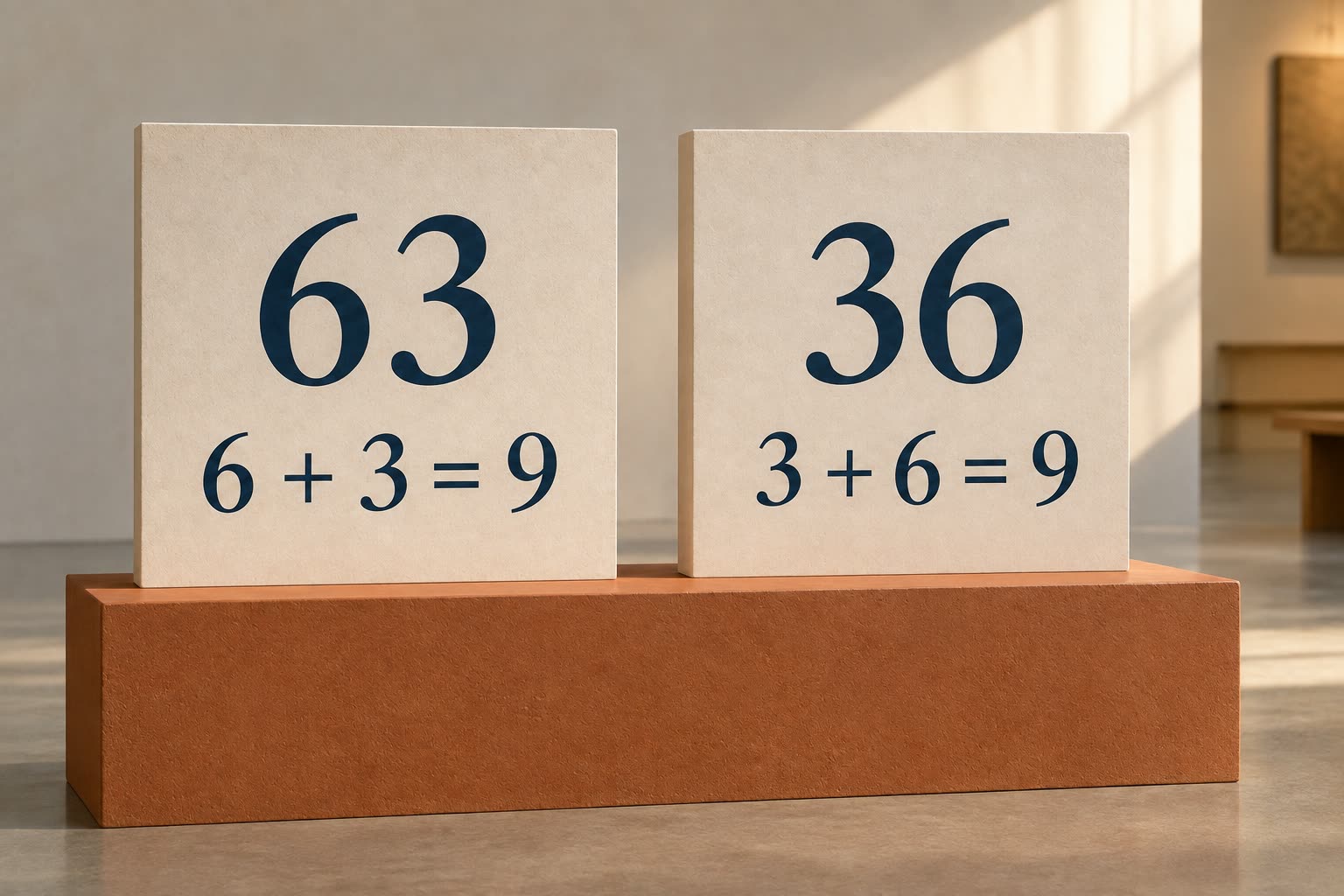
Six plus three and three plus six both equal 9. Changing the order of the two addends leaves the sum unchanged, while the two-digit numerals themselves remain different numbers.
| Expression | Result | What was done |
|---|---|---|
| 6 + 3 | 9 | Added the digits of 63 |
| 3 + 6 | 9 | Added the digits of 36 |
| 7 × 9 | 63 | Multiplied the factors used in the Roman discussion |
The Roman product explains why 63 can be discussed as seven nines. It is not a second derivation of the angel-number story about creative care.
The root 9 gives modern writers common vocabulary across these digit sums.
A claim that 36 always starts with a spoken need while 63 always starts with completed care goes further than the arithmetic. Such a story needs an identified interpretive source and cannot be treated as a sequence of events revealed by reversal.
The written digits do not tell us whether someone asked for help before it was given, or whether a relationship or role is ending.
In love and career readings, giving is different from acceptance
Andrews' gift image offers a particular way to discuss relationships: the giver can finish and offer something, but the recipient has their own response. A letter intended as an expression of care may be welcome, unwelcome or left unanswered.
Astrology.com describes 63 in twin-flame terms as a deep spiritual connection. That description does not establish that the other person shares the interpretation or wants renewed contact.
| Example | An observable completion | A separate question |
|---|---|---|
| A recipe book given to a partner | The book has been prepared and offered | Whether the partner wants or uses it |
| A work demonstration recorded for a colleague | The recording has been made | Whether it explains the task the colleague actually needs |
In a career setting, Andrews' title The Song That Was Taught, Not Composed directs attention to passing something on. A demonstration can preserve knowledge, but producing it does not show that another person has learned the task.
For example, the recording may cover the usual process while omitting an exception the new colleague encounters. The unresolved question concerns the explanation and the work, rather than whether enough completion energy was present.
A career change may create an occasion for that kind of teaching. The number does not require someone to leave a job or prescribe when a handover must occur.
When numerology uses similar service themes in Life Path 9, it begins with a birth-date calculation. A sighting of 63 is not evidence that a person has that chart position.
Seeing 63 and seeing 6:03 are related only after a choice of notation
A clock displaying 6:03 contains a zero that the numeral 63 does not. Adding all three displayed digits gives 6 + 0 + 3 = 9, but the matching total does not make the two displays identical.
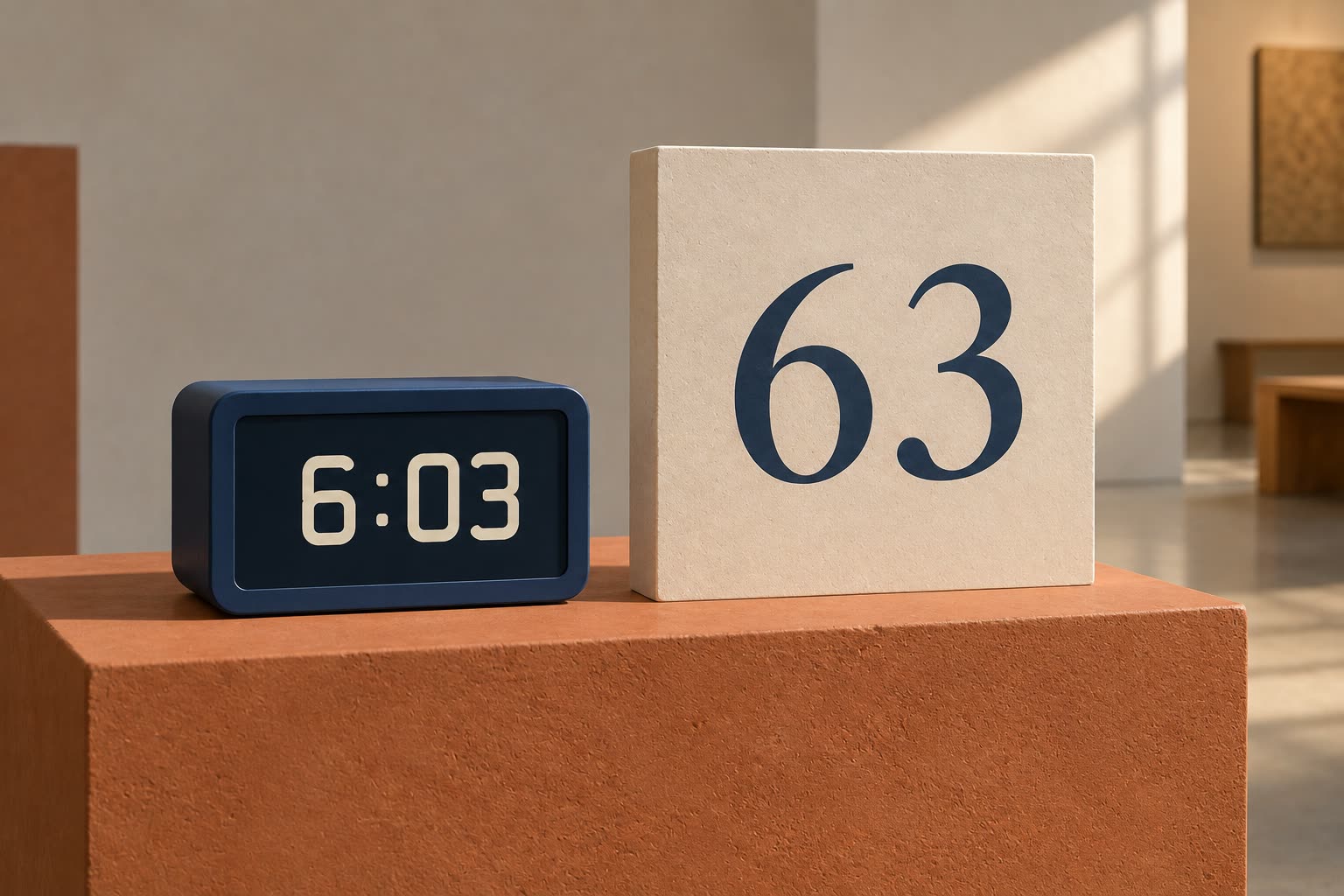
A person may associate them because the six and three stand out. That is a choice about which visual features to group, rather than proof that both displays carry a single message.
The APA's selective-attention definition describes how some stimuli receive attention while others do not. It offers one possible account of why familiar digits begin to seem especially frequent.
A sighting record that groups page 63, room 63 and 6:03 together has already made a classification decision. A number journal can retain the original display and setting so that the grouping remains visible.
The record describes remembered observations, not a measured probability of bad luck or an instruction to complete a relationship. Those conclusions would require evidence the list does not contain.
Frequently Asked Questions
Does turning 63 establish a dangerous year?
The climacteric texts document an ancient belief and disagreement about it. They do not establish an individual's health outlook.
Do all Kabbalistic fillings give the value 63?
The cited Judaica account lists 72, 63, 45 and 52. The spelling used in the filling affects the total.
Can 63 guarantee that a creative gift will be accepted?
Andrews' reading concerns making and releasing a gift. Acceptance still belongs to the recipient and is not determined by the numeral.
Sources
- (n.d.). Number 6 Meaning in Numerology. Numerology.com. Link
- (n.d.). Number 3 Meaning in Numerology. Numerology.com. Link
- (n.d.). Number 9 Meaning in Numerology. Numerology.com. Link
- (2023, updated 2026). Angel Number 63: The Song That Was Taught, Not Composed. Numerologist.com. Link
- (2011). Angel Number 63 (posted July 12, 2011). Sacred Scribes Angel Numbers. Link
- (n.d.). 63 Angel Number Meaning. Astrology.com. Link
- (c. 170 CE). Attic Nights (Noctes Atticae), Book 15, chapter 7: the sixty-third year and Augustus's letter to Gaius. Latin text of the Loeb edition (1927) at LacusCurtius. Link
- (238 CE). De die natali, chapter 14.9-16: the climacteric years 49, 63 and 81. Latin text at LacusCurtius. Link
- (2026). Climacteric year (the grand climacteric). Wikipedia. Link
- (1921). Number in Scripture: Its Supernatural Design and Spiritual Significance, 4th edition. Eyre & Spottiswoode, London (public-domain text). Link
- (2007). Gematria (the values 72, 63, 45 and 52 of the Tetragrammaton). Jewish Virtual Library (Gale Group). Link
- (n.d.). Gematria: the fillings (miluim) of the Name Havayah. inner.org. Link
- (2018). Selective attention. APA Dictionary of Psychology. Link
About Our Editorial Process
Every KnowTheAngels guide separates calculation method, tradition context, and personal reflection. We cite where interpretations come from, present more than one view, and never present symbolic reading as prediction.
Read our editorial policy