What Does Angel Number 83 Mean, and Why Does It Reach 11 or 2?
The 11-or-2 calculation, two modern interpretations, differing karmic terminology and the separate biblical references to 83
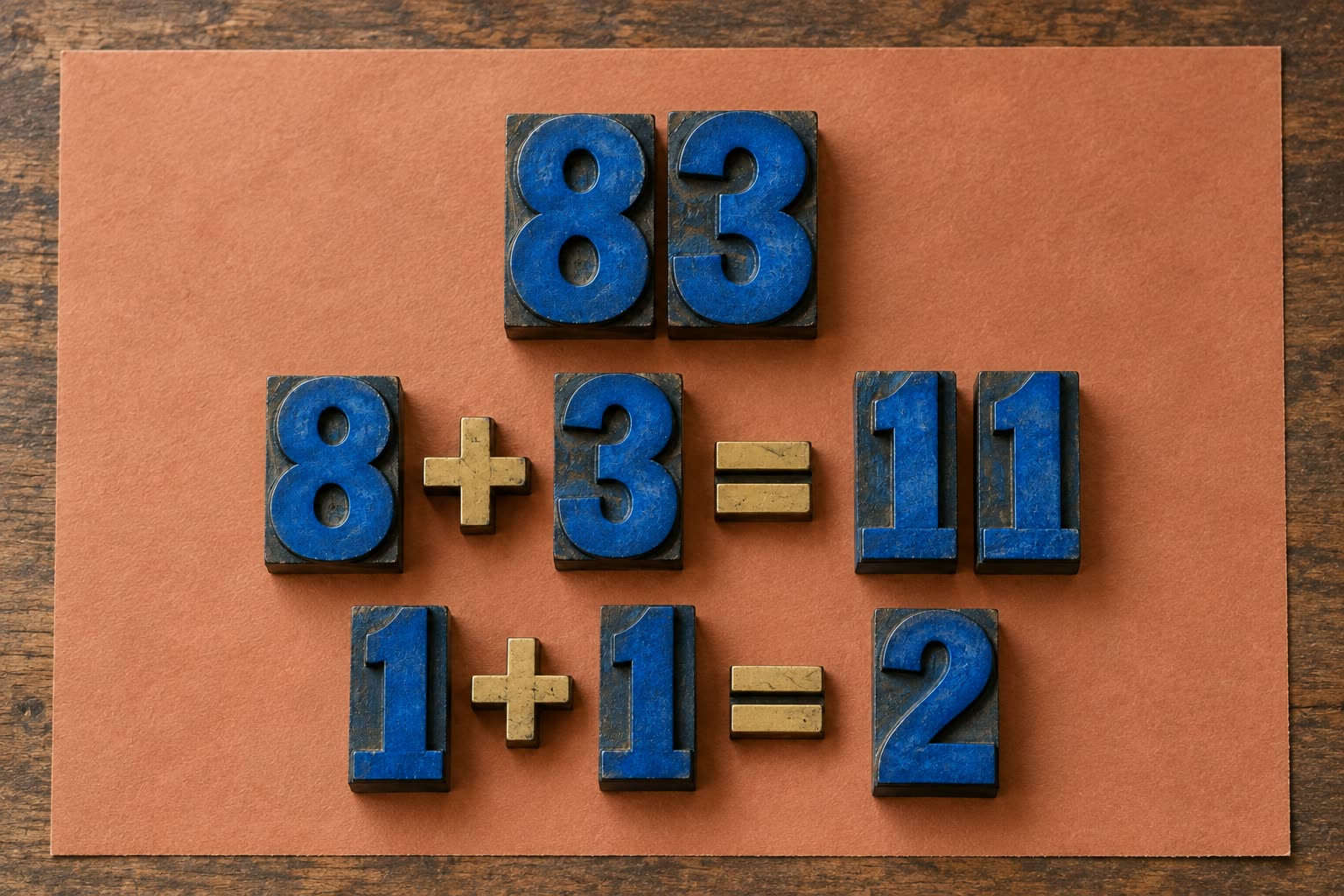
Angel number 83 has two common reduction results: 8 + 3 = 11, and 1 + 1 = 2 when the calculation continues to one digit. The stopping rule explains why readings can discuss both a master number and partnership.
Modern writers then add their own interpretations. Joanne Walmsley links 83 with productive creativity and prosperity, while Blair Andrews uses the image of a skilled maker choosing unfinished work to complete.
Their readings do not turn the calculation into a prediction, and the biblical references to 83 concern different subjects.
Quick Facts
- First sum
- 8 + 3 = 11
- Full reduction
- 1 + 1 = 2
- Reversal
- 38 reaches the same 11 and 2
- Master-number distinction
- 11 is the intermediate result; 83 is the starting number
- Biblical age
- Aaron was 83 in Exodus 7:7
- Psalm numbering
- Psalm 83 is Psalm 82 in the Septuagint and Vulgate
Does 83 reduce to 11 or 2? The stopping rule matters
The first addition is 8 + 3 = 11. A method that preserves master number 11 stops there, while full reduction continues with 1 + 1 = 2.
The two results come from different stopping rules, not competing answers to the same addition.
Numerology.com treats 11 as a master number associated with intuition and also relates it to qualities of 2. In that framework, retaining 11 preserves an additional interpretive distinction rather than making the relationship to 2 disappear.
Calling 83 itself a master number skips a step: 83 is the starting number, and 11 is the sum reached from its digits.
| Number | First digit sum | If reduced to one digit |
|---|---|---|
| 83 | 8 + 3 = 11 | 1 + 1 = 2 |
| 38 | 3 + 8 = 11 | 1 + 1 = 2 |
| 82 | 8 + 2 = 10 | 1 + 0 = 1 |
| 84 | 8 + 4 = 12 | 1 + 2 = 3 |
Reversing 83 to 38 preserves both 11 and 2. An interpretation that places achievement before expression for 83, and expression before achievement for 38, adds a narrative about order to this shared arithmetic.
The numbers 29, 47, 56, 65, 74 and 92 also have a digit sum of 11. That sum alone cannot identify a unique project, relationship or event.
A full birth-date calculation is a separate operation with different inputs. Seeing 83 does not establish that someone has a particular Life Path or master-number position in a personal chart.
Prosperity or unfinished work: two authors interpret 83
Numerology.com describes 8 through achievement. Its profile of 3 emphasizes communication and creativity.
Walmsley and Andrews develop that vocabulary into different readings of 83. Their examples connect the number with choices about creative work, but emphasize different parts of the situation.
Where the two 83 readings put the emphasis
Her July 2011 entry links productive use of creativity with prosperity. Guidance from angels and Ascended Masters belongs to her stated spiritual framework.
His craftsperson faces unfinished work and must choose a piece. Selection receives more attention than general encouragement to continue.
Andrews also connects the number themes with tarot, including Justice at XI. Tarot numbering depends on the deck tradition, so his association is part of that chosen framework rather than a definition of the integer 11.
The two readings are distinguishable without turning them into absolute opposites. Someone can continue a creative practice while selecting one piece to finish; the authors emphasize different aspects of that situation.
Neither interpretation supplies evidence that seeing 83 means a project will succeed. The reader is encountering an authored symbolic reading, not a calculation that tests the quality of the work.
Why Walmsley's karmic 11 is not the same as a karmic debt number
Walmsley calls the intermediate 11 in the reduction of 83 a "karmic number". The word karmic has a narrower use in Hans Decoz's category of karmic debt numbers.
| Source | Number or category | What this says about 83 |
|---|---|---|
| Walmsley's entry for 83 | "Karmic number 11", then 2 | Her spiritual label accompanies the two reduction stages. |
| Decoz's master-number terminology | 11 | The intermediate sum belongs to a master-number category. |
| Decoz's karmic debt category | 13, 14, 16 and 19 | None appears in the sequence 83 to 11 to 2. |
These terms cannot be exchanged without changing the system being described.
Calling 11 karmic in Walmsley's vocabulary therefore does not identify one of Decoz's listed debts.
This observation concerns this calculation only. A numerological chart uses other inputs and positions, so the result does not settle every label someone might obtain from a separate chart.
A claim about obligation, punishment or a past life would require more than applying the word karmic to a number. Neither the digit sum nor the terminology comparison establishes such a claim.
Creativity, career and money: finishing a piece is not an income forecast
Andrews' craftsperson image makes creative work a relevant application of his reading of 83. It can describe a situation in which someone has developed several ideas but has not selected one to complete.
For example, a photographer may have an unfinished series and several unrelated drafts. The metaphor concerns the choice of work; it cannot reveal which photographs an audience will value or buy.
Walmsley's entry explicitly associates the number with manifesting prosperity and abundance. That claim belongs to her spiritual interpretation and is not demonstrated by the sum 11 or its reduction to 2.
The association of 8 with achievement helps explain why success appears in the reading, while 3 supplies the theme of expression. Neither digit measures demand, delivery costs or payment.
What the 83 reading can and cannot establish
What the evidence supports
- Arithmetic
The digits total 11, and full reduction reaches 2.
- Source attribution
Walmsley connects 83 with prosperity; Andrews uses the selection of creative work as a metaphor.
What remains limited
- Project selection
The calculation does not compare the quality or feasibility of two projects.
- Income
Completing or presenting a piece does not establish that someone will purchase it.
A finished series can remain private, and a public portfolio can attract attention without a sale. Treating all three stages as "success" hides the particular outcome someone is actually hoping for.
At work, the achievement-and-expression pairing may also describe explaining a plan to colleagues. It does not show that an experienced person is right, that a presentation is persuasive or that others have agreed to participate.
83 in the Bible: Aaron's age and the numbering of a psalm
Exodus 7:7 states that Moses was eighty and Aaron eighty-three when they spoke to Pharaoh. Here 83 is an age attached to a named person in a particular scene.
Exodus 4:14-16 supplies the context for Aaron's speaking role: Moses raises a difficulty with speech, and Aaron is appointed to speak for him. The narrative explains that role through the relationship and commission, not through adding the digits of Aaron's age.
A modern reader may notice a resemblance between Aaron's speech and the communication theme assigned to 3. That resemblance is a later comparison; these passages do not teach an angel-number method.
Psalm 83 uses the number in a different way: it identifies a psalm attributed to Asaph, opening with an appeal for God not to remain silent. The poem concerns hostility toward Israel and calls for divine action.
The same psalm is numbered 82 in the Greek Septuagint and Latin Vulgate traditions. Its opening and subject identify it across those numbering systems.
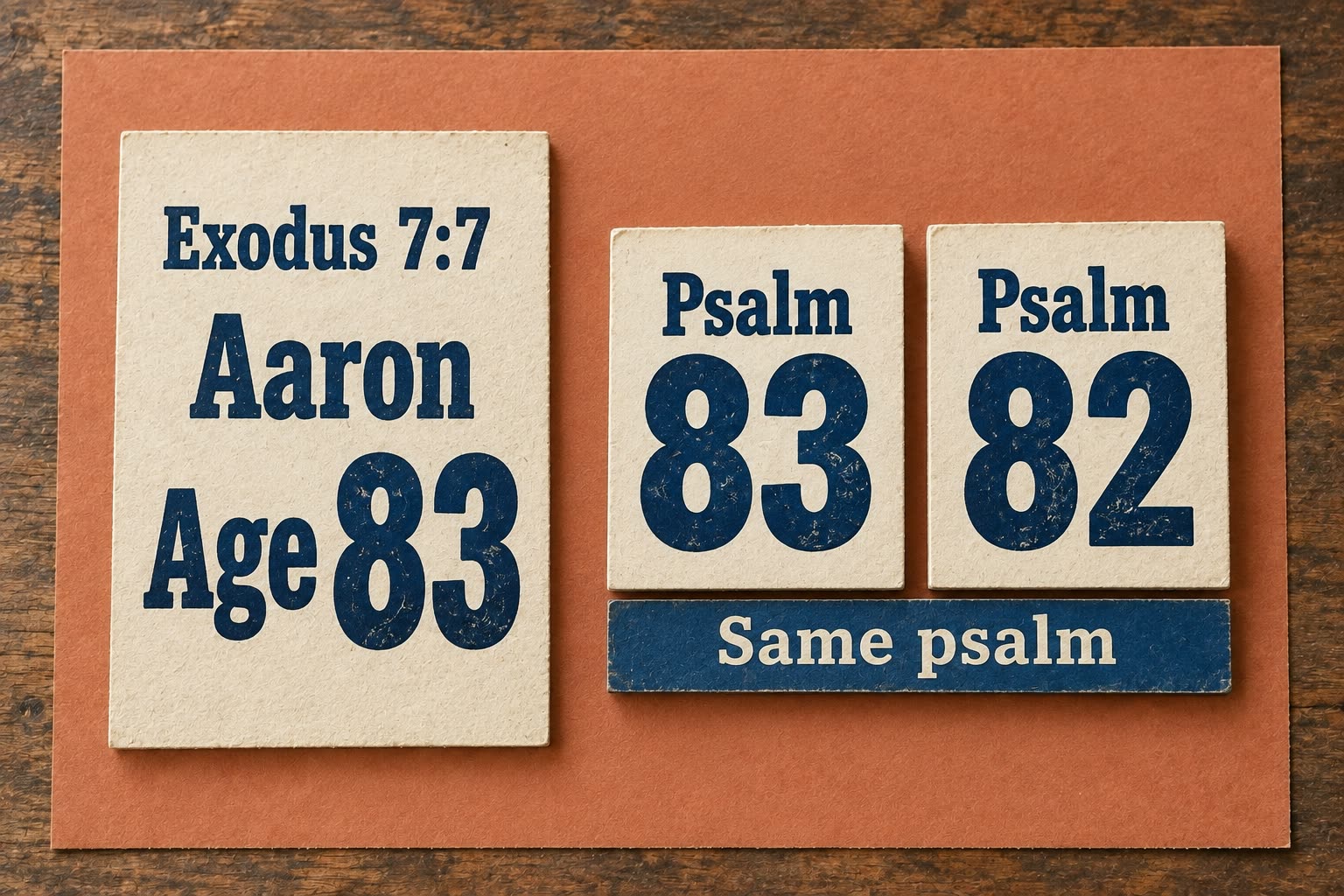
That difference matters to numerological claims based on a chapter label. A reader using the other numbering tradition encounters the same text under a different integer.
Aaron's age is part of a verse's content, whereas the psalm number locates a composition within a collection. Treating both as one coded message about creative work erases that distinction.
Love and twin flames: what the final 2 does not reveal
Reducing 83 through 11 to 2 makes partnership relevant to writers who associate 2 with cooperation. It does not establish that two particular people are destined to be together.
The digit 3 may add a communication theme to a relationship reading. For example, a couple discussing how to share responsibility may recognize those themes in circumstances they already know.
The example cannot be reversed into a prediction: seeing 83 does not show that a hidden imbalance exists or that a partner wants a particular conversation.
A twin-flame interpretation adds a modern relationship belief to the numerical symbolism. The reduction supplies no evidence of reunion, mutual feelings or permission to renew unwanted contact.
Another person's stated wishes remain information about the relationship that the number cannot replace.
Repeated 83 sightings do not identify an unfinished project
A receipt total, page number or familiar bus route can make 83 part of an ordinary day. Repeated exposure to the same setting can account for repeated encounters with its number.
The APA definition of selective attention describes concentrating on certain stimuli while overlooking others. Increased attention is one possible explanation when 83 seems newly prominent, though a list of sightings does not establish the cause.
Connecting those sightings to an unfinished project is an additional interpretation drawn from Andrews' metaphor.
A number journal can record where a sighting occurred and what was already on someone's mind. That record documents a remembered association; it does not demonstrate that the number selected the project or delivered advice about it.
The distinction prevents a circular reading in which thinking about a project explains every 83, and every 83 is then counted as evidence to choose that project. A spiritual belief may still carry personal meaning without the diary proving its origin.
Frequently Asked Questions
Is 83 itself a master number?
No: its digits add to 11, which is treated as a master number in methods that retain it. Keeping that intermediate result is a convention of the method.
Does reversing 83 to 38 change the reduction?
No: both have the digit sum 11 and the fully reduced result 2. Different symbolic readings of their order require an interpretation beyond addition.
Does 83 prove I have a karmic debt?
The sequence 83 to 11 to 2 contains none of Decoz's listed debt numbers: 13, 14, 16 and 19. Walmsley's use of the word karmic for 11 is a different terminology.
Does seeing 83 make my Life Path number 11?
A Life Path calculation uses a full birth date. A sighting supplies neither that date nor the calculation needed to establish its result.
Sources
- (n.d.). Number 8 Meaning in Numerology. Numerology.com. Link
- (n.d.). Number 3 Meaning in Numerology. Numerology.com. Link
- (n.d.). The Master Numbers of Numerology (11 as "a seer"). Numerology.com. Link
- (n.d.). Number 2 Meaning in Numerology. Numerology.com. Link
- (2011). Angel Number 83 (posted July 15, 2011). Sacred Scribes Angel Numbers. Link
- (2023). Angel Number 83: The Craftsman Who Must Choose a Piece (April 17, 2023, updated May 21, 2026). Numerologist.com. Link
- (n.d.). Karmic Debt Numbers (13, 14, 16 and 19; core numbers). World Numerology. Link
- (2026). Major Arcana (Rider-Waite-Smith numbering). Wikipedia. Link
- (1611). Exodus 7:7 and 4:14-16. BibleGateway. Link
- (1611). Psalm 83:1-8. BibleGateway. Link
- (2026). Psalm 83 (Asaph; Septuagint and Vulgate numbering). Wikipedia. Link
- (2018). Selective attention. APA Dictionary of Psychology. Link
About Our Editorial Process
Every KnowTheAngels guide separates calculation method, tradition context, and personal reflection. We cite where interpretations come from, present more than one view, and never present symbolic reading as prediction.
Read our editorial policy