What Does Angel Number 38 Mean? Sources, 11/2 and the Bible
Conflicting abundance and compound-number readings, the difference between 38 and a chart result, and what two biblical periods of thirty-eight years actually count.
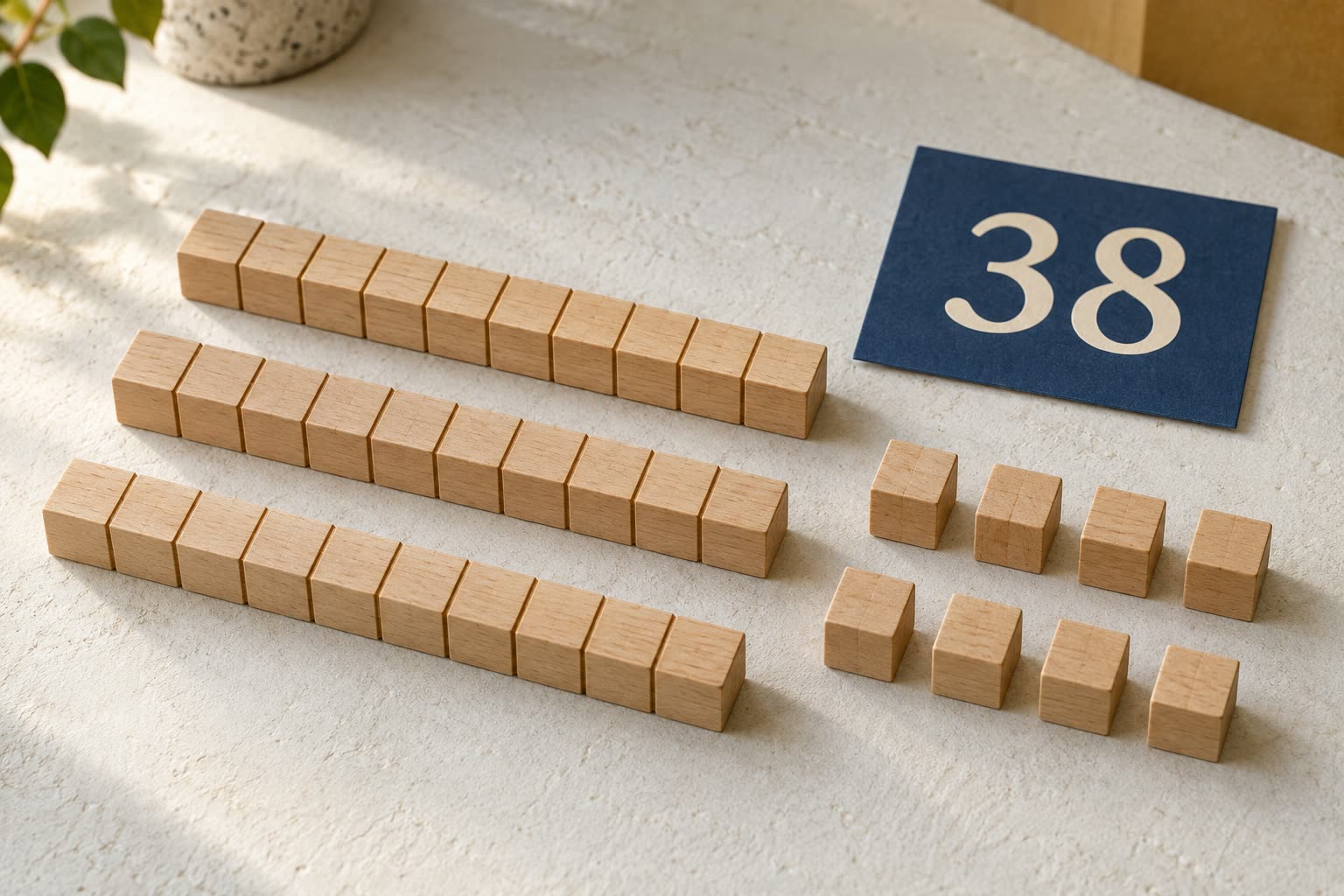
A hopeful reading of angel number 38 can sound quite different depending on the author you find. Joanne Walmsley presents abundance and spiritual support, Blair Andrews develops expression joined with discipline, and Cheiro's older compound-number system assigns 38 a warning about uncertainty and deception.
The addition is much less disputed: 3 + 8 = 11, followed by 1 + 1 = 2 if the method continues to a single digit. What changes is the stopping rule and the input. Seeing 38 on a receipt supplies a numeral; calculating a Life Path requires a complete birth date.
The number also appears as thirty-eight years in two biblical narratives. One counts an interval during Israel's journey, and the other the duration of a man's illness. Their contexts matter when you encounter claims that 38 universally promises prosperity, healing or a new relationship.
Quick Facts
- Digit sum
- 3 + 8 = 11; continued reduction gives 2
- Master convention
- 11 may be retained; 38 itself is not the master number
- Modern interpretations
- Walmsley: abundance; Andrews: expression and discipline
- Older compound reading
- Cheiro (1926): 38 shares the warning assigned to 29
- Biblical units
- Deuteronomy 2:14: journey interval; John 5:5: illness duration
- Reversal
- 83 has the same digit sum but a different decimal value
What does angel number 38 mean in the sources?
Blair Andrews combines the creative expression he associates with 3 and the discipline he associates with 8. His reading concerns a voice developed through practice and an awareness of consequences; those are symbolic associations in his account, rather than a measured description of everyone who notices 38.
Joanne Walmsley's Sacred Scribes entry places the number in a different setting: help from angels and Ascended Masters, with abundance expected to follow. Her inclusion of the sum 11 adds another symbolic layer. Cheiro's 1926 compound entry instead sends the reader to 29, whose interpretation emphasizes uncertainty and unreliable people.
| Source | Interpretation of 38 | Scope of the claim |
|---|---|---|
| Joanne Walmsley, Sacred Scribes (2011) | Spiritual support and increasing abundance | An angel-number interpretation that includes a future expectation |
| Blair Andrews, Numerologist.com | Creative expression joined with discipline and consequence | A symbolic account of developing a voice |
| Cheiro, compound entries 38 and 29 (1926) | Uncertainty, deception and unreliable friends | A warning within his compound-number system |
The disagreement is material if you arrived hoping that 38 confirms a decision. The same numeral has been used to promise reward and to warn of trouble, so agreement on the digits does not establish agreement on the outcome.
A statement that 3 represents expression and 8 represents achievement also does not establish a sequence of events. Decimal notation puts the 3 in the tens position and the 8 in the units position; it cannot tell you that speaking must happen before gaining money or influence. Any such chronology needs an identifiable interpretive source of its own.
Does 38 reduce to 11 or 2? The method and the input both matter
Adding the digits gives 3 + 8 = 11. If your chosen method retains 11 as a master number, that is the stopping point; ordinary reduction continues to 1 + 1 = 2. The notation 38/11/2 can preserve all three stages without pretending they are three different additions.
Hans Decoz's discussion of master numbers distinguishes calculations based on names from date-derived cycles, rather than imposing one stopping rule on every kind of input. Walmsley and Andrews retain 11 in their readings of the observed numeral 38. Following their angel-number convention does not supply the name or birth-date data needed to locate 11 in your personal chart.
| Input or operation | Worked calculation | What the result describes |
|---|---|---|
| Standalone 38 | 30 + 8 = 38; 3 + 8 = 11 | A decimal quantity or label, then its digit sum |
| Master-number retention | 38 → 11 | 11 retained by the stated stopping rule |
| Full single-digit reduction | 38 → 11 → 2 | The ordinary single-digit root |
| Reversed numeral 83 | 80 + 3 = 83; 8 + 3 = 11 | Different quantity, same sum and ordinary root |
| Full birth date: June 29, 1983 | 6 + 2 + 9 + 1 + 9 + 8 + 3 = 38 → 11 | A Life Path result under full-date digit addition with master retention |
| Birthday-only input: day 29 | 2 + 9 = 11 | A Birthday Number under retention, not a full-date calculation |
The worked date uses the method in the Life Path calculator: all the birth-date digits are added before the result is reduced. With master retention enabled, June 29, 1983 reaches 11; with it disabled, the calculation continues to 2. The Birthday Number for day 29 happens to reach 11 as well, but it uses only the day, so the two matching results occupy different chart positions.
Age 38 and a claimed birthday number 38 introduce another distinction. Your age counts elapsed years, while a calendar day of birth cannot be 38. An age, street address or ticket number therefore cannot substitute for the complete date in a Life Path calculation.
Reversing 38 to 83 preserves the sum because addition does not depend on digit order. Place value does change: 38 is three tens and eight units, while 83 is eight tens and three units. Neither that difference nor the shared 11 proves that one number means expression before achievement and the other means achievement before expression.
Andrews also connects the total 11 with Justice XI in the Rider-Waite-Smith Tarot. His scales-and-sword correspondence adds an image of weighing and discernment to his interpretation; it is not another calculation, and it does not make the starting numeral 38 itself a Tarot card or a master-number position.
Does 38 predict money? A payment needs more than a promising symbol
Walmsley associates 38 with help in manifesting abundance and prosperity, and connects plenty with sharing through a giving-and-receiving belief. That explains the source of a hopeful money reading. It does not show that a particular employer, customer or investment will pay you.
Cheiro's reference to 29 points in the opposite direction: uncertainty, deception, trials and unreliable friends. Treating that warning as a measured risk would be just as unsupported as treating Walmsley's expectation as a confirmed reward. The two systems disagree about what the number suggests; neither entry supplies the terms of your actual agreement.
At work, expression and achievement can have a concrete relationship without becoming a rule about 38. A convincing pitch may attract attention, but the person who likes it may not control the budget. A manager may have authority to approve a project while a separate department controls the payment date.
A proposal, an approval and a payment answer different questions
A quoted amount can still depend on acceptance, scope or a future sale.
Enthusiasm from a colleague differs from approval by the person responsible for the budget.
An issued invoice records a request for payment; it does not by itself show money received.
For example, a hypothetical illustration commission offers a $600 fee, with $180 in printing and $120 in delivery costs paid by the illustrator. If the full fee is received, those stated costs leave $300 before any other expenses. The arithmetic changes if the client cancels, pays only part of the fee, or the delivery cost rises; seeing 38 cannot settle any of those conditions.
A career interpretation is consequently limited by the evidence you have about the work itself: accepted scope, decision authority, costs and payment terms. Those details explain why a promising conversation and a profitable job are different states. They matter whether your preferred symbolic reading is optimistic or cautious.
Does 38 promise love or a twin-flame reunion?
Astrology.com associates 38 with a harmonious, abundant partnership and predicts that a twin flame is approaching. The arrival claim goes beyond interpreting a theme: it asserts a future event. A sighting of the number cannot establish who that person is, whether they want contact, or when a relationship will begin.
If you are considering a reunion, a direct answer from the other person concerns the relationship in a way that a number pattern does not. An affectionate message may express interest without settling plans for shared housing or long-term commitment. A twin-flame label also cannot turn a refusal or a request for distance into permission to keep contacting someone.
What can establish a shared relationship decision?
What the evidence supports
- A mutual answer
Both people can say whether they want contact, a reunion or a particular shared plan.
- Agreed responsibilities
The people involved can state what each has accepted about money, housing or time together.
What remains limited
- An arrival forecast
An author's prediction attached to 38 does not identify the person or a date.
- A repeated number or label
A sighting and a twin-flame description cannot supply another person's consent.
Power can affect a relationship when one person controls the lease, most of the income or access to shared resources. In that situation, a suggestion may carry consequences beyond the words themselves: disagreeing about a move could also put someone's housing at stake. That is a real circumstance to understand if it applies to you, rather than a condition that the digits 3 and 8 diagnose.
The sum 2 is sometimes used to discuss partnership, but arithmetic does not measure reciprocity. Whether both people can express a preference and negotiate an agreement remains a question about their behavior and circumstances, even when they share the same hopeful interpretation of 38.
What are the two 38-year periods in the Bible?
Deuteronomy 2:14 names thirty-eight years from Kadesh-barnea to the crossing of the brook Zered. It also says that the generation of men of war passed away during that interval. The number belongs to a specified portion of the journey and a generation's passing, rather than presenting the entire journey as thirty-eight years.
John 5:5 uses the number for a different unit: a man had been ill for thirty-eight years. The narrative places him at the pool of Bethesda, and verses 8-9 describe Jesus addressing and healing him. The duration of his illness is not a stated duration of residence at the pool.
| Text | What is counted | A conclusion the wording does not establish |
|---|---|---|
| Deuteronomy 2:14 | Years from Kadesh-barnea to the Zered crossing, during which the military generation passed away | That every part of the wilderness journey lasted 38 years |
| John 5:5, within John 5:1-9 | Years of one man's illness before the healing described in the scene | That he spent all 38 years beside the pool, or that someone else will recover after the same period |
Both passages contain a long interval, but they do different narrative work. Deuteronomy connects the interval to the passing of a generation before the journey continues; John introduces the length of one man's condition before describing his encounter with Jesus. Calling both periods waiting for abundance removes the events that give the numbers their meaning.
If you are looking for a biblical meaning of 38, these passages provide identifiable places to begin. Applying either number to a receipt or a clock is a further interpretive step, not something the cited verses instruct you to do. The texts also do not give a personal recovery schedule or a payment forecast.
The Bethesda angel and Augustine's 40-minus-2 interpretation
The angel connection at Bethesda depends on which text you are reading. The King James Version includes John 5:4, explaining that an angel troubled the water and that the first person entering afterward was healed. The NIV places the corresponding explanation in a footnote identifying material present in some manuscripts.
That difference matters when a search result presents John 5 as a straightforward biblical origin for angel number 38. The numeral describes the illness in verse 5; the angel-and-water explanation is a separate passage with a manuscript boundary. In the healing scene that follows, Jesus speaks to the man, rather than the man receiving an instruction through a repeated numeral.
Augustine offers another layer in Tractate 17 on the Gospel of John. His exposition treats forty as the law made complete and relates the missing two to the commandments of love, producing the comparison 40 - 2 = 38. The arithmetic is simple, but its religious significance comes from Augustine's interpretation of law and love.
This is commentary by a named Christian author, not the same kind of claim as Walmsley's modern abundance reading. Augustine's framework explains how he interprets this particular narrative; it does not establish a universal definition of every 38. It also cannot be used to diagnose your health or to infer that a person's illness proves a failure to love.
Seeing 38 on a clock, price or label: which number is the input?
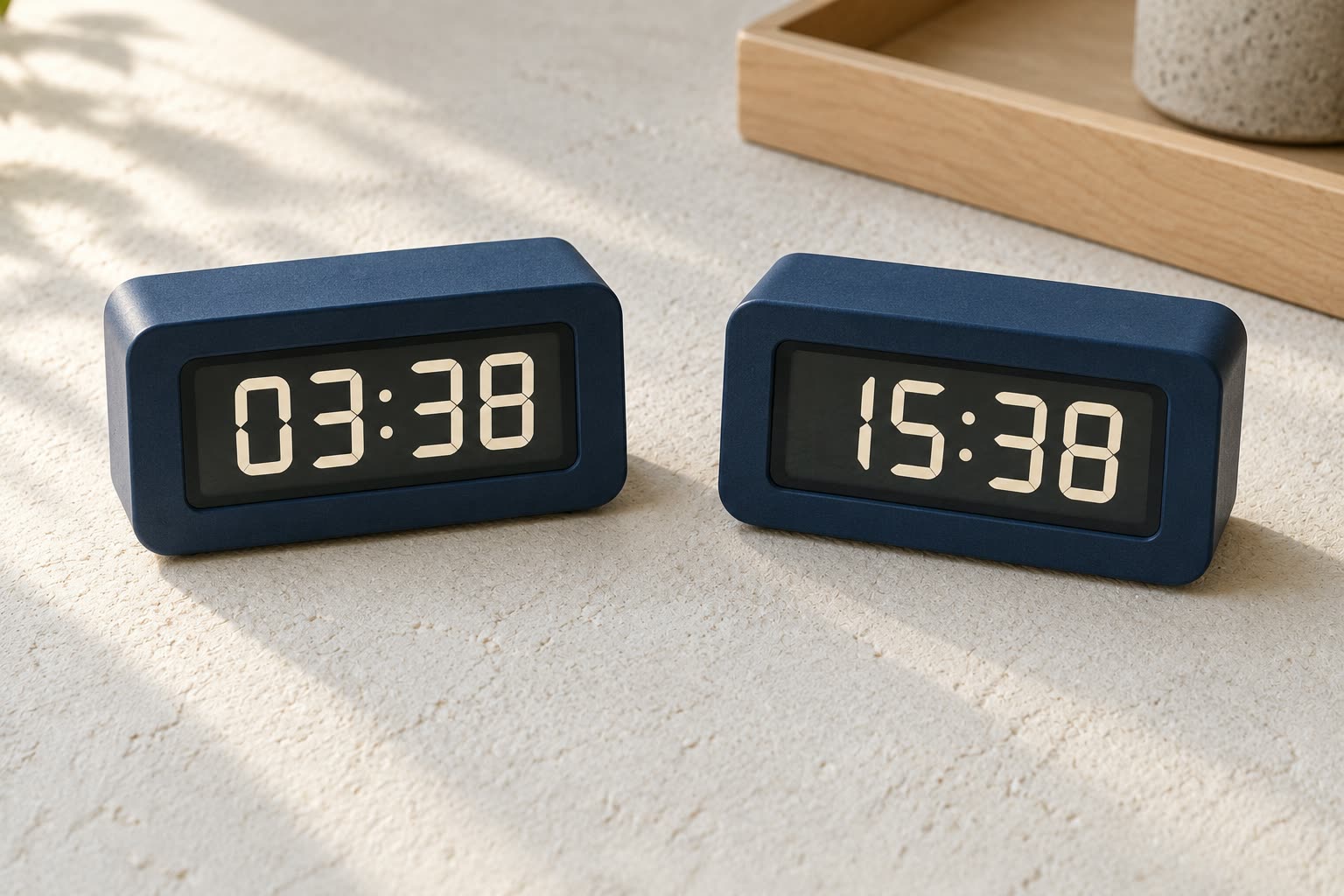
A room numbered 38, a price of $38 and a clock ending in :38 all contain the same two digits, but they supply different information. A room number identifies a location and a price includes a currency and an amount. A clock includes the hour as well as the minute, so reducing only 38 is a choice to select the minute field.
| Observed input | Digits included | Ordinary reduction |
|---|---|---|
| Standalone 38 | 3 + 8 = 11 | 11 → 2 |
| 03:38 in a 24-hour display | 0 + 3 + 3 + 8 = 14 | 14 → 5 |
| 15:38 in a 24-hour display | 1 + 5 + 3 + 8 = 17 | 17 → 8 |
| 3:38 PM in a 12-hour display | 3 + 3 + 8 = 14 | 14 → 5;PM is separate time context |
The last two rows can represent the same moment on different display settings. Changing 15:38 to 3:38 PM changes the printed digits, so a method that adds those digits reaches a different root without changing the time itself. Neither root demonstrates that the moment has acquired a different future meaning.
Repeated sightings raise a separate question about attention. The APA Dictionary of Psychology describes selective attention as attending to some stimuli rather than others; a number that has become significant to you may therefore be more noticeable. That explanation does not measure how often 38 actually appears, and it cannot prove the cause of a particular sighting.
A number journal can preserve the original display, the unit and the occasion, including whether several sightings came from the same clock or repeated daily routine. That record distinguishes separate observations from repeated exposure to one setting. It still does not turn a larger tally into evidence that money, a partner or a prescribed life sequence is on the way.
Frequently Asked Questions
Is 38 itself a master number?
No. The starting numeral is 38, its digit sum is 11, and full reduction gives 2. Walmsley and Andrews retain 11 in their angel-number readings, but a sighting does not establish master-number status in a birth-date or name chart.
Why do I keep seeing 38?
Selective attention can make a number you care about more noticeable, and a daily setting can expose you to the same display repeatedly. Without a record of where and when it appeared, the sightings do not establish its actual frequency or cause, and they cannot confirm a future event.
How is 38 different from 83?
They have different decimal values: 30 + 8 and 80 + 3. Both digit sums equal 11 and both ordinary roots equal 2; that shared arithmetic does not establish a speech-first or resources-first life sequence.
Does John 5 say the man waited at Bethesda for 38 years?
John 5:5 states that the man's illness had lasted thirty-eight years. It does not state that he spent that entire period at the pool. The angel-and-water explanation also differs between the KJV text and the NIV's some-manuscripts footnote.
Sources
- (n.d.). Master Numbers 11, 22, 33. World Numerology. Link
- (2011). Angel Number 38 (posted July 2, 2011). Sacred Scribes Angel Numbers. Link
- (2023). Angel Number 38: The Lantern You Did Not Ask For (updated May 21, 2026). Numerologist.com. Link
- (n.d.). 38 Angel Number Meaning. Astrology.com. Link
- (1926). Cheiro's Book of Numbers: the compound-number entries for 29 and 38. Herbert Jenkins, London; scanned text at Internet Archive. Link
- (1611). Deuteronomy 2:14. BibleGateway. Link
- (1611). John 5:1-9. BibleGateway. Link
- (2011). John 5:1-9, with the footnote on verses 3b-4. BibleGateway. Link
- (1888). Tractates on the Gospel of John, Tractate 17 (John 5:1-18). Nicene and Post-Nicene Fathers, First Series, vol. 7; New Advent. Link
- (n.d.). Selective attention. APA Dictionary of Psychology. Link
About Our Editorial Process
Every KnowTheAngels guide separates calculation method, tradition context, and personal reflection. We cite where interpretations come from, present more than one view, and never present symbolic reading as prediction.
Read our editorial policy