What Does Angel Number 89 Mean When a Major Chapter Is Closing?
Why 89 returns to 8 through 17, where the chapter-closing reading comes from in Doreen Virtue's and Joanne Walmsley's lists, what the chain of endings means for work, money and love, and Psalm 89
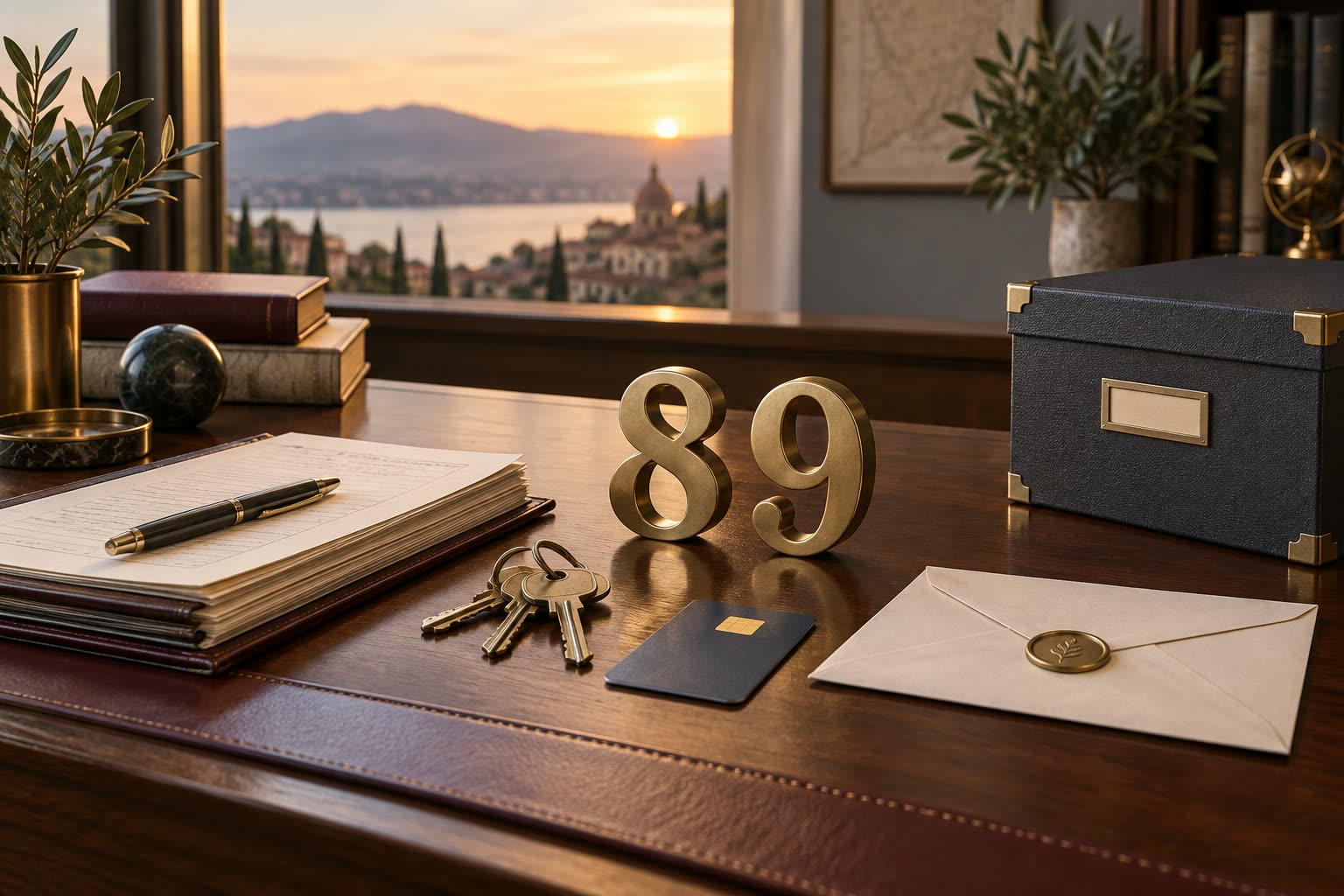
Angel-number writers treat 89 as the close of a material chapter: a job, business, contract, debt or shared household that is finishing while its money and obligations are still open. The reading pairs 8, which Numerology.com calls "the achiever", with 9, the digit of completion, and the sum 8 + 9 = 17 reduces to 1 + 7 = 8, so the arithmetic ends back on the material digit.
The ending itself comes from the angel-number lists. Doreen Virtue's Healing with the Angels (1999) says that a mix of 8s and 9s means a significant phase "has come to an end, bringing with it other events that will also end in a domino effect", and Joanne Walmsley's 2011 entry for 89 repeats the chain reaction while promising success to readers who turn to service-based work. Neither source says which chapter is meant, so the usable part of 89 is the chain: when one arrangement ends, which others end with it.
Quick Facts
- Reduction
- 8 + 9 = 17, then 1 + 7 = 8
- Why it returns to 8
- Adding 9 never changes a digital root
- 8 in numerology
- "The achiever" (Numerology.com)
- 9 in numerology
- "Completion, but not finality" (Numerology.com)
- Angel-number reading
- Endings that follow one another in a domino effect (Virtue 1999; Walmsley 2011)
- In the Bible
- Psalm 89 closes Book III of the Psalms; it is Psalm 88 in the Septuagint and Vulgate
Why does 8 + 9 = 17 land back on 8?
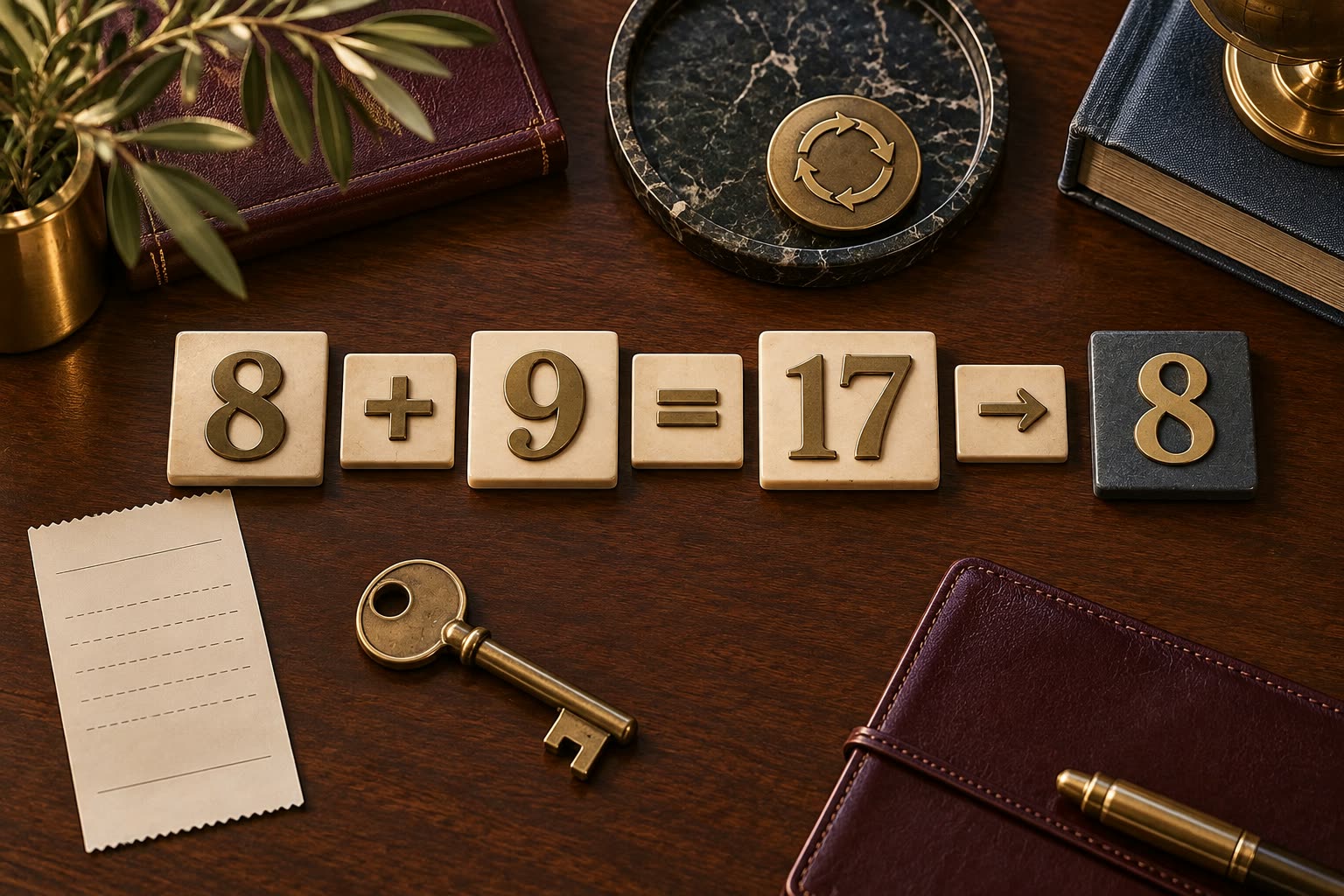
Eight plus nine is 17, and one plus seven is 8. The return is not peculiar to 89. A digital root is the remainder left after dividing by 9, so adding 9 to a number leaves its root unchanged, and every two-digit number ending in 9 reduces to its first digit; 69 comes back to 6 by the same rule.
The digits still give the return its meaning. Numerology.com describes the 8 as "the achiever" that "measures life by the goals it reaches", with "good business sense" and "a strong drive for success". It describes the 9 as "completion, but not finality", the close of one cycle that makes room for the next. A reading that ends on 8 rather than 9 stays with the achievement, the money and the authority after the cycle has closed, which is where the idea of an ending with open accounts comes from.
The middle total has a reading of its own on some sites. Numerologist.com treats 17 as the Star, trump XVII of the tarot, and reads 89 as a retrospective in which a person finally sees the pattern in years of work. That reading rests on the tarot correspondence rather than the sum, and 17 is not among Hans Decoz's karmic debt numbers, which are 13, 14, 16 and 19.
| Layer | Calculation | Source of the meaning |
|---|---|---|
| First digit | 8 | Numerology.com: achievement, business sense and success |
| Second digit | 9 | Numerology.com: a completion that opens another cycle |
| Compound | 8 + 9 = 17 | Numerologist.com: the Star, trump XVII of the tarot |
| Root | 1 + 7 = 8 | The material digit again, after the ending |
Where did the domino-effect reading of 89 begin?
It starts with Doreen Virtue. Her list of number sequences in Healing with the Angels (1999) has no entry for 89 on its own, but it groups every sequence that mixes 8s and 9s, such as 889 or 899, under one message: a significant phase "has come to an end, bringing with it other events that will also end in a domino effect." She compares it to a train at the end of the line, where "one car will stop while the following train cars will take a moment to slow down before stopping."
Joanne Walmsley's Sacred Scribes entry for 89, dated 15 July 2011, carries the same idea: an ending "may set off a chain-reaction with other related and unrelated situations or issues also drawing to a close". She adds two things Virtue does not say. The angels support the reader's "Divine life mission", and anyone thinking of starting or expanding "a spiritually-based practice, profession and/or career or service-based project" is told they "will find success".
The two layers point in different directions. Numerology keeps 89 on money and achievement, while Walmsley's promise turns it toward service and vocation. Both are interpretations. The train image is the part that describes something a reader can look for, because a real ending, such as leaving a job or selling a house, closes several arrangements that do not all stop on the same day.
What does 89 mean for a career or project ending?
Read through Virtue's train, the end of a job is the first car to stop. The last working day can arrive while the cars behind it are still moving: final pay and unused leave, pension paperwork, a notice period or a non-compete clause, shared files and logins, and clients or colleagues who still expect answers. The return to 8 singles out the cars with money and authority attached.
A handover is where most of those cars stop. The successor needs the open decisions, the recurring deadlines, the known risks and working access to systems before the final date, and the departing person's permissions end on that date. Help offered after leaving holds up better with a set period, a channel and, where it amounts to real work, payment, since open-ended availability keeps one car moving indefinitely.

Walmsley's promise of success concerns the next venture, and specifically a spiritual or service-based one. It cannot show whether a career change is sound; the terms of employment, savings, demand for the work and the reader's health decide that.
What does 89 mean for money and closing an account?
Walmsley lists "manifesting wealth, abundance and prosperity" among the traits of the 8, and many later pages turn that into a promise that 89 brings money at the end of a chapter. Her entry for 89 promises only that "your needs will be met" during the change, and neither she nor Virtue names an amount or a date.
The train image fits money closely, because accounts seldom stop on the day an arrangement ends. After a balance first shows zero, pending card charges, automatic renewals, refunds, payroll corrections, deposits and annual tax forms can still arrive, and a paid-off loan may leave a lien or security interest that has to be released in writing. The final statement and the written release, each dated, are the evidence that an account has closed, and a sighting of 89 adds nothing to them.

In love, does 89 predict a breakup or only the paperwork after one?
Neither Virtue's nor Walmsley's entry mentions romance, twin flames or reunion. Love readings of 89 apply the chain of endings to a relationship, which describes a separation without predicting one: a phase can end because a couple moves, a caring role finishes or a shared debt is paid off, while the relationship continues.
When a relationship does end, the 8 names what keeps moving after the emotional decision: a shared lease or mortgage, joint accounts, pets, childcare, cloud folders and account-recovery settings. Where children or debt remain shared, the arrangement changes form instead of stopping, and written schedules and payment methods reduce what has to be renegotiated at emotional moments.

Is 89 a biblical angel number?
No verse gives 89 a meaning, but Psalm 89 is what many readers find when they search the number. Its superscription attributes it to Ethan the Ezrahite. The first 37 verses celebrate God's covenant with David ("I have made a covenant with my chosen, I have sworn unto David my servant", 89:3, KJV), and from verse 38 the psalm turns to lament: "But thou hast cast off and abhorred, thou hast been wroth with thine anointed."
Two facts about the psalm bear on the number. Verse 52, "Blessed be the LORD for evermore. Amen, and Amen", is the doxology that closes Book III of the Psalter, so Psalm 89 does end a section of the book. In the Greek Septuagint and the Latin Vulgate, which number the Psalms differently, it is Psalm 88, so the number 89 comes from the Hebrew-based numbering used in most Protestant and modern Catholic Bibles rather than from the text itself.
Its lament over a promise that seems broken gives a reader a biblical text to sit with during a painful ending. The connection between the psalm and a sighting of 89 is the reader's own, since the psalm says nothing about number sequences.
Why does 89 keep appearing during a resignation or a house sale?
An ending in progress gives any number linked to it extra weight. In the APA's definition, selective attention is concentration on some stimuli to the exclusion of others, and once 89 is tied to a closing chapter, the sightings during a resignation week or a house sale are remembered while those on ordinary days are not. The number is common enough to meet often, on prices, page numbers and dates such as 1989.
A short record separates the pattern from the attention: where each 89 appeared, which ending was on the reader's mind, and the days it did not appear. If the number starts to feel like a verdict that something must end, the decision goes back to the contracts, accounts and people involved.
Is 98 the same as 89, and where do 88 and 90 differ?
| Number | Sum and root | What the structure describes |
|---|---|---|
| 89 | 8 + 9 = 17, root 8 | A material chapter closing, with endings in a chain |
| 98 | 9 + 8 = 17, root 8 | The same digits and root, with the ending first |
| 88 | 8 + 8 = 16, root 7 | Doubled 8 ending on the analytical 7; 16 is a karmic debt number for Decoz |
| 90 | 9 + 0 = 9 | Completion with no return to 8 |
| 8 | Single digit | Achievement and authority without the passage through 9 |
Order is all that separates 89 from 98 in the arithmetic, since both pass through 17 to 8, and Virtue's entry for 8s and 9s treats them alike. Readers who take the first digit as the starting point read 89 as a material position moving into an ending and 98 as an ending that leads into a new material responsibility.
Changing the second digit to 8 gives 88, whose two 8s add to 16 and reduce to 7, which Numerology.com describes as an analytical, research-minded number, while 89's 9 closes a cycle and its root returns to 8. Ninety has the 9 without an 8 to return to, so its reading stays with completion.
Frequently Asked Questions
Does 89 mean something will end soon?
It cannot show that. Virtue and Walmsley both describe an ending in their entries, but neither offers a way to tell which part of a reader's life is meant or when it will happen.
Does 89 mean a new career will succeed?
Walmsley's 2011 entry says a spiritually based or service-based venture will succeed, and gives no evidence for it. Whether a new venture works depends on its finances, demand and terms, which a number cannot report.
Sources
- (2011). Angel Number 89. Sacred Scribes, posted July 15, 2011. Link
- (2008). Number Sequences from the Angels. Spirit Library, posted August 18, 2008, excerpt from Healing with the Angels (entries for 111, 666, 6's and 9's, 8's and 9's). Link
- (1999). Healing with the Angels: How the Angels Can Assist You in Every Area of Your Life. Hay House, Carlsbad, CA, 1999 (ISBN 1-56170-640-X); Open Library record. Link
- (n.d.). Number 8 Meaning in Numerology. Numerology.com. Link
- (n.d.). Number 7 Meaning in Numerology. Numerology.com (the 7 as an analytical number). Link
- (n.d.). Number 9 Meaning in Numerology. Numerology.com (completion and the weakness of self-sacrifice). Link
- (n.d.). Angel Number 89: The Rhythm That Passed Under the Star. Numerologist.com (the 17 read through the Star card). Link
- (n.d.). Karmic Debt Numbers. World Numerology (13, 14, 16 and 19). Link
- (2026). Digital root. Wikipedia (the root as the remainder on division by 9). Link
- (2018). Selective attention. APA Dictionary of Psychology. Link
- (1611). Psalm 89. Bible Gateway. Link
- . Psalm 89: A Lament over God's Promise to David. New American Bible, Revised Edition. Link
- (2026). Psalm 89. Wikipedia (Ethan the Ezrahite; doxology closing Book III; Psalm 88 in the Septuagint and Vulgate). Link
About Our Editorial Process
Every KnowTheAngels guide separates calculation method, tradition context, and personal reflection. We cite where interpretations come from, present more than one view, and never present symbolic reading as prediction.
Read our editorial policy