What Does Angel Number 17 Mean Across Conflicting Traditions?
The root 8, Italy's XVII and VIXI, the Star card, and Augustine's explanation of the 153 fish
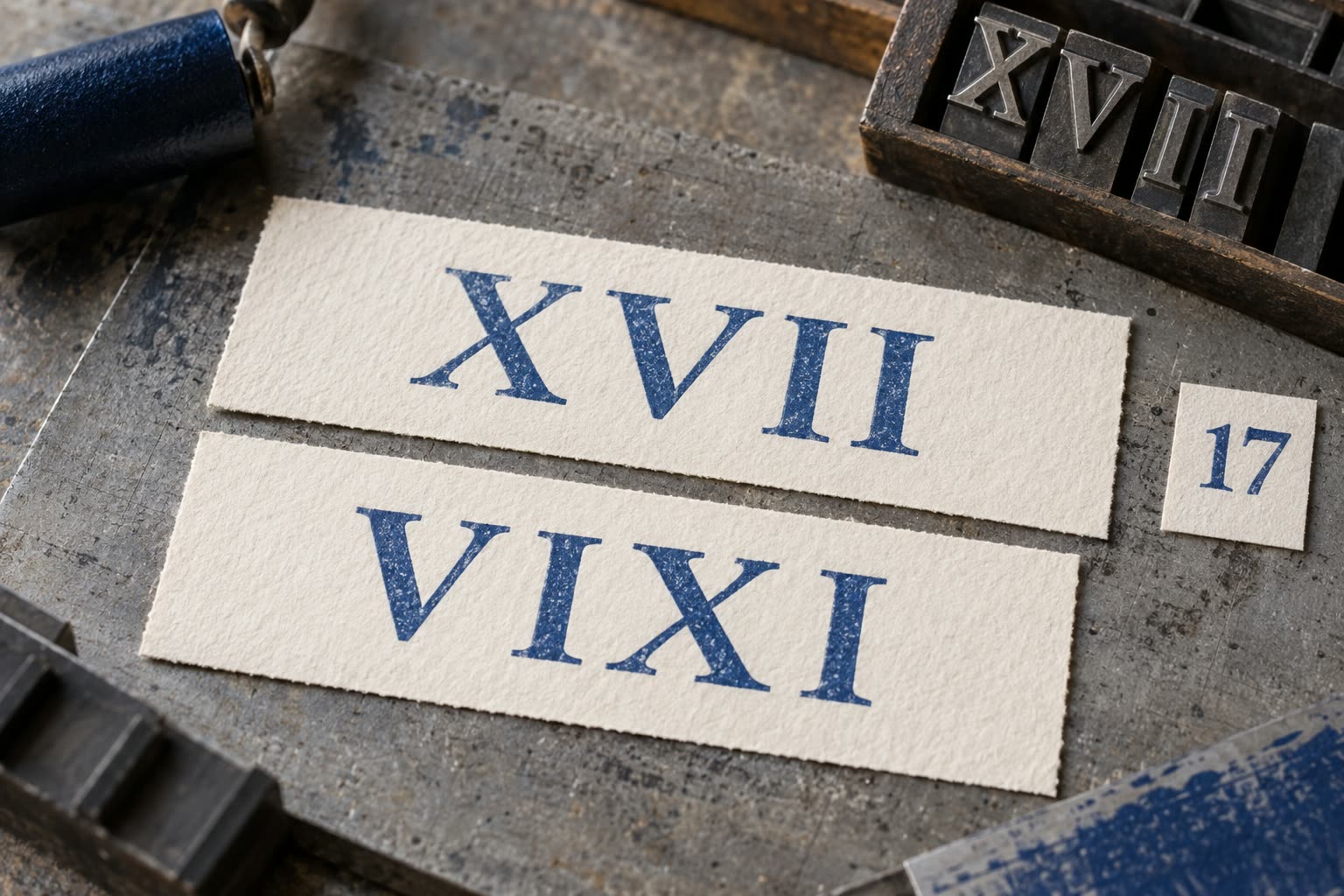
Angel number 17 reduces to 8 through 1 + 7, but its reputation changes with the tradition. Cheiro describes a fortunate star, Italian superstition connects XVII with the Latin word VIXI, and tarot assigns XVII to the Star.
These associations come from different operations: adding digits, rearranging letters and numbering a card. The biblical question adds another distinction, because Genesis records dates involving seventeen while Augustine uses seventeen to explain the 153 fish in John.
Quick Facts
- Decimal root of seventeen
- 1 + 7 = 8
- Italian letter association
- XVII rearranges into VIXI, Latin for 'I have lived'
- Waite's seventeenth trump
- The Star, with one large star and seven smaller stars
- Cheiro's compound title
- The Star of the Magi
- Augustine's calculation
- 1 + 2 + ... + 17 = 153
- Full 17:17 timestamp
- 1 + 7 + 1 + 7 = 16; 1 + 6 = 7
Is 17 lucky or unlucky? Three traditions give different answers
Seventeen has an unlucky reputation in Italian superstition through its Roman spelling, XVII.
Rearranging those letters produces VIXI, Latin for 'I have lived', which the customary explanation connects with a life already ended.
This is a word association, not a property of seventeen's digit sum. Clare Speak's account of the Italian Friday-the-seventeenth tradition documents the custom; it does not show that the date causes misfortune.
Plutarch gives a different explanation in Isis and Osiris, chapter 42. He reports that Osiris died on the seventeenth and that the Pythagoreans disliked seventeen because it stood between sixteen and eighteen.
His geometric comparison concerns a square with sides of four and a rectangle with sides of three and six. In each, the numerical area equals the numerical perimeter when the side lengths use the chosen unit.
| Figure | Area in square units | Perimeter in units |
|---|---|---|
| 4 by 4 square | 4 × 4 = 16 | 4 + 4 + 4 + 4 = 16 |
| 3 by 6 rectangle | 3 × 6 = 18 | 3 + 6 + 3 + 6 = 18 |
Seventeen interrupts the sequence between those two equal numerical results. Area and perimeter still measure different things, so their matching numbers explain the particular geometric symbolism rather than a physical equality.
Cheiro's 1926 compound-number entry takes the opposite position. He calls 17 the 'Star of the Magi' and describes an eight-pointed star associated with Venus, peace and love.
His fortunate interpretation includes a condition: seventeen is favorable if it is not associated with the single numbers 4 and 8.
That condition belongs to Cheiro's scheme, not to the decimal reduction that necessarily gives 17 the root 8.
The disagreement therefore survives even when the arithmetic is correct. Latin spelling, Plutarch's account and Cheiro's symbolism provide different reasons for their judgments, rather than evidence for one universal lucky or unlucky number.
How do 1, 7 and 8 contribute to the numerology of 17?
Adding the digits of seventeen produces eight in one step. In the Pythagorean numerology presented by Hans Decoz, the digit profiles supply themes with which a writer may interpret that result.
| Numerical element | Attributed theme | What the operation establishes |
|---|---|---|
| 1 | Self-direction and leadership | The first digit of 17 |
| 7 | Analysis, inward study and solitude | The second digit of 17 |
| 1 + 7 = 8 | Management, business and material achievement | The reduced total is 8 |
These profiles allow a symbolic comparison between initiative, analysis and management. They do not establish that initiative happens first, private study happens next and authority follows afterward.
Reversing the compound produces 71, whose digits also total eight. Addition preserves the total when the order changes, so a different reading of angel number 71 would need an additional interpretive rule.
The shared root connects seventeen with angel number 8, but it does not make their visible forms identical.
Decoz's Life Path 7 profile concerns a result calculated from a birth date.
Borrowing its analytical vocabulary for a sighted seventeen is an interpretation, not evidence that the sighting reveals someone's Life Path.
The distinction matters when descriptions start sounding personal. A root calculation can be checked from the printed digits; a claim about someone's character or circumstances requires information the calculation does not contain.
What does tarot's Star XVII add to the meaning of 17?
In A. E. Waite's The Pictorial Key to the Tarot, XVII identifies the Star in the numbered trump sequence. Waite describes one large eight-rayed star above a figure pouring water, with seven smaller stars around it.
The figure pours from two vessels, one toward water and one toward land. Waite relates the scene to spiritual gifts and freely flowing life, so the card's meaning comes from its described imagery and interpretation.
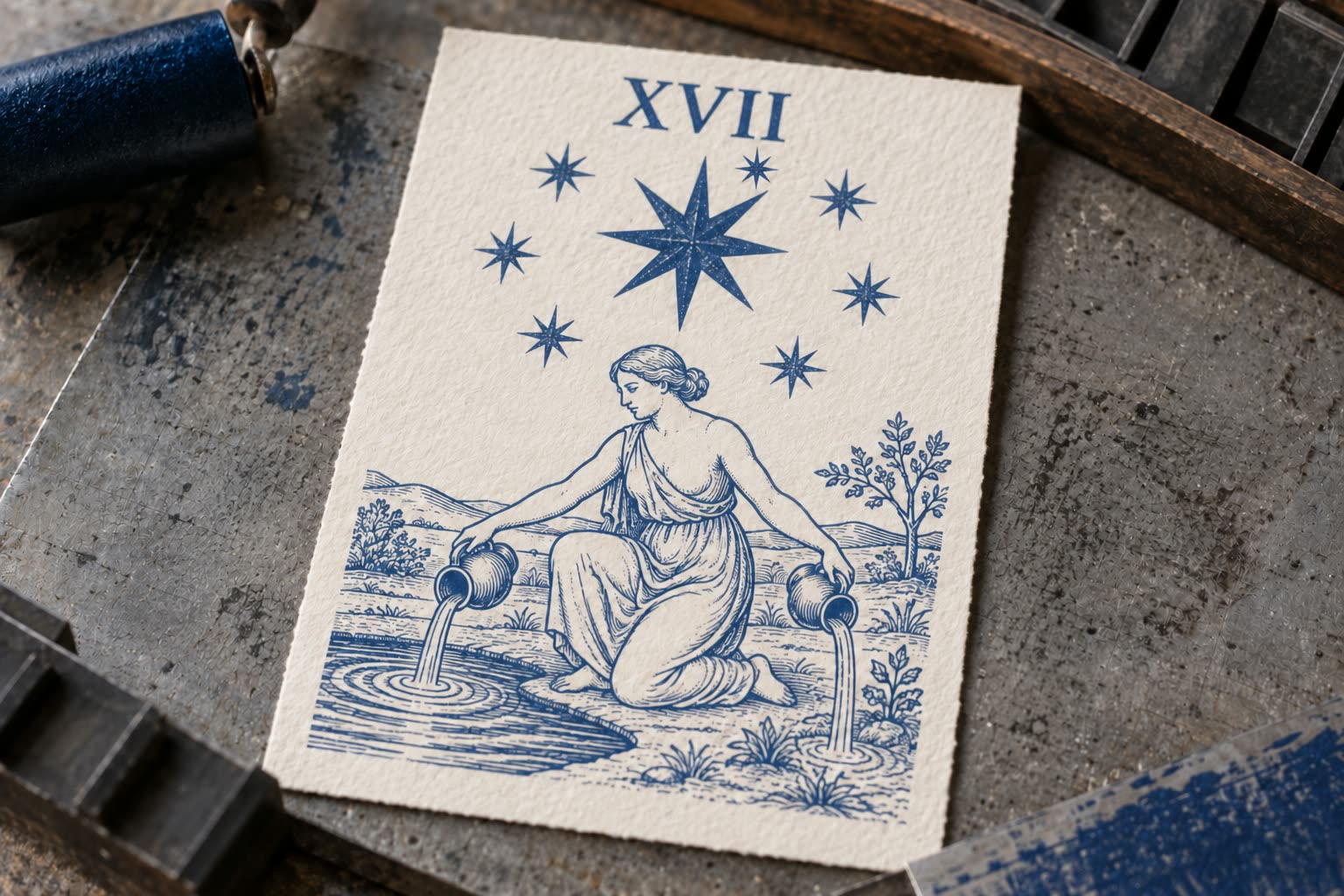
Cheiro's compound 17 also uses a star, but his eight-pointed Star of the Magi and Venus association are not the whole of Waite's card. A shared star subject does not by itself establish that either author copied the other.
The neighboring trumps are the Tower XVI and the Moon XVIII.
Their numbering locates the Star between those cards, but a seventeen on a bill does not establish that someone has passed through a Tower event or is approaching a Moon event.
A tarot reading also involves a card and a reading context. Recognizing XVII as the Star explains the historical association without converting every printed 17 into a drawn card.
What does 17 mean in the Bible and Augustine's 153 fish?
Genesis uses seventeen in two dates within the flood narrative. Genesis 7:11 places the beginning of the flood on the seventeenth day of the second month in Noah's six-hundredth year.
| Passage | Date given | Event described |
|---|---|---|
| Genesis 7:11 | Second month, seventeenth day | The flood begins |
| Genesis 8:4 | Seventh month, seventeenth day | The ark rests on the mountains of Ararat |
The resting of the ark is not the end of the entire flood account. Treating both dates as a universal sign of victory would replace the narrative's different events with a later symbolic rule.
Augustine makes an explicit interpretive use of seventeen in Tractate 122, section 8, on John's Gospel. He combines ten, associated with the commandments, and seven, associated with the Spirit, to obtain seventeen.
He then connects that seventeen with the 153 fish counted in John 21:11. The arithmetic is a triangular sum: adding every positive whole number from one through seventeen gives 153.
The result can be checked without adding seventeen separate terms. Pairing 1 with 17, 2 with 16 and so on produces eight pairs worth 18 each, leaving 9 in the middle: 8 × 18 + 9 = 153.
That calculation is different from seventeen's digit reduction to eight. It takes the sum of a series ending at seventeen, rather than the sum of the digits in seventeen.
Augustine's commandments-and-Spirit explanation is a Christian theological reading of the fish count.
John supplies the count of 153; the connection through seventeen belongs to Augustine's commentary.
Love and career: what can the interpretations of 17 actually support?
Cheiro's association of seventeen with peace and love provides a named source for a favorable relationship reading. It does not identify a partner, disclose an unspoken decision or establish that affection is reciprocated.
The analytical theme borrowed from Decoz's seven can describe reflection within a relationship. Reflection is not the same as agreement: in a hypothetical discussion about moving together, one person's carefully considered preference still leaves the other person's preference unknown.
Calling that relationship a twin-flame connection adds a spiritual description. Neither the star image nor 1 + 7 = 8 establishes another person's consent or a reunion date.
For career and money, the relevant modern association is Decoz's eight: management, business and material achievement.
His Life Path 8 profile supplies that vocabulary within a birth-date system, not a forecast attached to a receipt.
A hypothetical researcher offered a management role illustrates how analysis and administration can meet. The job involves additional responsibilities because of the role's actual duties, not because the digits of seventeen show that private knowledge must become authority.
Cheiro's favorable compound reading also cannot be simplified into '17 guarantees wealth'. Its condition concerning 4 and 8 remains part of the attributed claim, even though modern root-eight descriptions often sound positive about achievement.
An offer, an agreed salary and a received payment establish different facts.
A seventeen associated with any one of them supplies no evidence for the other two.
Why do I keep seeing 17, especially on clocks?
A clock produces seventeen repeatedly by its own counting rules. On a 24-hour display, every minute of the 17th hour contains 17, and minute :17 appears during every hour.
| Display convention | Count within a full day | How the count is obtained |
|---|---|---|
| 24-hour HH:MM | 83 | 60 states in hour 17, plus 24 states at :17, minus the shared 17:17 |
| 12-hour display | 24 | The minute :17 appears once in each of the day's 24 hours |
These are possible display states, not eighty-three actual sightings by one person.
Someone who rarely looks at a clock during the late afternoon will encounter a different subset.
The whole timestamp 17:17 also has a different root from a lone seventeen. Its four digits add to sixteen and then seven, whereas 1 + 7 alone gives eight.
Arnold Zwicky's account of the frequency illusion describes heightened noticing followed by an impression that the noticed item has become unusually common. Ben Zimmer's discussion traces the term to Zwicky's 2005 description.
A number journal can preserve the setting of a sighting, including whether it was a clock minute, calendar date or unrelated identifier. Assessing frequency would also require the occasions when seventeen was absent and the other numbers available to notice.
A remembered cluster may therefore involve both repeated opportunities and selective attention. That explanation does not settle a personal spiritual interpretation, but it separates the observed appearances from the meaning assigned afterward.
Frequently Asked Questions
Is seventeen always considered lucky?
No, Cheiro gives 17 a favorable compound interpretation with a condition concerning 4 and 8, while Italian superstition connects XVII with VIXI and an unlucky reputation. These are different traditions, not a demonstrated effect of the number.
Does angel number 17 prove that someone loves me?
Cheiro's peace-and-love association does not establish a particular person's feelings. The number supplies no statement from that person and no evidence of mutual agreement.
Are 17 and 71 interchangeable in numerology?
They share the root 8 because 1 + 7 and 7 + 1 have the same sum. Their visible order differs, but arithmetic alone does not turn that reversal into a reversed sequence of events.
Does seventeen have the same meaning as the 153 fish?
Augustine connects them by adding 1 through 17 to obtain 153 in his commentary on John 21:11. That is a particular theological explanation, rather than a claim that every biblical seventeen means the fish count.
Sources
- . Life Path Number meanings (1, 7, 8). World Numerology. Link
- (1910). The Pictorial Key to the Tarot, Part II, XVII: The Star. William Rider & Son. Link
- (1926). Cheiro's Book of Numbers, Chapter XIII, compound number 17, pp. 80-81. Herbert Jenkins. Link
- (2024). Why Italians fear Friday 17th, with some even taking a day off work. The Local Italy. Link
- (1936). Isis and Osiris, chapter 42 (Moralia, Loeb Classical Library). LacusCurtius. Link
- (c. 420). Tractates on the Gospel of John, Tractate 122, section 8. New Advent. Link
- . The flood narrative (New Revised Standard Version). Bible Gateway. Link
- (2019). "Frequency illusion" in the OED (on Arnold Zwicky's 2005 coinage). Language Log. Link
About Our Editorial Process
Every KnowTheAngels guide separates calculation method, tradition context, and personal reflection. We cite where interpretations come from, present more than one view, and never present symbolic reading as prediction.
Read our editorial policy