What Does Seeing 19:19 Mean for Closure and New Starts?
What Decoz's karmic-debt 19 adds, which angel the mirror-hour lists attach to 19:19, and why each 19 reduces to 1 while the full time reduces to 2
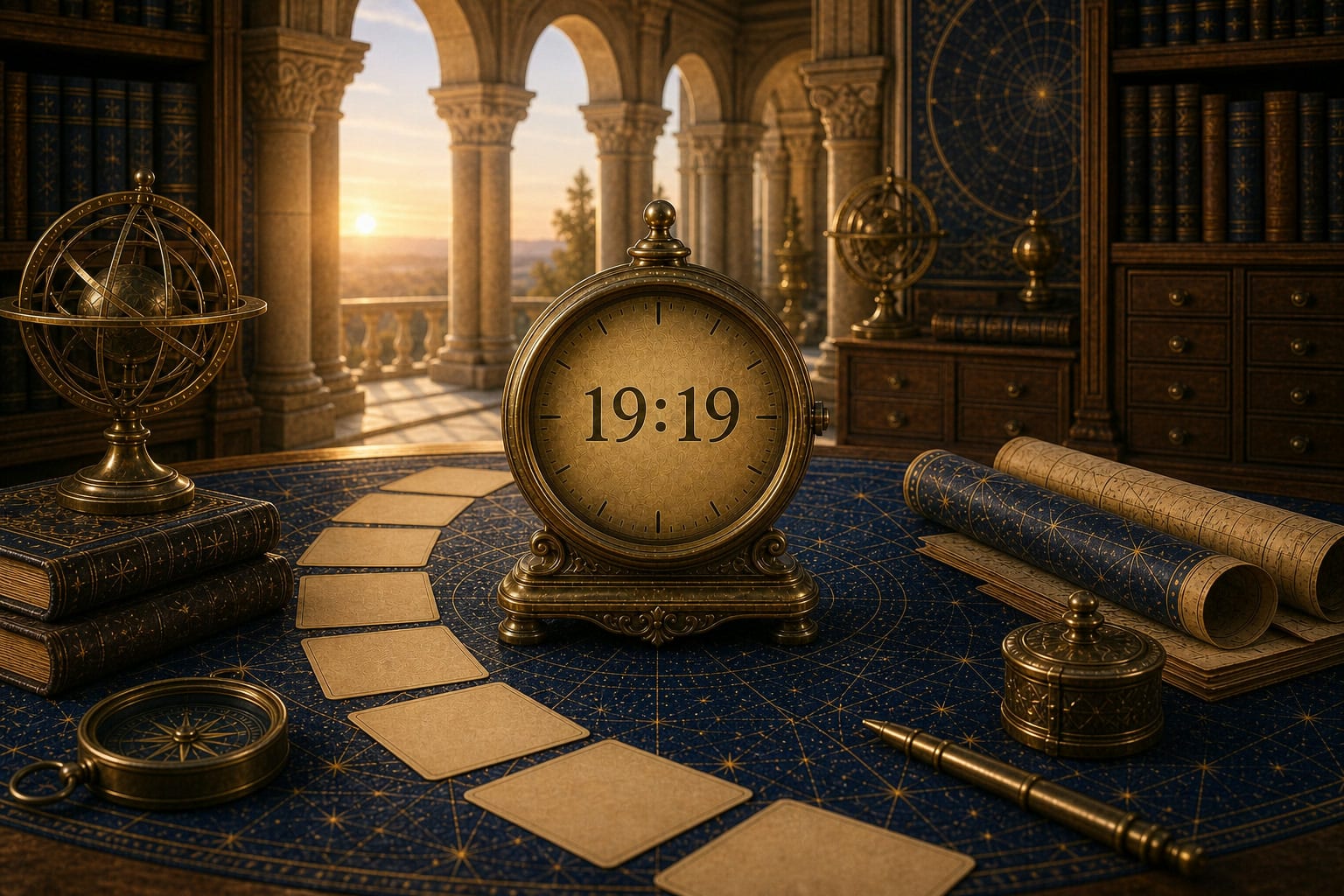
19:19 is a repeated clock time: the same 19 sits on both sides of the colon, and it can only appear on a 24-hour display, since a 12-hour clock shows that minute as 7:19. The closure-and-new-start meaning people give it comes from the digits inside each 19, which pair 9, the last of the single digits, with 1, a number Numerology.com calls a symbol of "new beginnings".
The full time adds a second layer. All four digits total 20, which reduces to 2, the number Numerology.com ties to partnership. A 19:19 reading therefore carries a built-in tension: each half favors starting over on your own terms, while the whole time favors bringing someone else in.
Quick Facts
- Display
- 24-hour clocks only; a 12-hour clock shows 7:19 p.m.
- Each half
- 19: 1 + 9 = 10, then 1 + 0 = 1
- Full display
- 1 + 9 + 1 + 9 = 20, then 2 + 0 = 2
- Karmic debt
- 19 is one of Hans Decoz's four: 13, 14, 16 and 19
- Mirror-hour angel
- Yeialel (UCM, Astrofame) or Leuviah (Signifika)
- Tarot card
- XIX, The Sun
How does 19 pass through 10 to become a number of closure and restart?
The reading rests on how a single 19 reduces. It takes two steps: 1 + 9 = 10, then 1 + 0 = 1. Numerology.com describes the 9 as "the ending of one cycle and the potential it creates for another cycle to begin", and in 19 that 9 carries the count past ten and back to 1. The digit that closes a cycle is the one that restarts the count, which is the whole of the closure-and-new-start idea in numerical form.
The fresh start is a solitary one. Numerology.com describes the 1 as a number that shoves "softer energies of cooperation and patience" aside for the sake of movement. It describes the 2, the root of the full time, as the number of partnership and mediation. A reading that reports only the 1 turns 19:19 into a call to go it alone, and one that reports only the 2 drops the fresh start that each half describes.
One, two, or master number 11: which root does 19:19 have?
Each sum gives a different answer. Each half on its own gives 1. The full time adds all four digits: 1 + 9 + 1 + 9 = 20, then 2 + 0 = 2. Some mirror-hour writers add the hour and minute as whole numbers instead; Astrofame does this for 20:20, writing 20 + 20 = 40. Applied to 19:19, that route gives 19 + 19 = 38, then 3 + 8 = 11, then 1 + 1 = 2.
The second and third routes agree on 2, but only the third passes through 11, which Numerology.com lists as a master number, one of the exceptions it allows to the rule of reducing to a single digit. A numerologist who keeps master numbers and adds hour and minute as whole numbers would therefore stop at 11 rather than 2.
| Route | Working | Result |
|---|---|---|
| Each half on its own | 1 + 9 = 10, then 1 + 0 = 1 | 1, twice |
| All four digits | 1 + 9 + 1 + 9 = 20, then 2 + 0 = 2 | 2 |
| Hour plus minute | 19 + 19 = 38, then 3 + 8 = 11, then 1 + 1 = 2 | 2, by way of 11 |
Why do mirror-hour sites read 19:19 as good news for love?
The cheerful tone comes from tarot, not numerology. Card XIX of the Major Arcana is The Sun, and in A. E. Waite's 1910 Pictorial Key to the Tarot its divinatory meaning is "Material happiness, fortunate marriage, contentment." Astrofame and Signifika both pair 19:19 with The Sun; Astrofame titles its entry "the mirror hour of success and light" and calls 19:19 "a radiant period" in love, a time for deepening a bond.
Twin-flame readings come only from mirror-hour sites such as Signifika, which gives 19:19 a twin-flame section; none of the numerology or tarot sources behind these layers mentions twin flames.
The numerology gives a plainer relationship question. If a relationship has just ended, the two 1s fit the work of starting again alone; if one is beginning, the full-time 2 asks whether both people are actually cooperating. The time on a screen cannot show what another person feels or plans.
Yeialel or Leuviah: which angel belongs to 19:19?
Two angels, because the sites pick from the list of 72 angels they take from Kabbalistic tradition in two different ways. The first method divides the day into 72 windows of 20 minutes. The angel calendar published by Kaya and Christiane Muller's UCM school gives Yeialel, the 58th angel, the window 19h00 to 19h19, so 19:19 is the last minute of it, and Astrofame's 19:19 entry names Yeialel on the same basis.
The second method matches the hour to the angel's place in the list. Signifika's 19:19 page names Leuviah, "the 19th angel of the Kabbalistic tradition". Under the 20-minute schedule, UCM places Leuviah at 6h00 to 6h19 in the morning, so the two methods give different angels for the same minute.
| Method | Angel for 19:19 | Who uses it |
|---|---|---|
| Each angel rules a 20-minute window | Yeialel, 58th angel (window 19h00 to 19h19) | UCM angel calendar; Astrofame |
| Angel number matches the hour | Leuviah, 19th angel | Signifika |
Even the two sources that agree on Yeialel describe it differently. UCM calls it "the Angel of mental strength and high levels of intelligence" and lists concentration and patience among its qualities; Astrofame calls it "the angel of optimism and patience". Anyone using the angel layer has to choose a publisher's system first, because the minute alone does not settle it.
Does Decoz's karmic-debt lesson of standing alone apply to 19:19?
In the system taught by Hans Decoz, 19 is one of four karmic debt numbers, alongside 13, 14 and 16. Decoz writes that a person with the 19 debt "will learn independence and the proper use of power", is often "left standing alone", and tends to resist help. The lesson he draws is that such a person is "inextricably connected to others" and needs their support.
Decoz applies karmic debt to the core numbers of a birth chart, such as the Life Path, Expression and Birth Day, not to numbers met during the day. A 19 on a clock is therefore not a karmic debt placement in his method, and reading 19:19 as a sign of personal karmic debt stretches the method past where its author uses it.
The theme still matches the arithmetic of 19:19 closely. The two 1s are the independence in Decoz's description, and the full-time 2 is the dependence on other people that he calls the most important part of the 19 lesson. Someone whose own chart holds a 19 in a core position can read that description there; the clock only repeats the digits.
What makes 19:19 feel frequent when 19:18 does not?
Repeated sightings of 19:19 need a 24-hour display somewhere in your day: a phone set to that format, a car dashboard, an oven, or a station board. A routine that puts one of those screens in front of you at the same point each evening, such as the train home or the start of a meal, will show you the same minute on many days.
Attention does the rest. In 2005 the linguist Arnold Zwicky named the frequency illusion: "once you've noticed a phenomenon, you think it happens a whole lot, even 'all the time'", because you now register nearly every occurrence. The 19:18s and 19:21s seen on the same evenings leave no memory, so the count in your head is not a fair sample. A week of notes in a number journal, recording when you looked and what had just ended or started, shows whether a routine explains the sightings before any meaning is read into them.
Frequently Asked Questions
What does 19:19 on the clock mean?
In numerology, each 19 reduces to 1, a number linked with new beginnings, and the full time reduces to 2, the number of partnership. The closure-and-new-start reading comes from the 9 and 1 inside each 19; mirror-hour sites add the angel Yeialel or Leuviah and The Sun tarot card.
Why does each 19 reduce to 1 when the full time reduces to 2?
Each 19 is reduced on its own: 1 + 9 = 10, then 1 + 0 = 1. The full timestamp adds all four digits, 1 + 9 + 1 + 9 = 20, and 2 + 0 = 2, so the two sums describe different things: each half, and the display as a whole.
Is 19:19 a good sign?
Mirror-hour sites present it as good news because they pair it with The Sun, which Waite read as "material happiness, fortunate marriage, contentment". Numerology gives no good or bad verdict: the 1 and 2 describe ways of acting, not events that will happen.
Is 19:19 the same as angel number 1919?
Read as a four-digit number, 1919 has the same digit total, 20, and the same root, 2. The clock version adds the 24-hour format and the mirror-hour angel lists, while the standalone angel number 19 guide covers the number outside a clock.
What should I do after seeing 19:19?
Write down the time, what you were doing, and what had recently ended or begun. Then ask which layer fits: the 1, a start you are making on your own, or the 2, a start that depends on someone else.
Which angel is associated with 19:19?
Mirror-hour sites give two answers. The UCM angel calendar and Astrofame name Yeialel, the 58th angel, whose 20-minute window runs from 19h00 to 19h19, while Signifika names Leuviah, the 19th angel, by matching the hour to the angel's place in the list of 72.
Sources
- (2026). Number 1 Meaning in Numerology. Numerology.com. Link
- (2026). Number 9 Meaning in Numerology. Numerology.com. Link
- (2026). Number 2 Meaning in Numerology. Numerology.com. Link
- (2026). The Master Numbers of Numerology. Numerology.com. Link
- (2026). Karmic Debt Number 19. World Numerology. Link
- (2026). Karmic Debt Numbers in Numerology. World Numerology (core-number scope of karmic debt). Link
- (2026). Angel 58 Yeialel. UCM angel reference, Angel Calendars: Intellectual Calendar 19h00-19h19. Link
- (2026). Angel 19 Leuviah. UCM angel reference, Angel Calendars: Intellectual Calendar 6h00-6h19. Link
- (2026). 19:19, the mirror hour of success and light. Astrofame. Link
- (2026). 20:20, the mirror hour that calls for patience. Astrofame (hour-plus-minute reduction 20 + 20 = 40). Link
- (2026). Mirror Hour 19:19 Meaning. Signifika. Link
- (1910). The Pictorial Key to the Tarot. William Rider & Son; Part III, section 3, card 19, The Sun. Link
- (2005). Just between Dr. Language and I. Language Log, August 7, 2005 (the Frequency Illusion). Link
About Our Editorial Process
Every KnowTheAngels guide separates calculation method, tradition context, and personal reflection. We cite where interpretations come from, present more than one view, and never present symbolic reading as prediction.
Read our editorial policy