What Does Seeing 20:20 Mean for Patience and Trust?
Where the patience reading of 20:20 comes from, why three different angels are named for it, when waiting should stop, and why each 20 reduces to 2 while the full time totals 4
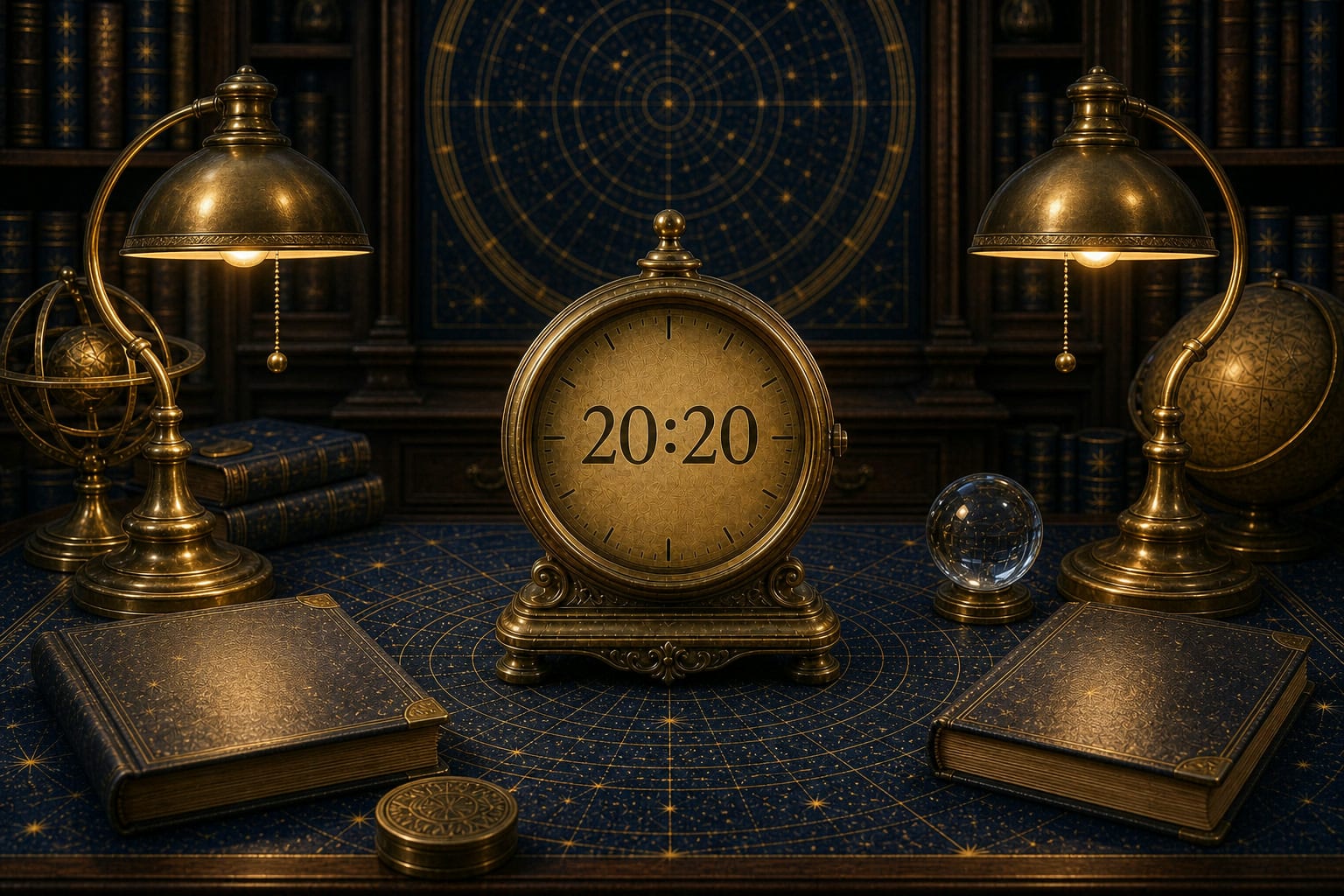
20:20 shows the number 20 on both sides of the colon. In numerology each 20 reduces to 2, because the zero adds nothing, and the four digits together total 4. The patience people link with 20:20 starts from that 2: Hans Decoz describes people with a 2 Life Path as "patient and cooperative", and the mirror-hour site Astrofame calls 20:20 "the mirror hour that calls for patience".
The 4 changes what kind of patience fits. Numerology.com describes 4 through "practicality, hard work, discipline, and responsibility", so the whole-time layer points to waiting that has a structure: an agreed plan, a date to review, or work that carries on while the outcome is pending. The pattern belongs to 24-hour displays; on a 12-hour clock the same minute reads 8:20 and repeats nothing.
Quick Facts
- Display
- 24-hour clocks only; a 12-hour clock shows 8:20 p.m.
- Each half
- 20: 2 + 0 = 2
- Full display
- 2 + 0 + 2 + 0 = 4
- Same roots as
- 11:11, which also gives 2 per half and 4 overall
- Mirror-hour angel
- Umabel, Iahhel or Pahaliah, depending on the publisher
- Tarot card
- XX, Judgement
Why is patience associated with 20:20?
The patience reading has three owners, and each gives patience a different reason. Numerology.com calls the 2 "a mediator, able to see two sides of a situation", which places the patience Decoz describes between people: waiting while someone else answers, agrees, or catches up.
The 4 adds a second kind. Numerology.com lists "Patient" among the traits of the 4, alongside "Organized" and "Dependable", which describes the steady patience of work done one stage at a time.
The mirror-hour layer adds trust. Astrofame ties 20:20 to the angel Umabel and tells the reader to "let go of your pressing desires and learn to trust", then adds that "the change you await will come". That last line is a promise, and neither the 2 nor the 4 supports it. The numerology versions describe patience as cooperation and steady effort, so they keep a person talking and working while they wait; the mirror-hour version describes patience as letting go, which means pushing less.

Why does 20:20 reduce like 11:11 but read differently?
Because zeros add nothing, 20:20 reduces exactly like 11:11: both give 2 on each side and 4 overall. The difference is that 11 is one of the master numbers Numerology.com lists, with 22 and 33, so numerologists who keep master numbers read 11:11 through 11 rather than 2. Twenty has no such exception, so in 20:20 the 2 stands on its own.
| Time | Each half | Full display | What differs |
|---|---|---|---|
| 20:20 | 2 + 0 = 2 | 2 + 0 + 2 + 0 = 4 | Plain 2s, with no master number on the way |
| 11:11 | 11, a master number, or 1 + 1 = 2 | 1 + 1 + 1 + 1 = 4 | Same roots, but 11 is kept by master-number readers |
| 22:22 | 22, a master number, or 2 + 2 = 4 | 2 + 2 + 2 + 2 = 8 | The same digit doubled lands on a different root |
Umabel, Iahhel or Pahaliah: why do mirror-hour lists disagree about 20:20?
Because each site maps the minute to the list of 72 angels it takes from Kabbalistic tradition in its own way, three different names come back for 20:20.
| Angel | How the minute is matched | Who names it |
|---|---|---|
| Umabel, 61st angel | A 20-minute window counted as 20:00 to 20:20, ending on this minute | Astrofame; EP Mundo |
| Iahhel, 62nd angel | A 20-minute window of 20h20 to 20h39, starting on this minute | UCM angel calendar (Kaya and Christiane Muller) |
| Pahaliah, 20th angel | The angel's place in the list matches the number 20 | Signifika |
The first two follow the same schedule and split only at the boundary. UCM's calendar ends Umabel's window at 20h19 and starts Iahhel's at 20h20; Astrofame gives Umabel's period as 8:00 to 8:20 pm and EP Mundo says Umabel exerts "influence between 20:00 and 20:20", so both count the minute that UCM gives to the next angel. Pahaliah comes from a different method altogether, and UCM places its window at 6h20 to 6h39 in the morning.
The message changes with the angel. Astrofame calls Umabel "the angel of detachment and freedom"; UCM calls Iahhel "the Angel of rediscovered knowledge" and links it with introspection and retreat; Signifika links Pahaliah with "redemption, spiritual vocation, and moral strength". Anyone who wants the angel layer has to choose a publisher's schedule first, because the minute alone does not decide it.
When should patience after seeing 20:20 become action?
The tarot card that mirror-hour sites attach to 20:20 pulls the other way from the 2s. Card XX of the Major Arcana is Judgement, which A. E. Waite titled The Last Judgment. Waite's 1910 divinatory meaning is "Change of position, renewal, outcome", and he calls it the card of a transformation made "in answer to the summons of the Supernal": a card about answering a call rather than waiting for one.
Put the layers together and they give a workable test. The 2 supports waiting while another person or process is still responding, the 4 asks for a structure around the wait, and Judgement marks the moment a call is answered. Patience fits while something is still moving and you know when you will look again; action fits once that review date has passed with nothing new, or when a deadline, consent, or a repeated broken promise is involved.
| Situation | Patience fits when | Action fits when |
|---|---|---|
| A job application | The employer gave a decision date that has not arrived | The date has passed without contact, so a follow-up is due |
| A pause in a relationship | Both people agreed when they would talk again | The agreed date came and went, or only one person is waiting |
| A plan or project | Work continues each week while the result is pending | Nothing has moved since the last review |
Love readings of 20:20 follow the same split. Astrofame's love paragraph advises "Press pause to move forward more serenely" and says "The right person is on the way", which is a prediction, while UCM lists marriage and divorce among the situations tied to Iahhel. Neither can show what another person feels. The 2 in 20:20 describes cooperation, and cooperation needs both people taking part.
Why does 20:20 seem to follow you, and is it about 20/20 vision?
Because a 12-hour clock shows this minute as 8:20, a repeated 20:20 means a 24-hour display is part of your routine: a phone set to that format, a car dashboard, a cooker, or a work screen. A habit that puts you in front of that screen at the same point each evening will show you the same minute on many days.
Michael Shermer calls the wider habit "patternicity", "the tendency to find meaningful patterns in meaningless noise". In his 2008 Scientific American column he argues that evolution favored it because believing in a false pattern usually cost less than missing a real one. That explains why 20:20 starts to feel frequent once it has caught your eye, though it does not decide whether a sighting means anything to you. The guide to recurring numbers covers how attention and personal meaning sit side by side.
The digits also carry an association from eye care. An American Academy of Ophthalmology article quotes ophthalmologist J. Kevin McKinney: "A person with 20/20 vision can see what an average individual can see on an eye chart when they are standing 20 feet away." That describes normal sight rather than perfect sight, and a clarity reading of 20:20 borrows from the eye chart, not from numerology or the mirror-hour lists.
Frequently Asked Questions
What does 20:20 on the clock mean?
In numerology, each 20 reduces to 2, a number Decoz links with patience and cooperation, and the full display totals 4, a number of structure and discipline. Mirror-hour sites add an angel, Umabel, Iahhel or Pahaliah depending on the site, and the Judgement tarot card.
How does each 20 reduce to 2 while the full time totals 4?
The per-half sum treats hour and minute separately: 2 + 0 = 2 each time. The full sum adds every digit on the display: 2 + 0 + 2 + 0 = 4. Astrofame reaches the same 4 by adding the hour and minute as whole numbers, 20 + 20 = 40, then 4 + 0 = 4.
Does 20:20 mean I should keep waiting?
No clock time can decide that. The 2 in 20:20 fits waiting while something is still moving, and the 4 asks for a plan and a review date; once that date passes with no change, acting is the more reasonable choice.
Is 20:20 the same as angel number 2020?
Read as a four-digit number, 2020 has the same digit total, 4. The clock version adds the 24-hour format and the mirror-hour angel lists, while the standalone angel number 20 guide covers the number outside a clock.
What does 20:20 mean in love?
Astrofame's love paragraph predicts that the right person is on the way, and UCM lists marriage and divorce among the situations tied to Iahhel. In numerology the 2 describes cooperation, so a pause in a relationship fits 20:20 while both people have agreed on a date to talk again; the time cannot show what the other person feels.
Sources
- (2026). Life Path Number 2. World Numerology. Link
- (2026). Number 2 Meaning in Numerology. Numerology.com. Link
- (2026). Number 4 Meaning in Numerology. Numerology.com. Link
- (2026). The Master Numbers of Numerology. Numerology.com. Link
- (2026). 20:20, the mirror hour that calls for patience. Astrofame. Link
- (2026). 20:20 Meaning of Guardian Angel Numbers. EP Mundo. Link
- (2026). Mirror Hour 20:20 Meaning. Signifika. Link
- (2026). Angel 61 Umabel. UCM angel reference, Angel Calendars: Intellectual Calendar 20h00-20h19. Link
- (2026). Angel 62 Iahhel. UCM angel reference, Angel Calendars: Intellectual Calendar 20h20-20h39. Link
- (2026). Angel 20 Pahaliah. UCM angel reference, Angel Calendars: Intellectual Calendar 6h20-6h39. Link
- (1910). The Pictorial Key to the Tarot. William Rider & Son; Part II, card 20, and Part III, section 3, card 20, The Last Judgment. Link
- (2008). Patternicity: Finding Meaningful Patterns in Meaningless Noise. Scientific American, December 1, 2008. Link
- (2025). What Does 20/20 Vision Mean?. American Academy of Ophthalmology. Link
About Our Editorial Process
Every KnowTheAngels guide separates calculation method, tradition context, and personal reflection. We cite where interpretations come from, present more than one view, and never present symbolic reading as prediction.
Read our editorial policy