What Does Seeing 2:22 Mean in Numerology and Angel Readings?
Three 2s on the clock, the 6 they add up to, and where the master-number and Cahetel readings come from
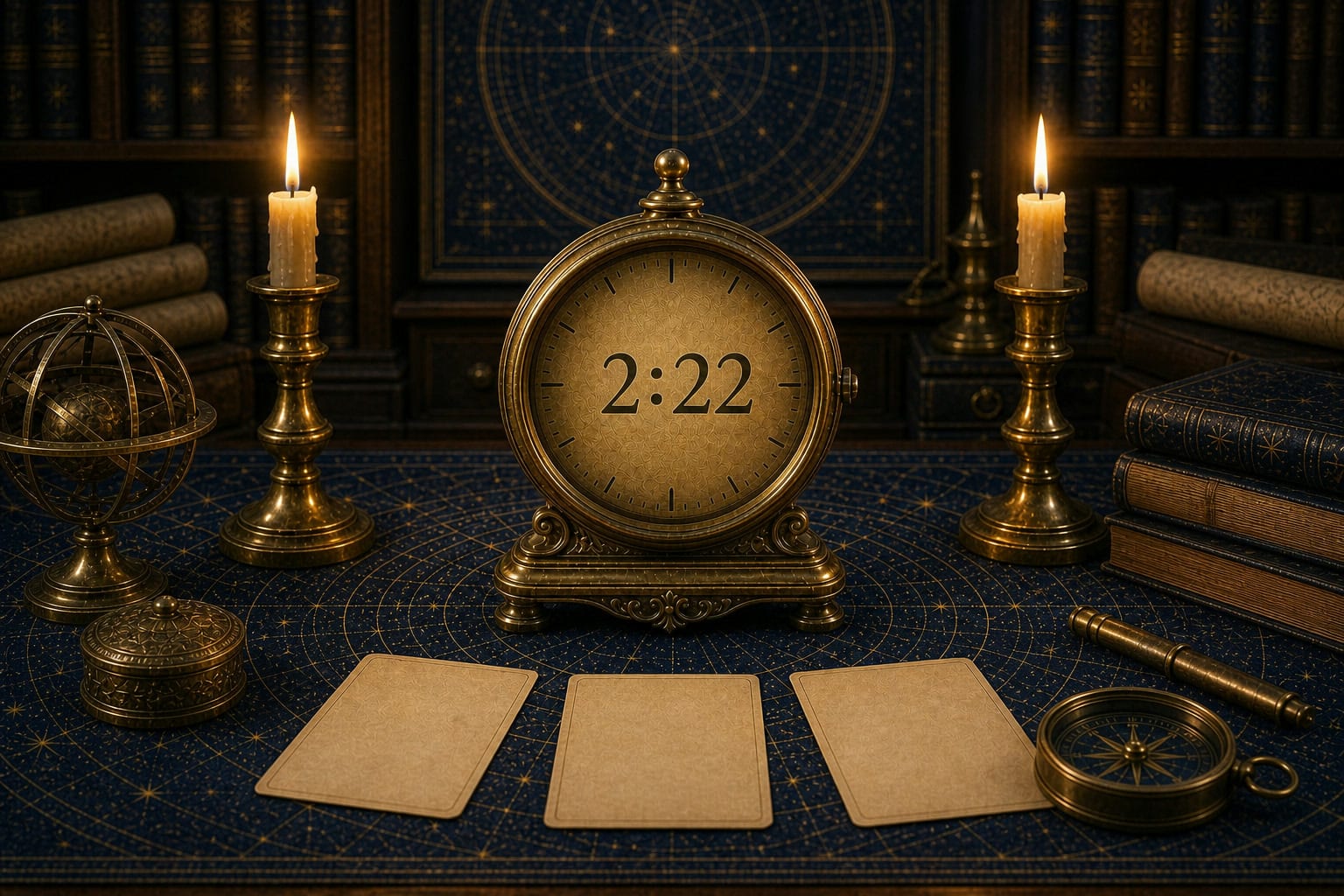
On a 12-hour clock, 2:22 shows the digit 2 three times: once for the hour and twice in the minutes. Numerology adds the digits, 2 + 2 + 2 = 6, and Hans Decoz describes 2 as the sensitive, cooperative number and 6 as the number of care and responsibility. That pairing sits under most 2:22 readings, which point to a relationship, a joint task, or a promise someone is keeping.
Three further readings circulate, and each has its own owner. Some angel-number writers treat the minutes as master number 22; Doreen Virtue's 2008 list reads repeated 2s as newly planted ideas beginning to grow; and French-language sites that list “heures miroirs” assign 02:22 to Cahetel, one of 72 names Kabbalists draw from Exodus 14. The clock format matters as well, because a phone set to 24-hour time shows the afternoon sighting as 14:22, with different digits.
Quick Facts
- Digits shown
- 2, 2 and 2 (hour 2, minutes 22)
- Digit total
- 2 + 2 + 2 = 6
- Decoz's digit themes
- 2: tact and cooperation; 6: care and responsibility
- Master number 22
- Decoz counts it only in personal chart numbers, not clock times
- French category
- Heure triplée (triple hour), not a strict mirror hour
- Angel in French lists
- Cahetel, for the 02:20 to 02:40 slot
- 24-hour display
- 02:22 at night; the afternoon shows 14:22
Why 2:22 lands on 6 in numerology
The calculation is short. The hour supplies one 2, the minutes supply two more, and 2 + 2 + 2 = 6. A clock that shows a leading zero, as in 02:22, adds nothing to the sum, and because 6 is already a single digit there is no second reduction step.
Hans Decoz describes the digit 2 as sensitive, gentle, tactful and cooperative, and calls it the most underestimated of the single digits when it comes to strength. He describes 6 by its loving, caring nature and treats it as the number of responsibility and service. Three 2s leading to a 6 therefore put a relationship or a shared effort in the foreground and then ask what you are responsible for inside it. That is why readings of 2:22 turn so readily to partnership, household duty, or a joint project.
Does the Master Builder reading of 22 apply to a clock?
Some angel-number sites read the minutes of 2:22 as master number 22, which Decoz calls the Master Builder. He explains the title through its digits: two sensitive 2s that add up to the practical, grounded 4, so the 22 joins intuition to the capacity to build on a large scale.
Decoz also limits where master numbers count. In his system they matter in the core numbers of a personal chart, such as the Life Path, Expression and Soul Urge, and in a few other chart positions. A time on a clock is not one of them, so reading the 22 in 2:22 as a master number extends his method; his method itself does not call for it.
The choice changes the reading. Kept whole, 2:22 becomes a 2 beside a 22: cooperation standing next to large-scale building, with the 4 of the 22 underneath. Added digit by digit, it becomes three 2s leading to 6, which is what a numerology calculator returns. Either version can be used, provided the reader knows which one a given interpretation rests on.
Why do French lists call 02:22 a triple hour and give it to Cahetel?
In the French naming used for these times, 2:22 is a triple hour. French-language sites such as Astroya sort repeating times into three groups, and English-language pages often use “mirror hour” loosely for all of them.
| French term | Pattern | Examples |
|---|---|---|
| Heure miroir (mirror hour) | The minutes repeat the hour exactly | 21:21, 22:22 |
| Heure inversée (reversed hour) | The minutes reverse the hour's digits | 13:31, 12:21 |
| Heure triplée (triple hour) | One digit appears three times | 02:22, 03:33 |
These lists attach an angel to each time. The names come from the Shem HaMephorash, a Kabbalistic reading of Exodus 14:19–21: each of the three verses has 72 Hebrew letters, and combining them yields 72 three-letter names, often listed as angels. French horoscope and angel-card sites then divide the day into 72 slots of 20 minutes from midnight and give each slot to one name, in order. None of the sites we checked names who first set up that rotation, so it is best understood as a modern French convention layered on the older list of names.
By that count, 02:20 to 02:40 is the eighth slot, and the eighth name is Cahetel, also spelled Cahethel. Pauline Mussey's triple-hour entry for Astrocenter gives 02:22 to Cahetel, associates the name with protection and fertility, and pairs the time with L'Amoureux, the Lovers, which is Major Arcana VI and matches the digit total of 6. Because the angel belongs to the whole 20-minute slot, 02:21 and 02:39 receive Cahetel as well; the repeated digits do not select the angel.
Why the afternoon 2:22 shows as 14:22 on a 24-hour clock
A 12-hour clock shows 2:22 twice a day, once after midnight and once after noon. A 24-hour display shows those minutes as 02:22 and 14:22, and only the night-time one keeps the three 2s. At 14:22 the visible digits are 1, 4, 2 and 2, which add up to 9, so a reading built on 2 + 2 + 2 = 6 describes a pattern that screen never displayed.
For anyone counting sightings, the format therefore matters. Afternoon sightings of 2:22 on a 12-hour kitchen clock usually belong to a daily routine, such as a break at the same time each day, while a 02:22 on a phone usually follows waking in the night. The two call for different explanations before any symbolic reading comes in.
Do Decoz or Virtue link 2:22 to a partner or a twin flame?
No numerology source cited here gives 2:22 a romantic forecast. Decoz supplies the character of the digits, 2 for tact and cooperation and 6 for care and family responsibility, and applied to a relationship those point to give-and-take: who adjusts to whom, and who carries the practical care.
Doreen Virtue's list of number sequences, posted on Spirit Library in 2008, the year her book Angel Numbers 101 appeared, reads repeated 2s as newly planted ideas that are beginning to grow, with the advice to keep nurturing them until evidence appears. Her message concerns something the reader has started, and it names no partner. Virtue renounced her New Age teaching after converting to Christianity in 2017, which matters to readers who treat her list as the standard reference.
Claims that 2:22 announces a twin-flame reunion come from later online readers, not from Decoz or Virtue. The twin-flame idea is a New Age belief that one soul is divided between two people, and nothing in the clock time can show whether a particular person is thinking of you or coming back. A message, a conversation or a change in how they act can.
Why 2:22 and 222 share a total of 6 while 22:22 totals 8
The digit 2 appears in several patterns, and the display changes what each one is.
| Pattern | What is shown | Digit total | Usual framework |
|---|---|---|---|
| 2:22 | Three 2s on a clock, hour 2 and minutes 22 | 6 | French triple hour; Cahetel's 20-minute slot |
| 222 | Three 2s anywhere, such as a receipt or a license plate | 6 | Virtue's repeated-2 message, with no time of day |
| 22:22 | Four 2s, on a 24-hour display only | 8 | French mirror hour, with the minutes repeating the hour |
2:22 and 222 share their arithmetic, so their numerology is identical; the clock adds an hour of the day and the French slot system. 22:22 shares the digit but totals 8, and on a 12-hour clock the same moment reads 10:22, which has no repeated pattern at all.
Why you keep noticing 2:22: the frequency illusion
The linguist Arnold Zwicky named the frequency illusion in 2005: once something has caught your attention, it seems to turn up everywhere. 2:22 suits it well. A 12-hour clock shows the pattern for two of the 1,440 minutes in a day, rare enough to feel significant and common enough to meet again, especially when a routine puts a screen in front of you at that time.
Memory adds to the effect, because the glance that lands on 2:22 is kept and the glances at 2:19 or 2:26 are forgotten. A written note of every clock check over a few days, misses included, shows whether 2:22 really comes up more often than other minutes or whether the hits simply stand out. That record does not rule out a spiritual reading, but it shows how much of the pattern comes from routine and attention.
Frequently Asked Questions
Is 2:22 a sign from angels?
Angel-number writers such as Doreen Virtue present repeated numbers as messages from angels. Numerology treats the digits as symbols and says nothing about who sent them, and the sighting itself cannot settle which view is right.
Is 2:22 a bad sign or a warning?
None of the sources used here treats 2:22 as a warning. Decoz's descriptions of 2 and 6 concern cooperation and care, and Astrocenter's triple-hour entry presents Cahetel's slot as a protective one.
Does 2:22 mean someone is thinking about me?
No numerology method or angel-number list cited here makes that claim. The sighting records your own attention; another person's thoughts show in what they say and do.
Which angel do French heures miroirs lists give 02:22?
Cahetel, also spelled Cahethel. These lists divide the day into 72 slots of 20 minutes, one for each name of the Shem HaMephorash, and 02:20 to 02:40 is the eighth slot, so the eighth name covers 02:22 along with every other minute in that slot. Within the lists, 02:22 is classed as an heure triplée, a triple hour.
Sources
- (2026). The Numerology Meaning of Single Digit Numbers 1-9. World Numerology. Link
- (2026). Life Path Number 6 Meaning. World Numerology. Link
- (2026). Master Numbers 11, 22, 33. World Numerology (master numbers and the chart positions where they count). Link
- (2008). Number Sequences from the Angels. Spirit Library, posted 18 August 2008 (entries for sequences of 2). Link
- (2026). Doreen Virtue. Wikipedia (Angel Numbers 101, Hay House, 2008; 2017 conversion). Link
- (2026). Heure miroir : signification complète des 24 heures. Astroya (mirror and reversed hours defined). Link
- (2026). Heure triplée 02h22. Astrocenter (undated; read September 2026). Link
- (2026). Les 72 Anges Gardiens Kabbalistiques. Heure-Miroir.eu (20-minute daily slots counted from midnight). Link
- (2026). Shem HaMephorash. Wikipedia (Exodus 14:19–21 and the list of 72 names). Link
- (2026). Twin flame. Wikipedia. Link
- (2019). “Frequency illusion” in the OED. Language Log, on Arnold Zwicky's 2005 term. Link
About Our Editorial Process
Every KnowTheAngels guide separates calculation method, tradition context, and personal reflection. We cite where interpretations come from, present more than one view, and never present symbolic reading as prediction.
Read our editorial policy