What Does Seeing 21:21 Mean in Mirror-Time Interpretations?
Why 21:21 appears only on 24-hour clocks, how its digits reduce to 3 and 6, and where the completion and Damabiah readings come from
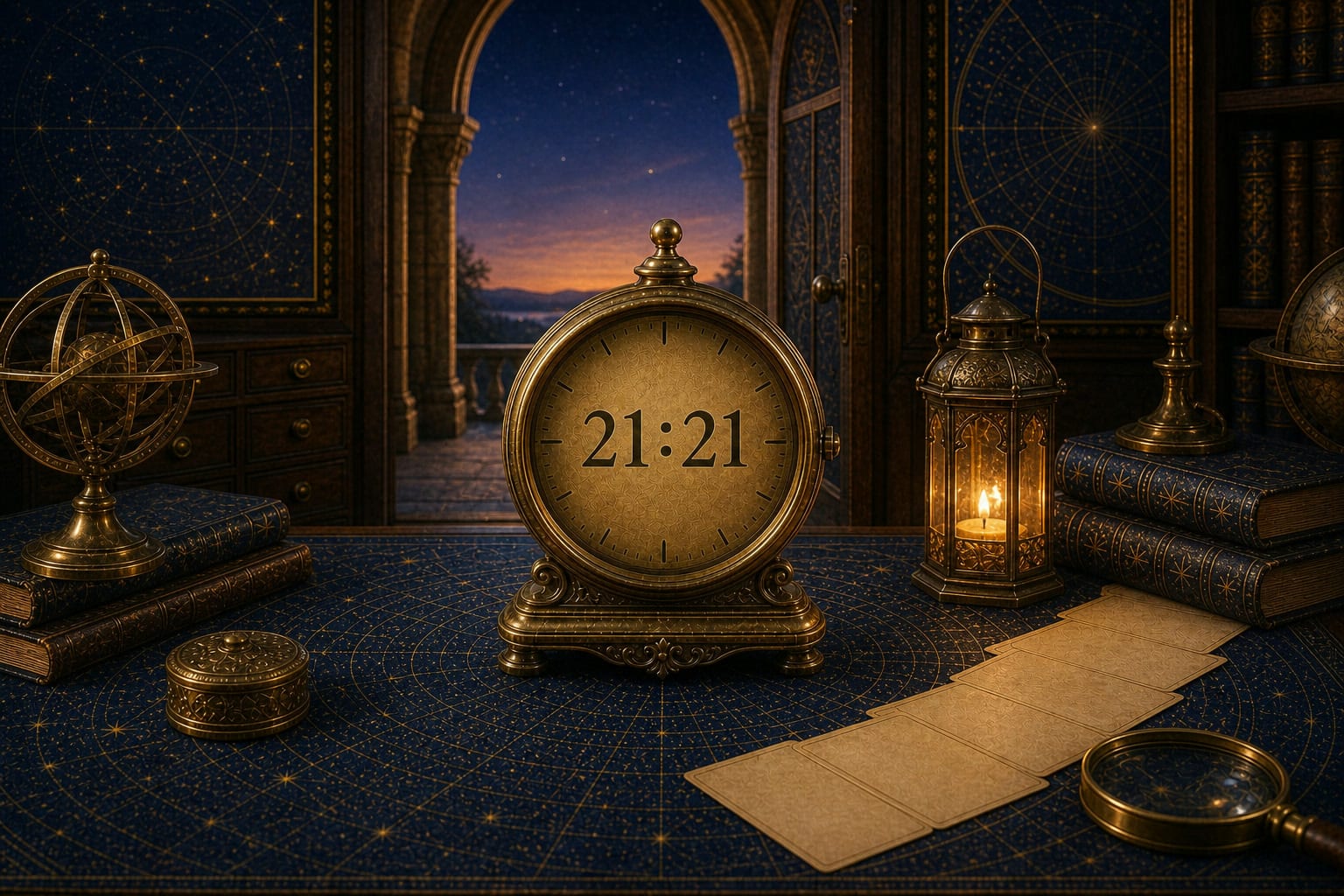
21:21 is the mirror hour that falls at 9:21 in the evening. Its digits only mirror each other on a 24-hour display, so most of what is written about it comes from the French-language tradition of heures miroirs (mirror hours), which lists every doubled time from 00:00 to 23:23.
Three separate systems feed the readings found online. Numerology reduces each 21 to 3 and the whole time to 6. Tarot and the palmist Cheiro tie the number 21 to completion through the picture on card XXI. Mirror-hour websites add a guardian angel, Damabiah, drawn from the 72 angel names of Christian Kabbalah.
None of these systems was built for clocks. Each borrows the meaning of a number and applies it to a time of day, which is why the readings describe themes such as expression or completion and never name an event.
Quick Facts
- Clock display
- Mirrored only in 24-hour time; 9:21 PM in 12-hour time
- Each half
- 2 + 1 = 3
- Full reduction
- 6, from 2 + 1 + 2 + 1 or from 21 + 21 = 42
- Tarot number
- XXI, The World, the last numbered major arcana card
- Angel in French lists
- Damabiah, 65th of the 72 names (21:20 to 21:40)
- Digits read backward
- 1212, the digits of 12:12
Why is 21:21 read as a time of completion?
Mirror-hour websites commonly describe 21:21 as the point where long effort reaches completion or success. That reading draws on the number 21 in tarot and has little to do with numerology's 3 or 6. The major arcana of a standard tarot deck number 22 cards, and the last numbered card is XXI, The World, which shows a figure dancing inside a wreath. French mirror-hour pages make the pairing directly: Source Sacrée's entry on 21h21 (March 2026) matches the time to Le Monde, arcane XXI of the Tarot de Marseille.
The palmist Cheiro gave 21 a similar meaning in Cheiro's Book of Numbers. He wrote that 21 "is symbolised by the picture of 'the Universe'", the title Aleister Crowley's Thoth deck later gave card XXI, and that it is "also called 'the Crown of the Magi'", a number of advancement and honours won after a long struggle.
Neither source was describing clocks. Cheiro assigned compound numbers to names and birth dates, and the tarot order belongs to a deck of cards, so the mirror-hour reading borrows from both. In practice the completion theme fits a stretch of work that is ending, such as a thesis, a renovation or a long period of caring for a relative. It offers a frame for reflecting on that ending and gives no information about whether the result will be good.
Why does 21:21 give 3 for each half but 6 overall?
Two sums apply to 21:21, and each answers a different question. Reducing the hour on its own gives 2 + 1 = 3, and the minute gives the same 3. Adding all four digits gives 2 + 1 + 2 + 1 = 6. Adding the halves as whole numbers reaches the same root by another route: 21 + 21 = 42, and 4 + 2 = 6.
| Calculation | Result | Association in modern numerology |
|---|---|---|
| Hour 21: 2 + 1 | 3 | Communication and creative expression |
| Minute 21: 2 + 1 | 3 | The same 3, repeated |
| All four digits: 2 + 1 + 2 + 1 = 6 | 6 | Responsibility, nurturing and protection |
| Both halves: 21 + 21 = 42, then 4 + 2 | 6 | The same full root by a second route |
Numerology.com describes the number 3 as a communicator that shines in every form of expression. Its account of 6 points the other way, toward responsibility, nurturing and protection, the number that shows up and does more than its share. Read together, the halves describe how something gets said, and the full time describes who depends on it. A reading that stops at the two 3s sounds purely creative; the full root of 6 asks what a piece of expression costs the people around it, as with a speech at a family event or a proposal that changes a household routine.
On its own, angel number 21 reduces to the same 3. The clock supplies the second 21, and with it the full-time 6.
Why does a 12-hour clock show 9:21 and never 21:21?
A 12-hour clock never displays 21:21. The same minute reads 9:21 PM, which has no repeated pair, so the mirror exists only on phones, computers, ovens and dashboards set to 24-hour time. That format is the most widely used time notation in the world and the basis of the ISO 8601 standard; France adopted it in 1912, while the United States and several other English-speaking countries keep the 12-hour clock in daily life.
The split explains where 21:21 readings come from. Mirror-hour lists are largely a French-language genre, with books such as Diane Boyer's 2019 guide Anges Gardiens: Signification des heures miroirs, inversées, triples, and in France every doubled time appears on everyday 24-hour clocks. A reader with a 12-hour phone meets these digits more often as the number 2121 on a receipt or an address, which reduces to the same 6 but carries none of the mirror-hour tarot or angel pairings.
Read backward, 2121 becomes 1212, the digits of 12:12. Numerology.com links 1 with independence and new beginnings and 2 with cooperation and partnership, so 12:12 opens on the independent digit while 21:21 opens on the cooperative one and ends on 1.
Why does the angel Damabiah cover 21:33 as well as 21:21?
French mirror-hour websites name Damabiah as the angel of 21:21. Cristina Balan's page on 21:21 for perversnarcissique.org (December 2025) describes Damabiah as an angel of benevolence and protection, and Source Sacrée lists Damabiah as the 65th angel of the Kabbalah.
The name belongs to a much older list. The Shem HaMephorash, a divine name in Jewish mysticism, is built from Exodus 14:19-21: each of the three verses has 72 Hebrew letters, and reading them together yields 72 three-letter names. The Christian Kabbalist Johann Reuchlin (1455-1522) treated those names, made pronounceable with endings such as -el or -yah, as the names of angels, and Damabiah is the 65th in the standard order.
Placing the angels on a clock is a recent step. Mirror-hour sites give each of the 72 names 20 minutes of the day, starting with the first at midnight, because 72 periods of 20 minutes fill exactly 24 hours. Under that count the 65th period runs from 21:20 to 21:40, so 21:33 falls under Damabiah as fully as 21:21 does. The sites that use the scheme cite no author or book for it, which makes Damabiah's link to 21:21 a convention of modern mirror-hour writing and not part of the Kabbalistic source.
Can 21:21 tell you what a partner is thinking?
Many searches for 21:21 in love ask whether someone is thinking of the reader. None of the layers above can answer that: numerology describes the reader's own themes, the tarot pairing describes a card, and the angel attribution describes a 20-minute slot of the day.
What the numbers offer is a question to bring to a real relationship. The two 3s concern saying things aloud and the 6 concerns shared commitments, so in a love reading 21:21 fits the moment when something important has gone unsaid because raising it might unsettle an arrangement both people rely on, such as whose job decides where the household lives. The answer still comes from the conversation and from how the other person behaves afterwards.
Is seeing 21:21 every evening just routine?
Routine is the first explanation to rule out. If you usually pick up your phone between 21:00 and 21:30, when a programme ends or children are in bed, 21:21 sits inside a window you are already watching, and the chance of meeting it rises with every evening glance.
Memory adds a second effect. The linguist Arnold Zwicky named it the frequency illusion in a 2005 Language Log post: "once you've noticed a phenomenon, you think it happens a whole lot". The unremarkable times seen on the same evenings, such as 21:17 or 21:26, leave no trace, while each 21:21 is filed as another instance.
A week in a number journal separates the two effects. Recording each sighting with what you were doing shows whether 21:21 follows a routine. If it does, the pattern describes your evening, and any reflection you attach to the 3, the 6 or the World card is a meaning you chose to apply.
Frequently Asked Questions
What does 21:21 mean on a clock?
Each 21 reduces to 3 in numerology and the full time to 6, pairing expression with responsibility. Mirror-hour writers add a completion theme from tarot card XXI, The World, and the angel Damabiah. These are interpretations of a daily time, and none of them predicts a specific event.
Is 21:21 a mirror hour?
Yes. In French mirror-hour lists a mirror hour is any time whose hour and minute match, and a 24-hour clock has 24 of them, from 00:00 to 23:23. On a 12-hour clock the same moment reads 9:21 and is not a mirror.
Does 2121 mean the same as 21:21?
They share digits and the root 6, since 2 + 1 + 2 + 1 = 6. 2121 is read as a four-digit number wherever it appears, while the tarot and angel pairings of the mirror-hour lists apply only to the clock time.
What does 21:21 mean in love?
In numerology the two 3s concern saying things aloud and the 6 concerns shared commitments, so a love reading of 21:21 points to something important left unsaid because raising it could unsettle an arrangement both people rely on. The time cannot show whether a partner is thinking of you; the conversation and how they act afterwards can.
Sources
- (n.d.). Number 3 Meaning. Numerology.com. Link
- (n.d.). Number 6 Meaning. Numerology.com. Link
- (n.d.). Number 1 Meaning. Numerology.com. Link
- (n.d.). Number 2 Meaning. Numerology.com. Link
- (1935). Cheiro's Book of Numbers, compound numbers section, pp. 126-133. Herbert Jenkins, London. Link
- (2026). The World (tarot card). Wikipedia. Link
- (2026). Heure miroir 21h21. Source Sacrée (published 3 March 2026). Link
- (2025). Mirror Hour 21:21: Meanings and Angelic Messages. perversnarcissique.org. Link
- (2019). Anges Gardiens: Signification des heures miroirs, inversées, triples. Independently published, ISBN 9781079112580
- (2026). Shem HaMephorash. Wikipedia. Link
- (2026). 24-hour clock. Wikipedia. Link
- (2005). Just between Dr. Language and I. Language Log (7 August 2005). Link
About Our Editorial Process
Every KnowTheAngels guide separates calculation method, tradition context, and personal reflection. We cite where interpretations come from, present more than one view, and never present symbolic reading as prediction.
Read our editorial policy