What Does Seeing 22:22 Mean in Numerology and Mirror-Time Readings?
Four identical digits, two master-number halves and a full root of 8, with the Fool card, Cheiro's warning and the Habuhiah attribution traced to their sources
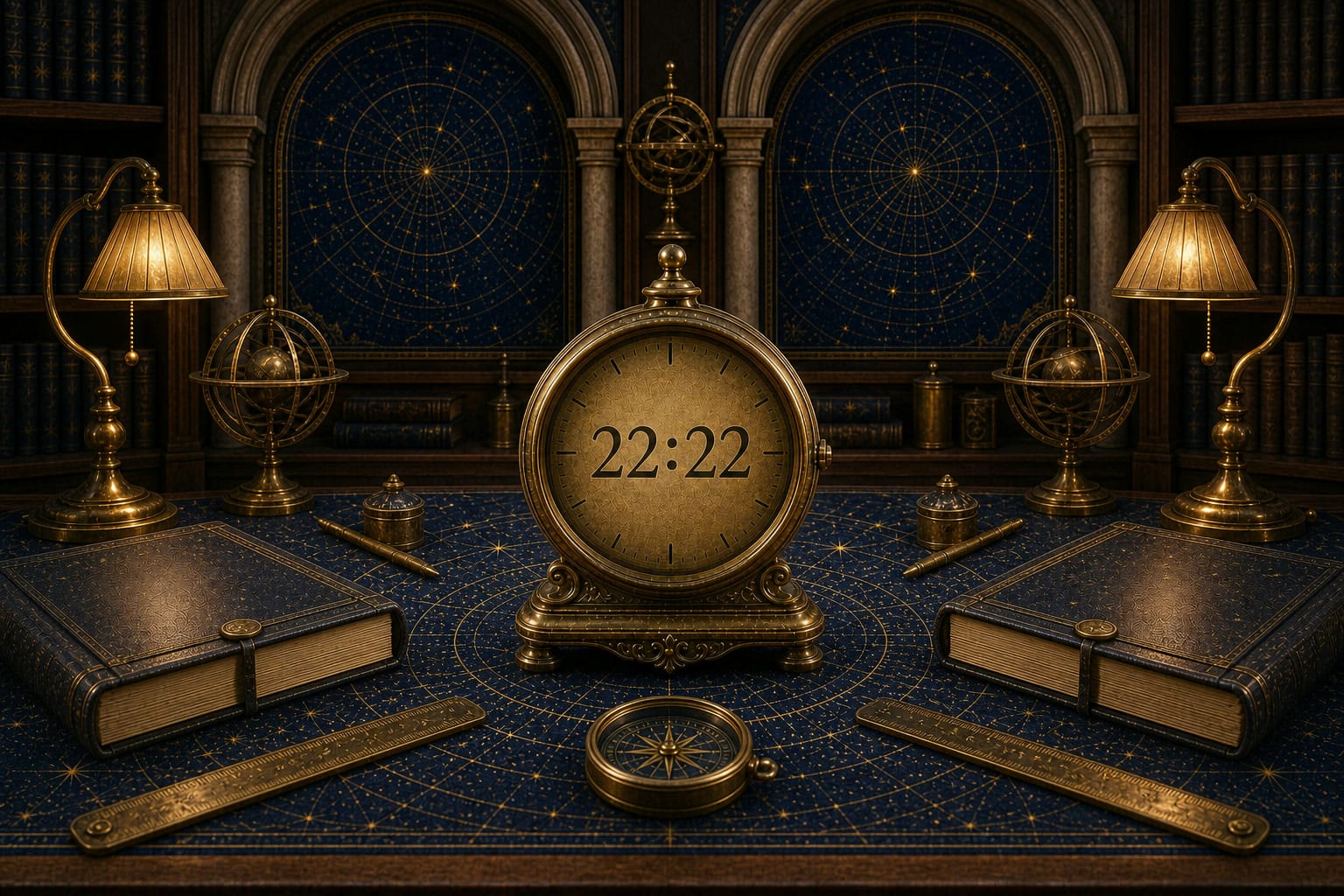
22:22 falls at 10:22 in the evening and shows the same digit four times. Only three moments in a 24-hour day do that: 00:00, 11:11 and 22:22. Anyone who sees it is reading a phone, computer or dashboard set to 24-hour time.
The readings attached to it pull in two directions. Modern numerology calls 22 the Master Builder and reduces the full time to 8, a number of achievement. French mirror-hour websites pair 22:22 with the Fool, the tarot card of setting out, and with the angel Habuhiah. The palmist Cheiro, writing in the early twentieth century, read 22 as a warning about judgment clouded by other people.
Quick Facts
- Clock display
- Four 2s in 24-hour time; 10:22 PM in 12-hour time
- Identical-digit times
- 00:00, 11:11 and 22:22 are the only three
- Each half
- Master number 22, or 2 + 2 = 4 if reduced
- Full reduction
- 8, from 2 + 2 + 2 + 2
- Halves added
- 22 + 22 = 44, then 4 + 4 = 8
- Tarot pairing
- The Fool, numbered XXII in some older decks
- Angel in French lists
- Habuhiah, 68th of the 72 names (22:20 to 22:40)
Why is 22:22 rarer than other mirror hours?
Most mirror hours repeat a pair of digits, as 21:21 does, but 22:22 repeats a single digit four times. A time can only manage that when the digit is small enough to open an hour, and the first digit of an hour never goes above 2. That leaves 00:00, 11:11 and 22:22.
The 12-hour clock removes two of the three. Midnight shows as 12:00 and 22:22 shows as 10:22, so 11:11 is the only four-of-a-kind time on a 12-hour display. Readers with 12-hour phones, the usual setting in the United States, meet the four 2s mainly as the number 2222, while 22:22 belongs to countries where the 24-hour clock is the everyday format, including France, where it became standard in 1912.
Why does 22:22 stand out when 22:17 does not?
22:22 falls in the late evening, when a phone or television is often the nearest clock. If your screen time usually starts around 22:00, you pass 22:22 almost every night, and a phone set to 24-hour time shows it in large digits on the lock screen.
The shape of the time does the rest. Michael Shermer's 2008 Scientific American column calls the underlying habit patternicity, "the tendency to find meaningful patterns in meaningless noise". A four-of-a-kind reading looks designed while 22:17 does not, even though each appears exactly once a day, so the 22:22 sightings are the ones that get noticed and remembered.
Logging sightings for a week, with what you were doing each time, shows whether 22:22 tracks a habit such as a set bedtime routine. If it does, the time is a fixed point in your evening, and whichever of the 22, 4 or 8 readings you bring to it is a reflection you chose.
Should each 22 stay a master number, become 4, or add to 8?
Numerology offers three calculations for 22:22, and they do not collapse into one answer. Systems that preserve master numbers keep each half as 22, and Hans Decoz calls master number 22 the Master Builder, the number that turns large plans into concrete results. Systems that reduce every compound number turn each half into 2 + 2 = 4, which Numerology.com links with practicality, hard work and discipline. Adding all four digits gives 2 + 2 + 2 + 2 = 8, a number Numerology.com describes through hard work, success and karmic balance.
| Method | Calculation | Result | Associated with |
|---|---|---|---|
| Master numbers kept | 22 and 22 left unreduced | 22 twice | Large-scale building, in Decoz's reading |
| Each half reduced | 2 + 2 = 4 for each half | 4 and 4 | Practical work and discipline |
| Full time | 2 + 2 + 2 + 2 | 8 | Achievement and balance |
| Halves added | 22 + 22 = 44, then 4 + 4 | 44, then 8 | Decoz: a power number that strengthens the 8 |
The choice changes the scale of the reading. Kept as 22, the time points to plans that take years, such as a building, a business or a long training. Reduced to 4, it points to the week's work on that plan. The full 8 adds the results side: money, standing and what the effort returns.
The 44 step is where numerologists disagree most. Decoz treats 44 as a power number and not a master number, and writes that an 8 built on 44 has its potential for success "greatly enhanced", while other writers promote 44 as a master number of its own, which standard Western practice does not recognise.

Which of 2:22, 222 and 2222 shares the arithmetic of 22:22?
The four sequences share the digit 2 but differ in how many times it appears and where. On a 12-hour clock 2:22 appears twice a day, while a 24-hour display turns the afternoon one into 14:22 and keeps the pattern only at 02:22 in the night. Angel number 222 is the three-digit sequence read wherever it turns up. 2222 has the same digits as 22:22 but no hour and minute.
| Sequence | Where it appears | Reduction | What differs |
|---|---|---|---|
| 2:22 or 02:22 | Clocks, twice a day in 12-hour time | 2 + 2 + 2 = 6 | Three 2s and no master number |
| 222 | Anywhere: receipts, plates, page numbers | 6 | Three 2s read as one number |
| 2222 | Anywhere | 8 | Same digits as 22:22, no clock pairings |
| 22:22 | 24-hour clocks, once a day | 8 | Two master-number halves, plus the mirror-hour tarot and angel pairings |
Two results follow from the table. The three-2 patterns reduce to 6 and the four-2 patterns reduce to 8, so in numerology 22:22 sits with 2222 and shares only its clock setting with 2:22. And only 22:22 splits into two 22s, which is why the master-number layer applies to it and not to 222.
Why do the Fool card and Cheiro disagree about 22?
French mirror-hour writers pair 22:22 with the Fool. Source Sacrée's page on 22h22 matches the number 22 to Le Mat, "arcane XXII, aussi numéroté 0", and Astrolink's 2025 article on the time reads the card as freedom, spontaneity and adventure. The pairing depends on counting the Fool as the 22nd card: most historical decks leave it unnumbered, the Rider-Waite deck numbers it 0, and only some 18th-century Belgian decks labelled it XXII.
Cheiro's number symbolism points somewhere less cheerful. In Cheiro's Book of Numbers he wrote that 22 "is symbolised by 'a Good Man blinded by the folly of others, with a knapsack on his back full of Errors'", and he read it as a warning about illusion and about false judgment formed under other people's influence. His picture of a traveller with a pack, attacked by a tiger, resembles the traditional Fool with his bundle and chasing animal, yet it carries the opposite tone from the mirror-hour reading of freedom.
The angel comes from a third scheme. Mirror-hour sites divide the day into 72 periods of 20 minutes, one for each of the 72 angel names that Christian Kabbalists drew from Exodus 14:19-21, and the 68th period, 22:20 to 22:40, belongs to Habuhiah. Cristina Balan's December 2025 page on perversnarcissique.org describes Habuhiah as an angel of peace and healing, and Source Sacrée gives the same name. Habuhiah covers 22:35 exactly as much as 22:22, and no author or book is cited for the 20-minute division, so the angel is a feature of modern mirror-hour lists and not of the older angel names.
Is 22:22 a twin flame or love sign?
Twin-flame readings of 22:22, found on many mirror-hour websites, rest on the doubled 2 and on the mirrored shape of the time. Numerology.com describes 2 as the cooperative, sensitive number of partnership and mediation, so four of them make an obvious image of a couple.
The clock cannot identify a partner or report what someone feels. Where the numerology does apply is the building side: under the master-number and 4 readings, 22:22 fits a question about shared long-term work, such as a joint mortgage, a move or raising children, better than a question about whether someone will come back. Cheiro's reading adds a caution at the same point, about decisions shaped more by other people's opinions than by what the two partners have seen for themselves.
Frequently Asked Questions
What does 22:22 mean on a clock?
In numerology 22:22 holds master number 22 twice and reduces to 8 across all four digits, which readers connect with long-term building and its results. Mirror-hour writers add the Fool card and the angel Habuhiah. These are interpretations of a daily time and do not forecast an event.
Is 22:22 a master number time?
Each half is 22, which Hans Decoz and other Pythagorean numerologists keep unreduced as a master number. Systems that reduce every compound number read each half as 4 instead, and every system gets 8 from the four digits.
Why does my clock show 10:22 instead of 22:22?
Your clock is set to 12-hour time. 10:22 PM is the same minute, but its digits add to 1 + 0 + 2 + 2 = 5, and none of the mirror-hour pairings apply to it.
Sources
- (n.d.). Master Number 22: The Master Builder. World Numerology. Link
- (n.d.). Power Numbers Explained: 44, 55, 66, 77, 88, 99. World Numerology. Link
- (n.d.). Number 2 Meaning. Numerology.com. Link
- (n.d.). Number 4 Meaning. Numerology.com. Link
- (n.d.). Number 8 Meaning. Numerology.com. Link
- (1935). Cheiro's Book of Numbers, compound numbers section, pp. 126-133. Herbert Jenkins, London. Link
- (2026). The Fool (tarot card). Wikipedia. Link
- (n.d.). Heure miroir 22h22. Source Sacrée. Link
- (2025). Mirror Hours 22:22: Meaning and Message. Astrolink (published 22 May 2025, updated 14 November 2025). Link
- (2025). Mirror hour 22:22: Spiritual meaning and messages. perversnarcissique.org. Link
- (2026). Shem HaMephorash. Wikipedia. Link
- (2026). 24-hour clock. Wikipedia. Link
- (2008). Patternicity: Finding Meaningful Patterns in Meaningless Noise. Scientific American (1 December 2008). Link
About Our Editorial Process
Every KnowTheAngels guide separates calculation method, tradition context, and personal reflection. We cite where interpretations come from, present more than one view, and never present symbolic reading as prediction.
Read our editorial policy