What Do Repeating Twos Mean, and How Do 2, 22, 222, and 2222 Differ?
What Walmsley and Virtue assign to each run of twos, why numerology lands 22, 222 and 2222 on 4, 6 and 8, and when 22 counts as a master number
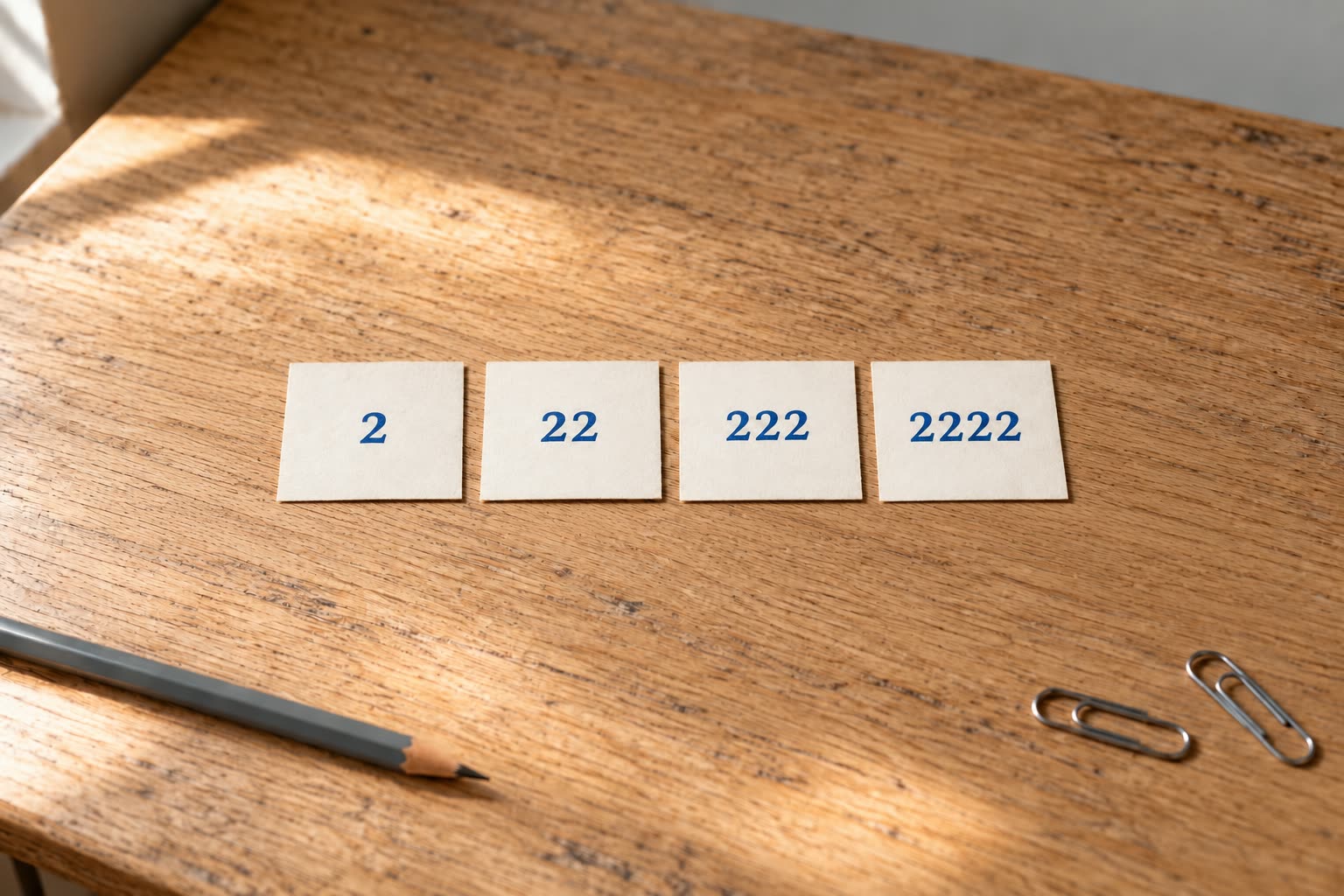
Repeating twos do not form a simple strength ladder. Modern numerology adds the digits, sending 22, 222 and 2222 to roots 4, 6 and 8, while angel-number authors assign separate messages and disagree about which message belongs to 222.
The single 2 supplies the partnership theme: Numerology.com describes it as "the coming together or balancing of two individual people". The pair 22 adds a third layer because Hans Decoz retains it as a master number in defined chart positions.
Quick Facts
- Digit sums
- 22 to 4; 222 to 6; 2222 to 8
- Single 2 in numerology
- Partnership, balance and mediation (Numerology.com)
- 222 in Walmsley (2010)
- Everything will turn out for the best in the long term
- 222 in Virtue
- Newly planted ideas beginning to grow into reality
- Is 22 a master number?
- Yes in a chart's core numbers; reduced to 4 in year, month and day cycles
- On the clock
- 2:22 twice a day on a 12-hour display; 22:22 once on a 24-hour display
What do repeating twos mean, according to Walmsley and Virtue?
Joanne Walmsley's Sacred Scribes post on repeating twos, published in August 2010, gives each length its own message. The single 2 carries "peace, kindness, diplomacy, friendship".
Her 22 is "Master Number 22", whose essence is "unlimited potential of mastery in any and all areas". She reads 222 as a promise that "everything will turn out for the best in the long-term" and 2222 as newly planted ideas beginning to take form.
The growing-ideas wording predates Walmsley's post and appears under a different number. Doreen Virtue's entry for 222 in Healing with the Angels, reposted online in 2008, says that newly planted ideas are beginning to grow into reality and urges the reader to keep nurturing them.
The same image therefore sits under 222 in Virtue and 2222 in Walmsley. Walmsley gives 222 a separate promise about the long-term outcome.
What the source lists establish
What the evidence supports
- Separate entries
Walmsley's 2010 post assigns distinct readings to 2, 22, 222 and 2222.
- A documented disagreement
Virtue places the growing-ideas language under 222, while Walmsley places it under 2222.
What remains limited
- No strength ladder
Neither source says that adding another 2 makes the same message stronger.
- No shared derivation rule
Neither source explains a method that produces its length-by-length assignments.
Any reading of 222 or 2222 therefore needs the author named beside it. Combining Walmsley's 222 promise with Virtue's 222 seed image, or treating Walmsley's 2222 as a stronger 222, turns separate entries into a rule neither author gives.
Why do 22, 222 and 2222 reduce to 4, 6 and 8?
Numerology tells the forms apart by adding their digits. Each extra 2 adds 2 to the total, so the four common forms land on the even digits in order.
The 6 that numerology reads under 222 comes from this step. So does the 8 under 2222, which owes nothing to added force in the extra 2s.
| Run | Addition | Root | Numerology.com on the root |
|---|---|---|---|
| 2 | Single digit | 2 | Partnership and the balancing of two people |
| 22 | 2 + 2 | 4 | "Practicality, hard work, discipline, and responsibility" |
| 222 | 2 + 2 + 2 | 6 | "The embodiment of the heart": love, support and nurture |
| 2222 | 2 + 2 + 2 + 2 | 8 | "the achiever", which "measures life by the goals it reaches" |
Read with its root, the run moves away from partnership as it grows: 22 toward work and structure, 222 toward care for others, and 2222 toward goals and achievement. A reading of 2222 as a louder 222 skips the step that separates them.
Past four 2s the cycle turns to the odd digits. Five 2s total 10 and reduce to 1, six reach 3, and the run climbs through 5, 7 and 9 before ten 2s total 20 and return to 2.
Runs of twos therefore reach all nine roots, as runs of fours do, while runs of threes never leave 3, 6 and 9.
Is 22 a master number when it appears on a clock or a receipt?
In a birth chart it can be. Hans Decoz counts 11, 22 and 33 as master numbers only when they fall among a person's core numbers, which he lists as the Life Path, Expression, Birthday, Heart's Desire and Personality numbers, plus a few other positions such as the Maturity number and long-term cycles.
He always reduces them in Personal Year, Month and Day calculations, writing that "a month simply does not have Master number power". In a chart, 22 is his Master Builder: two "sensitive, gentle, cooperative" 2s that add up to a grounded and pragmatic 4.
A 22 on a receipt or a door never passes through that calculation, but Decoz still gives repeated sightings a separate reading. He describes a repeatedly seen 22 as an opportunity to do something big, and Walmsley likewise calls the sighted pair a master number.
The master label reaches a sighting through those sighting interpretations. The Master Builder meaning stays with a calculated 22 in a chart.
The four digits in 2222 already sum to 8. Writing them as 22 + 22 produces 44, which Decoz classifies among the power numbers from 44 to 99 rather than the master numbers; reducing 44 also returns to 8.
Do repeating twos say anything about love or a twin flame?
The partnership meaning comes from the single 2, not from the longer runs. Numerology.com's profile makes 2 the digit of partnership and a mediator that sees both sides, but it also says the 2 may set aside its own needs to keep the peace or remain in an unpleasant situation too long.
Walmsley's entries for 22, 222 and 2222 and Virtue's entry for 222 do not mention a partner, romance or a twin flame. Reading 222 as a twin-flame sign adds a later claim that neither list supplies.

Read through their roots, the runs point to different parts of a relationship: the steady commitment of 4 under 22, the care of 6 under 222, and the shared goals of 8 under 2222. The 2's own weakness belongs in any love reading of twos, since a harmony kept by one person staying silent is the pattern Numerology.com warns about, not the balance the digit stands for.
Why do 2:22, 22:22 and other runs of twos keep turning up?
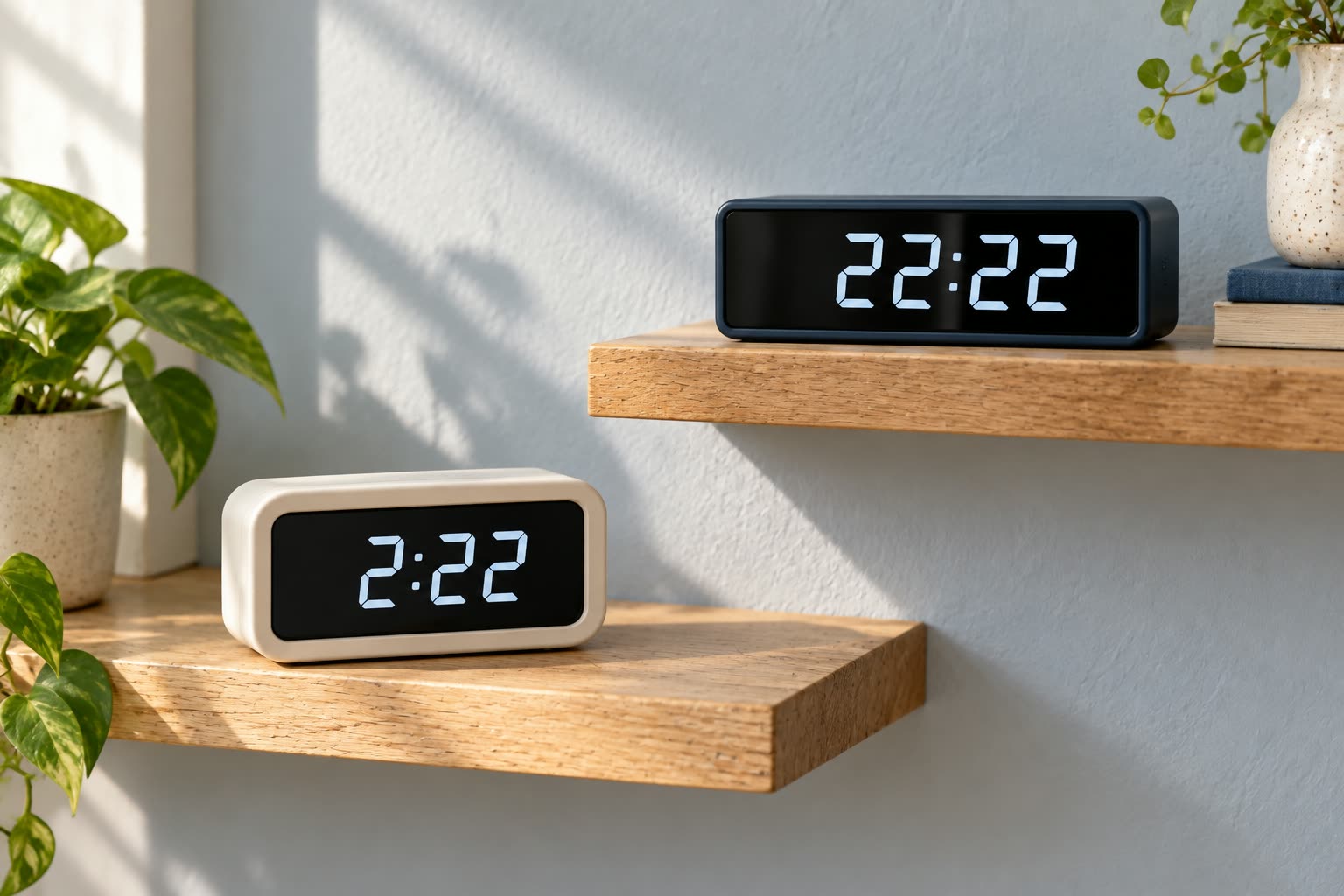
Clocks supply many runs of twos. A 12-hour display shows 2:22 twice a day.
On a 24-hour display, the only times with four matching digits are 00:00, 11:11 and 22:22. That makes 22:22 the one moment of the day when such a clock shows 2222.
Why a run of twos feels like a message is a separate question, and research on coincidences addresses it. Mark Johansen and Magda Osman describe coincidences as surprising pattern repetitions judged unlikely by chance when no better cause is available.
Their 2020 experiments treat that sense of coincidence as a prompt to consider whether an unknown cause might be operating. That prompt can start the search for meaning, but the experiments used ordinary coincidences from a diary study rather than number sightings, so they do not settle what a repeated number means.
Frequently Asked Questions
Is 22 always a master number?
Decoz does not always keep 22 whole: he retains it among a personal chart's core numbers and a few long cycles, then reduces it to 4 in Personal Year, Month and Day calculations. A 22 seen on a clock or receipt receives his separate sighting interpretation about an opportunity to do something big.
Do more 2s make the message stronger?
More 2s do not make the message stronger in numerology because each extra 2 changes the root: 22 to 4, 222 to 6 and 2222 to 8. The angel-number lists also give each length a different message, and Walmsley and Virtue disagree about which message belongs to which length.
How do Walmsley and Virtue disagree about 222 and 2222?
Walmsley reads 222 as things turning out well in the long term and 2222 as new ideas taking form, the message Virtue gave to 222. In numerology 222 reduces to 6, the root of care, and 2222 to 8, the root of achievement.
Sources
- (n.d.). Number 2 Meaning in Numerology. Numerology.com. Link
- (n.d.). Number 4 Meaning in Numerology. Numerology.com. Link
- (n.d.). Number 6 Meaning in Numerology. Numerology.com. Link
- (n.d.). Number 8 Meaning in Numerology. Numerology.com. Link
- (2010). Angel Numbers - Number Sequences - Repeating 2's. Sacred Scribes, August 26, 2010. Link
- (2008). Number Sequences from the Angels. Spirit Library, posted August 18, 2008, from Healing with the Angels (entries for 111, 222 and 333). Link
- (n.d.). Master Numbers 11, 22, 33. World Numerology (core-number rule, power numbers 44 to 99, and the reading of master numbers seen repeatedly). Link
- (2020). Coincidence judgment in causal reasoning: How coincidental is this?. Cognitive Psychology 120:101290, doi:10.1016/j.cogpsych.2020.101290. Link
About Our Editorial Process
Every KnowTheAngels guide separates calculation method, tradition context, and personal reflection. We cite where interpretations come from, present more than one view, and never present symbolic reading as prediction.
Read our editorial policy