What Did the Angel Gabriel Say to Mary at the Annunciation?
Luke 1:26-38 line by line, why Zechariah lost his voice and Mary did not, the "full of grace" translation question, the older birth announcements Luke echoes, why painters show Mary reading or spinning, and the feast and prayer that keep the scene in church life
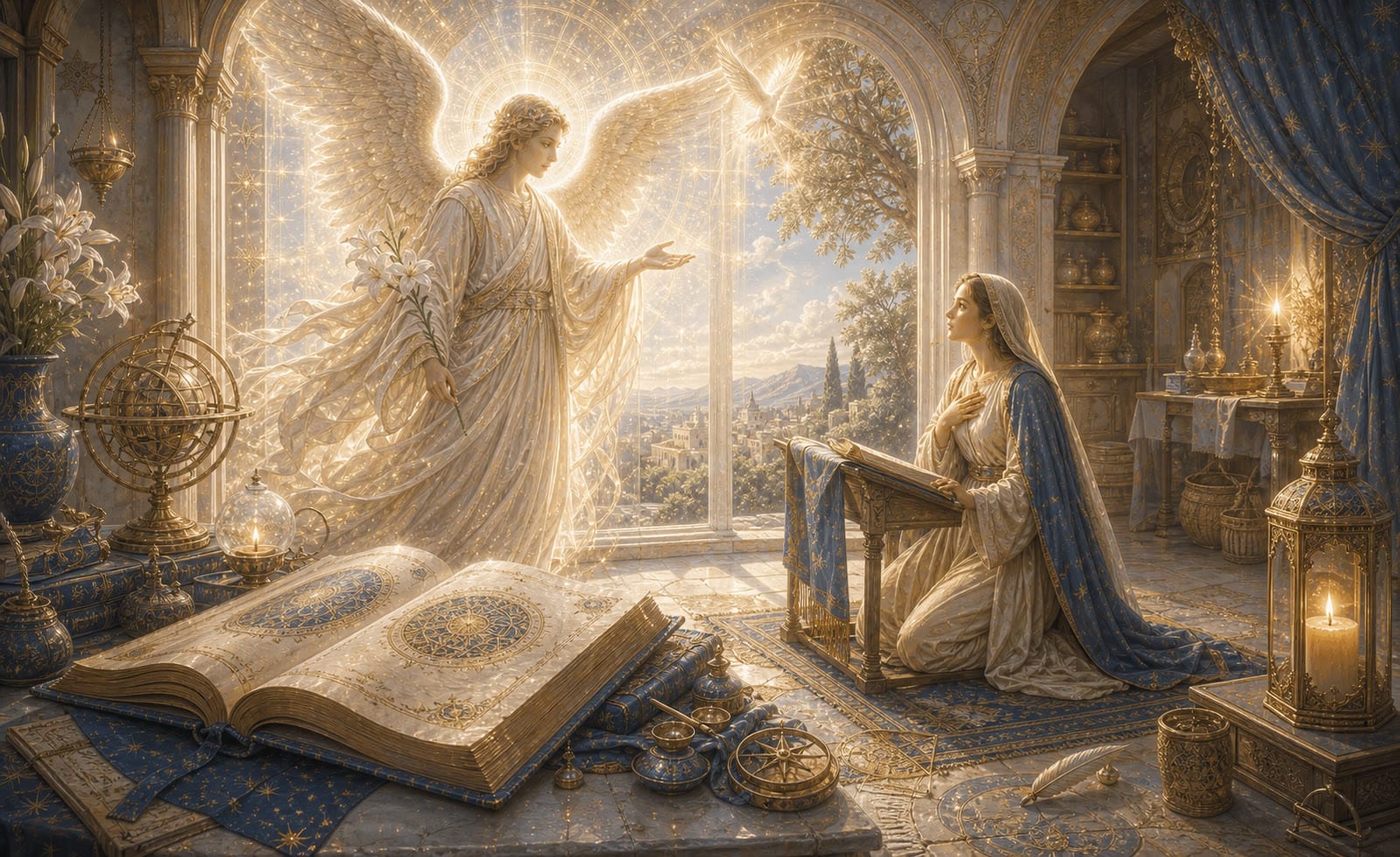
At the Annunciation, the angel Gabriel tells Mary of Nazareth that she will conceive and bear a son named Jesus, who will receive the throne of David and reign without end (Luke 1:26-38). Mary asks how this can happen, since she is a virgin, and Gabriel answers that the Holy Spirit will come upon her.
Luke is the only Gospel that tells this scene, and he places it straight after a matching visit by Gabriel to the priest Zechariah (Luke 1:5-25). Matthew gives Joseph a separate, unnamed angel in a dream, and the Qur'an keeps its own account of the announcement in Surah 19.
Quick Facts
- Primary passage
- Luke 1:26-38
- Angel
- Gabriel, named in Luke 1:19 and 1:26
- Place
- Nazareth, a town in Galilee
- Paired scene
- Gabriel and Zechariah in the Temple, Luke 1:5-25
- Greek greeting
- Chaire, kecharitomene (Luke 1:28)
- Feast day
- March 25; Evangelismos in Orthodox churches
- Prayer
- The Angelus, said morning, noon, and evening
What did Gabriel say to Mary, line by line in Luke 1?
Gabriel speaks to Mary three times in Luke 1:26-38, and Mary answers twice, once with a question and once with consent. Luke dates the visit to "the sixth month" of Elizabeth's pregnancy and names the town, Nazareth in Galilee.
He also records that Mary is engaged to Joseph, "of the house of David." The promise of "the throne of his ancestor David" in verse 32 depends on that detail, because Luke traces David's line through Joseph (Luke 3:23-31).
| Verses | Speaker | What is said | What it settles |
|---|---|---|---|
| 1:28 | Gabriel | "Greetings, favored one! The Lord is with you." | Mary is greeted before she is told anything |
| 1:29 | Mary, silently | She "was much perplexed by his words and pondered what sort of greeting this might be." | Her first response is thought, not speech |
| 1:30-33 | Gabriel | "Do not be afraid, Mary... you will conceive in your womb and bear a son, and you will name him Jesus." | The name, the title Son of the Most High, David's throne, a kingdom with no end |
| 1:34 | Mary | "How can this be, since I am a virgin?" | The obstacle is said out loud |
| 1:35-37 | Gabriel | "The Holy Spirit will come upon you... For nothing will be impossible with God." | How it will happen, plus a sign she can check |
| 1:38 | Mary | "Here am I, the servant of the Lord; let it be with me according to your word." | She agrees, and only then does the angel leave |
Gabriel gives Mary a sign she never asked for. Her older relative Elizabeth, "who was said to be barren," is six months pregnant, and in the next scene Mary sets out to see her (Luke 1:36, 1:39).
Why do some Bibles say "full of grace" and others "favored one"?
The difference comes from one Greek word in Luke 1:28, kecharitomene, a perfect passive participle of the verb charitoo, "to grace" or "to favor." Jerome's Latin Vulgate rendered it gratia plena, "full of grace," and that Latin phrase became the opening of the Hail Mary.
The grammar describes favor God has already given and that still stands. The disagreement is over whether the English word "full" says more than the Greek does.
- Douay-Rheims (Catholic): "Hail, full of grace, the Lord is with thee: blessed art thou among women."
- RSV Catholic Edition: "Hail, full of grace, the Lord is with you!"
- New American Bible, Revised Edition (Catholic): "Hail, favored one! The Lord is with you."
- King James Version (Protestant, 1611): "Hail, thou that art highly favoured, the Lord is with thee: blessed art thou among women."
- NIV and ESV (Protestant): "Greetings, you who are highly favored!" and "Greetings, O favored one."
- NRSVUE (ecumenical): "Greetings, favored one! The Lord is with you."
So the split between Catholic and Protestant Bibles is real, but it is not tidy. The NABRE, a Catholic translation approved by the US bishops, reads "favored one" like most Protestant versions.
Catholic teaching reads the word as a lasting state. The Catechism cites Gabriel's greeting "full of grace" when it teaches that Mary was redeemed from the moment of her own conception (CCC 490-491), the doctrine of the Immaculate Conception that Pius IX defined in 1854.
Martin Luther argued the other side in his 1530 Open Letter on Translating. A German who heard "full of grace," he wrote, would think of a keg full of beer or a purse full of money, so his Bible printed "du Holdselige," roughly "you gracious one."
Protestant commentators generally keep "favored one" because the participle names what God has done for Mary, and they do not read it as evidence about her conception.
Chaire, the first word of the greeting, was an everyday Greek hello whose literal sense is "rejoice."
The line "blessed art thou among women" in the King James and Douay-Rheims comes from later manuscripts. Modern critical editions keep it only at Luke 1:42, where Elizabeth says it.
Why was Zechariah struck silent when Mary was not?
Both people ask Gabriel a question, and on the page the questions look close: Zechariah asks how he can know that this will happen (Luke 1:18), and Mary asks how this can be (Luke 1:34).
Gabriel gives the reason himself: Zechariah will be mute "because you did not believe my words" (Luke 1:20). The charge is unbelief, and the wording of each question shows where it lies.
Zechariah asks for proof that the promise will come true. Mary takes for granted that it will and asks how, since she has no husband yet.
Ambrose of Milan drew the contrast in the fourth century, in a comment Thomas Aquinas preserved in his Catena Aurea. Zechariah "refuses to believe that which he says he does not know," while Mary "avows herself willing to do that which she doubts not will be done, but how, she is anxious to know."
| Zechariah (Luke 1:5-25) | Mary (Luke 1:26-38) | |
|---|---|---|
| Who | An elderly priest of the division of Abijah | A young woman engaged to Joseph; Luke gives no age |
| Where | The Temple sanctuary in Jerusalem, beside the altar of incense | Nazareth, a small town in Galilee |
| Obstacle | He is old, and Elizabeth is barren | She has no husband yet |
| Question | "How can I know that this will happen?" | "How can this be?" |
| What the question seeks | A guarantee | An explanation of the means |
| Outcome | Mute until his son is named John | An answer and a sign, then her consent |
The silence is also the sign Zechariah asked for. He wanted to know how he could be sure, and being unable to speak is how he knows, until he writes "His name is John" on a tablet and his speech returns (Luke 1:63-64).
The Temple scene also opens during prayer at the hour of incense (Luke 1:10), which recalls how Gabriel reached Daniel "at the time of the evening sacrifice" in Daniel 9:21. Luke's first Gabriel scene begins in the same setting of liturgical prayer where Gabriel last appeared in the Hebrew Bible.
Hagar, Sarah, and Samson's mother: the older birth announcements Luke echoes
Luke writes both Gabriel scenes in a form Israel's scriptures had already used for promised births. Raymond Brown's analysis, summarized by the Jesuit scholar Felix Just, finds five steps in the announcements of Ishmael, Isaac, Samson, John, and Jesus: an angel appears, the hearer is afraid, the message is given, the hearer objects or asks for a sign, and a sign is given.
Birth announcements from Genesis to Luke
Each scene follows the older form, and each changes something in it.
- Genesis 16:7-13The angel of the LORD finds Hagar at a spring on the road to Shur and tells her to name her son Ishmael
The first birth announcement in the Bible goes to a runaway Egyptian slave woman, who names God El-roi, the God who sees.
- Genesis 18:1-15Three visitors at Mamre tell Abraham that Sarah will have a son, and Sarah laughs
The LORD's question, "Is anything too wonderful for the LORD?" (18:14), is the passage the NABRE cross-references to Gabriel's "nothing will be impossible with God" (Luke 1:37).
- Judges 13:2-24An angel tells the childless wife of Manoah that her son will be a Nazirite, and she must avoid wine and strong drink
Luke gives John the same rule: "He must never drink wine or strong drink" (Luke 1:15).
- Luke 1:5-25Gabriel announces John to Zechariah in the Temple
An old man and a barren wife repeat the pattern of Abraham and Sarah.
- Luke 1:26-38Gabriel announces Jesus to Mary in Nazareth
The form is kept, but the mother is a young woman with no husband, not an older woman who could not conceive.
Set side by side, the older stories explain why Luke puts two annunciations in one chapter. John's birth fits the old pattern of a mother past hope, while Jesus's birth goes beyond it.
The older messengers also keep their names back. Manoah asks the angel's name and is told, "Why do you ask my name? It is too wonderful" (Judges 13:18), whereas Gabriel names himself to Zechariah and adds, "I stand in the presence of God" (Luke 1:19).
In Genesis 16 and Judges 13 the messenger is the angel of the LORD, whose words at times merge with God's own, so that Hagar says she has seen God. Gabriel in Luke never speaks as God; he speaks for God, under his own name.
Was the angel in Joseph's dream Gabriel?
Matthew does not say.
His messenger is simply "an angel of the Lord" who appears to Joseph "in a dream" (Matthew 1:20), and no name is given there or in the two later dreams that send the family to Egypt and back (Matthew 2:13, 2:19).
The two scenes differ in more than the name. Gabriel speaks to Mary while she is awake and before she conceives; Matthew's angel speaks to a sleeping Joseph after he has learned she is pregnant and has decided to end the engagement quietly (Matthew 1:18-19).
The message is shaped for Joseph's decision: "Joseph, son of David, do not be afraid to take Mary as your wife, for the child conceived in her is from the Holy Spirit." Matthew then quotes Isaiah 7:14 and reports that Joseph "did as the angel of the Lord commanded him" (Matthew 1:20-24).
Identifying Joseph's angel with Gabriel is an inference drawn by reading Luke into Matthew, not something either Gospel says. Matthew and Luke tell the conception from different sides, and neither mentions the other's scene.
How does the Qur'an tell the annunciation to Mary?
Surah Maryam gives a short parallel account in 19:16-21. Mary withdraws from her family "to a place toward the east" behind a screen, and God sends "Our Angel," in Arabic ruhana, literally "Our spirit," who appears to her "as a well-proportioned man" (Sahih International).
Her first words are a plea for protection: "I seek refuge in the Most Merciful from you." He answers that he is "only the messenger of your Lord" sent to announce "a pure boy," and when she asks how, since no man has touched her, he replies that God says, "It is easy for Me."
Early commentators cited by Ibn Kathir, among them Mujahid and Qatadah, say the unnamed "Our spirit" of these verses is Jibril, the Qur'an's name for Gabriel.
A second telling in Surah Al Imran (3:42-47) has "the angels," in the plural, speak to Mary and name the child "the Messiah, Jesus, the son of Mary." The Qur'an has no Joseph in the story and does not call the child Son of God, as Luke 1:35 does.
Zechariah's scene is told differently as well. In Qur'an 3:41 and 19:10 he asks for a sign, and the sign he is given is silence, three days in 3:41 and three nights in 19:10, with no word of punishment.
Why is Mary reading or spinning in pictures of the Annunciation?
Luke says nothing about what Mary was doing when Gabriel arrived, so artists took the detail from two later sources, and the choice usually shows which church the image comes from. Eastern icons give her a skein of purple yarn, while Western paintings from the Middle Ages on usually give her a book.
The yarn comes from the second-century Protoevangelium of James. There the priests choose seven young women of David's family to make a new veil for the Temple, and the lot for "the true purple and the scarlet" falls to Mary. She is first greeted by a voice while fetching water, then goes home, sits down to spin the purple, and the angel appears (chapters 10-11). A twelfth-century icon at St Catherine's Monastery on Sinai keeps that moment: Mary sits enthroned with the purple yarn in her hand, and a beam of light carries a dove down toward her.
The book is a Western addition. Dorian Llywelyn, S.J., surveying Annunciation images for the Jesuit journal Thinking Faith, dates its first appearance to the ninth century and says the reading Mary had become the standard picture by the late eleventh. Ambrose, writing around 377, had called Mary "most studious in reading," and when medieval writers asked what she was reading, Ambrose's answer usually prevailed: Isaiah 7:14, "a virgin shall conceive," the same verse Matthew quotes after Joseph's dream.
The dove on a beam of light, as in the Sinai icon, is the one element of these pictures taken from Luke. It illustrates Gabriel's answer to Mary's question: "The Holy Spirit will come upon you, and the power of the Most High will overshadow you" (Luke 1:35).
Why is the Feast of the Annunciation on March 25?
March 25 falls exactly nine months before Christmas, so the feast marks the conception that the December 25 birth date assumes. The Catholic Encyclopedia's article on the Annunciation puts it plainly: the March date "depends upon the date of the older feast of Christmas."
A third-century calculation reached the same spring date from the other end of Jesus' life. Frederick Holweck's Catholic Encyclopedia article on the feast notes that early Christians widely took March 25 as the day Jesus died, and the treatise De Pascha Computus, written around 240, argues that he was conceived as well as died shortly after the spring equinox, the season in which the world was believed to have been created.
Holweck places the feast's beginning around the Council of Ephesus in 431. The Synod of Laodicea in 372 does not know it, Proclus of Constantinople (d. 446) seems to mention it, and by 692 the Council in Trullo treated it as a festival inside Lent, exempting "the holy day of the Annunciation" from the rule that Lenten weekdays use only the Liturgy of the Presanctified (canon 52).
How churches keep March 25
The date is shared. What happens when it runs into Holy Week is not.
If March 25 falls in Holy Week, the feast moves to the Monday after the Second Sunday of Easter (Universal Norms on the Liturgical Year, no. 60).
Never moved, even when it lands on Easter itself, a rare overlap called Kyriopascha. It is one of two days in Lent when fish is allowed.
Listed among the Principal Feasts of the church year.
A quarter day for rents and hiring, and the first day of the legal year until the calendar reform of 1752.
In Greece the same date is also Independence Day, tied to the revolt of 1821, so church bells and military parades share March 25.
How does the Angelus pray the Annunciation?
The Angelus is a short Catholic devotion that retells the Annunciation in three lines, each followed by a Hail Mary, and it is traditionally said at 6 a.m., noon, and 6 p.m. when a church bell rings. The Catholic Encyclopedia calls it a practice "in honour of the Incarnation repeated three times each day."
| Versicle | Response | Scripture behind it |
|---|---|---|
| "The Angel of the Lord declared unto Mary." | "And she conceived of the Holy Spirit." | Luke 1:31-35, Gabriel's message and his answer |
| "Behold the handmaid of the Lord." | "Be it done unto me according to thy word." | Luke 1:38, Mary's reply |
| "And the Word was made flesh." | "And dwelt among us." | John 1:14, the Incarnation itself |
Each Hail Mary opens with Gabriel's greeting from Luke 1:28 joined to Elizabeth's words from Luke 1:42. Someone who keeps all three hours therefore repeats the angel's line nine times a day.
The closing prayer asks that those "to whom the Incarnation of Christ thy Son was made known by the message of an angel" may be brought "by his Passion and Cross to the glory of his Resurrection." From Easter Sunday until Pentecost, the Regina Caeli is said in its place.
The custom grew out of an evening bell. A synod at Gran, in Hungary, mentioned three Hail Marys at the evening bell in 1307, Pope John XXII attached an indulgence to the practice in 1318 and 1327, and the morning and noon bells came later.
Popes still lead the Angelus at noon on Sundays from a window above St. Peter's Square, which keeps Luke's scene in a weekly public prayer.
Frequently Asked Questions
Where is the Annunciation in the Bible?
The Annunciation to Mary is Luke 1:26-38. Gabriel's announcement to Zechariah comes just before it in Luke 1:5-25, and Matthew 1:18-25 tells how an unnamed angel spoke to Joseph in a dream.
Who was the angel at the Annunciation?
Luke names him as Gabriel (Luke 1:26), the same angel who had named himself to Zechariah a few verses earlier (Luke 1:19). In the Qur'an's account the messenger is unnamed, and early Muslim commentators identify him as Jibril.
What is the difference between the Annunciation and the Visitation?
The Annunciation is Gabriel's message to Mary in Luke 1:26-38. The Visitation follows in Luke 1:39-56, when Mary travels to see Elizabeth, who greets her as "blessed among women," and Mary answers with the Magnificat; the Catholic calendar keeps it on May 31.
Where did the Annunciation take place?
Luke places it in Nazareth, in Galilee. The Catholic Basilica of the Annunciation, consecrated in 1969, stands over the traditional house site, while the Greek Orthodox Church of St. Gabriel stands by the town spring, following the second-century Protoevangelium of James, where Mary first hears the greeting while drawing water.
Is the Feast of the Annunciation a holy day of obligation?
No. Canon 1246 of the Code of Canon Law lists the Catholic holy days of obligation, and the Annunciation is not among them, although it keeps the rank of a solemnity.
Was Mary afraid of the angel Gabriel?
Luke says she was "much perplexed" by the greeting and wondered what it meant (Luke 1:29), and Gabriel's next words are "Do not be afraid, Mary." In the Qur'an her first reaction is to seek refuge in God from the stranger (19:18).
Sources
- (2021). Luke 1:5-80. Bible Gateway. Link
- . Luke 1:28 in multiple translations (DRA, RSVCE, NABRE, KJV, NIV, ESV, NRSVUE). Bible Gateway. Link
- (2021). Matthew 1:18-2:23. Bible Gateway. Link
- (2021). Genesis 16:7-13 and 18:1-15; Judges 13:2-24. Bible Gateway. Link
- (2021). Daniel 9:20-23. Bible Gateway. Link
- . Surah Maryam 19:2-21 and Surah Al Imran 3:38-47. Quran.com. Link
- (14th century). Tafsir Ibn Kathir on Qur'an 19:17. QuranX. Link
- (1992). Catechism of the Catholic Church, paragraphs 484-494. Vatican. Link
- (13th century). Catena Aurea on Luke 1:34-35. Isidore.co. Link
- (1530). An Open Letter on Translating. Christian Classics Ethereal Library. Link
- . The Infancy Narratives in Luke's Gospel (summarizing Raymond E. Brown's annunciation pattern). Catholic Resources. Link
- (1907). Annunciation. The Catholic Encyclopedia. Link
- (692). Canons, canon 52. New Advent. Link
- (1969). Universal Norms on the Liturgical Year and the General Roman Calendar, no. 60. Liturgy Office of England and Wales. Link
- . Annunciation. OrthodoxWiki. Link
- (1907). Angelus. The Catholic Encyclopedia. Link
- . Angelus. USCCB Prayers. Link
- (2nd century). Chapters 10-11. New Advent. Link
- (1983). Code of Canon Law, canon 1246. Vatican. Link
- (2011). Luke 1:37, with cross-reference to Genesis 18:14. Bible Gateway. Link
- (1907). The Feast of the Annunciation. The Catholic Encyclopedia. Link
- (2016). The Purple Thread, the Virgin's Ear and the Book of the Annunciation. Thinking Faith (Jesuits in Britain). Link
- (2018). Annunciation on Holy Saturday: The Particularities of the Day. OrthoChristian.com. Link
- . Fasting and Fast-Free Seasons of the Church. OCA Liturgics. Link
- . The Annunciation of Our Lord (Principal Feast). Common Worship: The Church's Year. Link
- (2026). Lady Day: March 25 was the start of the year in England and Wales until 1752. The Conversation. Link
- . Greek Independence Day. Britannica. Link
- (2026). Angelus, 20 September 2026. Vatican. Link
- . Nazareth: Basilica of the Annunciation. Custody of the Holy Land. Link
About Our Editorial Process
Every KnowTheAngels guide separates calculation method, tradition context, and personal reflection. We cite where interpretations come from, present more than one view, and never present symbolic reading as prediction.
Read our editorial policy