How Many Angels Were at Jesus' Tomb, and Why Do the Gospels Differ?
Mark's young man, Matthew's angel of the Lord, Luke's two men, and John's two angels, read passage by passage, with the explanations harmonizers and critical scholars give for the differences
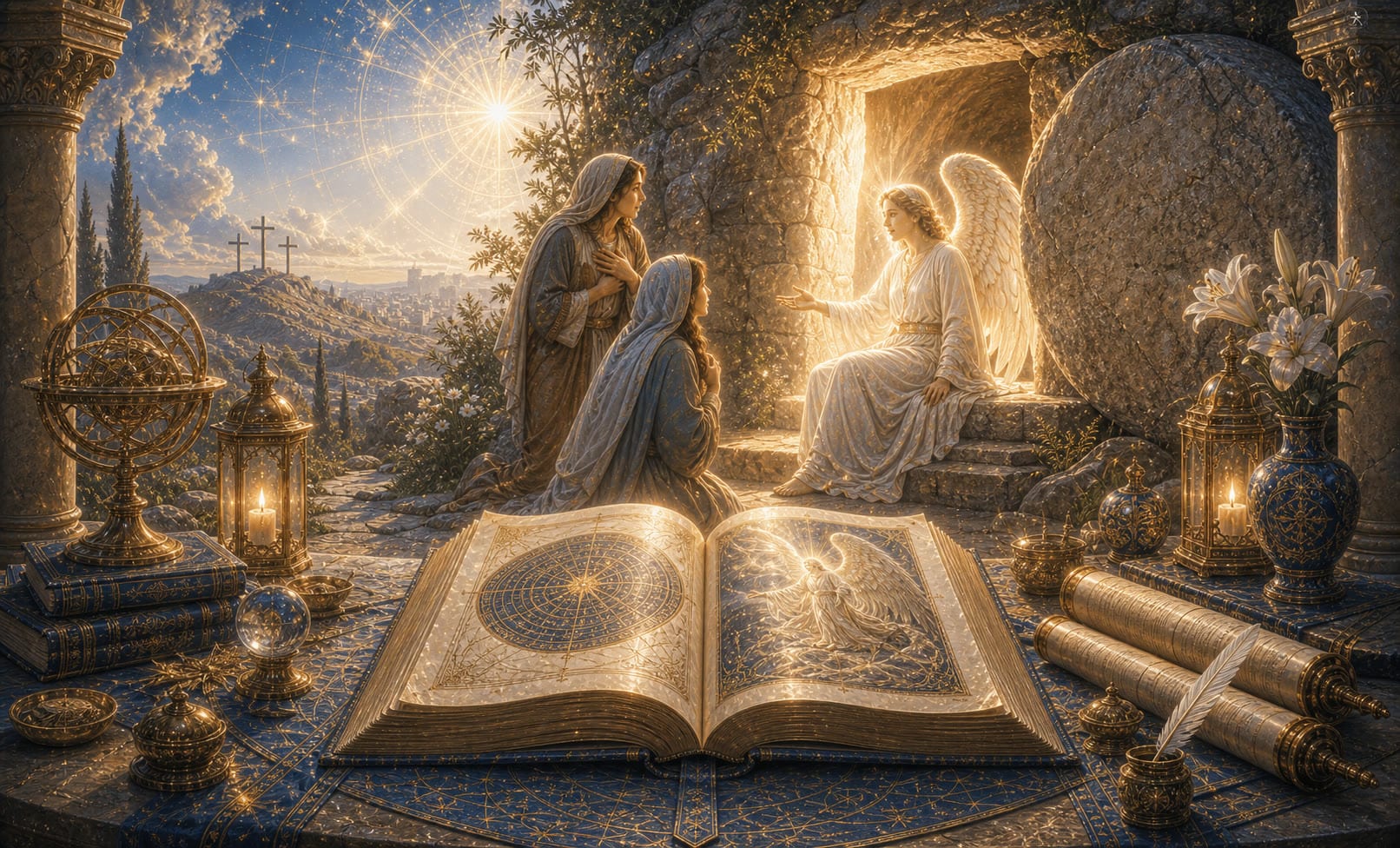
The four Gospels place one or two heavenly figures at Jesus' empty tomb, and each describes them differently, though every account dresses them in white or dazzling clothing and has them speak to women who came to the tomb.
Scripture quotations below follow the New Revised Standard Version Updated Edition (NRSVUE), with Catholic study notes from the New American Bible Revised Edition (NABRE) where they explain a detail.
The mismatch is an old question. Augustine answered it around 400 CE in his Harmony of the Gospels, and modern scholars still divide over how to explain it.
Quick Facts
- Figures per Gospel
- Mark 1, Matthew 1, Luke 2, John 2
- Named in the Gospels
- None of them
- Clothing
- White robe (Mark), white as snow (Matthew), dazzling (Luke), white (John)
- Who moves the stone
- An angel in Matthew 28:2; the other three find it already moved
- Who sees them
- Groups of women in Matthew, Mark, and Luke; Mary Magdalene alone in John
- Later name given
- Gabriel, in a homily by Gregory Palamas (14th century)
Which Gospels have one figure at the tomb, and which have two?
Mark and Matthew each describe a single messenger at the tomb, while Luke and John each describe two.
| Passage | Figures | Where they are | Clothing | Who sees them |
|---|---|---|---|---|
| Mark 16:5 | One young man | Inside, sitting on the right side | A white robe | Mary Magdalene, Mary the mother of James, and Salome |
| Matthew 28:2-3 | One angel of the Lord | Outside, sitting on the stone he rolled back | White as snow, with an appearance like lightning | Mary Magdalene, the other Mary, and the guards |
| Luke 24:4 | Two men, called "a vision of angels" at 24:23 | Inside, standing beside the women | Dazzling clothes | Mary Magdalene, Joanna, Mary the mother of James, and other women |
| John 20:12 | Two angels | Inside, one at the head and one at the feet | White | Mary Magdalene alone, looking in from outside |
Two accounts also show people who look in and see no angel. Peter finds only the linen cloths in Luke 24:12, and in John 20:5-8 Peter and the other disciple enter before Mary returns and see only the wrappings.
Set side by side, the four agree on an opened tomb, a missing body, and white-clad messengers who speak first to women. They disagree on the count, the posture, and whether the text calls the figures men or angels.
"He is not here": what each tomb messenger tells the women
In Matthew, Mark, and Luke the message has one core: Jesus is not here, because he has been raised. Each Gospel frames that sentence in its own way.
Matthew's angel begins "Do not be afraid," invites the women to "come, see the place where he lay," and sends them to tell the disciples that Jesus is going ahead of them to Galilee (Matthew 28:5-7). He closes with a line found nowhere else: "This is my message for you."
Mark's young man says "Do not be alarmed" and adds two words Matthew leaves out, telling the women to inform "his disciples and Peter" (Mark 16:6-7). Peter had denied Jesus three times in Mark 14:66-72, and he is the only disciple any tomb message names.
Luke's pair opens with a question: "Why do you look for the living among the dead?" (Luke 24:5). In place of a Galilee meeting, they tell the women to remember what Jesus said in Galilee about being handed over, crucified, and rising on the third day. Verse 8 records the result in four words: "they remembered his words."
In John 20:13 the angels speak only once, to ask Mary Magdalene why she is weeping.
Across the four Gospels, then, the angels' speaking part shrinks from a full commission in Matthew to a single question in John.
Who rolled away the stone from Jesus' tomb, and why?
Only Matthew shows who moved the stone: after a great earthquake, "an angel of the Lord, descending from heaven, came and rolled back the stone and sat on it" (Matthew 28:2); in the other three Gospels the women arrive to find it already moved.
The NABRE note on this verse reads the act as evidence for the women. The stone is rolled back "not to allow the risen Jesus to leave the tomb but to make evident that the tomb is empty," and the same note points out that no New Testament writer describes the resurrection itself.
Matthew's title "angel of the Lord" is the one his Gospel already used for the messenger who speaks to Joseph in a dream at Matthew 1:20. The NABRE note draws the parallel: in both scenes the angel interprets an event and then says what must be done.
Two phrases from the Book of Daniel reappear in Matthew's description. His appearance "like lightning" matches the face of the linen-clothed man in Daniel 10:6, and clothing "white as snow" is how Daniel 7:9 describes the Ancient One.
The guards react in the opposite way from the women. They "shook and became like dead men" (28:4) while the angel tells the women not to fear, and in 28:11-15 the same guards are paid to say the disciples stole the body.
Was Mark's young man in a white robe an angel?
Most readers, ancient and modern, take Mark's young man as an angel, and Matthew was the first to read him that way. The NABRE note on Matthew 28:2-4 says Matthew's interpretation of the "young man" as an angel "is probably true to Mark's intention."
The clues sit in Mark's own wording. The figure wears white, the color of Jesus' clothes at the Transfiguration in Mark 9:3, he explains what God has done, and the women react with the alarm that angel scenes in the Bible usually produce.
Calling an angel a "young man" (Greek neaniskos) was an established Jewish way of writing. Second Maccabees 3:26 and 3:33 describe two heavenly young men who flog Heliodorus, Josephus calls the angel who visits Manoah's wife a young man (Antiquities 5.277), and in Tobit 5:5 Tobias greets Raphael as "young man" without knowing he is an angel.
A minority of scholars read a second, symbolic layer into the figure, because Mark uses neaniskos in only one other place: the young man who runs away naked when Jesus is arrested (Mark 14:51-52). The main proposals differ on what that link means.
- An angel. Matthew's reading, the NABRE notes, and most commentators.
- A picture of baptism. Robin Scroggs and Kent Groff (1973) read the stripped youth and the robed youth as dying and rising with Christ.
- Mark's own community. John Dominic Crossan (1976) took the figure as the newly baptized member of Mark's community, and so as that community of "those reborn in the resurrected Christ."
- A restored disciple. Abraham Kuruvilla (2011) reads the white robe as the runaway's shame exchanged for glory.
Kuruvilla, of Dallas Theological Seminary, argues for the literary link and still concludes that "this 'young man' was an angel" as the event behind the text.
Were Luke's two men in dazzling clothes angels?
Luke answers the question himself later in the same chapter: at 24:4 the women see "two men in dazzling clothes," and at 24:23 the travelers on the road to Emmaus report that the women "had indeed seen a vision of angels."
Luke opens three scenes with the same words, "suddenly two men": Moses and Elijah at the Transfiguration (Luke 9:30), the pair at the tomb (24:4), and two men in white robes at the Ascension (Acts 1:10).
Jared Hay (2023) argues from that repeated phrase that Luke wants readers to recognize Moses and Elijah again at the tomb and the Ascension.
The Emmaus report in 24:23 still calls the pair angels, so most readings keep them as angels, and Hay's proposal remains a minority view.
For counting purposes, Luke's men and John's angels describe the same kind of figure. Luke's word "men" records how they looked; his own later verse records what they were.
Why do John's angels ask Mary why she is weeping?
In John the angels meet one grieving woman and announce nothing about the resurrection. Mary Magdalene stands weeping outside, bends to look in, and sees "two angels in white sitting where the body of Jesus had been lying, one at the head and the other at the feet" (John 20:11-12).
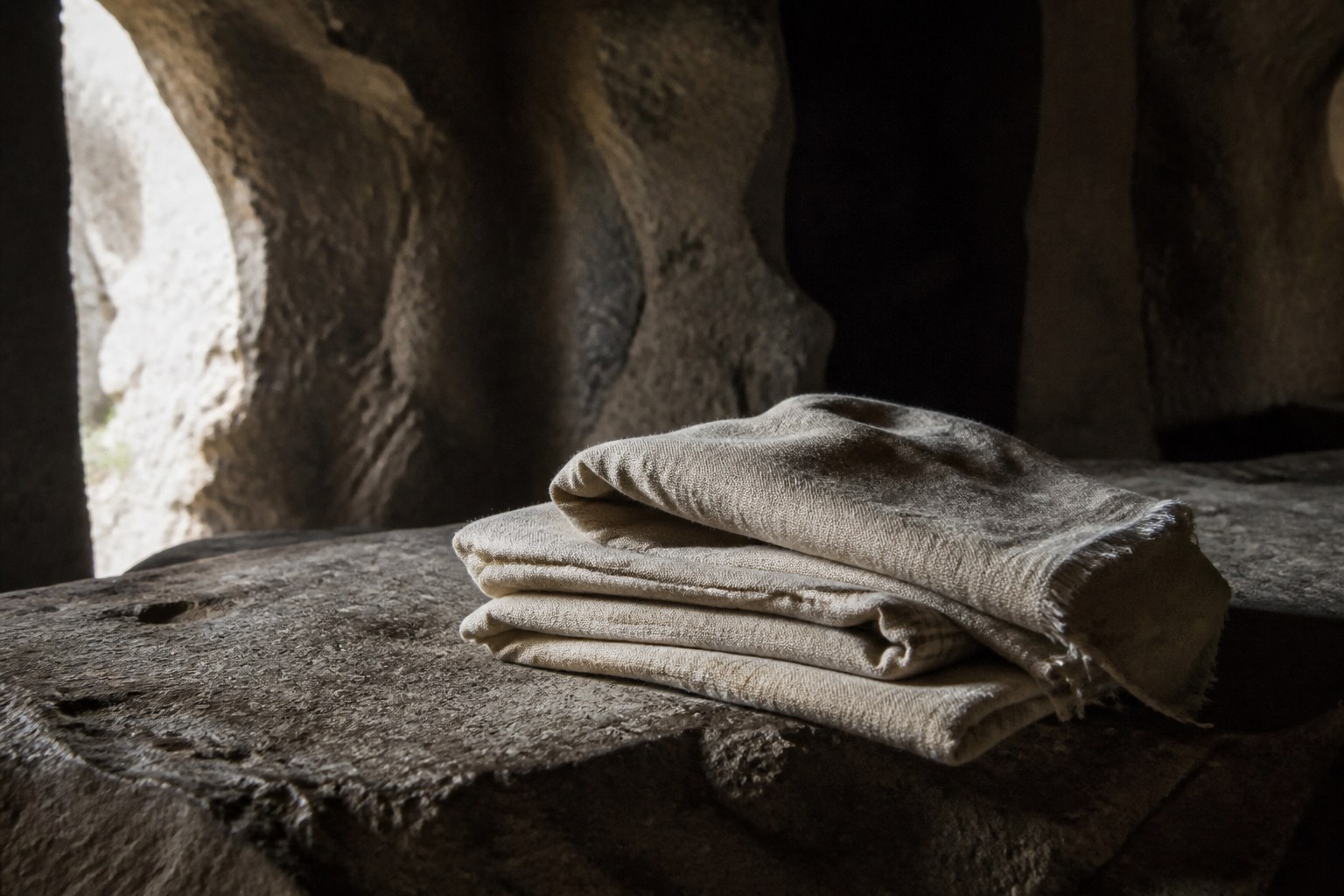
Their one question, "Woman, why are you weeping?", is asked again word for word by Jesus two verses later (20:15). The angels open the conversation, and it ends only when the risen Jesus calls her by name.
Seated at the head and the feet, the pair marks the exact place the body had occupied. The NABRE note on John 20:1-10 says John's empty-tomb story "seems to be a fusion" of the Matthean and Lucan traditions, and John's count of two angels matches Luke's pair rather than Matthew's single angel.
John also moves the commission away from the angels, since Jesus himself sends Mary to his brothers in 20:17, and she announces "I have seen the Lord" in 20:18.
How do harmonizers reconcile one angel with two at the tomb?
Harmonizers start from the premise that all four accounts report one morning accurately, each writer choosing different moments. Augustine gave the classic version in The Harmony of the Gospels, Book 3, chapter 24.
He proposed that the women met angels in two places, so that Matthew reports "the one who was sitting outside upon the stone," Mark "the one who was sitting within the sepulchre on the right side," and Luke's standing pair are angels who rose to their feet to speak.
A simpler argument runs through modern apologetics. The Christian Research Institute puts it this way: "wherever there are two angels, there is also one," so Mark and Matthew may mention only the angel who spoke without denying a second.
Four differences and the harmonizing answer to each
Christian Research Institute
Augustine, Harmony 3.24
Augustine, Harmony 3.24
Luke 24:23 calls the two men angels
What harmonizing cannot supply is a verse that states the full count. The combined picture of two angels, one of whom speaks, exists only after the four texts have been fitted together.
Why do the Gospel accounts differ, according to critical scholars?
Critical scholarship begins from Markan priority, the widely held view that Mark was written first and that Matthew and Luke used it as a source. On that view the tomb figures change because later writers rewrote Mark's scene.
Matthew's changes are the easiest to see: he turns Mark's young man into an angel descending from heaven, adds the earthquake and the stone-rolling, and adds guards whose bribe in 28:11-15 answers a stolen-body story that, he says, "is still told among the Judeans to this day."
Luke doubles the figure and replaces the Galilee meeting with a call to remember Jesus' words. That fits his plan for the ending, since every appearance of the risen Jesus in Luke takes place in or near Jerusalem.
How the tomb figure changes from text to text
The order follows the common scholarly view that Mark came first and the Gospel of Peter came last.
- MarkOne young man in a white robe, already inside
No descent, no earthquake, and the women tell no one (16:8)
- MatthewOne angel of the Lord descends and moves the stone
An earthquake, guards, and a direct command to report
- LukeTwo men in dazzling clothes, later called angels
The message turns to remembering Jesus' own words
- JohnTwo angels seated at head and foot
They ask one question, and Jesus gives the commission
- Gospel of PeterTwo radiant men descend, three figures come out, a young man waits inside
A noncanonical text that goes on to describe the resurrection itself
The Gospel of Peter, usually dated to the second century and kept outside the New Testament, shows the growth continuing. Its guards watch two men come down, the stone roll aside by itself, and three figures leave the tomb with a cross following them, before a young man in a splendid robe, seated inside, speaks to Mary Magdalene and her companions (Gospel of Peter 35-42, 55-56).
The literary explanation describes how the written accounts relate; it does not by itself decide whether angels were present. Readers who accept it hold a wide range of views on what happened at the tomb.
Did later tradition name the tomb angels Gabriel and Michael?
No Gospel names the angels at the tomb.
The identification with Gabriel comes from later Eastern tradition, most clearly from Gregory Palamas, the 14th-century archbishop of Thessalonica.
In his homily for the Sunday of the Myrrhbearers, Palamas calls the angel who rolled back the stone "that same angel of the Annunciation, Gabriel." The homily holds that the Virgin Mary came to the tomb with Mary Magdalene, and it pictures Gabriel descending as he watched her approach.
Earlier Western preaching left the angel unnamed and read its details instead. Gregory the Great, preaching on Mark's account in the 590s, took the right side as a sign of eternal life and the white garment as a sign of "the glory of our great Feast."
Michael's link to resurrection comes from the end of history rather than from Easter morning. Daniel 12:1-2 sets Michael rising at a time of anguish when many who sleep in the dust will awake, and Tiffany Studios' 1904 Angel of the Resurrection window shows Michael with the trumpet that calls the dead to rise.
We did not find Michael named at Jesus' tomb in the Gospels, Augustine, Gregory the Great, or Palamas. Modern devotional claims that Michael and Gabriel stood at the tomb together join two separate later traditions, and no early source we checked makes that pairing.
Frequently Asked Questions
Did the angels at Jesus' tomb have wings?
No Gospel mentions wings; the texts describe only clothing and brightness, from Mark's white robe to Luke's dazzling clothes. Winged tomb angels come from later Christian art.
Were the angels at the tomb sitting or standing?
Three accounts have them sitting: on the stone in Matthew 28:2, on the right side in Mark 16:5, and at the head and feet in John 20:12. Luke 24:4 has two men standing beside the women.
Did the guards see the angel?
Only Matthew has guards at the tomb, and in 28:4 they see the angel and shake "like dead men." The angel speaks to the women and says nothing to the guards.
Why does the angel in Mark say "and Peter"?
Mark 16:7 singles out Peter, who had denied Jesus three times in Mark 14:66-72, and many readers take the phrase as a sign that the denial did not cut him off. Matthew leaves the phrase out, an omission the NABRE note calls "curious."
Did the women tell anyone what the angel said?
In Mark 16:8 they flee and say nothing "for they were afraid," and the two oldest complete manuscripts of Mark end there. In Matthew 28:8 they run to tell the disciples, and in Luke 24:9-11 they report everything to the eleven, who do not believe them.
Is the Gospel of Peter part of the Bible?
No. It is an early noncanonical gospel known mainly from a fragment found at Akhmim in Egypt in the 1880s, and unlike the four Gospels it describes the resurrection itself.
Sources
- (c. 1st century CE). Matthew 28:1-15 (NRSVUE). Bible Gateway. Link
- (c. 1st century CE). Mark 16:1-8 and 14:51-52 (NRSVUE). Bible Gateway. Link
- (c. 1st century CE). Luke 24:1-24, Luke 9:30, and Acts 1:10-11 (NRSVUE). Bible Gateway. Link
- (c. 1st century CE). John 20:1-18 (NRSVUE). Bible Gateway. Link
- . Daniel 7:9, 10:6, 12:1-2; 2 Maccabees 3:26, 33; Tobit 5:4-5 (NRSVUE). Bible Gateway. Link
- (2011). Study notes on Matthew 28:2-4, 28:6-7, and 28:8. Bible Gateway. Link
- (2011). Study notes on Mark 16:1-8 and John 20:1-10. Bible Gateway. Link
- (c. 400). The Harmony of the Gospels, Book 3, chapter 24 (paragraphs 61-69). New Advent. Link
- (c. 591). Homily 21 on the Gospels (Easter, on Mark 16:1-7), section 2. Catholicism.org. Link
- (14th century). Homily on the Sunday of the Myrrhbearers (Migne, PG 151, 236-248), trans. Photios Touloumes. Full of Grace and Truth. Link
- (2nd century). Gospel of Peter 35-42 and 55-56, trans. Raymond E. Brown. Early Christian Writings. Link
- (c. 94). Antiquities of the Jews 5.8.2-3 (5.277, 5.279). Jewish Antiquities, Book 5
- (2011). The Naked Runaway and the Enrobed Reporter of Mark 14 and 16: What Is the Author Doing with What He Is Saying?. Journal of the Evangelical Theological Society 54.3, pp. 527-545. Link
- (1973). Baptism in Mark: Dying and Rising with Christ. Journal of Biblical Literature 92, pp. 531-548
- (1976). Empty Tomb and Absent Lord (Mark 16:1-8). The Passion in Mark, ed. Werner H. Kelber (Fortress), p. 148
- (2023). 'And suddenly, two men...': Moses and Elijah in Lukan Perspective. The Expository Times 134.10, p. 435. Link
- (2023). Who Did the Women Encounter at the Empty Tomb: a Man, Men, or Angels?. Bible Answers. Link
- . Empty tomb (Markan priority and the Gospel accounts). Wikipedia. Link
- . Angel of the Resurrection (Tiffany Studios window, 1904). Wikipedia. Link
About Our Editorial Process
Every KnowTheAngels guide separates calculation method, tradition context, and personal reflection. We cite where interpretations come from, present more than one view, and never present symbolic reading as prediction.
Read our editorial policy