Which Angels Appear in Genesis, and What Roles Do They Play There?
The cherubim of Eden, the sons of God, Hagar's angel, the visitors at Mamre and Sodom, the voice at Moriah, and Jacob's stairway and wrestling match
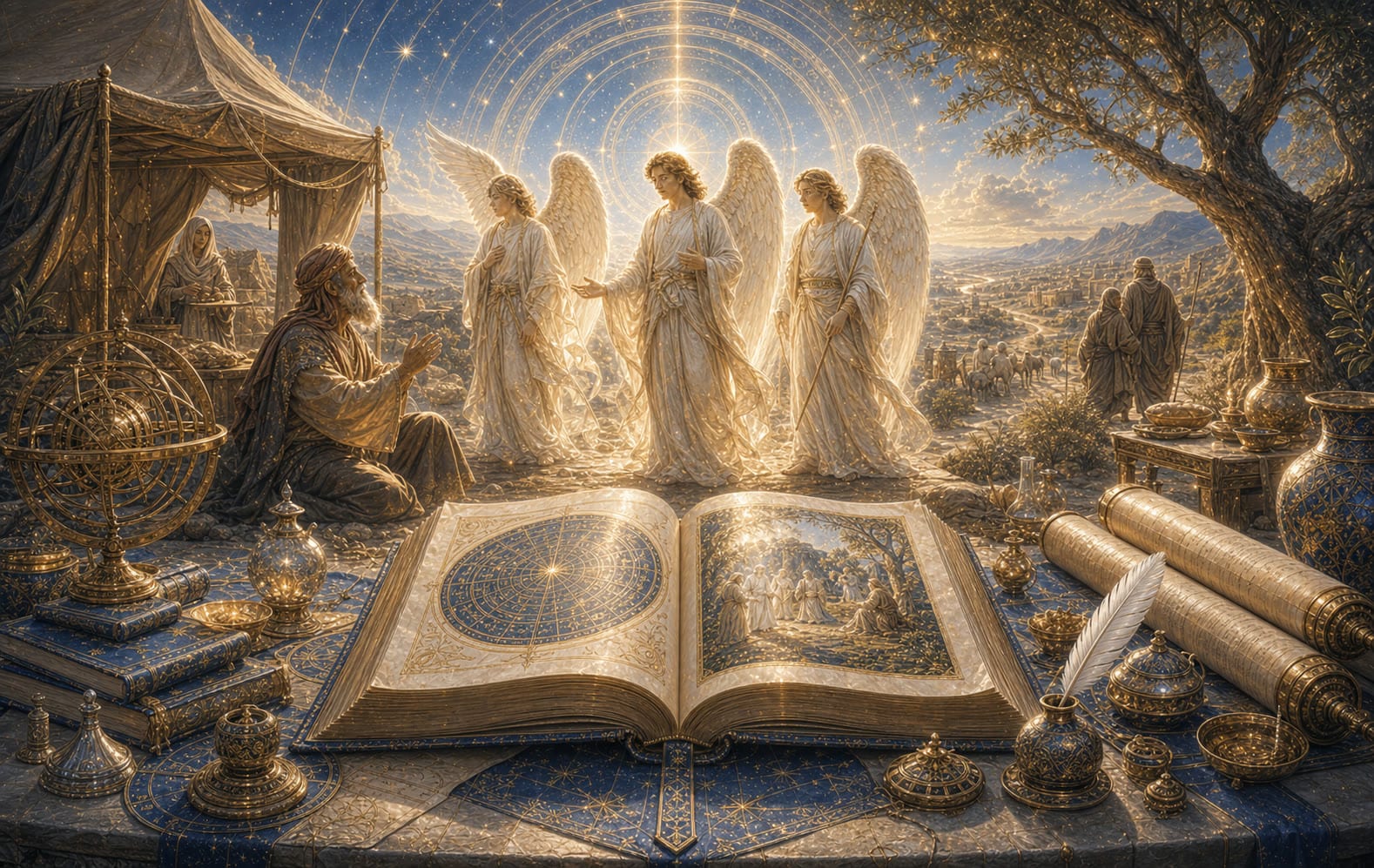
Angels in Genesis look like travellers. Abraham serves three of them a meal, the men of Sodom take two of them for strangers, and Jacob wrestles one who is called simply "a man" and will not give his name: "Why is it that you ask my name?" (32:29). Wings, faces, and fire belong to later books.
The Hebrew word for angel, mal'ak, means messenger, and Genesis uses it for both kinds. In 32:1 "the angels of God" meet Jacob, and two verses later Jacob sends mal'akhim, messengers, to his brother Esau. A heavenly messenger is known by who sent it and whose words it carries, and in several scenes the messenger's words become the LORD's own.
Quick Facts
- First heavenly beings
- Cherubim east of Eden (Genesis 3:24)
- First use of "angel"
- The angel of the LORD finds Hagar (Genesis 16:7)
- "Angel of the LORD" in Genesis
- Only in chapters 16 and 22
- Angels given names
- None; the Talmud later names Michael, Gabriel, and Raphael (Bava Metzia 86b)
- Jacob's angel scenes
- Genesis 28:12; 31:11-13; 32:1-2; 32:24-30; 48:16
- Disputed passage
- The sons of God of Genesis 6:1-4
Where do angels appear in the book of Genesis?
Angels or other heavenly beings appear in thirteen passages of Genesis, from the gate of Eden to Jacob's deathbed.
| Passage | Who appears | What happens |
|---|---|---|
| Genesis 3:24 | Cherubim with "a sword flaming and turning" | They guard the way to the tree of life east of Eden |
| Genesis 6:1-4 | The sons of God | They take human wives before the flood; who they are is disputed |
| Genesis 16:7-13 | The angel of the LORD | He finds Hagar at a spring, sends her back, and promises her descendants |
| Genesis 18:1-33 | Three men at the oaks of Mamre | They eat Abraham's meal and promise Sarah a son |
| Genesis 19:1-22 | Two angels | They lodge with Lot, blind the crowd, and lead his family out of Sodom |
| Genesis 21:17-19 | The angel of God, calling from heaven | He speaks to Hagar before God shows her a well |
| Genesis 22:11-18 | The angel of the LORD, calling from heaven | He stops Abraham from sacrificing Isaac and repeats the promise |
| Genesis 24:7, 40 | An angel Abraham expects God to send | It goes ahead of the servant who finds Rebekah, unseen |
| Genesis 28:12 | Angels of God on a stairway | They go up and down while Jacob sleeps at Bethel |
| Genesis 31:11-13 | The angel of God in a dream | He tells Jacob to leave Laban and says, "I am the God of Bethel" |
| Genesis 32:1-2 | The angels of God | They meet Jacob, who names the place Mahanaim, "two camps" |
| Genesis 32:24-30 | A man | He wrestles Jacob until daybreak and renames him Israel |
| Genesis 48:15-16 | "The angel who has redeemed me from all harm" | Jacob calls on him to bless Joseph's sons |
Are angels created in Genesis 1, and when do they first appear?
Not in the creation story. Genesis 1 and 2 never mention angels, so interpreters have had to place their creation themselves. In Genesis Rabbah 1:3, Rabbi Yochanan says "the angels were created on the second day" and Rabbi Chanina says the fifth, each backing his date with a verse, while Augustine suggested they were made with the light of the first day, "if we are justified in understanding in this light the creation of the angels" (City of God 11.9).
The first heavenly beings Genesis actually shows are the cherubim of 3:24. After the man and woman are driven out, God places "the cherubim and a sword flaming and turning to guard the way to the tree of life" at the east of Eden. They guard a boundary and say nothing, the same silent guarding role cherubim have when they reappear as golden figures over the ark.
The word angel does not appear until 16:7, when the angel of the LORD finds Hagar. Between those two points, the only beings Genesis might count as heavenly are the sons of God of chapter 6.
Who were the sons of God in Genesis 6?
Genesis 6:2 says that "the sons of God saw that they were fair, and they took wives for themselves of all that they chose," and 6:4 sets the event in the time of the Nephilim. The passage never says who the sons of God were, and three readings have competed since antiquity.
| Reading | Early witnesses | What it rests on |
|---|---|---|
| Heavenly beings | 1 Enoch 6-7; Josephus, Antiquities 1.3.1 | In Job 1:6 the same Hebrew phrase names the heavenly beings who stand before the LORD |
| Rulers or judges | Targum Onkelos; Genesis Rabbah 26:5; Rashi | Elohim can mean judges or powerful men as well as God |
| Descendants of Seth | Augustine, City of God 15.23 | Genesis 4 and 5 set Cain's line against Seth's |
Josephus reports the angelic reading as tradition: "many angels of God accompanied with women, and begat sons that proved unjust." The Book of Enoch tells the same story at length in chapters 6 and 7. There the heavenly beings who come down to marry are called the Watchers.
Rabbinic tradition pushed back. Targum Onkelos translates "the sons of the rulers," and Genesis Rabbah 26:5 reports that Rabbi Shimon bar Yochai "used to curse anyone who would call them" sons of God rather than sons of judges. Rashi gives the rulers reading first and the angelic one second, as princely angels sent by God who "intermingled with them."
Augustine left open whether angels, being spirits, could father children, and he concluded that "the sons of God, who were according to the flesh the sons of Seth," fell into the society of Cain's descendants (City of God 15.23).
The choice decides whether Genesis contains a story of angels sinning. Readers who take the angelic view usually connect it with Jude 6 and 2 Peter 2:4, which speak of angels who sinned and are kept in chains of darkness, though neither letter names Genesis 6.
Who spoke to Hagar in the wilderness?
The angel of the LORD, the first figure in the Bible to carry that title. He finds Hagar, Sarai's Egyptian slave, "by a spring of water in the wilderness, the spring on the way to Shur" (16:7), after she has run away from Sarai's harsh treatment.
He tells her to go back and promises, "I will so greatly multiply your offspring that they cannot be counted for multitude" (16:10), then names her unborn son Ishmael, "God hears" (16:11). A promise of countless descendants is the promise God makes to Abraham, and Hagar treats the speaker as God: she "named the LORD who spoke to her, 'You are El-roi,'" and asked, "Have I really seen God and remained alive after seeing him?" (16:13).
Whether this angel of the LORD is God appearing in visible form or a messenger speaking in his sender's first person is the central dispute over the figure, and Genesis 16 is one of the scenes every side cites.
Hagar hears a heavenly voice a second time after Abraham sends her and Ishmael away into the wilderness of Beer-sheba (21:14). "The angel of God called to Hagar from heaven" (21:17), and then "God opened her eyes, and she saw a well of water" (21:19). The first meeting sends her back into Abraham's household, and the second keeps her son alive outside it.
Who were the three men who visited Abraham at Mamre?
Genesis calls them men. The chapter opens, "The LORD appeared to Abraham by the oaks of Mamre" (18:1), and then Abraham "looked up and saw three men standing near him" (18:2). He runs to meet them, has their feet washed, and serves bread, curds, milk, and a calf, which they eat under the tree (18:4-8).
The story then separates the three. One of them, speaking as the LORD, promises, "I will surely return to you in due season, and your wife Sarah shall have a son" (18:10). The men set out toward Sodom "while Abraham remained standing before the LORD" (18:22), and 19:1 says that "the two angels came to Sodom in the evening." Three arrive at the tent, two reach Sodom, and the third is never called an angel.
Jewish tradition reads all three as angels with one task each, and the Babylonian Talmud gives them names (Bava Metzia 86b).
| Angel | Task in the Talmud's account |
|---|---|
| Michael | Came "to announce to Sarah that she was to give birth to a son" |
| Raphael | Came "to heal Abraham after his circumcision" |
| Gabriel | "Went to overturn Sodom" |
Rashi gives the rule behind the division, "one angel does not carry out two commissions," and has Raphael go on from Abraham to rescue Lot.
Christian readers have often taken one visitor as the LORD himself. Justin Martyr argued that the one "who is both Angel and God and Lord" appeared as a man to Abraham (Dialogue with Trypho 58), and Hebrews 13:2, "some have entertained angels without knowing it," is usually read as a reference to this meal.
What did the two angels do in Sodom?
They came to destroy the city and to get Lot's family out first. Lot, "sitting in the gateway of Sodom," presses them to stay with him (19:1-3), and that night the men of the city surround the house and demand the visitors.
The angels act three times. They pull Lot back inside and strike the crowd at the door "with blindness" (19:10-11). They state their errand: "We are about to destroy this place, because the outcry against its people has become great before the LORD" (19:13). And when Lot lingers at dawn, "the men seized him and his wife and his two daughters by the hand, the LORD being merciful to him" (19:16).
The chapter calls the same pair angels and men by turns, and the people of Sodom see only men. Their errand completes a line from the day before, when the LORD told Abraham, "I must go down and see whether they have done altogether according to the outcry that has come to me" (18:21); the two who arrive in Sodom carry out that inspection.
Who stopped Abraham from sacrificing Isaac?
The angel of the LORD, calling from heaven. As Abraham takes the knife, the angel calls, "Abraham, Abraham!" and says, "Do not lay your hand on the boy or do anything to him, for now I know that you fear God" (22:11-12).
The angel does not provide the substitute. Abraham looks up and sees "a ram, caught in a thicket by its horns" (22:13), offers it, and names the place "The LORD will provide" (22:14).
Then the angel calls a second time and repeats the promise of descendants as an oath, "By myself I have sworn, says the LORD" (22:16). Earlier he had said Abraham had not withheld his son "from me," though the offering was made to God, so here too the messenger speaks in God's first person.
Genesis uses the phrase "angel of the LORD" only here and in chapter 16, and both scenes concern the life of one of Abraham's sons: Ishmael promised to a runaway slave, and Isaac spared on the altar.
What do the angels on Jacob's ladder mean?
Genesis does not explain them. Jacob, running from Esau, sleeps at Bethel and dreams of "a stairway set up on the earth, the top reaching to heaven; and the angels of God were ascending and descending on it" (28:12). The NRSVUE translates the Hebrew sullam as stairway, with ramp as another possibility; ladder is the King James rendering.
The angels have no speaking part. The words come from the LORD, who "stood beside him" and repeats the promise of land and descendants given to Abraham (28:13-15). Jacob's response is about the place: "Surely the LORD is in this place," he says, and "this is none other than the house of God, and this is the gate of heaven" (28:16-17).
Rashi reads the order of the verbs, up before down, as a change of escort: the angels who had accompanied Jacob in the land of Israel "were not permitted to leave the Land," so they ascended, and angels assigned to minister outside the Land descended to go with him. The Gospel of John applies the image to Jesus: "you will see heaven opened and the angels of God ascending and descending upon the Son of Man" (John 1:51).
Jacob meets angels twice more on the road. In a dream at Haran, "the angel of God" calls him and then says, "I am the God of Bethel" (31:11-13), tying the order to leave Laban back to the stairway dream. On the way home "the angels of God met him," and he names the place Mahanaim, "two camps," saying, "This is God's camp!" (32:1-2). Rashi reads the messengers Jacob sends to Esau in the next verse as "actually angels," following Genesis Rabbah 75:4.
Who did Jacob wrestle with at Peniel?
Genesis calls him "a man" who wrestled with Jacob "until daybreak" (32:24), then lets the characters say more. The man renames Jacob Israel, "for you have striven with God and with humans and have prevailed" (32:28), and Jacob names the place Peniel because "I have seen God face to face, yet my life is preserved" (32:30).
Hosea 12:4 calls the opponent an angel: "He strove with the angel and prevailed; he wept and sought his favor." The line before it says, "in his manhood he strove with God" (Hosea 12:3), so the prophet treats the angel as the form in which Jacob met God.
Later interpreters divided along the same lines as at Mamre. Genesis Rabbah 77:3, followed by Rashi, identifies the man as Esau's guardian angel, which ties the fight to Jacob's meeting with Esau the next morning. Justin Martyr counted him with the visitor at Mamre as the one "who is both Angel and God and Lord," appearing in human form.
Jacob mentions an angel once more at the end of his life. Blessing Joseph's sons, he calls on "the God who has been my shepherd all my life to this day" and on "the angel who has redeemed me from all harm" (48:15-16), setting God and the angel in parallel lines of one blessing.
Frequently Asked Questions
Is the serpent in Genesis a fallen angel?
Genesis does not say so. It calls the serpent "more crafty than any other wild animal that the LORD God had made" (3:1). The identification with Satan comes later, in texts such as Revelation 12:9, which speaks of "that ancient serpent, who is called the devil and Satan."
Did the angels at Mamre really eat?
Genesis 18:8 says they ate. The Talmud (Bava Metzia 86b) answers that they "merely appeared as though they ate and drank," and the angel Raphael says the same of himself in Tobit 12:19: "I was not really eating anything, but what you saw was a vision."
Are the Nephilim the children of angels?
Only on the angelic reading of Genesis 6. Genesis 6:4 places the Nephilim on the earth "in those days" and "also afterward," and Numbers 13:33 reports Nephilim in Canaan long after the flood, so Genesis does not present them as one generation that the flood ended.
Is the angel who redeemed Jacob the same as the angel of the LORD?
Genesis 48:16 does not use that title, but interpreters who read the angel of the LORD as God's own presence often cite this verse, because Jacob sets "the angel" beside God as the one who blesses. Rashi reads it more simply as "the angel who was usually sent to me in my trouble," pointing back to the angel of God in Jacob's dream at 31:11.
Sources
- (2021). Genesis 3:1, 24; 6:1-4; 16:7-13; 18:1-22; 19:1-16; 21:14-19; 22:6-16; 24:7, 40. Bible Gateway. Link
- (2021). Genesis 28:12-17; 31:11-13; 32:1-3, 24-30; 48:15-16. Bible Gateway. Link
- (2021). Numbers 13:33; Job 1:6; Hosea 12:3-4; Tobit 12:19; John 1:51; Hebrews 13:2; 2 Peter 2:4; Jude 6; Revelation 12:9. Bible Gateway. Link
- . Bava Metzia 86b. Sefaria. Link
- . Bereshit Rabbah 1:3 and 26:5. Sefaria. Link
- (11th century). Commentary on Genesis 6:2; 18:2; 28:12; 32:4; 32:25; 48:16 (Hebrew verse numbers). Sefaria. Link
- . Genesis 6:2. Sefaria. Link
- (c. 93). Antiquities of the Jews, Book 1, chapter 3, section 1. Project Gutenberg. Link
- (c. 417-426). City of God, Book 11, chapter 9 and Book 15, chapter 23. Nicene and Post-Nicene Fathers, New Advent. Link
- (c. 155-160). Dialogue with Trypho, chapters 56 and 58. Ante-Nicene Fathers, vol. 1, New Advent. Link
- . Commentaries on Hebrews 13:2. Bible Hub. Link
- (2010). Angels: A History. Oxford University Press
About Our Editorial Process
Every KnowTheAngels guide separates calculation method, tradition context, and personal reflection. We cite where interpretations come from, present more than one view, and never present symbolic reading as prediction.
Read our editorial policy