How the Numerology Compatibility Calculator Sorts Two Life Path Numbers
Two birth dates, two Life Path numbers, and a three-category sorting rule checked against published pair readings
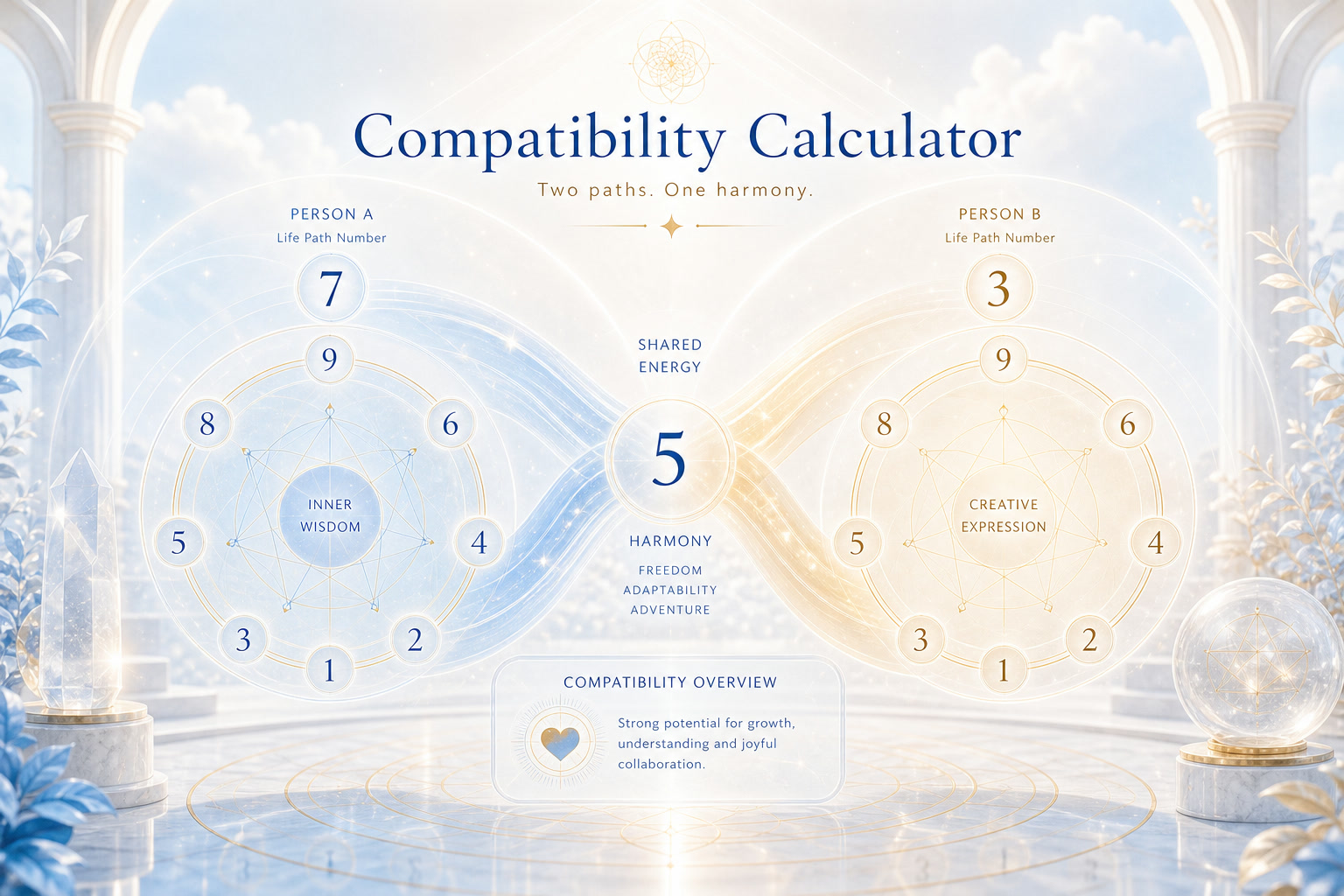
This tool organizes your input for reflection. It does not prove angel contact, predict an outcome, or replace your judgment.
This calculator takes two birth dates, reduces each to a Life Path number, and sorts the pair into one of three categories: same number, complementary (within two or adding to ten), or challenging (everything else). The result shows each person’s digit-sum arithmetic and one sentence naming the category.
The sorting rule is a numerical shortcut, not a summary of published numerology. On some pairs the classification agrees with what Andrews, Decoz, and Numerology.com write; on others it contradicts all three.
The pair guides linked from the result carry the fuller, source-by-source reading.
Quick Facts
- Input
- Two birth dates (month, day, year selects; 1930 to 2010)
- Calculation
- Full-date digit sum reduced to a Life Path number; 11, 22, and 33 always kept
- Sorting rule
- Same number, within two or adding to ten, or everything else
- Result
- Two Life Path cards with visible arithmetic, plus one pair-dynamic sentence
- Follow-up
- Pair guide link for single-digit pairs; no pair link for master numbers
What the calculator takes and shows
The input is two birth dates. Each person’s date is entered with three dropdown selects for month, day, and year; the year list runs from 1930 to 2010.
There is no name field, no zodiac input, and no master-number toggle. The tool always preserves 11, 22, and 33 as master numbers.
The result panel shows three cards. Person A and Person B each get a Life Path card displaying the number, the digit-sum step line, and a one-line theme.
A third card, labeled "Pair Dynamic," shows one sentence classifying the pair. That sentence comes from a fixed numerical rule, not from a named numerology source.
How each birth date becomes a Life Path number
The tool writes the selected month, day, and year without zero-padding, then adds every digit. March enters the sum as 3, not 03.
For a Person A birth date of March 5, 1990: 3 + 5 + 1 + 9 + 9 + 0 = 27, then 2 + 7 = 9. The result is Life Path 9.
For a Person B birth date of February 10, 1985: 2 + 1 + 0 + 1 + 9 + 8 + 5 = 26, then 2 + 6 = 8. The result is Life Path 8.
If the running total or a reduction step reaches 11, 22, or 33, the tool stops and keeps the master number. There is no option to change this.
The method is the same full-date digit sum the Life Path calculator uses. One difference: the compatibility tool does not check whether the selected date exists on the calendar, so a selection like February 30 still produces a result.
The three-category sorting rule
The pair sentence is determined by comparing the two Life Path numbers as plain integers. Three tests are applied in order.
If the two numbers are equal, the result reads "Mirror energy — deep understanding but potential for amplified challenges."
If the numbers differ by two or less, or add to exactly ten, the result reads "Balancing energies that support each other’s growth." Every other combination reads "Dynamic tension that promotes growth through contrast."
For the worked example (Life Path 9 and Life Path 8), the difference is one. That falls within two, so the tool returns the complementary sentence.
| Category | Result sentence | Pairs |
|---|---|---|
| Same (9 pairs) | Mirror energy — deep understanding but potential for amplified challenges. | 1-1, 2-2, 3-3, 4-4, 5-5, 6-6, 7-7, 8-8, 9-9 |
| Complementary (18 pairs) | Balancing energies that support each other’s growth. | 1-2, 1-3, 1-9, 2-3, 2-4, 2-8, 3-4, 3-5, 3-7, 4-5, 4-6, 5-6, 5-7, 6-7, 6-8, 7-8, 7-9, 8-9 |
| Challenging (18 pairs) | Dynamic tension that promotes growth through contrast. | 1-4, 1-5, 1-6, 1-7, 1-8, 2-5, 2-6, 2-7, 2-9, 3-6, 3-8, 3-9, 4-7, 4-8, 4-9, 5-8, 5-9, 6-9 |
Nine of the 45 unique single-digit pairs fall into same, eighteen into complementary, and eighteen into challenging.
The result sentence is the tool’s own wording. It does not quote or summarize a named numerology author.
Where the rule agrees and disagrees with published pair readings
The published pair readings summarized on this site do not apply a difference-of-two or sum-to-ten rule. Andrews (Numerologist.com), Decoz and Numerology.com each describe a pair on its own terms.
On some pairs the tool’s classification matches the published consensus. On others it reaches the opposite conclusion.
The 2-8 pair guide shows agreement. The tool classifies 2-8 as complementary (the numbers add to ten), and all three publishers read the pair positively.
On that guide, Decoz calls 8 the "most favorable" match for a 2. Andrews calls the pair "the classic complementary arrangement," and Numerology.com says the pair can "bring each other balance."
The 4-5 pair guide shows the opposite. The tool classifies 4-5 as complementary (difference of one), but all three sources describe genuine difficulty.
On the 4-5 guide, Andrews calls the pair "the pairing that numerology most consistently identifies as genuinely difficult." Numerology.com labels it a "challenging combination" with "polar opposites."
Decoz warns the 4 to avoid the 5, calling the 5 "attractive, but dynamic and restless."
Life Path 3 and 9 runs the other way. The tool classifies 3-9 as challenging (difference of six), but all three sources on the pair guide read it positively.
Andrews calls 3-9 "one of numerology’s warmer harmonies." Numerology.com describes "great chemistry" and says the coupling "could last a lifetime," while Decoz writes that the 3 makes "a great connection" with the 9.
| Pair | Tool category | Published readings (from pair guides) |
|---|---|---|
| 2-8 | Complementary (adds to 10) | All three agree: complementary |
| 4-6 | Complementary (difference 2) | Andrews and Decoz: harmonious. Numerology.com: rarely interested in each other, but the bond is strong when they do connect |
| 2-4 | Complementary (difference 2) | Numerology.com: one of the best. Decoz: may bore. Andrews: loyal, different reassurance needs |
| 4-5 | Complementary (difference 1) | All three: genuinely difficult |
| 3-9 | Challenging (difference 6) | All three: positive |
| 1-8 | Challenging (difference 7) | Numerology.com and Decoz: two captains. Andrews: formidable if authority is shared |
| 1-7 | Challenging (difference 6) | Numerology.com: wildcard. Decoz: poor. Andrews: tends platonic |
| 5-9 | Challenging (difference 4) | Andrews: potential. Numerology.com: oil and water. Decoz: unfavorable |
| 8-8 | Same | Numerology.com: attractive but competitive. Decoz: not favored |
The tool’s sorting rule is a rough numerical filter. It sometimes matches the published consensus and sometimes reaches the opposite conclusion, which is why the linked pair guide provides a more reliable reading than the single sentence.
How master numbers change the comparison
The tool compares master numbers as plain integers, with no reduction and no special handling. That produces classifications a reader may not expect.
Life Path 11 and Life Path 2 differ by nine, so the tool classifies them as challenging. When master numbers are not kept, 11 reduces to 2, which would make the pair 2 and 2.
Life Path 11 and 9 differ by two, placing them in the complementary category. Life Path 22 and 4 differ by eighteen, and 33 and 6 by twenty-seven, so both land in challenging.
| Pair | Integer difference | Category |
|---|---|---|
| 11 and 11 | 0 | Same |
| 11 and 9 | 2 | Complementary |
| 11 and 2 | 9 | Challenging |
| 22 and 4 | 18 | Challenging |
| 33 and 6 | 27 | Challenging |
| 11 and 22 | 11 | Challenging |
When either Life Path number is 11, 22, or 33, the result panel shows no pair guide link. The pair guides cover only combinations of 1 through 9.
Which results include a pair guide link
When both Life Path numbers are between 1 and 9, the result card shows a primary link to that pair’s dedicated compatibility guide. The URL follows the pattern /numerology/compatibility-A-B/, with the smaller number listed first.
A secondary link points to the numerology method overview. This link appears on every result regardless of master-number status.
If either number is a master number (11, 22, or 33), the primary pair guide link does not appear. The secondary method link remains.
Frequently Asked Questions
Does the calculator check whether the birth date is real?
No. The compatibility tool does not validate dates, so an impossible combination such as February 30 still produces a result.
Why does my result not show a pair guide link?
Pair guide links appear only when both Life Path numbers are between 1 and 9. A master number (11, 22, or 33) in either result means no pair link is generated.
Does the three-category rule come from published numerology?
No. The categories use a difference-and-sum test on two plain integers, and published pair readings by Andrews, Decoz, and Numerology.com sometimes reach the opposite conclusion.
Sources
- (2026). Life Path 2 and 8 Compatibility: Support Meets Strength. Numerologist.com. Link
- . Life Path 2 Compatibility and Life Path 8 Compatibility (sections on 2-8 and 8-2). Numerology.com. Link
- . Relationship Compatibility for Life Path 1 to 9 (a section for each Life Path). World Numerology. Link
- (2026). Life Path 4 and 5 Compatibility: Stability Meets Freedom. Numerologist.com, full article. Link
- . Life Path 4 Compatibility. Numerology.com, section on Life Path 5. Link
- . Life Path 5 Compatibility. Numerology.com, section on Life Path 4. Link
- (2026). Life Path 3 and 9 Compatibility: Two Creatives Who Get Each Other. Numerologist.com, full article. Link
- . Life Path 3 Compatibility. Numerology.com, section on Life Path 9. Link
- . Life Path 9 Compatibility. Numerology.com, section on Life Path 3. Link
- (2026). Life Path 4 and 6 Compatibility: Grounded, Warm, Built to Last. Numerologist.com, full article. Link
- . Life Path 6 Compatibility. Numerology.com, section on Life Path 4. Link
- (2026). Life Path 2 and 4 Compatibility: Built to Last. Numerologist.com, compatibility section. Link
- (2026). Life Path 1 and 8 Compatibility: Two Power Players. Numerologist.com, full article. Link
- . Life Path 1 Compatibility. Numerology.com, section “Life Path 1 and 8”. Link
- . Life Path 8 Compatibility. Numerology.com, section “Life Path 8 and 1”. Link
- (2026). Life Path 1 and 7 Compatibility: Leader Meets Loner. Numerologist.com, published May 4, 2026, updated July 20, 2026. Link
- . Numerology Life Path 7 Compatibility. Numerology.com, section on Life Path 7 and 1. Link
- (2026). Life Path 5 and 9 Compatibility: Two Free Spirits. Numerologist.com. Link
About Our Editorial Process
Every KnowTheAngels guide separates calculation method, tradition context, and personal reflection. We cite where interpretations come from, present more than one view, and never present symbolic reading as prediction.
Read our editorial policy