What Crystals Are Used for Angel Connection, and Why?
A material-first guide to identifying, caring for, and using one stone as a tactile symbol without medical or angel-contact claims
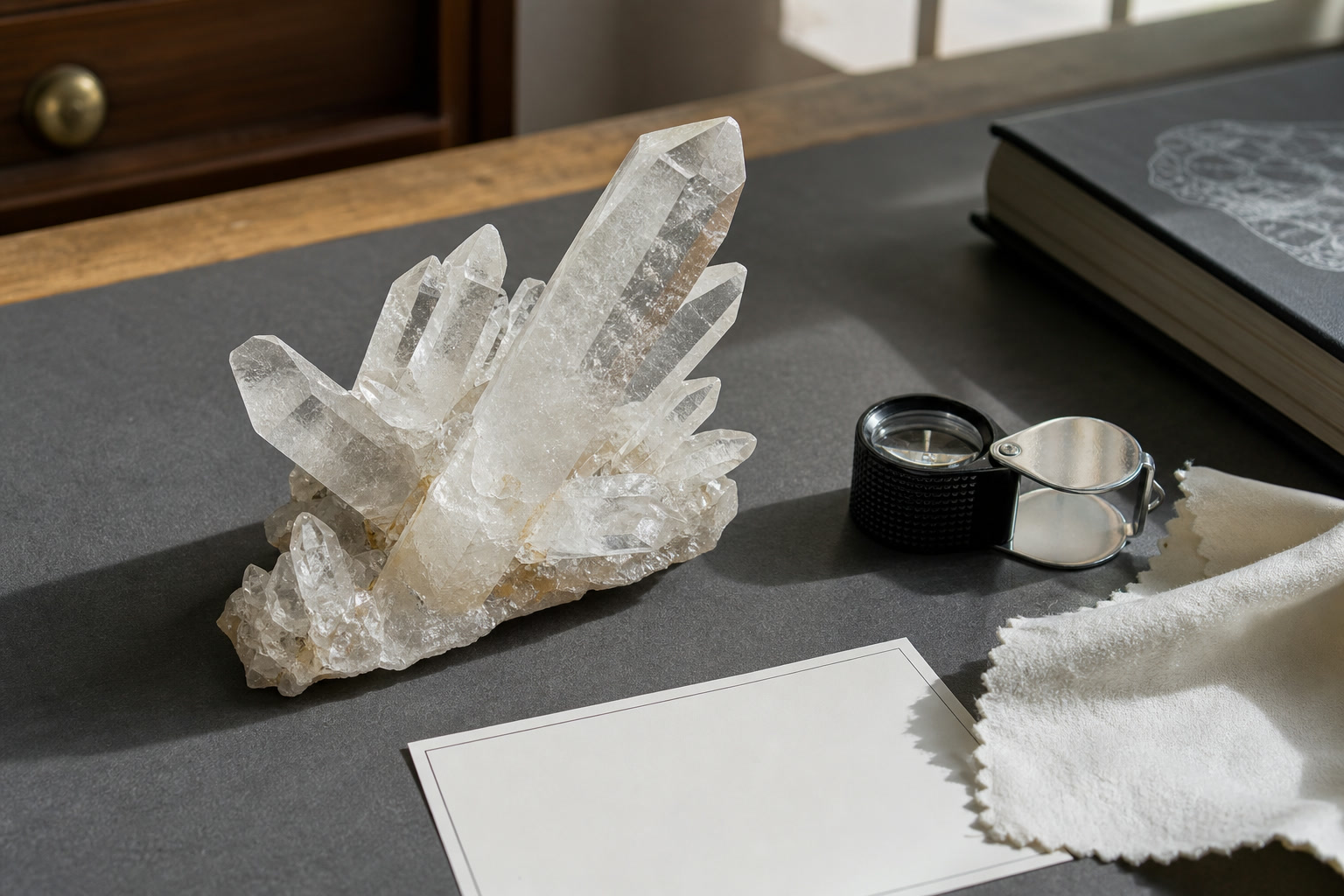
Crystals in angel practice are physical minerals used as tactile or symbolic supports. Their hardness, composition, color, fractures, coatings, and treatments belong to geology and material care.
Angel associations belong to later spiritual interpretation. Identify the stone before you assign meaning or choose a cleansing method.
Start with one specimen and keep the seller label. Compare color, transparency, luster, and obvious inclusions with a reputable mineral reference.
Dyed, heat-treated, coated, reconstructed, and mislabeled material still needs appropriate care even when the buyer values it symbolically.
A stone may help attention by giving the hand or eye one stable object. It cannot establish a spiritual cause for a sensation, replace medical care, or make a prayer more effective.
The practice remains optional and the claim remains proportionate.
Quick Facts
- First task
- Identify the mineral and any coating, dye, treatment, or composite material
- Care rule
- Use mineral-specific guidance before water, salt, heat, or sunlight
- Practice size
- One stone, one chosen association, and one short reflection
- Claim split
- Composition is material fact; angel association is modern symbolism
- Health boundary
- A crystal does not diagnose, treat, protect, or prove contact
Which crystals are commonly used for angel connection?
Modern angel and crystal guides commonly name clear quartz, amethyst, rose quartz, selenite, celestite, and angelite. Clear quartz is usually associated with clarity or amplification, amethyst with contemplation, rose quartz with compassion, and pale blue or white stones with calm, sky, or heavenly imagery.
These are modern correspondences, not a universal mineral system or proof that a stone creates contact. Authors and communities assign the meanings differently, so the useful question is whether you can name both the material and the source of the symbolism you chose.
| Name used in practice | Material identity | Why the identity matters |
|---|---|---|
| Clear quartz, amethyst, rose quartz | Quartz varieties | They share a mineral family, but color, inclusions, treatments, and settings still affect care |
| Selenite | A crystalline variety of gypsum | Gypsum is soft, has perfect cleavage, and is slightly soluble in water, so repeated soaking is a poor default |
| Celestite or celestine | Strontium sulfate | The sky-blue name does not supply an angel property; verify the specimen before choosing a cleaning method |
| Angelite | A trade name used for blue-gray anhydrite | The spiritual-sounding label is a market name, not a separate mineral species |
If you already own one of these stones, begin with its label, seller, setting, and visible condition. If you are buying one, prefer a seller who states the mineral identity and any treatment instead of promising healing, protection, or guaranteed angel messages.
Why does mineral identity come before spiritual meaning?
A trade name is not always a mineral name. Color labels can cover quartz, glass, calcite, gypsum, treated material, or a composite.
Identity affects durability and care before it affects any chosen symbolism.
Keep the seller’s label and note where the specimen came from. Compare luster, transparency, color zoning, cleavage, and obvious coatings with a reputable reference.
Avoid destructive home tests on a valued object.
Quartz is one of the most abundant minerals in the Earth’s crust.
Smithsonian National Museum of Natural HistoryDepartment of Mineral Sciences reference
That statement supports a material fact about quartz. It does not support a claim that clear quartz amplifies prayer, and it does not establish one universal angel association that every tradition shares.
Readers using a dedicated devotional surface should treat the stone as one object within altar practice, not as the source of the altar’s meaning.
Identification therefore changes what the reader can safely do and accurately claim. The specimen remains a real material object even when its chosen symbolism changes.
For the reader, mineral identity is the gateway to safe care. It also prevents a trade label from quietly becoming evidence for a spiritual association.
Which claims belong to geology and which belong to symbolism?
Composition, crystal structure, hardness, cleavage, solubility, inclusions, and treatments are material claims. Color associations, angel links, chakra correspondences, and intentions are interpretive claims supplied by communities and authors.
The two categories use different evidence. A mineral reference can support composition or hardness.
A modern spiritual author can document a published correspondence, but publication does not turn that correspondence into geology.
| Claim | Owner | How to state it |
|---|---|---|
| Quartz contains silicon and oxygen | Mineral science | Material description |
| Amethyst is purple quartz | Mineral science | Identity and color variety |
| A stone represents calm or courage | Chosen symbolism | Personal or community association |
| A stone guarantees protection | Unsupported outcome claim | Do not present as fact |
Modern crystal correspondences vary. A purple symbolism guide can show how liturgy, status, optics, and modern spirituality give the same color different owners.
Labeling the symbolic choice does not make the practice empty. It makes clear who assigned the meaning and keeps the mineral from being asked to prove it.
The meaning of blue provides another example.
Wavelength, dye, mineral color, liturgy, and spiritual association are related topics with different owners.
The reader can now state both claims accurately. “This is blue fluorite” describes the specimen, while “I use blue as a calm symbol” describes the chosen practice.
Care for the actual material, not the cleansing trend
Water, salt, sunlight, heat, acids, and abrasion do not affect every mineral in the same way. Fractures, inclusions, dyes, coatings, metal settings, and glued components add more variables.
The safe default depends on identity and construction, not on a universal cleansing list. Even two specimens sold under the same color name may contain different minerals or surface treatments.
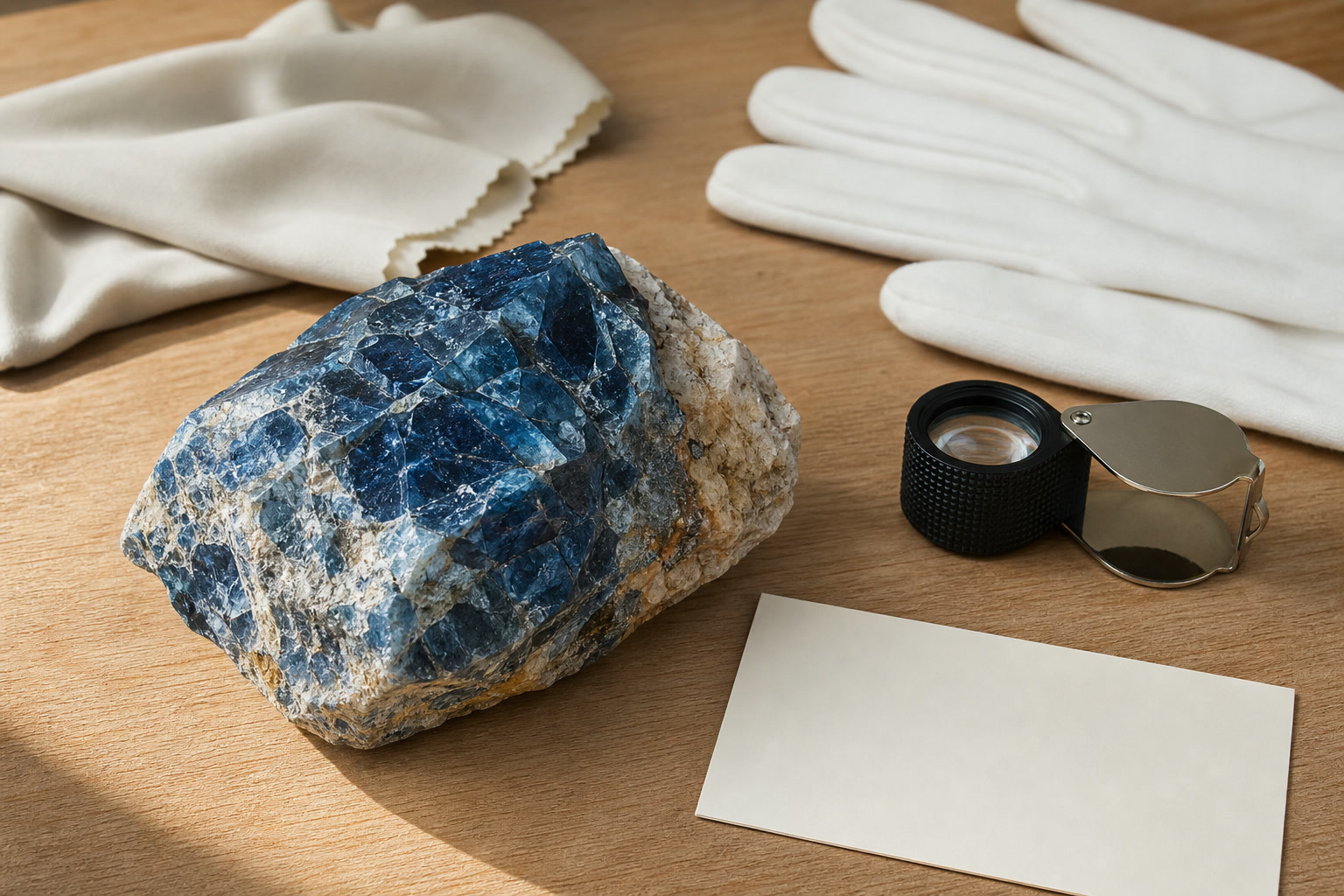
A soft dry cloth is a cautious starting point for dust. Use mineral-specific conservation guidance before immersion or salt.
Some specimens are soft, soluble, porous, coated, or light-sensitive.
Energetic cleansing is a symbolic ritual, while physical cleaning changes the material surface. Keep those actions distinct so a spiritual routine does not damage the specimen.
If a stone is used during prayer during illness, clean it for ordinary hygiene and keep it away from unsafe remedies. The prayer owns the petition.
Treatment remains with qualified care.
Material care protects both the object and the reader’s honesty. A damaged coating or dissolved surface is not spiritual release.
It is a preventable physical change.
This distinction gives the reader a safer next step. Identify first, choose the least aggressive care, and leave symbolic cleansing separate from physical cleaning.
How can one stone support attention without becoming necessary?
Choose one stone that is comfortable to hold or place in view. Name one association you are intentionally using, such as steadiness, courage, remembrance, or calm.
Use a timer and decide the ending before the session begins. The physical weight or cool surface may help attention return, but the sensation does not need interpretation.
A ten-minute one-stone focus practice
The object supports attention and remains optional.
- Identify
- Input
- One labeled specimen
- Action
- Confirm the best available mineral identity and safe handling.
- Result
- The material boundary is visible.
- Choose
- Input
- One current intention
- Action
- Write the symbolic association in your own words.
- Result
- Meaning follows the reader’s stated purpose.
- Attend
- Input
- Breath, prayer, or quiet observation
- Action
- Hold or view the stone for a fixed short period.
- Result
- Attention has one tactile or visual anchor.
- Remove
- Input
- The timer ending
- Action
- Put the stone away and continue without it.
- Result
- The practice tests whether the object remains optional.
This differs from oracle-card reflection. A card carries authored imagery and words.
A mineral supplies texture, weight, color, and a chosen association.
Repeat the same method without the stone on another day. If prayer or calm feels impossible without it, reduce use rather than adding more objects.
A one-image visualization tests attention through an inner picture instead. Comparing the methods can show whether tactile contact or mental imagery is the more useful anchor.
The stone remains optional when the reader can complete the same intention with breath, words, or silence. That comparison is a practical dependence check.
What do healing and protection claims miss?
A crystal cannot diagnose illness, replace treatment, neutralize a dangerous person, or guarantee a safe outcome.
Sensations during use may come from temperature, pressure, expectation, posture, emotion, or focused attention.
Health and protection claims miss the distance between a subjective experience and a verified outcome. Feeling calmer may matter, but it does not show that a disease changed or a threat disappeared.
A protection prayer can name danger and a safety step. The stone should not be presented as a shield that removes the need for that action.
- Medical claim. Use clinical evidence and qualified treatment.
- Safety claim. Use plans, boundaries, services, and direct facts.
- Symbolic claim. Name the author, community, or personal choice.
- Material claim. Check mineral and conservation references.
Avoid blame after harm or illness.
A person did not fail because the stone was wrong, uncleansed, absent, or used without enough belief.
A traditional prayer source can be traced through a community or text. Crystal correspondences need the same honesty about modern authorship instead of borrowing an invented ancient lineage.
For the reader, the result is a clean claim boundary. Use mineral references for the object, clinical evidence for health, safety planning for danger, and labeled symbolism for reflective practice.
Can a crystal prove angel connection?
The direct answer is no. A crystal cannot prove angel connection.
Warmth, tingling, a color impression, calm, or coincidence cannot identify an angel as the cause.
The stone can remain meaningful as a chosen symbol without carrying that proof burden.
Describe the experience before interpreting it. Note which hand held the stone, room temperature, duration, posture, expectation, and whether the sensation continued after the stone was set down.
A beginner meditation uses breath return to train attention without requiring an object. Compare both methods if the stone begins to compete with the actual practice.
| Need | Better owner | Why |
|---|---|---|
| Tactile focus | One-stone practice | The material gives the hand or eye an anchor |
| Prayer for illness | Healing prayer | Petition can sit beside treatment and caregiving |
| Concrete safety response | Protection prayer | The method names danger and action |
| Attention without objects | Breath meditation | The return skill travels anywhere |
The practice is proportionate when the mineral is identified, safe care is known, symbolism is labeled, and the reader can put the stone away without feeling spiritually unprotected.
A gratitude practice may name appreciation for the object or the person who gave it. Thanks does not verify the stone’s angel association.
The reader can keep the symbol and release the proof claim. That boundary preserves material care, personal meaning, and freedom to practice without dependence.
Frequently Asked Questions
Which crystals are used in angel practice?
Modern guides often mention clear quartz, amethyst, rose quartz, selenite, and celestite. These associations vary by author and community.
They are not universal ancient angel classifications.
How do I choose one crystal?
Choose a specimen you can identify and care for safely.
Then name one symbolic association you are intentionally using.
Do not choose by a promise of guaranteed healing, protection, or contact.
Can I cleanse every crystal with water or salt?
No.
Minerals differ in hardness, solubility, fractures, inclusions, and surface treatments.
Use a dry cloth and mineral-specific care guidance when identity or durability is uncertain.
Can a crystal prove angel connection?
No.
Warmth, tingling, color impressions, calm, and coincidence have several possible causes.
A stone can support reflection without proving a supernatural presence.
Sources
- (n.d.). All Sorts of Quartz. Smithsonian National Museum of Natural History. Link
- (n.d.). Rose Quartz Care and Cleaning. GIA. Link
- (1989). Gem News: ‘Angelite’. Gems & Gemology, Gemological Institute of America. Link
- (n.d.). Gypsum HS333 (Selenite). USGS Spectroscopy Laboratory. Link
- (n.d.). Celestite. Mineral Resources Program. Link
- (2022). Health: Crystal Therapy. Advertising Standards Authority. Link
- (1996). New Age Religion and Western Culture. Brill
About Our Editorial Process
Every KnowTheAngels guide separates calculation method, tradition context, and personal reflection. We cite where interpretations come from, present more than one view, and never present symbolic reading as prediction.
Read our editorial policy