What Does Blue Light Mean Spiritually in Religion and Angel Beliefs?
The blue cord of Numbers 15:38, the ultramarine robe of medieval Marian art, the modern seven-ray teaching that ties blue to Archangel Michael, and the eye conditions that make blue light appear
Blue light carries several spiritual meanings, and each one has a different owner. Jewish law and medieval Christian painting gave blue its oldest meanings, and neither treated a patch of blue light as a sign that an angel was near.
The link to Archangel Michael is the newest layer. It comes from the seven-ray teaching of the Summit Lighthouse and from Doreen Virtue's angel books, not from the Bible or from Catholic tradition.
The older layers are better documented. Numbers 15:38 asks for a cord of blue on each corner fringe of a garment, and European painters kept ultramarine, a pigment ground from Afghan lapis lazuli, for the Virgin's mantle.
Most blue light people notice has an ordinary cause, from a screen's glow to pressure on a closed eye. A sudden shower of new flashes in one eye is different and needs an eye doctor straight away.
Quick Facts
- Oldest written source
- Numbers 15:38, a cord of blue (tekhelet) on each corner fringe
- Why Mary wears blue
- Ultramarine from lapis lazuli, at its best worth more than gold
- Michael's blue
- 20th-century ascended-master teaching and Doreen Virtue's books, not scripture
- Common ordinary cause
- Phosphenes, afterimages of warm light, and screen or LED light
- See a doctor now if
- New flashes come with many new floaters or a curtain over your vision
What does blue light mean spiritually, and who says so?
In most modern angel writing, blue light means protection, courage, and truthful speech, and it is credited to Archangel Michael.
That reading is only a few decades old.
The traditions that gave blue its older weight point elsewhere: to the sky and the divine throne, to remembering commandments, and to the cost of honoring a holy figure. The table sets out who says what, and what kind of evidence stands behind each claim.
| Owner | What blue stands for | Dates from | Kind of evidence |
|---|---|---|---|
| Hebrew Bible and the Talmud | Remembering the commandments; the sea, sky, and divine throne | Numbers 15:38; Menachot 43b | Scripture and rabbinic teaching |
| Medieval and Renaissance painting | The Virgin Mary's dignity and the value of her image | 12th century onward | Surviving paintings, patrons' payments, pigment analysis |
| Summit Lighthouse seven-ray teaching | The first ray: God's will, faith, and Michael's protection | After 1958 | Revelations its founders say they received |
| Doreen Virtue's angel books | Michael's presence, courage, and shielding | 1990s to 2017 | Personal reports; the author later withdrew them |
| Popular chakra charts | The throat center and honest speech | Modern | Popular convention with no single author |
| Eye and brain science | No symbolic meaning; pressure, afterimages, retinal changes | Current | Clinical research |
Two of those owners worked with a blue people could hold: a dyed thread and a ground stone. The Michael owners describe a blue people report seeing, and that difference decides how much each can tell you about a light in your own room.
Who made blue Archangel Michael's color?
No scripture gives Michael a color.
The books that name Archangel Michael, from Daniel to Revelation, describe what he does and say nothing about the color of his light.
The blue assignment traces to the ascended-master movement.
Its idea of seven spiritual rays grew out of Theosophy, the movement Helena Blavatsky co-founded in 1875.
The Summit Lighthouse, started by Mark Prophet in 1958 and later led by Elizabeth Clare Prophet, gave each ray a color, a master, and a pair of archangels. In its teaching the first ray is blue and stands for God's will, faith, and protection.
Michael and his counterpart, Archeia Faith, serve that ray, with El Morya as its master.
Doreen Virtue made the link familiar during the angel boom of the 1990s and 2000s. Her Hay House books sorted archangels by the color of light they were said to give off, and in The Miracles of Archangel Michael (2008) she wrote that his aura is "a royal purple that's so bright, it looks like cobalt blue."
Her own descriptions were not uniform. She also paired Michael with a golden light, and the angel-color charts that followed her call his blue royal, sapphire, or cobalt.
Virtue left the field in 2017 after converting to Christianity. She now treats her earlier New Age angel teaching as a mistake, yet the blue-Michael link she spread still fills card decks and websites.
Older Western esoteric practice places Michael elsewhere.
The Golden Dawn's Lesser Banishing Ritual of the Pentagram, from the late 1800s, sets him in the south with the element of fire, which ties him to flame rather than to sky or water.
How do Summit Lighthouse members call on Michael's blue flame?
In Summit Lighthouse teaching, the blue flame is the energy of the first ray, and members call on it through Michael when they ask for protection. The organization pictures his angels in "blue armor" and describes his legions as carrying "shields and swords of blue flame."
The best-known text is a short decree attributed to Elizabeth Clare Prophet, known by its opening words, "Lord Michael before." Members are taught to say it aloud and to repeat it in sets of three.
That spoken form sets the Michael decree apart from the colored-light shield exercises of later angel books, which ask a person to imagine a bubble of light in silence. Online Michael recordings often mix the two, naming him and then wrapping the listener in blue.
What it cannot do is lock a door or end a threat.
A Michael meditation built on scripture can keep blue as an optional focus color while real steps, such as calling someone or changing a lock, do the protecting.
Why does the Virgin Mary wear blue?
Mary wears blue in Western art largely because of a stone.
Ultramarine, the most brilliant and stable blue painters had from the Middle Ages into the 1800s, was ground from lapis lazuli mined in Afghanistan.
The National Gallery in London notes that the best grades could be worth more than gold. Patrons commissioning a painting would often pay for the exact amount of ultramarine they wanted used, so a deep blue mantle on the Virgin was a visible gift.
Blue was not always her color.
The historian Michel Pastoureau dates the change to the twelfth century, when images of Mary, earlier shown in dark garments of mourning, began to dress her in a blue mantle.
In Pastoureau's account the shift came with a new interest in light in church building. Abbot Suger filled his rebuilt abbey church of Saint-Denis with blue glass around 1140, and blue became a color fit for heaven.
Painters handled the pigment with matching care. Cennino Cennini's handbook, written around 1400, calls ultramarine "a color noble, beautiful, and perfect beyond all colors" and gives a full chapter (62) to extracting it from the stone.
Some of that history is still visible on gallery walls. Sassoferrato's The Virgin in Prayer (1640 to 1650) reached the National Gallery with its ultramarine robe painted over in cobalt blue to suit Victorian taste, and cleaning brought the original back.
The price fell only in 1828, when Jean-Baptiste Guimet won a 6,000-franc French prize for synthetic ultramarine. His pigment sold for about 400 francs a pound, against 3,000 to 5,000 francs for the natural stone.
After that, a blue robe no longer showed what a patron could afford. The Marian meaning stayed, carried by habit and devotion rather than by price.
What is tekhelet, the blue thread of Numbers 15:38?
Tekhelet is the blue dye the Torah commands for one cord on each corner fringe of a garment. The JPS translation of Numbers 15:38 reads: "let them attach a cord of blue to the fringe at each corner."
The next verse gives the reason: seeing the fringe should bring the commandments to mind. Blue here is a reminder a person wears, with no message of its own.
The Talmud explains why that color was chosen.
Rabbi Meir says tekhelet resembles the sea, the sea resembles the sky, and the sky resembles the Throne of Glory (Menachot 43b), citing Exodus 24:10 and the sapphire throne of Ezekiel's vision in 1:26.
Those verses lead back to lapis. The Hebrew word in them is sappir, which the NRSVUE renders "sapphire stone" and the Common English Bible "lapis-lazuli tiles," the same stone later ground into Mary's ultramarine.
The dye came from a sea creature the Talmud calls the chilazon, which it describes as rare and therefore expensive (Menachot 44a). Tekhelet sat beside argaman, the costly purple dye of the Tabernacle, and the high priest's robe was made "of pure blue" (Exodus 28:31).
Knowledge of the source was then lost.
The Ptil Tekhelet timeline places the end of the snail-dye industry around the Arab conquest of 639 CE, and by about 750 CE a Jewish text could say "now we have no tekhelet, only white."
The recovery took most of the twentieth century. In 1913 Yitzhak Herzog, later Chief Rabbi of Israel, named the banded dye-murex snail (Murex trunculus, now Hexaplex trunculus) as the likely source, but he could not get a steady blue from it.
Around 1980 the chemist Otto Elsner found the missing step: the snail's dye turns blue instead of purple when sunlight reaches it during dyeing. Rabbi Eliyahu Tavger dyed ritual fringes with it in 1985, and the Ptil Tekhelet association formed in the early 1990s to make the threads.
For a reader asking what blue means in the Bible, tekhelet is the clearest answer. It is a color worn to remember obligations, and no Jewish source treats it as an angel sign.
What in the eye and the room produces blue light?
Blue light with the eyes closed is usually a phosphene, light the eye or brain produces without any light coming in. Cleveland Clinic lists rubbing the eyes, pressure on the eyeball, coughing, sneezing, and standing up quickly as common triggers.
Phosphenes can be brightly colored and fade within seconds, with no change in vision afterward. That short, harmless pattern fits many of the sparks and soft glows people notice in meditation or while falling asleep.
Afterimages explain another share, and they favor blue.
Look at a yellow lamp, a candle flame, or a low orange sun, then close your eyes, and the patch left behind often takes the opposite color, which for warm light is blue.
With the eyes open, unexplained blue in a room usually has a source that is easy to miss: a router or charger standby light, a screen reflected on the ceiling, LED headlights sweeping past a window, or sunlight through colored glass. In photographs, blue orbs usually come from dust or droplets near the lens catching the flash.
Flashes are the exception to that calm list. Flashes of light in one eye, together with many new floaters or a dark shadow across part of the view, can mean the retina is tearing or detaching, and the National Eye Institute advises going to an eye doctor or emergency room right away.
Most flashes are less serious.
The NHS says they usually come from posterior vitreous detachment, a common change in the gel inside the eye, yet it still wants an urgent check when flashes appear for the first time or suddenly increase.
Migraine aura is the other frequent cause of flashing or zigzag light. The NHS says aura should not last longer than an hour.
- Go right away (eye doctor or emergency room): new flashes with a shower of new floaters, or a shadow or curtain over part of your vision.
- Get an urgent same-day check (optician, NHS 111, or your eye doctor): flashes or floaters for the first time, a sudden increase, blurred vision, eye pain, or flashes after an eye injury or eye surgery.
- Call emergency services: a sudden, very painful headache with loss of vision, slurred speech, confusion, or weakness on one side.
- Get medical advice the same day: an aura that lasts longer than an hour.
- Mention it at your next routine exam: brief sparks after rubbing your eyes, coughing, or standing up, with vision unchanged.
Get the eye checked first. Any meaning the moment holds will still be there after the appointment.
Is a patch of blue light a sign that an angel is near?
Only the modern Michael teachings read blue light as a sign of an angel.
The Summit Lighthouse and Virtue's books teach that people may sense Michael as blue light, and that is a belief about what a light means rather than a finding anyone can check.
Neither Jewish law nor Christian art makes that claim at all. The First Letter of John asks believers to "test the spirits to see whether they are from God" (1 John 4:1, NRSVUE), and a Christian reader can apply that test to a light as well as to a voice.
What a reader can do is record the moment plainly: the time, the setting, any light source found, what was on your mind, and what changed afterward. A communication journal keeps those details apart from the meaning you later give them.
If the blue came with a strong sense of presence, write that feeling down as its own entry. If it came while you slept, light in a dream is read by different rules from light seen awake.
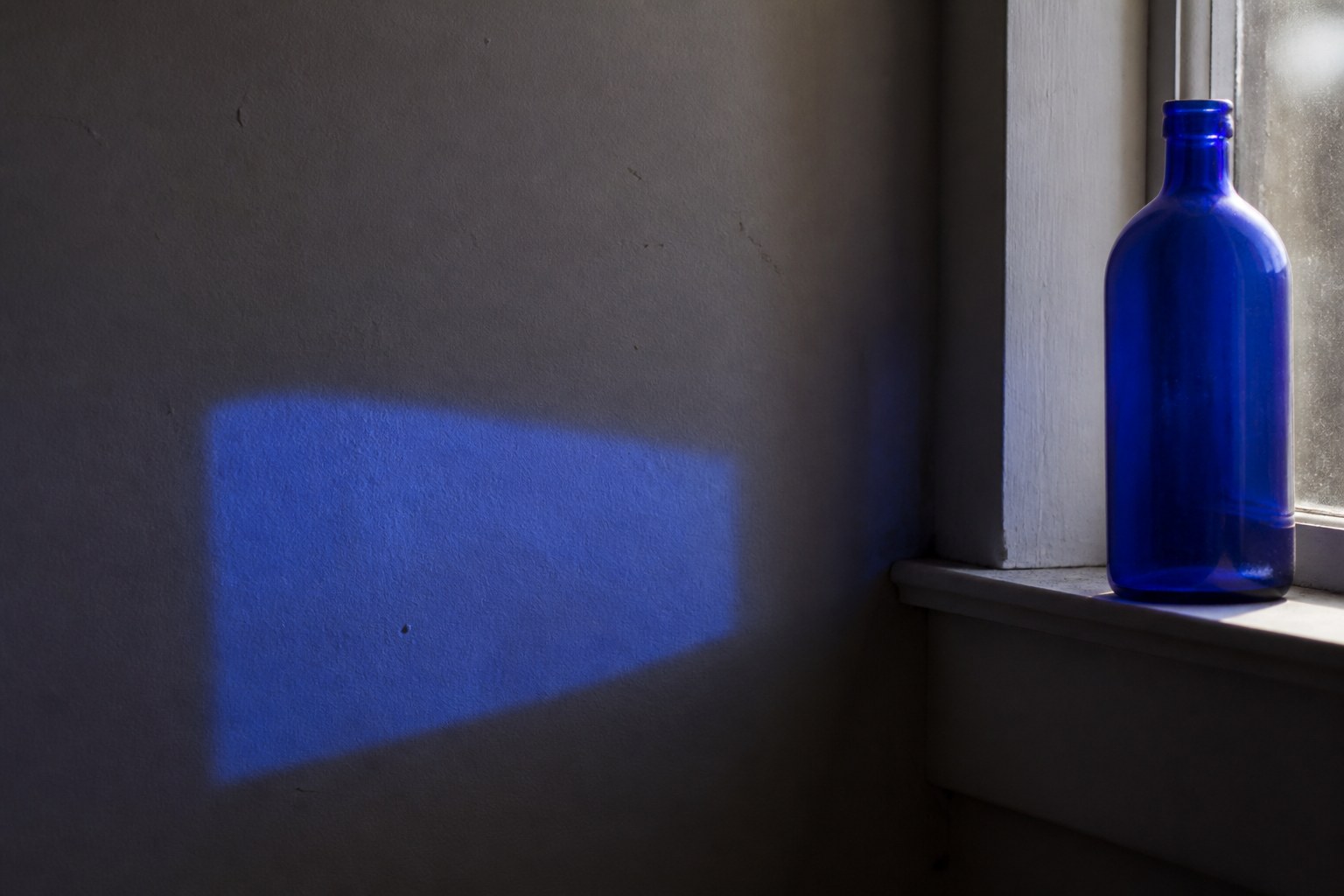
Finding the source does not settle what the moment meant to you. A reader who traces the blue to a bottle on the sill can still ask why that patch of color held their attention that afternoon.
Blue can also carry a meaning the reader chooses on purpose. A Jewish reader may think of the fringe thread, a Catholic of Mary's mantle, and someone raised on angel cards of Michael, and each is drawing on a real history with a known author.
Frequently Asked Questions
Is blue Archangel Michael's color in the Bible?
No, the Bible never gives Michael a color. The blue link comes from the Summit Lighthouse's seven-ray teaching, which puts Michael on the blue first ray, and from Doreen Virtue's angel books.
What color is Archangel Michael, according to Doreen Virtue?
Virtue wrote that Michael's aura is a royal purple so bright it looks cobalt blue, and she also linked him with gold light. She stopped teaching about angels in 2017.
What does the color blue mean in the Bible?
The main biblical blue is tekhelet, the dyed cord that Numbers 15:38 asks for on each corner fringe. Exodus 24:10 and Ezekiel 1:26 also describe a sky-colored sappir stone, often read as lapis lazuli, under or around God's throne, and Numbers 4:6 covers the Ark with "a cloth of pure blue."
Is it normal to see blue light when meditating with my eyes closed?
Usually, yes. Brief colored sparks or glows behind closed eyes are phosphenes or afterimages and fade within seconds.
New flashes in one eye after you open them, with new floaters or a shadow over your vision, need an eye doctor right away.
Did painters use ultramarine only for the Virgin Mary?
Not only for her. Because it was so costly, painters in the 1300s and 1400s kept it mostly for the robes of Christ and the Virgin, and wealthy patrons sometimes paid for it in secular portraits too.
Do Jewish people wear blue tzitzit today?
Some do, using murex-dyed thread from groups such as Ptil Tekhelet. Many rabbinic authorities consider the identification uncertain, so most observant Jews still wear white fringes only.
Sources
- (2023). THE JPS TANAKH: Gender-Sensitive Edition, Numbers 15:38, Numbers 4:6, Exodus 28:31, and Ezekiel 1:26. Sefaria. Link
- . Menachot 43b, William Davidson Edition (Rabbi Meir on tekhelet, sea, sky, and throne). Sefaria. Link
- . Menachot 44a, William Davidson Edition (the chilazon). Sefaria. Link
- . Exodus 24:10. Bible Gateway. Link
- . 1 John 4:1. Bible Gateway. Link
- . Tekhelet Timeline. Ptil Tekhelet. Link
- . What Color Was Tekhelet?. Bible History Daily. Link
- . Tekhelet: The Mystery of the Long-Lost Biblical Blue Thread. Chabad.org. Link
- . Colour Stories: Blue. The National Gallery. Link
- (2001). Blue: The History of a Color. Princeton University Press. Link
- . Il libro dell'arte, chapter 62 (LXII), on ultramarine. Wikisource. Link
- . Pigments through the Ages: Ultramarine, history. WebExhibits. Link
- . Theosophical Society. Britannica. Link
- . Archangel Michael and Faith. The Summit Lighthouse. Link
- . El Morya, chohan of the first ray. The Summit Lighthouse. Link
- (2008). The Miracles of Archangel Michael (excerpt: 8 Ways to Recognize Archangel Michael). Hay House, excerpted on Beliefnet. Link
- (2017). Doreen Virtue's conversion to Christianity sparks debate. The Wild Hunt. Link
- . Lesser Banishing Ritual of the Pentagram. Internet Sacred Text Archive. Link
- . Phosphenes: What They Are and Common Causes. Cleveland Clinic. Link
- . Retinal Detachment. National Institutes of Health. Link
- . Floaters and flashes in the eyes. NHS. Link
- . Migraine: Symptoms. NHS. Link
About Our Editorial Process
Every KnowTheAngels guide separates calculation method, tradition context, and personal reflection. We cite where interpretations come from, present more than one view, and never present symbolic reading as prediction.
Read our editorial policy