How Do Beginners Start Angel Meditation Safely?
A five-minute sitting built on breath and return, with opening words for Christian, New Age, and secular practice, and clear points at which to stop

Angel meditation for beginners is usually a short sitting of about five minutes: settle the body, open with a few words that fit your beliefs, rest attention on the breath, and return each time the mind wanders. The skill being built is the return, not a vision or a feeling of contact.
The same phrase names three different practices. Christian contemplative prayer, New Age angel meditation, and secular mindfulness share a posture and a breath anchor, but they disagree about who is being addressed and what a good session looks like.
The method below works inside any of the three. Where a tradition would change it, that difference is labelled, and so are the points at which a beginner should shorten a session or stop.
Quick Facts
- First session
- Five minutes in a supported chair with a timer
- Core skill
- Notice wandering attention and return without self-criticism
- Opening words
- One sentence from your own tradition, or none at all
- Trauma-sensitive options
- Eyes open, feet or sound as the anchor, freedom to stop
- Stop early for
- Panic, flashbacks, feeling unreal, or a voice that gives orders
- Main boundary
- Warmth, tingling, or calm does not prove an angel is present
What should happen in your first five-minute angel meditation?
A first session has four parts: arrive, open, return, and end.
Five minutes is long enough to lose attention several times and short enough to finish without strain.
Beginner guides disagree on length, with some suggesting two minutes and others ten. No tradition fixes the number, so five minutes here is a practical starting point that you can shorten.
Sit in a chair with both feet flat and your back supported.
Set a timer with a sound that will not startle you before you close your eyes.
Your first five minutes
The timer decides the length, so your attention only has to practice returning.
- Arrive
- Input
- A supported chair and a five-minute timer
- Action
- Feel both feet on the floor and let three breaths pass without changing them.
- Result
- The body has a steady starting point.
- Open
- Input
- One sentence that fits your beliefs, or silence
- Action
- Say it once, silently or aloud, then stop speaking.
- Result
- The intention is set without turning into a running conversation.
- Return
- Input
- The moment you notice attention has moved
- Action
- Name it briefly as thinking, hearing, or feeling, then come back to the breath at the nose, chest, or belly.
- Result
- Each drift becomes one repetition of the skill.
- End
- Input
- The first sound of the timer
- Action
- Open your eyes, look around the room, and stand slowly.
- Result
- The session closes on time and is easy to repeat tomorrow.
The opening sentence depends on the tradition you practice in. A Christian might pray "Lord, I am here; let your angels keep me in your peace," someone in a New Age frame might say "I invite my guardian angel to sit with me," and a secular practitioner might say nothing at all.
A session counts as complete even if attention wandered for most of the five minutes. Each time you noticed and came back, you practiced the thing the session is for.
Afterward, write one line: the length, the anchor, and what pulled you away most often.
That note gives tomorrow one thing to adjust without turning the sitting into a score.
Leave the extras out in week one. A candle, a crystal, an altar, or background music can come later, and each one gives attention another thing to watch.
Is angel meditation prayer, visualization, or mindfulness?
It can be any of the three, and the difference changes what a good session means.
Knowing which frame you are using before the first sitting prevents judging one practice by another's standard.
In Catholic teaching, meditation is a form of prayer that seeks to understand and answer God, and the Catechism says plainly that "a method is only a guide" (CCC 2707). The Church calls devotion to angels legitimate and good, but in this kind of prayer angels are companions, not the goal.
Centering Prayer, a Christian contemplative method taught by Contemplative Outreach, is the closest match to breath-anchored sitting.
A chosen sacred word stands for consent to God's presence, and when thoughts come the instruction is to return "ever-so-gently" to that word.
New Age angel meditation usually speaks to angels directly. Popular scripts invite a guardian angel or a named archangel to be present, sometimes ask for the angel's name, and read warmth, tingling, or sudden peace as signs of contact.
That is a modern devotional framework, and older churches handle it cautiously. The Vatican's 2001 Directory on Popular Piety discourages assigning names to angels other than Gabriel, Raphael, and Michael, the three named in Scripture.
Secular mindfulness removes the angel entirely. The breath anchor and the return stay the same, and the National Center for Complementary and Integrative Health, a US federal agency, reviews it as a health practice with no spiritual claim attached.
| Frame | Who is addressed | Typical opening | What a good session means |
|---|---|---|---|
| Christian contemplative prayer | God; a guardian angel may be addressed in devotional prayer | A short prayer or a sacred word such as "peace" | Consent and gentle return, with no felt experience required |
| New Age angel meditation | A guardian angel or named archangel, spoken to directly | An invitation such as "I invite my guardian angel to be present" | Often described as felt contact, warmth, or a received message |
| Secular mindfulness | No one | None, or a plain intention to notice the breath | Noticing and returning; effects are studied as health outcomes |
The five-minute method works in all three. Mixing frames without noticing is the real beginner risk, because a Christian prayer judged by a New Age test of felt contact will look like failure on most days.
Why returning matters more than clearing the mind
None of these traditions asks a beginner to stop thinking.
Minds keep producing plans, memories, sounds, and body signals, and a goal of an empty mind turns every one of them into a mistake.
The Centering Prayer guidelines treat body sensations, feelings, images, and reflections all as thoughts, and each gets the same gentle return. Angel meditation can borrow that rule whether the anchor is a word or the breath.
The rule matters more here than in secular practice. An image of light or a sudden comforting sentence is also a thought, so it gets the same return, not a pause to decide whether it was a message.
Watch for the second thought. A worry about work arrives, then another voice says the session is going badly; let go of the verdict first, then come back to the breath.
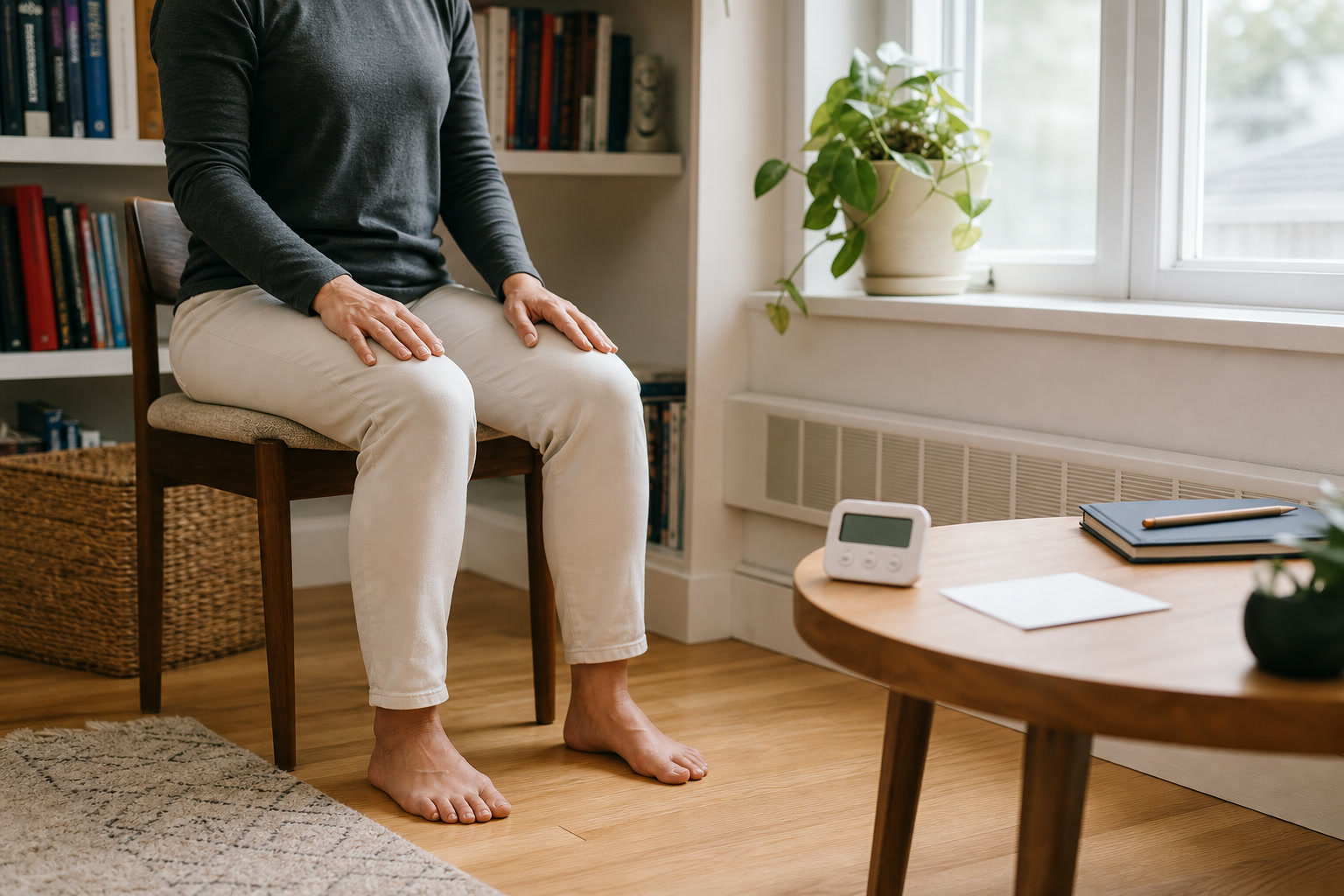
The feet make a steady alternative anchor. If watching the breath feels tight or anxious, feel the pressure of both soles on the floor and return there instead.
On busy days, count exhales from one to five and start again. Losing count only shows that attention moved, so you begin again at one.
Sounds get the same treatment. Hear the car or the voice in the next room, let it be there, and return; fighting a noise usually takes more attention than the noise itself.
After a week, many beginners find that the return comes sooner.
The mind still wanders, but it spends less time building a story about wandering.
Should a beginner use a guided angel meditation or sit in silence?
Either can work, and the choice depends on what you need in the first week.
A recording can hold attention for someone who gets lost in silence, while a silent sitting teaches the return without another voice deciding where attention goes.
Most guided angel meditations are visualizations. The speaker asks you to picture light, a winged figure, or a garden, and often to receive a message or a name before counting you back.
That is a different exercise from the breath method above. Holding a scene takes effort, and a scripted moment of "receiving" sets up an expectation that most sessions will not meet.
If you choose a recording, listen once with your eyes open before you use it.
The check below takes a minute and shows whether the script suits your beliefs and your first week.
Before you press play on a guided angel meditation
- Length
Ten minutes or less, so the recording ends before you tire.
- A way out
It tells you how to come back, and nothing in it says you must stay with the eyes closed.
- Promises
It does not promise contact, healing, or a sign in every session.
- Requests
It does not ask you to receive an angel's name or an instruction you must act on.
- Words you would use
Its opening prayer or invitation is one you would say yourself.
A script that fails the check is not harmful by default. It belongs to guided imagery, which has its own method for handling what the imagination produces.
What if you fall asleep, feel pain, or nothing happens?
Each common first-week problem has its own fix.
Change one condition before deciding that meditation does not suit you.
Match the fix to the problem
One change at a time shows which adjustment actually helped.
A quiet or blank sitting is not rejection and not a missing gift
Use a chair, not the bed
The return works the same in a new posture
Make the task smaller before adding guidance
A chosen movement disturbs less than a long fight
The empty session needs the most reassurance, because many angel scripts promise warmth or a sign. Centering Prayer makes no such promise; its guidelines ask only for consent and return, which is why a quiet sitting counts as a finished one.
Staying still through sharp pain is not a spiritual achievement. A floor cushion is optional, and many beginners find a plain chair easier because balance stops competing with attention.
Falling asleep every time you sit in bed may mean the body needs sleep more than practice. An evening release practice suits that problem better than a formal sitting at midnight.
Can meditation cause anxiety or bring up trauma?
Yes, for a minority of people, and more often than many beginner guides admit.
The NCCIH summary calls meditation generally low in risk while noting that research on its harms is still limited.
A 2020 systematic review led by Miguel Farias in Acta Psychiatrica Scandinavica pooled 83 studies with 6,703 participants. About 8.3% reported an adverse effect, most often anxiety or depression.
The rate was 3.7% in experimental studies and 33.2% in observational ones. That gap shows how much the number depends on who is asked and how carefully.
Willoughby Britton's team at Brown University interviewed 96 people after an eight-week mindfulness course. 58% reported at least one unpleasant meditation-related effect, 37% had an effect that interfered with daily life, and 6% to 14% had lasting bad effects, mainly hyperarousal and dissociation.
Both teams found rates similar to those reported for other psychological treatments.
For a beginner, the practical point is simple: an unpleasant session is not a spiritual failure or an attack, and it is not something to push through.
People with a trauma history often find closed-eye, breath-focused attention the hardest version. Trauma-sensitive teaching puts choice first: eyes open or closed, sitting, standing, or moving, and an anchor the person picks, such as an object to hold.
In practice, you can keep your eyes open with a soft gaze on the floor, hold a smooth stone or the arm of the chair, or rest attention on the feet or on sounds. Any of these still counts as angel meditation if you open with the same words.
Therapists describe the range of arousal a person can handle as the window of tolerance.
A session that repeatedly pushes past it teaches the body alarm, not return, so a shorter session with the eyes open is the better practice.
When should you stop a session and get help?
Stop the session, open your eyes, and name a few objects in the room if any of the following happens. Stopping early is part of the method.
- Panic or rising fear that does not ease after you open your eyes and look around.
- Feeling unreal or detached from your body, your surroundings, or your own thoughts.
- Flashbacks or memories that arrive with the force of the original event.
- A voice or command that feels outside your control, especially one urging secrecy or harm.
- Lost sleep, or a sense that you need another session before you can feel safe.
If one of these repeats over several sessions, or stays with you after you stop, talk with a doctor or a licensed mental health professional before you continue.
NCCIH also advises against using meditation to replace conventional care or to delay seeing a provider about a health problem.
If you are in crisis or thinking about harming yourself, contact emergency services now. In the United States, you can call or text 988 to reach the Suicide and Crisis Lifeline.
A priest, pastor, or spiritual director can help with what an experience means within your faith.
That conversation can sit alongside clinical care; it does not replace it.
How long should beginner angel meditation last?
Five minutes a day is enough for the first week.
Add a minute or two only when the current length ends cleanly and your posture stays comfortable.
The timer guards against two opposite mistakes. One is quitting in the first restless minute; the other is stretching a pleasant session while waiting for something unusual to happen.
A phone works if it cannot pull you back. Turn on do-not-disturb, set the alarm, and lay the phone face down out of reach.
Contemplative Outreach recommends Centering Prayer for a minimum of 20 minutes, twice a day. That is a long-term commitment, not a week-one target, and five steady minutes teach more than twenty strained ones.
Adding time because a session felt disappointing turns length into a punishment.
Tie the sitting to something you already do, such as the first glass of water or closing a laptop after lunch.
A fixed cue is easier to keep than a fixed clock time.
Stop with the timer even when an image or phrase feels unfinished. If it still matters afterward, write one plain line about it and leave the meaning for later.
Which practice fits after your first week?
The next step should match the skill you are missing, and more minutes is only one option. Someone who can return to the breath may want help carrying attention into the day, working with images, or ending the evening.
| What you want | Practice to try | How it differs from the beginner sitting |
|---|---|---|
| One steady intention before the first task of the day | Morning angel meditation | It carries attention into one action instead of staying with the breath |
| To work with a chosen image | Guided angel visualization | It adds a deliberate scene and a planned return to the body |
| To repeat one phrase or name | Angel mantra meditation | The phrase becomes the anchor instead of an opening line |
| To close the day before sleep | Evening angel meditation | It reviews the day and ends with a release, not attention training |
Stay with the beginner sitting while the return still feels confusing or pressured.
Familiarity with one anchor makes later imagery and journaling easier to judge, because you already know what an ordinary session feels like.
Michael meditation is narrower still. It uses the archangel's traditional sword, shield, and scales to rehearse courage, and it builds on the basic return rather than replacing it.
Change one thing per week. Adding time, a new cue, and a new method at once hides which change actually helped.
Can meditation prove that an angel is present?
A meditation session cannot prove that an angel is present. Warmth, tingling, light behind closed eyes, tears, and a sense of company can all come from attention, expectation, posture, breathing, and memory.
The same sensations come up in secular mindfulness classes where no one mentions angels, so their presence alone cannot tell you what caused them.
A believer can still hold a spiritual meaning.
Describe the tingling sensations or points of light first, name one ordinary explanation that also fits, and leave the cause open.
Christian tradition has its own version of this caution. The First Letter of John tells readers not to trust every spirit but to "test the spirits" (1 John 4:1).
If a phrase or image stays with you, write it in a discernment journal after the timer and reread it a few days later. A sitting judged by how you act afterward is easier to trust than one judged by how intense it felt.
Frequently Asked Questions
How long should a beginner angel meditation last?
Five minutes a day is enough for the first week. Add a minute or two only when sessions end cleanly and your posture stays comfortable.
What should I focus on during angel meditation?
Rest attention on the breath at the nose, chest, or belly, or on the feet if the breath feels uncomfortable. When a thought, sound, or image pulls you away, notice it and come back to that same anchor.
What do I say to start an angel meditation?
Use one sentence from your own tradition, such as a short prayer to God or an invitation to your guardian angel. Say it once and then return to the breath; a secular sitting can skip it.
Do I need to see or feel my angel for the meditation to work?
No. Noticing that attention wandered and returning is the whole skill, and a quiet session with no image or sensation is a complete one.
Is guided angel meditation better for beginners?
It helps some people stay focused, but most guided angel recordings are visualizations. Pick one under ten minutes that does not promise contact or ask you to receive a name.
Can meditation be harmful?
For some people, yes. A 2020 review found adverse effects in about 8% of participants, most often anxiety or depression, so stop if a session brings panic, flashbacks, or detachment and seek professional help if it repeats.
Can I do angel meditation if I am not religious?
You can practice the same breath-and-return sitting as secular mindfulness. Leave out the opening invitation, or use a plain intention to notice the breath for five minutes.
Sources
- (1992). II. Meditation (nos. 2705-2708). The Holy See. Link
- (2001). Directory on Popular Piety and the Liturgy, The Holy Angels (nos. 212-217). The Holy See. Link
- . The Method of Centering Prayer. Contemplative Outreach, Ltd.. Link
- . Guidelines of Centering Prayer. Contemplative Outreach of St. Louis. Link
- (2022). Meditation and Mindfulness: Effectiveness and Safety. National Institutes of Health. Link
- (2020). Adverse events in meditation practices and meditation-based therapies: a systematic review. Acta Psychiatrica Scandinavica 142(5): 374-393. Link
- (2021). Defining and Measuring Meditation-Related Adverse Effects in Mindfulness-Based Programs. Clinical Psychological Science 9(6): 1185-1204. Link
- (2022). 10 Tips for Offering Trauma-Sensitive Mindfulness in Psychotherapy. Society for the Advancement of Psychotherapy. Link
- . 1 John 4:1. United States Conference of Catholic Bishops, New American Bible. Link
- . 988 Suicide and Crisis Lifeline. Substance Abuse and Mental Health Services Administration. Link
About Our Editorial Process
Every KnowTheAngels guide separates calculation method, tradition context, and personal reflection. We cite where interpretations come from, present more than one view, and never present symbolic reading as prediction.
Read our editorial policy