What Does Angel Number 26 Mean in Numerology and Gematria?
Why digit addition reaches 8, how Hebrew letter values total 26, and where claims about care, money and repeated sightings need different evidence
The meaning of angel number 26 depends on which kind of reading is being offered. Modern numerology starts with the digits 2 and 6; Hebrew gematria starts with letters whose numerical values total twenty-six.
Hans Decoz's digit profiles supply themes of cooperation, care and material authority. Blair Andrews develops a stewardship reading of 26, while Jewish textual interpretations connect twenty-six with the divine name and with Psalm 136.
A shared total does not make those traditions one method.
Quick Facts
- Digit-reduction result
- 2 + 6 = 8
- Reversed digits
- 6 + 2 also equals 8
- Letter-value total
- Yod 10 + he 5 + vav 6 + he 5 = 26
- Psalm count
- Psalm 136 contains 26 verses
- Rabbinic reference
- Pesachim 118a connects the refrains with 26 generations
Two calculations reach different answers: 26 as input and 26 as a total
Adding the digits of 26 gives 8. In Hans Decoz's profiles, 2 emphasizes cooperation, 6 care and responsibility, and 8 career, finances and authority.
Those descriptions provide a vocabulary for interpretation. They do not turn the calculation into a sequence in which a partnership necessarily becomes caregiving and then control.
| Operation | Starting material | Result |
|---|---|---|
| Digit reduction | The written digits 2 and 6 | 2 + 6 = 8 |
| Hebrew gematria | Four letters with values 10, 5, 6 and 5 | A total of 26 |
In the first operation, 26 is already present before the calculation begins. In the second, twenty-six is the result of adding values assigned to letters.
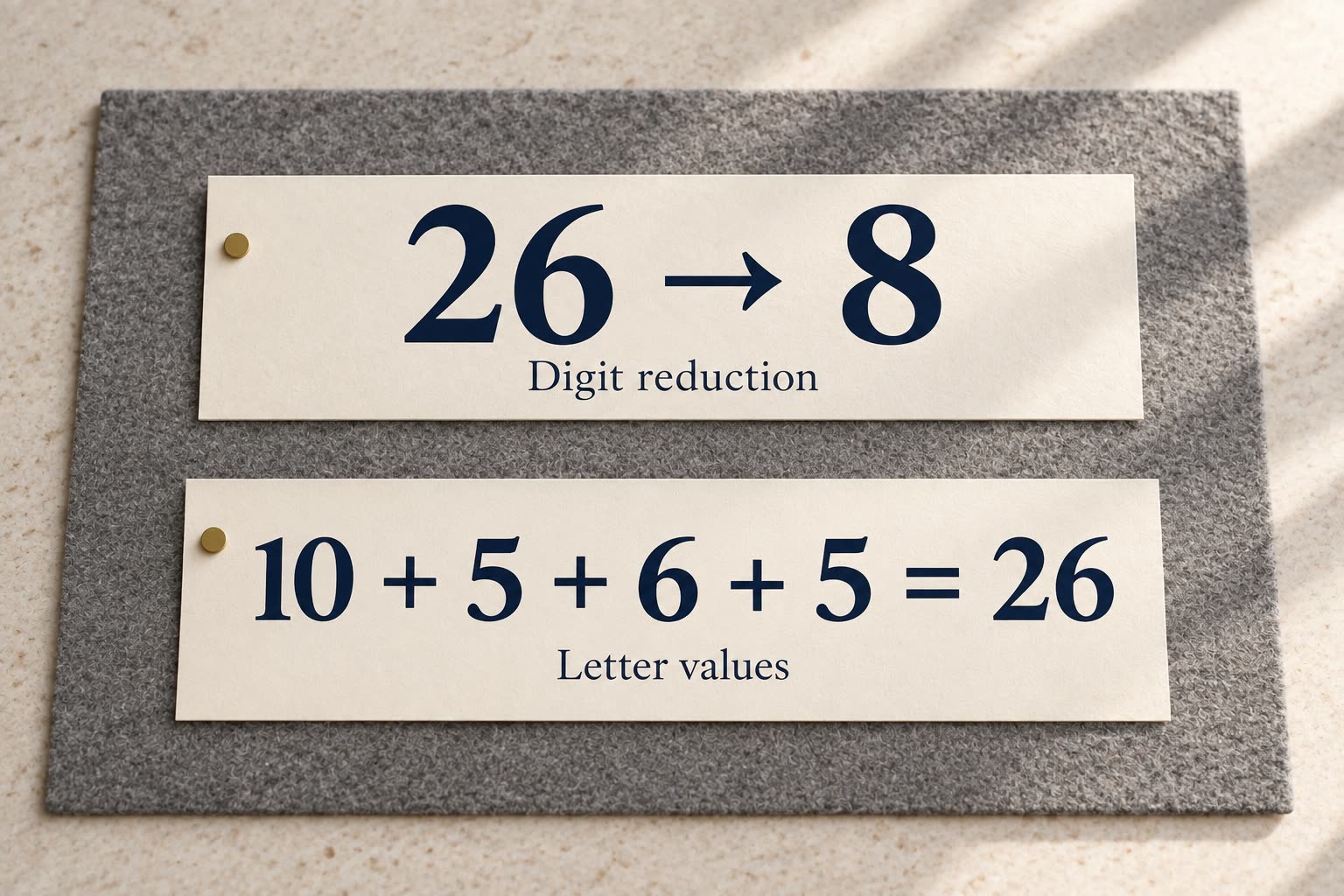
Combining the two is another interpretive choice. The fact that both operations can be performed does not show that Jewish gematria assigns the divine name Decoz's meaning for 8.
Reversing 26 to 62 leaves the digit sum unchanged. A story about care coming before partnership in 62 requires an author's explanation, because addition does not supply that story.
Nor is 26 one of the master numbers 11, 22 and 33 in Decoz's terminology. Its direct sum is 8, without an intermediate master-number result.
The Hebrew total: yod, he, vav and he
The four letters conventionally transliterated YHWH have the standard values yod 10, he 5, vav 6 and he 5. Their sum is 10 + 5 + 6 + 5 = 26.
Adding the letter values
- Identify the letters
- Input
- Yod, he, vav, he
- Action
- Assign the standard value to each letter in the name.
- Result
- 10, 5, 6, 5
- Keep repeated letters
- Input
- Both occurrences of he
- Action
- Include each occurrence in the addition.
- Result
- The value 5 appears twice.
- Add the four values
- Input
- 10 + 5 + 6 + 5
- Action
- Sum the values without first reducing each to another number.
- Result
- 26
The repeated he matters: a calculation includes every occurrence, not just each distinct letter once.
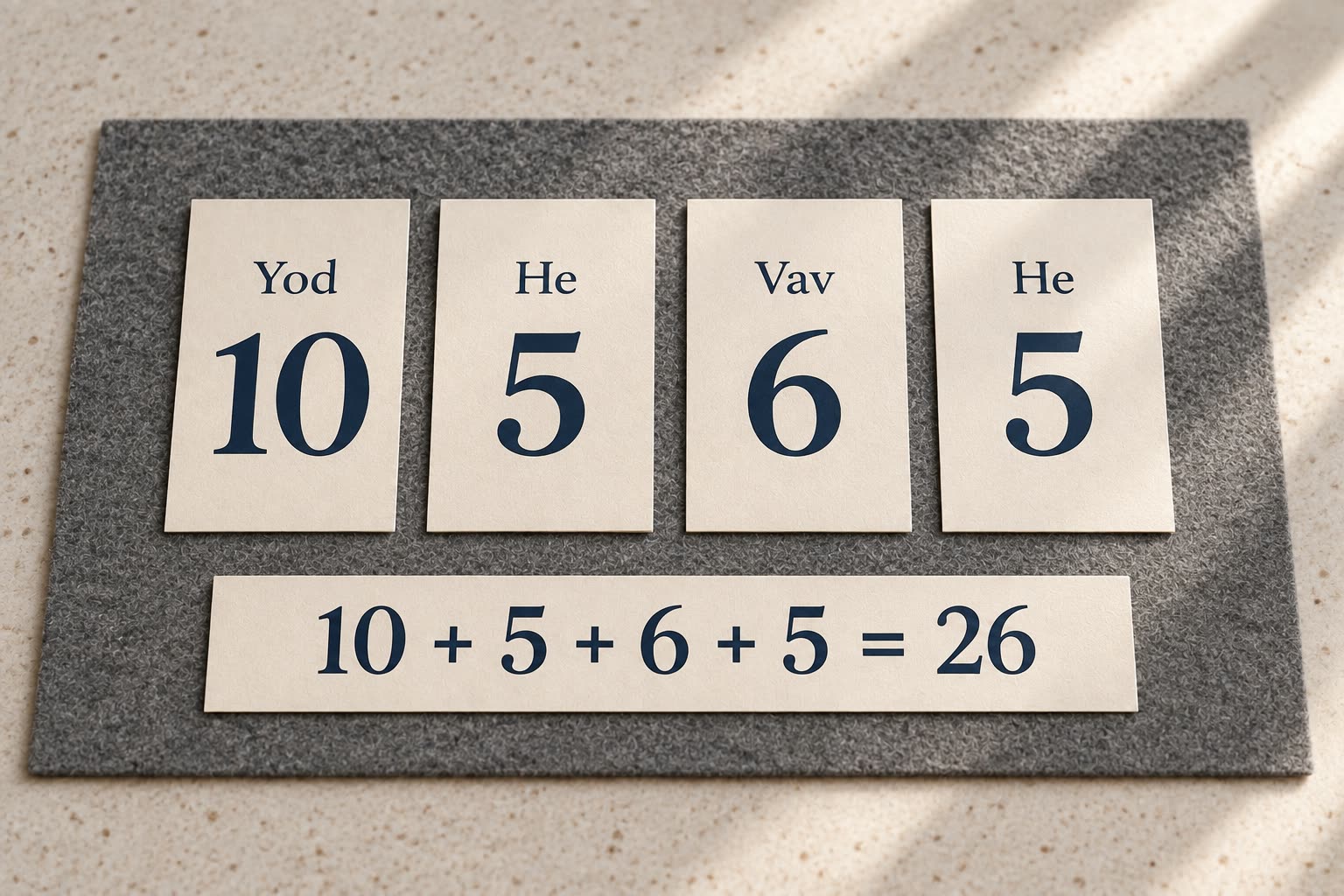
A teaching attributed to Rabbi Shimshon of Ostropoli, translated on Chabad.org as The Winning Equation, uses the divine-name total in a further comparison involving Mordecai and Esther. It connects reduced name values of thirteen each with twenty-six.
That example belongs to a particular Kabbalistic interpretation. It is not an instruction in the biblical narrative to interpret every encounter with the number as a message.
Hebrew has twenty-two letters, so twenty-six here is not an alphabet count. An explanation that substitutes the twenty-six letters of English has changed both the language and the calculation.
A claim about what a particular Hebrew word totals therefore needs the actual letters and the chosen valuation method. The total alone leaves those inputs unknown.
Psalm 136: twenty-six refrains and a rabbinic generation count
Psalm 136 has twenty-six verses, each repeating the refrain rendered in the King James Version as "for his mercy endureth for ever". This twenty-six comes from counting verses rather than adding letters.
Pesachim 118a attributes to Rabbi Yehoshua ben Levi an interpretation connecting the refrains with twenty-six generations sustained by God's kindness before the giving of the Torah. The Talmud supplies the connection between the count and those generations.
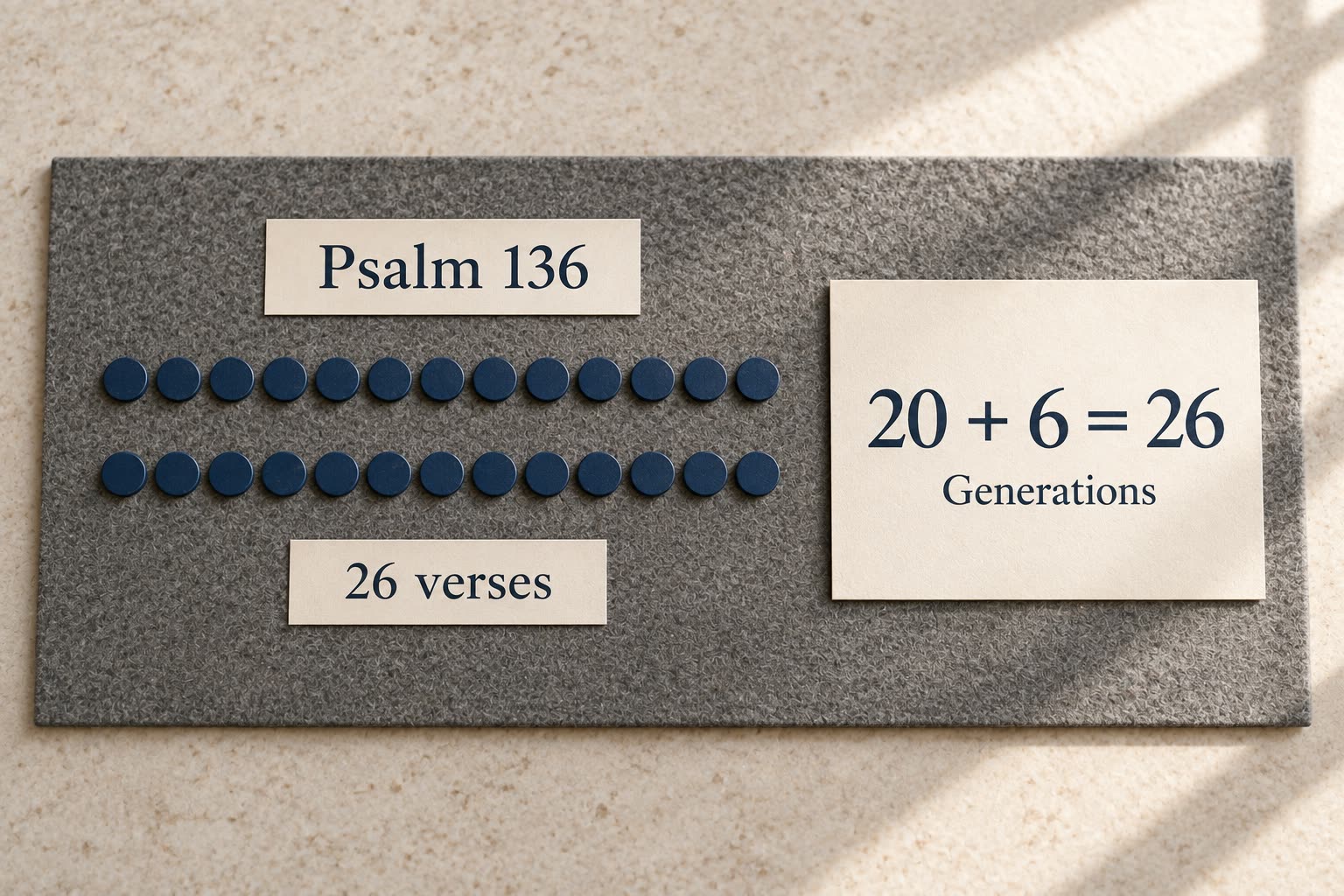
The genealogies in Genesis 5 and 11 can be followed from Adam through Abraham as twenty generations. Isaac, Jacob, Levi, Kohath, Amram and Moses add six more in the lineage used for that comparison.
| Count | Material being counted | Relevant distinction |
|---|---|---|
| 26 verses | Psalm 136 | Each verse repeats the refrain. |
| 20 + 6 generations | Genesis 5 and 11; the lineage through Moses in Exodus 6 | The selected textual genealogy determines which names enter the count. |
The textual choice matters because Luke 3:36 includes an additional Cainan between Arphaxad and Shelah, following the Greek genealogical tradition. Importing that name changes a count built from the other list.
This difference does not refute the rabbinic interpretation; it identifies the text that its comparison presupposes. A claim that every biblical genealogy produces an identical total would miss that condition.
Stewardship, manifestation and the missing step between work and income
Blair Andrews' reading of 26 emphasizes stewardship of resources passing through someone's hands. That image concerns how resources are handled, which differs from predicting that more resources will arrive.
Astrology.com calls 26 a manifestation number and connects it with abundance. This is a spiritual interpretation attached to the number, not a result of the arithmetic 2 + 6 = 8.
A project budget and its actual outcomes
What the evidence supports
- Symbolic vocabulary
Decoz's 8 profile discusses career, finances and authority.
- Known project facts
A budget records planned spending; an invoice records a request for payment.
What remains limited
- Future income
Neither seeing 26 nor writing an invoice establishes that a client will pay.
- Authority
Responsibility for daily work does not reveal who has agreed to approve spending.
Consider a hypothetical employee who organizes a project while a manager approves its budget. That division can be intentional, contested or temporary; the number does not tell which.

A promotion would require an actual change in role, and a sale would require a buyer. Describing either hope as manifestation does not supply those missing events.
Decoz's account of 8 also includes financial reversals, not only success. Selecting only its prosperity language removes a qualification from the source rather than strengthening the forecast.
Financial-abundance readings can explain why writers repeatedly select numbers rooted in 8. They still cannot provide an amount, arrival date or assessment of a particular offer.
Care, consent and the limits of a relationship reading of 26
Decoz's description of 6 includes both nurturing and possible problems with overinvolvement or excessive self-sacrifice. These are traits within his numerological profile, not observations about a couple who has seen 26.
For example, one partner may organize appointments with the other's agreement. The same outward task may become unwelcome when decisions are made against a clearly stated preference.
The task alone does not settle consent
The person concerned asked for the appointment to be arranged.
The action conflicts with what the person concerned has said.
The difference lies in the expressed wishes and agreement, not in how often the helper encounters a number.

Astrology.com's twin-flame interpretation uses a balance of feminine and masculine energies. Those categories belong to its spiritual framework and do not establish two people's mutual feelings.
Seeing 26 supplies no evidence that a reunion is wanted. An explicit request for no contact remains a boundary even when someone attaches personal meaning to the sighting.
Repeated 26s: the setting can repeat before the meaning does
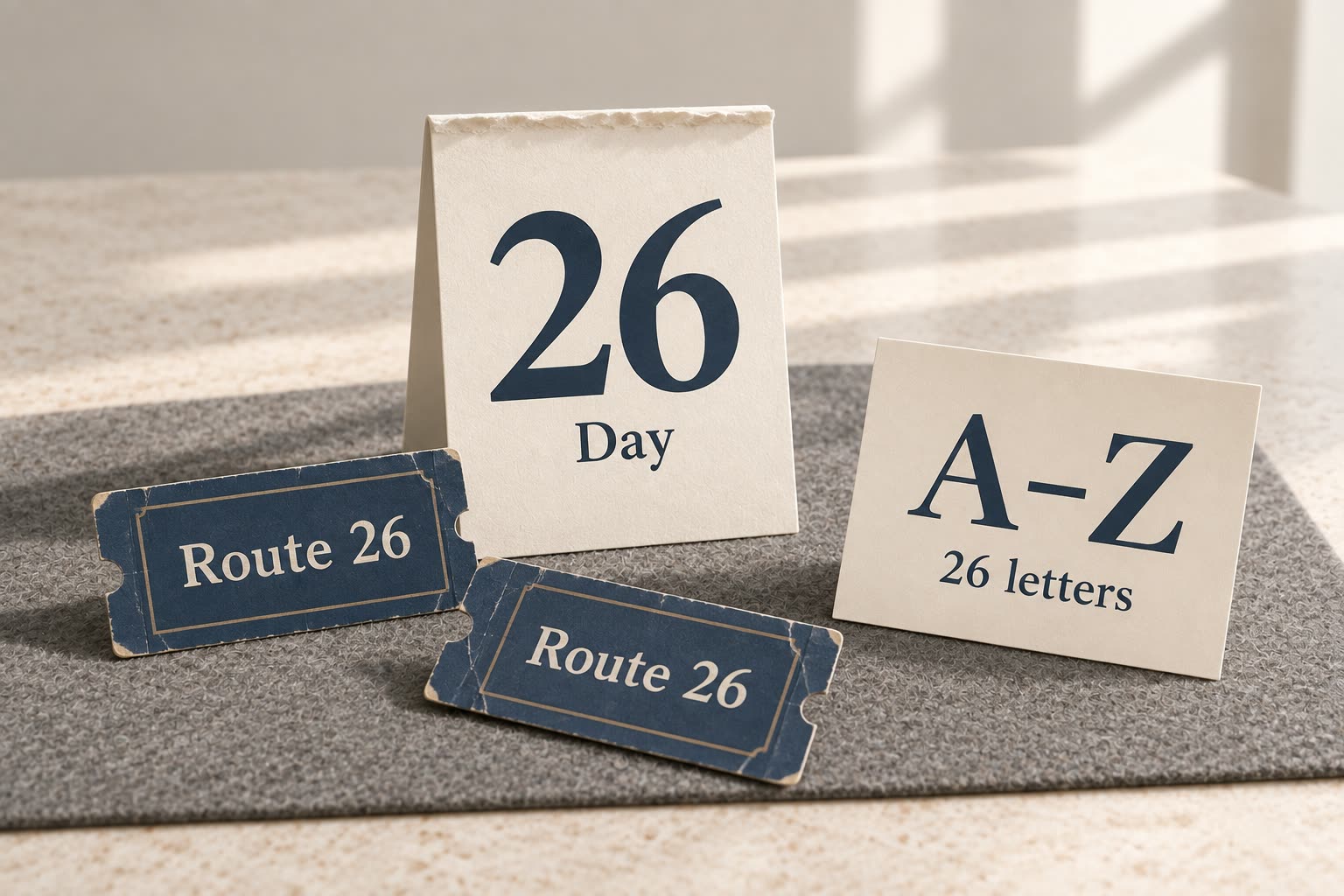
The 26th returns each month, an A-to-Z alphabet list contains twenty-six English letters, and a familiar route number can recur throughout a week. These contexts make the number available without requiring a personal message.
A number on a pharmacy receipt and the same number on a race bib do not acquire different evidential strength merely because one better fits a care-themed interpretation. Choosing the matching setting after the event can make the interpretation seem more selective than it was.
The APA definition of selective attention describes focusing on some stimuli while overlooking others. It offers one possible explanation for increased noticing, but it cannot diagnose the cause of an individual experience from a diary alone.
A number journal can preserve the time, place and circumstances of each remembered encounter. It also records what a person associates with it, which is different from proving where that association came from.
Without records of other numbers and missed encounters, the diary cannot establish that twenty-six has become unusually common.
Frequently Asked Questions
Is 26 a master number in Decoz's system?
No: Decoz identifies 11, 22 and 33 as master numbers. Adding 2 and 6 reaches 8 directly.
Does 26 always mean the divine name?
Twenty-six is the total of the standard letter values of YHWH. A number appearing elsewhere does not by itself identify those letters or establish that this calculation was intended.
Why does Psalm 136 appear in discussions of 26?
It has twenty-six verses with a repeated refrain. Pesachim 118a connects those refrains with a particular count of generations before the Torah.
Does 26 promise money or a reunion?
The arithmetic supplies no evidence of either outcome. Such promises belong to spiritual interpretations and cannot replace information about payment or another person's wishes.
Sources
- (n.d.). Numerology Meaning of number 2. World Numerology. Link
- (n.d.). Numerology Meaning of number 6. World Numerology. Link
- (n.d.). Numerology Meaning of number 8. World Numerology. Link
- (n.d.). Master Numbers 11, 22, 33. World Numerology. Link
- (n.d.). The Winning Equation. Chabad.org, Kabbalah Online. Link
- (2007). Gematria. Jewish Virtual Library (Gale Group). Link
- (1611). Psalm 136. Bible Gateway. Link
- (n.d.). Pesachim 118a. Sefaria, William Davidson edition. Link
- (1611). Genesis 5; Genesis 11:10-26; Exodus 6:16-20; Luke 3:36. Bible Gateway. Link
- (2018). Selective attention. APA Dictionary of Psychology. Link
- (2026). Angel Number 26 Meaning: The Quiet Steward. Numerologist.com. Link
- (n.d.). 26 Angel Number Meaning. Astrology.com. Link
About Our Editorial Process
Every KnowTheAngels guide separates calculation method, tradition context, and personal reflection. We cite where interpretations come from, present more than one view, and never present symbolic reading as prediction.
Read our editorial policy