What Does Angel Number 456 Mean for Structure Meeting Change?
Why 4 + 5 + 6 comes back to 6, how Walmsley and Andrews read the build, change and care in the run, and why the number also turns up on keypads and in Squid Game
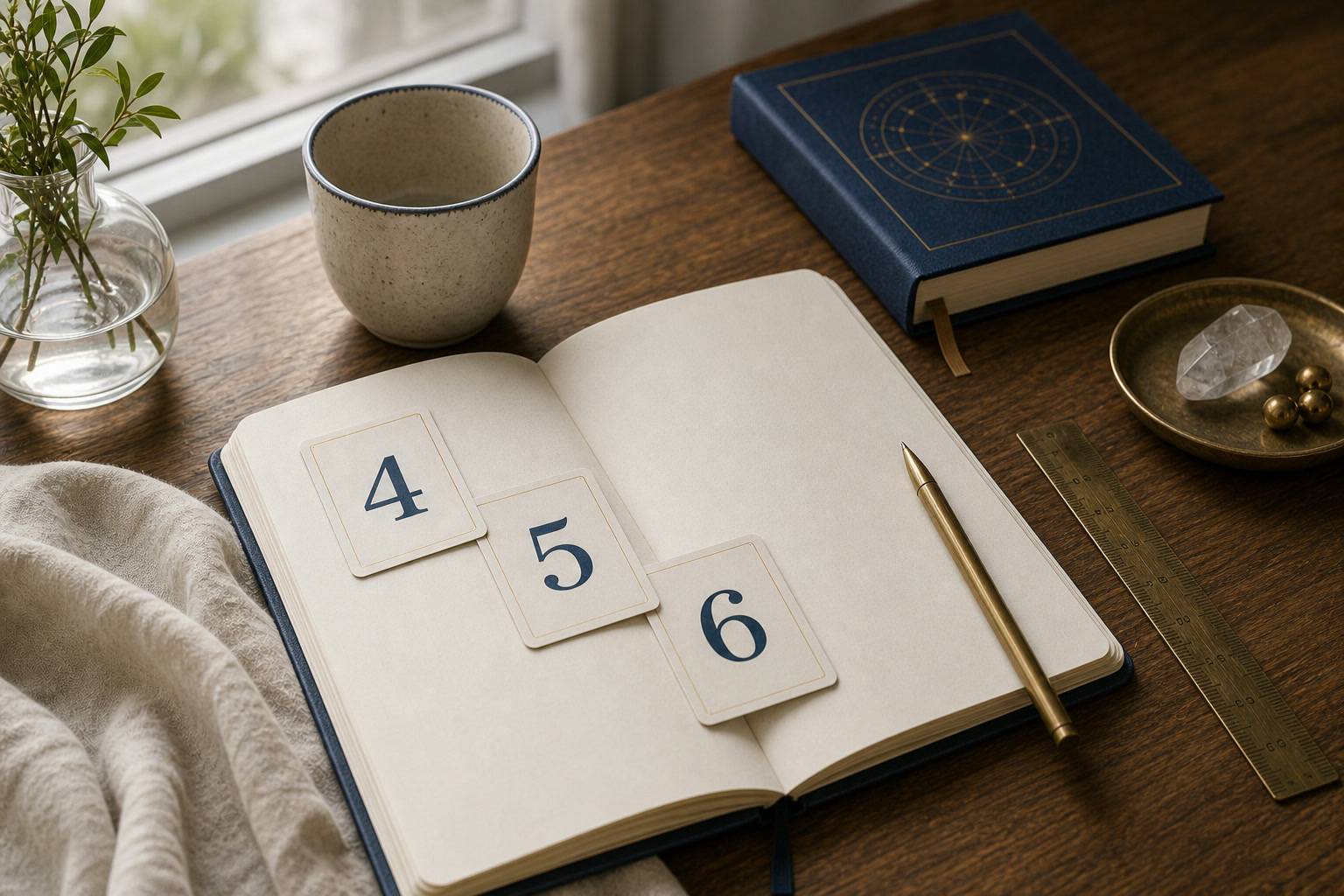
Angel number 456 is the middle run of the counting digits: the 4 that Hans Decoz calls "our rock", the 5 he describes as "unpredictable, always in motion, and constantly in search of change", and the 6, "aptly nicknamed the motherhood/fatherhood number". Read in order, the digits describe a settled structure that meets change and ends in care for other people.
Adding the digits confirms the ending. They total 15, and 1 + 5 = 6, so the sum lands on the digit the sequence already finishes with. Modern writers disagree about what that repetition asks of the reader: Joanne Walmsley sees steady progress, Blair Andrews a check on whether a settled life is still wanted.
Quick Facts
- Digits
- 4 (structure), 5 (change), 6 (care)
- Reduction
- 15 (from 4 + 5 + 6), then 1 + 5 = 6, matching the last digit
- Inside the sum
- 15, the number of The Devil in tarot
- Two modern readings
- Steps forward through change (Walmsley); build, free, love (Andrews)
- Everyday places
- Middle row of phone and calculator keypads; 4:56; Player 456 in Squid Game
Build, change, care: how Walmsley and Andrews read 456
Walmsley's entry of 11 September 2011 reads 456 as steps: the reader is "taking appropriate steps in your life to advance you in a positive fashion". She gives the 4 "hard work and responsibility", the 5 "making positive life choices and important changes" and the 6 "love of home and family and domesticity", then asks the reader to give any fears about coming changes to the angels, promising that the changes will bring "wonderful abundance and blessings".
Andrews compresses the run into three words, "build, free, love", and places it later in life. "456 tends to arrive in a life that has done everything right," she writes: "The foundation is poured. The walls are up." Her question is whether the freedom of the 5 was ever used, or whether the 6 at the top has become the name for a comfortable routine.
| Walmsley (2011) | Andrews (2025) | |
|---|---|---|
| 4 | "Hard work and responsibility" | Something built: a career, a home, a partnership |
| 5 | "Positive life choices and important changes" | Freedom found inside what was built |
| 6 | Home, family and service to others | Love, tested for whether it is still chosen |
| Main message | Changes ahead are safe to make | Check whether a settled life is still wanted |
The readings suit different moments. Walmsley's fits someone about to change something from a secure base, such as a move paid for by years of saving; Andrews' fits someone whose change has already happened, or never happened, and whose routine now needs an honest look.
Why does 456 come back to six?
Three consecutive digits add up to three times the middle digit, so 456 totals 3 × 5 = 15, and 15 reduces to 6. Each of the seven counting runs totals three more than the one before it, which makes the roots cycle through 6, 9 and 3.
| Run | Sum | Root | Last digit |
|---|---|---|---|
| 123 | 6 | 6 | 3 |
| 234 | 9 | 9 | 4 |
| 345 | 12 | 3 | 5 |
| 456 | 15 | 6 | 6 |
| 567 | 18 | 9 | 7 |
| 678 | 21 | 3 | 8 |
| 789 | 24 | 6 | 9 |
456 is the only row where the root and the final digit match. In the other six the sum points away from the last step: 123 ends on 3 and reduces to 6. At the top of the row, 789 ends on 9 and reduces to 6 as well. Andrews calls this "the strange arithmetic": "The same 6 that sits at the top of the staircase also sits at the bottom of the reduction."
For a reading, the match leaves no second number to qualify the last step. 234 adds a 9 of completion to a run that ends in structure; 456 repeats its own ending, so care for other people is both where the digits go and what they add up to.
Is it love or habit? The 15 inside 456 and Andrews' test
On the way to 6 the sum passes through 15, the number of The Devil, the fifteenth trump in most traditional tarot decks. Andrews reads the card as "the teacher of appetite", an older figure than the Christian villain later drawn over it, and uses it to test the love at the top of the run.
Her question for a couple is blunt: "Is this actually love, or is this what a stable, well-structured partnership gets called after enough years?" The test is structural, she adds, and "no one is being accused of loving wrong." Ordinary evidence answers it better than a number does: whether the two people still make new plans together, or only keep the ones they made a decade ago.
Walmsley's 6 puts home and family at the end of the run and reads the coming change as welcome. Neither writer connects 456 to twin flames or to reunion after a separation; both describe a home or relationship that already exists.
A settled job and the freedom of the 5: 456 at work and with money
Andrews gives the career version in one line: "You built something (4), found freedom inside it (5), and arrived at work you love (6)." Her Devil check asks whether the work itself is loved or only the position reached, a question that fits someone promoted out of the craft they came to do.
Decoz's 6 carries its own risk at work: "Highly responsible, the 6 can be counted on to show up and do more than their fair share of the work." In a job change read through 456, that points to the colleague who keeps the old structure running for everyone and never takes the freedom of the 5 for themselves.
Walmsley's "wonderful abundance and blessings" is a devotional promise. The digits 4, 5 and 6 make no forecast about pay, and a change of job or home still depends on its own numbers: the salary, the rent, the savings that cover the gap.
Why do I keep seeing 456? Keypads, 4:56 and Squid Game
4, 5 and 6 form the middle row of both keypad layouts in everyday use. Telephone keypads follow the ITU E.161 arrangement with 1, 2 and 3 on top, calculators put those digits on the bottom, and in both the 4-5-6 row sits in the centre. Clocks add 4:56 twice a day on a 12-hour display.
Since 2021 the number has also belonged to a television character. In Netflix's Squid Game the protagonist, Seong Gi-hun, played by Lee Jung-jae, is Player 456. A viewer of the series has a plain reason to notice the number, and the show gives it no numerological meaning.
Attention does the rest: after a number has been noticed it seems to recur more often than it really does, the frequency illusion described by Arnold Zwicky. Recording each 456 in a number journal with the place and what was happening shows whether the sightings gather around a real change in a settled life or around a phone keypad and a streaming queue.
Frequently Asked Questions
Is 456 a good sign?
Walmsley reads it as encouragement: the changes ahead are steps forward and will bring abundance. Andrews is less reassuring and reads it as a check on whether a stable life is still chosen or has become habit.
Does 456 mean a big change is coming?
In Walmsley's reading, change is on its way and is safe to make. The digits themselves predict nothing, and Andrews reads 456 as arriving after the change, when the question is what the settled life has become.
What does 456 mean in Squid Game?
It is the player number of the protagonist, Seong Gi-hun, in the Netflix series first released in 2021. The number identifies the character; the series does not give it a spiritual meaning.
Sources
- (2011). Angel Number 456 (posted September 11, 2011). Sacred Scribes Angel Numbers. Link
- (2025). Angel Number 456 (published March 26, 2023, updated May 12, 2025). Numerologist.com. Link
- (n.d.). Numerology Meaning of Number 4. World Numerology. Link
- (n.d.). Numerology Meaning of Number 5. World Numerology. Link
- (n.d.). Numerology Meaning of Number 6. World Numerology. Link
- (2026). The Devil (tarot card): the fifteenth trump in most traditional decks. Wikipedia. Link
- (2026). Telephone keypad: the ITU E.161 layout with 1, 2 and 3 on the top row, and the calculator layout with them on the bottom row. Wikipedia. Link
- (2026). Seong Gi-hun: Player 456 in Squid Game (2021), played by Lee Jung-jae. Wikipedia. Link
- (2026). Frequency illusion (term coined by Arnold Zwicky in 2005). Wikipedia. Link
About Our Editorial Process
Every KnowTheAngels guide separates calculation method, tradition context, and personal reflection. We cite where interpretations come from, present more than one view, and never present symbolic reading as prediction.
Read our editorial policy