What Does Angel Number 79 Mean When a Chapter Is Ending?
Walmsley's reading of 7 and 9, the karmic 16 on the way back to 7, and what Psalm 79 is about

Angel number 79 is the 7 of intuition and inner wisdom followed by the 9 of endings, and its digits add up to 16, which reduces back to 7. Joanne Walmsley's 2011 Sacred Scribes entry, the oldest dated angel-number reading of 79 we found, calls it "a highly spiritual number" and reads it as praise for the reader's work, together with a notice that "some issues or phases are coming to an end or conclusion".
The route back to 7 runs through 16, a number with a harder reputation: Hans Decoz counts it among his karmic debt numbers, and Cheiro in 1926 called it "the Shattered Citadel". Only three two-digit numbers take that route: 79, 88 and 97.
Quick Facts
- Digits
- 7 (intuition, inner wisdom) then 9 (endings, compassion)
- Reduction
- 7 + 9 = 16, then 1 + 6 = 7
- The 16 layer
- Karmic debt for Decoz; "the Shattered Citadel" for Cheiro
- Same total
- Only 79, 88 and 97 add up to 16
- Angel-number source
- Joanne Walmsley, Sacred Scribes, 14 July 2011
- In the Bible
- Psalm 79, a lament for Jerusalem quoted in 1 Maccabees 7:17
Why is 79 read as a sign that a phase is ending?
The ending comes from the 9. Walmsley's 2011 entry lists 9 as "endings and conclusions", along with compassion, humanitarianism and lightworking, and 7 as divine life purpose, intuition, inner-wisdom and spiritual awakening. Her message joins the two: the reader is "shedding old aspects" of life that no longer fit, and some phases are ending, "making way for fresh new beginnings".
Most of her entry is commendation. It congratulates the reader on "the lightwork you are doing" and presents the ending as room for something new. Later sites such as Astrology.com keep the pairing of inner wisdom and endings and add that a relationship may have ended and the reader should move on, a step Walmsley's text does not take.
Read in order, 79 puts reflection before the ending, and the reduction puts reflection after it as well. On this site's reading, that makes 79 a number about understanding what a finished chapter taught: a student who hands in a thesis, a carer whose role ends when a parent moves into residential care, or a worker whose contract runs out.
How does 16 carry 79 back to 7, and why is 16 called the Shattered Citadel?
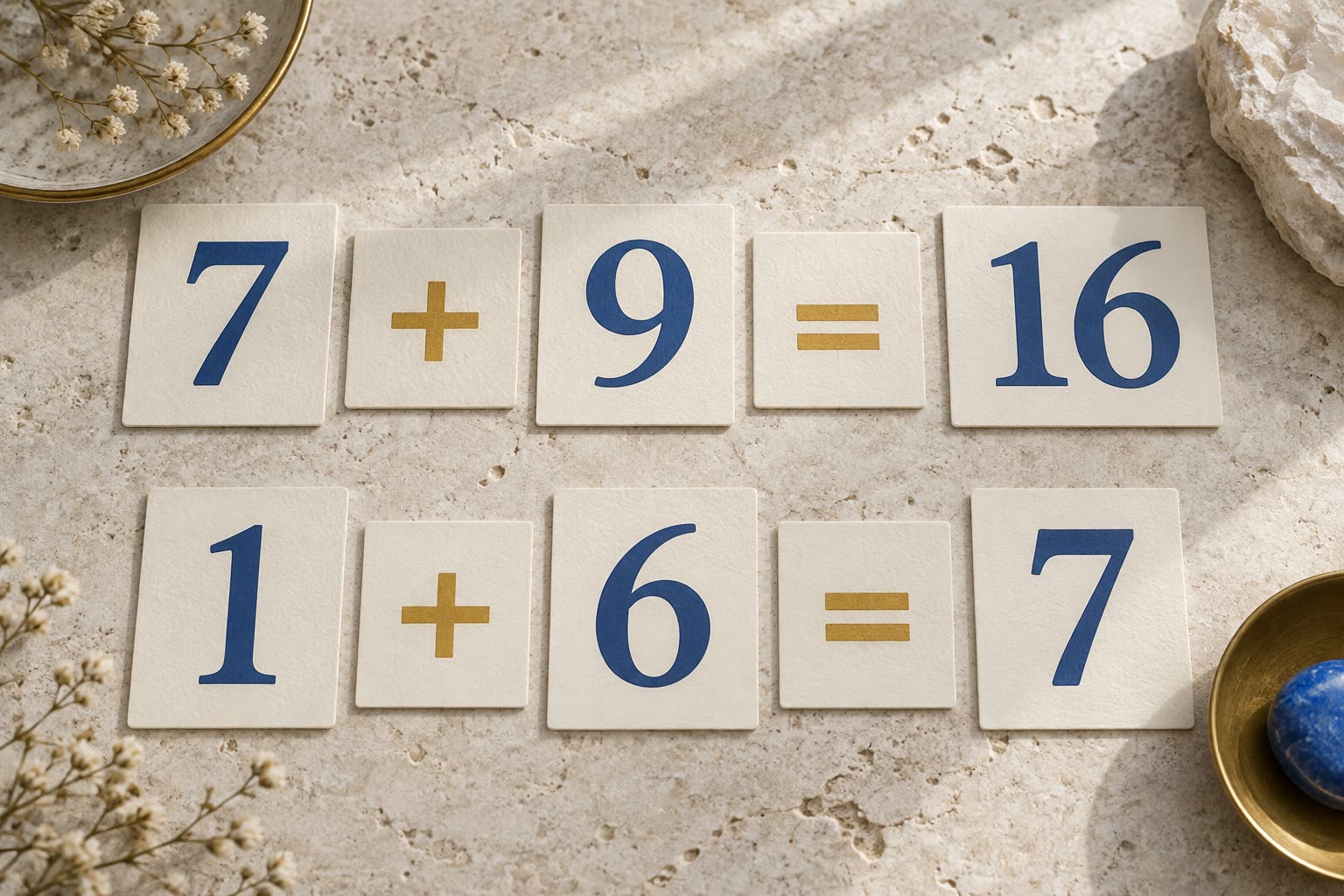
7 + 9 = 16, and 1 + 6 = 7, so 79 begins and ends on the same digit; Walmsley's entry gives the same sum. Only 79, 88 and 97 among two-digit numbers add up to 16, so the 16 layer is shared with just two other numbers.
The 16 is where the sources disagree. Hans Decoz lists it as a karmic debt number about "the fall of the ego and all it has built for itself", states that karmic debt is not a punishment, and applies it to core numbers of a birth chart rather than to numbers seen in daily life. Cheiro's 1926 book describes 16 as "a Tower Struck by Lightning from which a man is falling with a Crown on his head", "the Shattered Citadel", and a warning of "defeat of one's plans".
Cheiro's list of compound numbers stops at 52, so he has no entry for 79 itself, and Walmsley mentions 16 only as a step in the arithmetic. The dramatic readings therefore belong to 16, while the modern angel-number reading of 79 rests on its two digits.
What does 79 mean for endings and transitions?
Walmsley presents the ending in 79 as something already under way, and the number cannot say whether a particular job, relationship or project should end. Fatigue, conflict, grief and genuine completion can feel alike from the inside, so the useful question is what would show that something is finished.
Completion usually has outside evidence. When that evidence is missing, the discomfort may belong to one hard phase, and a smaller change, such as a lighter workload or one direct conversation, can show whether the whole chapter is really over.
Signs that something is finished rather than only difficult
- Delivered
The work that was agreed has been handed over or accepted.
- Expired
A contract, term or agreed period has run out.
- Outgrown
The reason for starting no longer applies.
- Agreed
The other people involved know it is ending and accept it.
- Settled
Money, belongings, records and promises have been returned or handed on.
The reduction back to 7 adds a further step: naming what the finished chapter taught before the next one starts. In Walmsley's entry that is the purpose of the ending, which clears room for a life that suits the reader better.
Does seeing 79 mean a breakup or a twin-flame return?
Walmsley's 2011 entry does not address romance, so the love readings come from later sites. Astrology.com says 79 can mean a relationship has ended and the reader should move on, or, for someone single, that a compatible partner is near, and its twin-flame section reads the number as a call to focus on spiritual growth. None of these claims cites a source.
For someone grieving a breakup, 79 can become tied to the hope that the other person will come back. A number cannot show another person's intentions, and a receipt or an address carrying 79 that brings an ex to mind is a record of the reader's memory rather than news about the ex's plans.
Endings inside a continuing relationship are the other common case. A couple can close an old arrangement, such as a long-distance period or an unfair split of household work, and agree a new one; read with the 7 on both sides, 79 fits that kind of change as well as a separation, since both begin and end with understanding what the old arrangement did.

Is 79 a sign to leave a job for service work?
Career is the one area Walmsley names directly: 79 asks the reader "to continue listening to your intuition about your spiritual practice and/or career path", and the 9 in her list brings altruism, philanthropy and humanitarianism. Later sites build on that: Astrology.com reads 79 as a sign to let go of the old and pursue a passion as work.
The number does not decide whether to resign. Savings, notice periods, benefits and the people who share the household income settle that question, and a transition handled well includes a handover of files, access, deadlines and the risks the next person needs to know. In the 79 reading, the handover is the 9 finishing the job, and the notes kept for the next role are the returning 7.

Why do I keep seeing 79?
Transitions make related cues stand out. Through selective attention, some stimuli are picked out while others are filtered away, so once 79 is linked with an ending, the same digits on a clock, a receipt or a page number are noticed while the other numbers seen that day pass unrecorded.
A short number journal can still be useful if it records the situation rather than the digits: where the sighting happened, what decision was open, and one fact that could be checked. Kept for a week, it can show whether the sightings cluster around one unmade phone call, one unpaid bill or one postponed conversation.
If checking for the number starts to raise anxiety, or decisions wait on the next sighting, stopping the log is the sensible step, and a doctor or counsellor can help with the anxiety itself.

Is 79 biblical? Psalm 79, the fall of Jerusalem and 1 Maccabees
No biblical text treats 79 as a symbolic number; the passage readers find is Psalm 79, a communal lament headed "A Psalm of Asaph". It opens "O God, the nations have come into your inheritance; they have defiled your holy temple" and mourns the dead left unburied around Jerusalem. The Greek Septuagint and the Latin Vulgate number it Psalm 78.
It is often connected with the Babylonian destruction of Jerusalem in 587 BC, and sometimes with the persecution under Antiochus IV in the Maccabean era. 1 Maccabees 7:16-17 quotes it directly after recording that sixty Hasideans were seized and killed in one day, which shows the psalm being reused for a later public catastrophe.
Its subject is a city and its temple, spoken in the plural voice of a community. Reading it as a private message that one person's job or relationship is ending changes both its scale and its subject, and a chapter number that differs between Hebrew and Greek Bibles cannot carry such a message.
79, 97 or 88: how are the three numbers that make 16 different?
79 and 97 share every ingredient: the same digits, the same 16 and the same root 7. In a reading that follows the digits in sequence, the order decides whether reflection leads into an ending (79) or follows one (97).
| Number | Digits in order | Reduction | Difference from 79 |
|---|---|---|---|
| 97 | 9 then 7 | 16, then 7 | Same digits and totals; the ending comes first and reflection follows |
| 88 | 8 then 8 | 16, then 7 | The only other two-digit route through 16; a doubled 8, the digit of money and authority |
| 78 | 7 then 8 | 15, then 6 | Same opening 7, followed by 8 |
| 80 | 8 then 0 | 8 | Next number in sequence; an 8 with a zero and no 7 at all |
| 7 | Single digit | None | The root 79 returns to, read without the 9 or the 16 |
Frequently Asked Questions
Is 79 a 7 or a 16 in numerology?
Both, at different steps. The digits add up to 16 (7 + 9), and 1 + 6 = 7 is the root. Some systems read the 16 as well: Decoz calls it a karmic debt number, and Cheiro called it the Shattered Citadel.
What does 79 mean in love?
Walmsley's 2011 entry, the older reading, does not mention love or relationships. Astrology.com reads 79 as a sign that a relationship has ended or that a compatible partner is near, and as a call for twin flames to focus on spiritual growth, without citing a source for any of it.
Is 79 a karmic number?
Only through 16, which Hans Decoz lists as a karmic debt number for core chart positions such as the Life Path. Applying the label to a number seen on a clock extends his rule.
What does 79 mean for career?
Walmsley's entry tells the reader to keep listening to intuition about their career path and spiritual practice, and its 9 adds service to others. It does not say to leave a job.
Sources
- (2011). Angel Number 79. Sacred Scribes Angel Numbers. Link
- (n.d.). 79 Angel Number Meaning. Astrology.com. Link
- (n.d.). Karmic Debt Numbers. World Numerology. Link
- (n.d.). Karmic Debt Number 16. World Numerology. Link
- (1926). Cheiro's Book of Numbers, Chapter XIII, the compound numbers 10 to 52, including 11, 13 and 16 (pp. 78-86 in the archived edition). Internet Archive. Link
- (n.d.). The Numerology Meaning of Single Digit Numbers 1-9. World Numerology. Link
- (2018). Selective attention. APA Dictionary of Psychology. Link
- (2021). Psalm 79:1-3; 1 Maccabees 7:16-17 (NRSVUE). New Revised Standard Version Updated Edition. Link
- (2026). Psalm 79 (numbering, dating and use in 1 Maccabees). Wikipedia. Link
About Our Editorial Process
Every KnowTheAngels guide separates calculation method, tradition context, and personal reflection. We cite where interpretations come from, present more than one view, and never present symbolic reading as prediction.
Read our editorial policy