What Does Angel Number 81 Mean When a New Step Finishes Old Work?
Capacity before a new step: the 8-1 order, the reduction to 9, the square of nine, and the Psalm 81 and gifts-of-the-Spirit claims

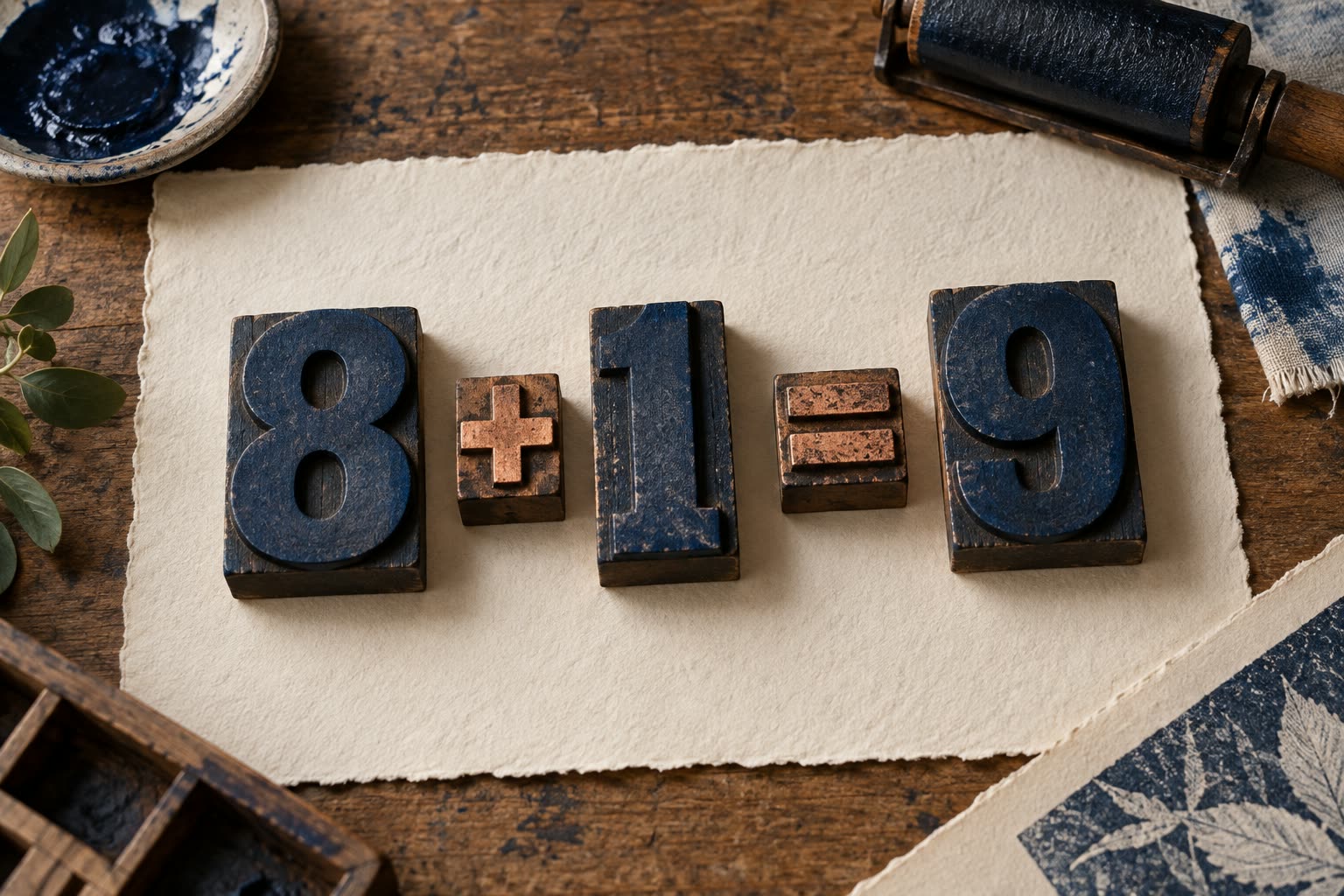
Angel number 81 puts 8, the digit numerology links with achievement and authority, before 1, the digit of beginnings, and reduces to 9, the digit of completion (8 + 1 = 9). In that order the number describes something already built or earned that needs one new step to finish, the reverse of 18, where a first step grows into authority. Eighty-one is also 9 x 9, so the completion digit appears in its product as well as its sum.
Two angel-number writers disagree on how much ends. Writing on her Sacred Scribes blog in July 2011, Joanne Walmsley says "endings and conclusions are in the offing" and asks the reader to release the old; Blair Andrews at Numerologist.com reads 81 as mastery meeting one small input and sums it up as "Completion, not graduation." Readers who ask whether 81 is biblical find answers that lean on Psalm 81 and on a claimed link with the gifts of the Holy Spirit.
Quick Facts
- Reduction
- 8 + 1 = 9
- Square
- 81 = 9 x 9 = 3 x 3 x 3 x 3
- Reverse number
- 18, where a first step grows into authority
- Sacred Scribes (2011)
- "Endings and conclusions are in the offing"
- Numerologist.com
- "Completion, not graduation" (Blair Andrews)
- Psalm 81
- The Levites' psalm for the fifth day of the week (Mishnah Tamid 7:4)
What changes when 8 comes before 1, and why is the total 9?
The reduction takes one step: 8 + 1 = 9. Numerology.com calls the 8 "the achiever", a number that measures life by the goals it reaches. It describes the 1 through newness and movement, and Hans Decoz writes that a 9 appearing as a cycle "often denotes a finality, the completion of an era." Read in order, the three describe an achievement already in hand, a single new move, and the ending that move brings about.
The order separates 81 from 18, which has the same digits and the same root. In 18 the first step comes first and the authority grows out of it, so readings of 18 concern handing over a role that has done its job. In 81 the capacity exists before anything new starts: years of training before an exam, a finished manuscript before it is submitted, savings built up before the last payment on a loan. The 1 is the move that puts that accumulated work to use, and the 9 is the stage it closes.
Andrews gives the same order a quieter emphasis. His 81 is "the master who receives one small input" and "finally understands what all the teaching was for", so the new step is small and what completes is an understanding of long work, with no ceremony attached.
Is 81 special because it is 9 x 9?
Eighty-one is 9 squared and 3 to the fourth power. Every multiple of 9 reduces to 9 (9 x 7 = 63, 6 + 3 = 9), so 81 reaches the completion digit through multiplication as well as addition, and writers who call it a strengthened 9 are counting both routes. Walmsley's and Andrews's entries do not mention the square at all, and in digit-sum numerology it leads to the same 9 as the addition.
Outside numerology, the 81 chapters of the Tao Te Ching are often cited alongside the number, and that count was an editor's choice. Traditional sources report early versions with 64, 68 or 72 chapters, and the Han-dynasty commentary attributed to Heshang Gong divided the text into the 81 used today. The Mawangdui manuscripts found in 1973 even reverse the order of its two parts, so the 81 chapters record a later arrangement of the text.
Does angel number 81 mean an ending or a new beginning?
It means both, and the two main readings weigh them differently. Walmsley's 2011 entry leans toward the ending: "important life changes are around you and endings and conclusions are in the offing", and the reader is asked to "surrender and release the 'old'" while better circumstances arrive. Andrews leans toward the beginning, but a small one: a single input that completes a long rhythm.
The difference shows in a real decision. On Walmsley's reading, 81 fits a job, lease or arrangement that is closing, and the question is what to let go. On Andrews's reading, it fits a project that is nearly finished and the one action still missing, such as the application sent, the manuscript submitted or the conversation held. Both readings make the 1 serve the 9, so a start that finishes nothing falls outside either of them.
At work and with money, what does the new step in 81 finish?
At work, 81 describes a person whose capacity is already built and who is deciding on the step that uses it: the qualified candidate who has not yet applied, the engineer handing a finished prototype to the team that will ship it, the founder closing one product line to fund another. Numerology.com's 8 is ambitious and strategic and its 1 self-directed, so the pair suits a decisive move, and the 9 measures that move by what it brings to a close.

Walmsley's list for 8 includes "manifesting wealth and abundance", and Astrology.com says of 81 that "your hard work and determination will bring you success and material abundance." Neither statement comes with a mechanism or an example. In money terms the 8-1-9 order fits a closure more naturally than a windfall: a final loan payment, an account closed, an estate settled. A final payment is finished only when the lender's statement shows a zero balance and any automatic debit has stopped.

In love, what does the one step in 81 close, and what about twin flames?
Andrews's love reading is the most specific. In a long partnership, he writes, 81 often marks the moment when "one small honest conversation", rehearsed for months, shifts everything. The relationship already built is the 8, and the conversation is the 1 that brings a long uncertainty to an end.
The step in 81 belongs to one person, while the uncertainty it ends involves two. A proposal, an apology or a request to live together is a 1, and whether it completes anything depends on the other person's answer, which no reading of the number can supply in advance.
Astrology.com reads 81 as a twin-flame sign of "the coming together of two individuals who possess great power and abundance". The claim has no source in numerology or in Walmsley's entry, which does not mention relationships, and the 9 in 81 fits the end of a connection at least as well as a reunion.

Is 81 biblical? What Psalm 81 says and the gifts-of-the-Spirit claim
No biblical text treats 81 as a sign. The association readers meet comes from Psalm 81, one of the twelve psalms of Asaph, headed "To the chief Musician upon Gittith". It is a festival psalm: "Blow up the trumpet in the new moon, in the time appointed, on our solemn feast day" (verse 3), and verses from it are still read in the Rosh Hashanah liturgy. The Mishnah (Tamid 7:4) lists it as the psalm the Levites sang in the Temple on the fifth day of the week, and it is still recited on Thursdays. Greek and Latin Bibles number it 80.
Verse 10 reads like a promise of plenty: "open thy mouth wide, and I will fill it." The line follows God's reminder that he "brought thee out of the land of Egypt", and the psalm ends in regret that Israel would not listen, naming "the finest of the wheat" and "honey out of the rock" as what they would have received (verse 16). The filling is offered to a people on condition that they keep the covenant, which is some distance from a personal promise of plenty.
Astrology.com links 81 to the gifts of the Holy Spirit but cites no verse. The list of spiritual gifts in 1 Corinthians 12:8-10 has nine items, from the word of wisdom to the interpretation of tongues, so it belongs with the 9, and no text multiplies it to 81.
When 81 keeps appearing near a deadline, what is it attached to?
Eighty-one is an ordinary figure on prices, page numbers, ages and order numbers. Once it has been linked with endings, those appearances become easier to notice, through the selective attention psychologists describe as focusing on some stimuli while filtering out others. A note of what was unfinished each time 81 appeared shows whether the sightings gather around one project or decision, which is the situation both Walmsley's and Andrews's readings describe.
How different is 81 from its reverse 18, and from 80, 82 and 9?
| Number | Arithmetic | What sets it apart |
|---|---|---|
| 18 | 1 + 8 = 9 | A first step that grows into authority; readings concern handing over |
| 80 | 8 + 0 = 8 | The 8 beside a zero whose role depends on the source |
| 81 | 8 + 1 = 9; also 9 x 9 | Established capacity and one new step that completes it |
| 82 | 8 + 2 = 10, 1 + 0 = 1 | Authority taking a partner; ends on 1 |
| 9 | Single digit | Completion and service without the 8 as a starting point |
Eighteen is the comparison that matters, because it shares both digits and the root. The order decides which way the reading looks: 18 at authority that has outlived its first purpose, 81 at capacity waiting for the step that finishes its work.
Frequently Asked Questions
Which single digit does 81 reduce to?
It reduces to 9 in one step: 8 + 1 = 9. Because 81 is also 9 x 9, it reaches the 9 by multiplication as well.
Will 81 bring money or a windfall?
No source shows that it does. Walmsley and Astrology.com attach abundance to the 8 without evidence, and the 8-1-9 order fits a finished payment or a closed account better than new income.
What does 81 mean spiritually?
Walmsley's 2011 entry asks the reader to keep up prayers, visualizations and affirmations and to pay attention to repeated thoughts and ideas, which she reads as guidance on the next step.
Sources
- (2011). Angel Number 81. Sacred Scribes Angel Numbers. Link
- (2023). Angel Number 81 Meaning: The Rhythm Takes Its First Step. Numerologist.com. Link
- . 81 Angel Number Meaning. Astrology.com. Link
- (2026). Number 8 Meaning in Numerology. Numerology.com. Link
- (2026). Number 1 Meaning in Numerology. Numerology.com. Link
- . Numerology Meaning of number 9. World Numerology. Link
- (2026). Tao Te Ching. Wikipedia. Link
- . Psalm 81:1-3, 10, 16; 1 Corinthians 12:8-10. Bible Gateway. Link
- (2026). Psalm 81. Wikipedia. Link
- . Tamid 7:4, the psalms sung by the Levites on each day of the week. Sefaria. Link
- (2018). Selective attention. APA Dictionary of Psychology. Link
About Our Editorial Process
Every KnowTheAngels guide separates calculation method, tradition context, and personal reflection. We cite where interpretations come from, present more than one view, and never present symbolic reading as prediction.
Read our editorial policy