What Does Angel Number 18 Mean in Numerology, Chai and Tarot?
Why Hebrew chai totals eighteen, how 18 reduces to 9, and why the Moon and Luke 13 need their own context
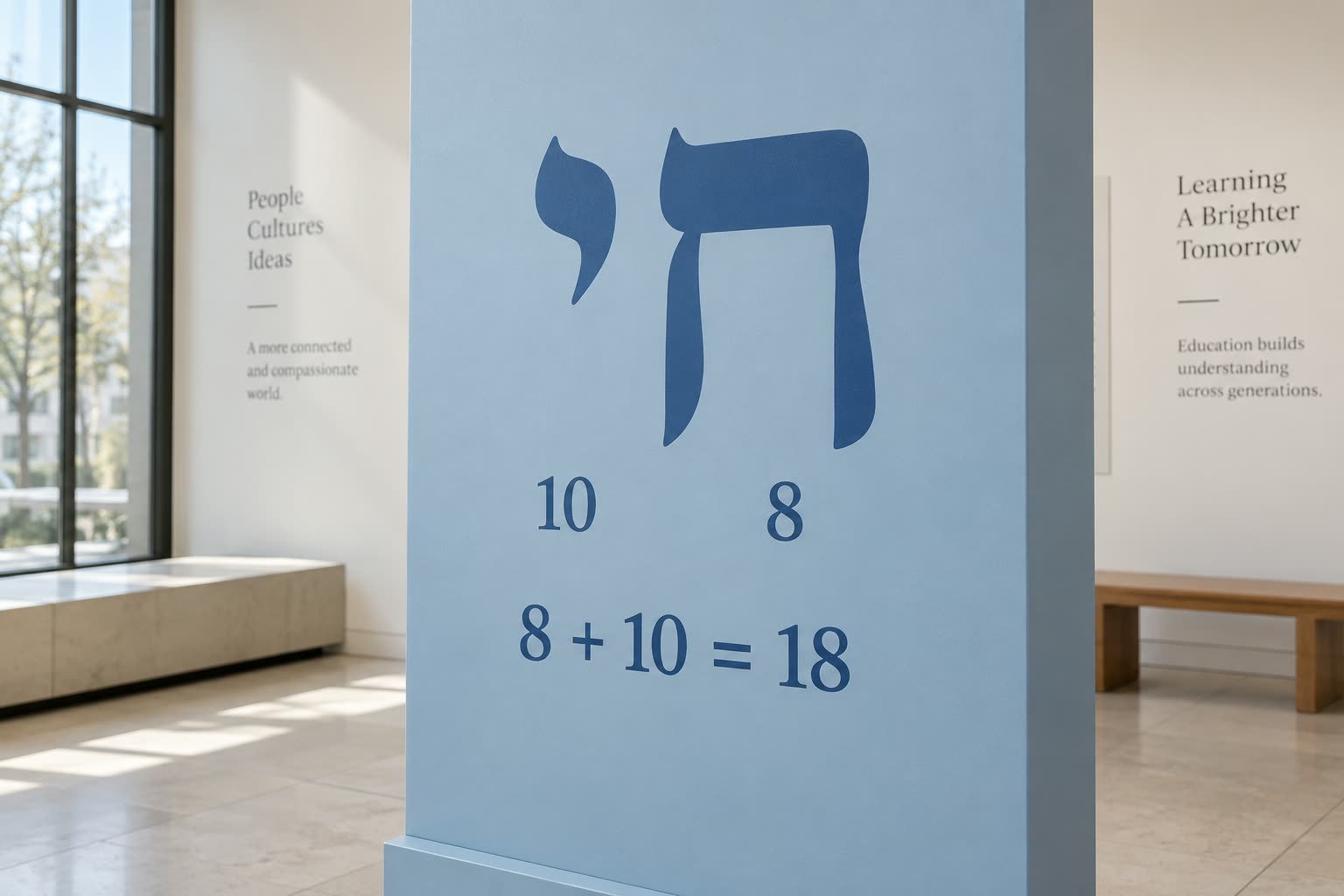
Eighteen is associated with life in Jewish tradition because the Hebrew letters of chai have values totaling 18. Decimal digit reduction takes a different route: 1 + 8 = 9, whose modern numerology profile Hans Decoz associates with philanthropy and broad human concern.
Tarot's Moon XVIII and Cheiro's compound-number warning do not share chai's favorable meaning. The answer to an angel-number sighting depends on which tradition is being applied, rather than a single message hidden in every eighteen.
Quick Facts
- Letters in chai
- Chet ח = 8; yud י = 10
- Chai's combined value
- 8 + 10 = 18
- Decimal reduction of 18
- 1 + 8 = 9
- Tarot's eighteenth trump
- The Moon
- Luke 13's two eighteens
- Eighteen disaster victims; eighteen years of a woman's affliction
- Reversed decimal form
- 81 also reduces to 9
- Complete clock pattern
- 18:18 totals 18 and reduces to 9
Why does chai make 18 a number of life?
The Hebrew word chai, חי, means 'life' or 'alive'. Its letters are chet, valued at eight, and yud, valued at ten, so their numerical sum is eighteen.
| Letter | Hebrew form | Numerical value |
|---|---|---|
| Chet | ח | 8 |
| Yud | י | 10 |
| Chai | חי | 8 + 10 = 18 |
Chabad's explanation of giving in multiples of eighteen connects the amount with that word. Gifts of 18, 36 or 54 express the life association because they are one, two or three multiples of chai's value.
The particular currency does not create the association. The chosen numerical amount carries the reference, while the actual gift still depends on the donor, recipient and occasion.
This is a recognizable Jewish custom, rather than evidence that an eighteen appearing on a clock brings money or extends a life. A deliberately chosen gift and an incidental sighting have different origins.
My Jewish Learning also identifies the historical eighteen blessings behind the prayer name Shemoneh Esreh, 'Eighteen'.
The name supplies a specific liturgical connection; it does not establish that every Jewish prayer has eighteen blessings.
The letter calculation preserves the word as its starting point.
Reducing its total further to nine would add a decimal operation that is not needed to explain why chai is associated with eighteen.
Does 1 + 8 = 9 mean the same thing as chai?
Decimal reduction of eighteen adds the printed digits and gives nine. Unlike chai's letter values, this operation starts with the numeral 18, not with a Hebrew word.
Hans Decoz describes one through independence and leadership, eight through management and material achievement, and nine through philanthropy and concern for humanity. A modern interpretation of eighteen may compare those profiles, but the comparison remains a symbolic reading.
The arithmetic explains why angel number 9 is relevant to eighteen's reduced meaning. It does not demonstrate that a powerful role has finished or that someone must hand it over.
The reverse, angel number 81, also totals nine.
Reversing the order leaves the sum unchanged, so an 'authority before initiative' story requires an extra interpretive claim beyond addition.
Eighteen is also twice nine, making it a multiple of nine as well as a number whose digits sum to nine. That agreement is a mathematical feature; Decoz's philanthropy association is a separate interpretation of the result.
His Life Path 9 profile belongs to a birth-date calculation.
An eighteen on a ticket does not supply the birth-date inputs needed to identify someone's Life Path.
The two calculations therefore answer different questions. Chai explains why a Hebrew word is linked with eighteen, while digit reduction explains why a decimal numeral belongs to root nine.
The Moon XVIII and Cheiro's warning about 18
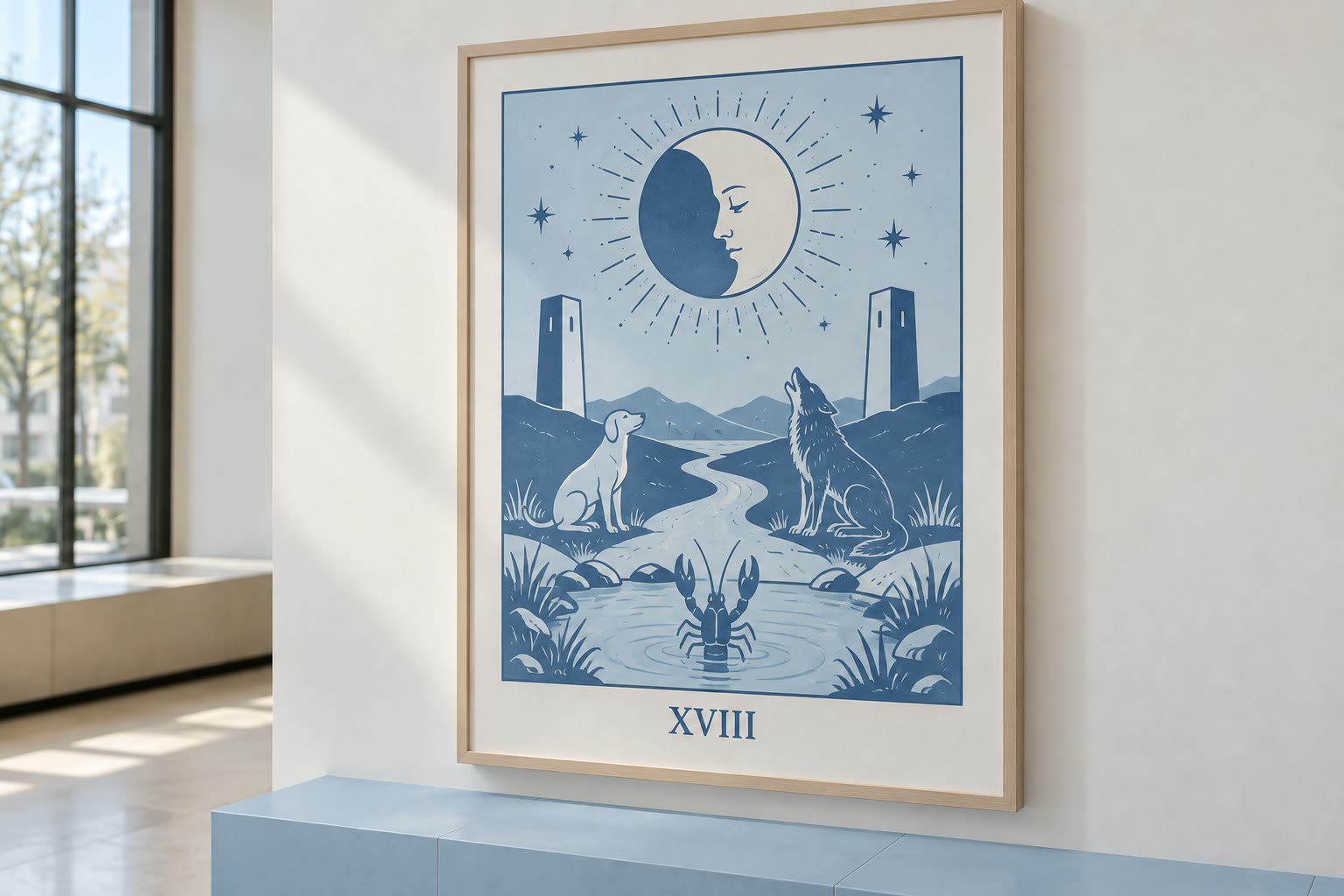
Waite's eighteenth tarot trump is the Moon, not a card described simply as the completion of a successful cycle. His account includes a path between two towers, a dog and a wolf, and a crayfish emerging from water.
In Part II, Waite connects the dog and wolf with fears of the natural mind and describes the path leading toward the unknown. His Part III divinatory list includes danger, deception, darkness and error.
| Source and object | Description or association | Limit of the comparison |
|---|---|---|
| Waite, tarot Moon XVIII | Dog, wolf, crayfish, towers and a path toward the unknown | A card interpretation in a tarot setting |
| Cheiro, compound number 18 | Conflict between material and spiritual sides; quarrels and treachery | An attributed compound-number warning |
| Jewish chai custom | Life expressed through letter values and multiples of eighteen | A word and gift convention, not a card reading |
Cheiro's 1926 entry gives eighteen a severe compound-number interpretation involving conflict, bitter quarrels and treachery. Its moon, animals and other pictorial details can be compared with tarot imagery without asserting an undocumented line of borrowing.
The comparison explains why a reader may find a hopeful chai account and an alarming eighteen account.
They refer to different objects and interpretive systems, so neither can be silently substituted for the other.
The neighboring tarot trumps are the Star XVII and the Sun XIX. Their order identifies the Moon's position in the deck; it does not schedule a period of uncertainty between two favorable events.
A printed eighteen is also not a drawn Moon card. Cheiro's warning and Waite's imagery do not establish that a sighting reveals a hidden enemy or predicts an accident.
Luke 13: why eighteen does not prove blame or a curse
Luke 13:4 refers to eighteen people killed when the tower of Siloam fell. Jesus asks whether they were worse offenders than other people in Jerusalem and answers no.
The passage continues with a call to repentance, but it rejects the proposed comparison that the dead were worse sinners. The count of eighteen therefore cannot support a verdict of special blame against the victims.
| Reference | What eighteen measures | Narrative context |
|---|---|---|
| Luke 13:4–5 | People killed by the tower of Siloam | Jesus rejects greater guilt as the explanation |
| Luke 13:11, 16 | Years of a woman's affliction | Jesus heals her and responds to a Sabbath objection |
| Judges 3:14 | Years under Eglon's rule | A period of foreign domination |
| Judges 10:8 | Years of oppression | A duration within Israel's narrative |
Later in the same chapter, Luke describes a woman who has been afflicted for eighteen years. Jesus heals her on the Sabbath and uses the duration when responding to objections about her release.
The two eighteens perform different jobs: one counts victims and the other measures years.
Their shared numeral does not make the disaster and the healing the same kind of event.
The eighteen-year periods in Judges also describe durations under oppressive rule. Their setting explains those occurrences without proving that eighteen universally means bondage.
A proposed link with 666 uses yet another method: 6 + 6 + 6 = 18. Revelation 13:18 supplies 666 within a number-of-the-beast passage, but it does not state that every eighteen inherits that number's identity.
Digit addition can establish the shared sum. It cannot transfer the narrative meaning from a vision in Revelation to the victims in Luke, a Hebrew gift custom or a clock display.
How do the readings of 18 apply to love, money and career?
A chai gift can express a wish for life or well-being through a deliberately selected amount. That gesture comes from the gift custom, not from a claim that eighteen guarantees a romantic union.
For example, a hypothetical donor choosing 36 uses two multiples of chai. The amount expresses the reference, while whether the recipient welcomes the gift remains a separate question about the people involved.
Cheiro's quarrels-and-treachery interpretation gives a very different relationship reading. It is not evidence that a partner has lied, and the Moon's deception association cannot identify what was said or concealed.
A twin-flame label similarly cannot establish that a separation has ended. The claim requires knowledge about a particular connection that neither the letter values of chai nor 1 + 8 = 9 supplies.
Career interpretations can draw on Decoz's root-nine association with philanthropy and concern beyond personal advancement. That theme differs from a prediction that an eighteen signals retirement, resignation or the end of a mandate.
A hypothetical charitable project can receive three gifts of 18, totaling 54. Each gift retains chai's numerical reference, while the amount available to the project comes from adding the actual contributions.
With money, the chai custom concerns an amount intentionally given.
Cheiro's warning concerns his symbolic judgment of a compound number, and neither provides a forecast of income or investment returns.
The same eighteen can therefore accompany generosity, an administrative total or an ordinary identifier. Its setting explains what happened, while the selected tradition explains the meaning someone attaches to it.
Why does 18 recur, and how is 18:18 different?
The 18th hour of a 24-hour clock is 6 p.m., and every displayed minute in that hour contains eighteen. The minute :18 also occurs during each of the day's twenty-four hours.
| Counting rule | Possible minute states | What is included |
|---|---|---|
| 24-hour HH:MM | 83 | 60 in hour 18, plus 24 at :18, minus the shared 18:18 |
| 12-hour display | 24 | One :18 during each hour; the hour itself is never 18 |
A person's actual sightings depend on when the clock is consulted.
The calculation describes possible exposures, not a claim that everyone encounters eighteen eighty-three times daily.
The complete pattern 18:18 has four digits: 1 + 8 + 1 + 8 = 18, followed by 1 + 8 = 9. It shares the root of eighteen, but the input is a repeated timestamp rather than a lone two-digit number.
Zwicky's frequency illusion describes increased noticing followed by an impression of increased frequency. Zimmer's discussion of the term preserves that distinction between an item becoming salient and a demonstrated change in its occurrence.
A record of sightings can distinguish the recurring clock format from unrelated appearances on dates or identifiers. A frequency claim also needs the occasions when the number could have appeared but did not.
Frequently Asked Questions
Does eighteen mean life in Hebrew?
Chai, חי, means life or alive, and its letters total eighteen through chet 8 plus yud 10. That word-value connection explains the custom of gifts in multiples of eighteen.
Is eighteen lucky or a warning?
The answer differs by tradition. Chai supplies a favorable life association, while Cheiro assigns compound 18 a warning about conflict and treachery; neither establishes the outcome of an incidental sighting.
Is eighteen the same as the number 666?
No, adding the digits of 666 gives 18, but the numbers are not identical, and Revelation 13:18 does not state that eighteen is another name for the beast's number.
Does seeing eighteen mean a relationship has ended?
The digit sum gives nine, not information about a relationship's status. An ending requires facts about what the people involved have said or agreed.
Sources
- . Life Path Number meanings (1, 8, 9). World Numerology. Link
- . Chai: Why Do Jews Give in Multiples of 18?. Chabad.org. Link
- . Significant Numbers in Judaism. My Jewish Learning. Link
- (1926). Cheiro's Book of Numbers, Chapter XIII, compound number 18, pp. 81-82. Herbert Jenkins. Link
- (1910). The Pictorial Key to the Tarot, Part II, XVIII: The Moon; Part III, section 2, divinatory meanings. William Rider & Son. Link
- . New Revised Standard Version. Bible Gateway. Link
- (2019). "Frequency illusion" in the OED (on Arnold Zwicky's 2005 coinage). Language Log. Link
- . The number-of-the-beast passage (NRSVUE). Bible Gateway. Link
About Our Editorial Process
Every KnowTheAngels guide separates calculation method, tradition context, and personal reflection. We cite where interpretations come from, present more than one view, and never present symbolic reading as prediction.
Read our editorial policy