Why Do You Keep Seeing 10:10, and How Is This Mirror Time Interpreted?
Two 10s that each reduce to 1, a digit total of 2, the angel French mirror-hour lists give it, and the reason watch adverts use it
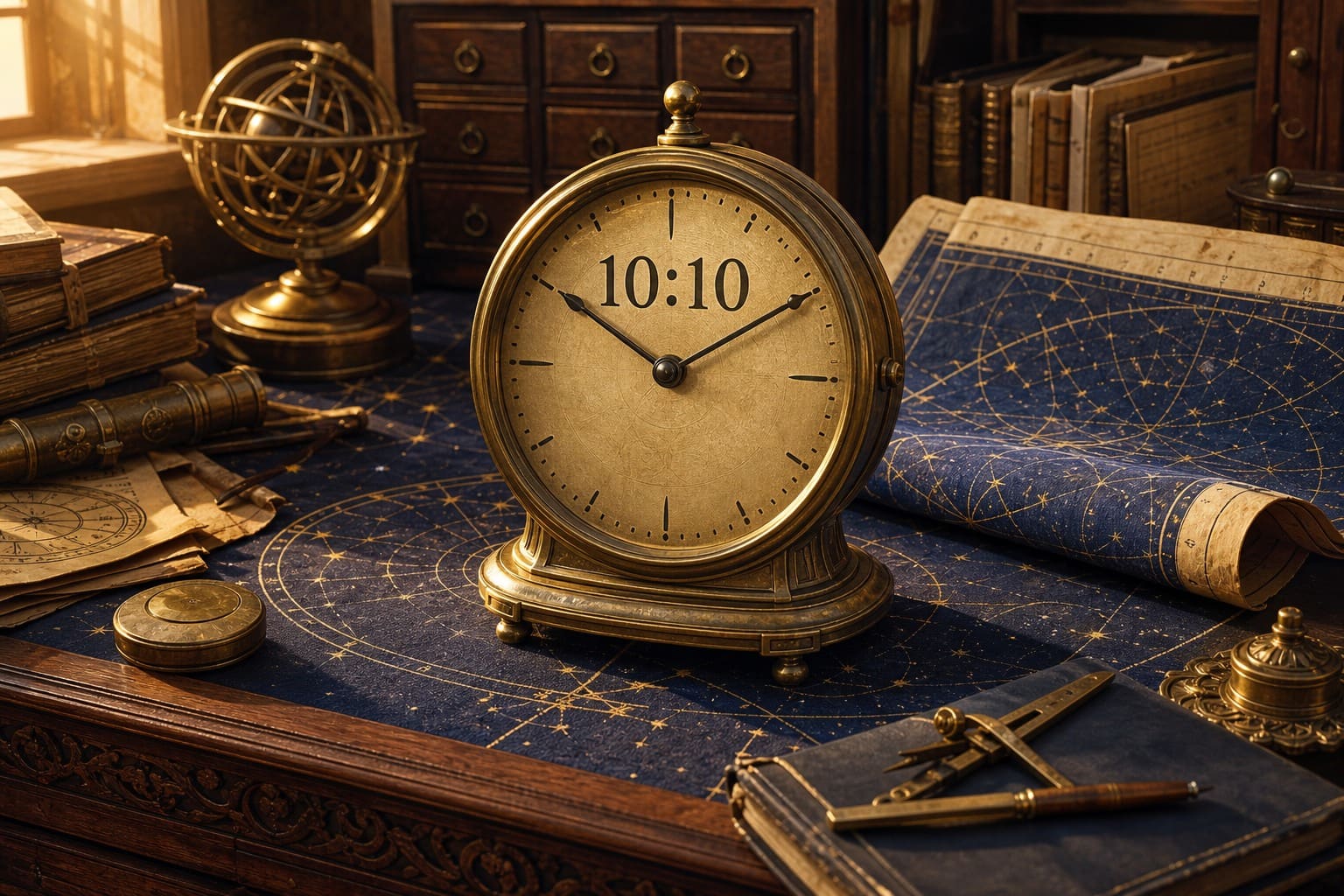
10:10 is read in numerology in two steps. Each 10 reduces to 1 (1 + 0 = 1), and the four digits together make 1 + 0 + 1 + 0 = 2. Numerology.com describes 1 as the number of independence and new beginnings and 2 as the gentle, diplomatic number of partnership, so readings of 10:10 pair a restart with a question about who else is involved.
Three other associations have grown around this particular time. French mirror-hour lists name an angel for it, some Christian readers connect it with John 10:10, and watch advertisers set their hands to it because the dial seems to smile.
Quick Facts
- Per-side root
- 10 → 1 + 0 = 1, on both the hour and the minute
- Digit total
- 1 + 0 + 1 + 0 = 2
- Master numbers
- None at any step (10, 20 and 2)
- Mirror-hour angel
- Lecabel on lists using the 20-minute rota (10:00 to 10:20)
- Evening display
- 22:10 on a 24-hour clock
- Advertising default
- Watch hands set near 10:10 (Karim et al., 2017)
What does 10:10 on the clock mean?
Read through numerology, 10:10 is a doubled beginning inside a partnership. Reduction adds digits until one remains, and on each side of 10:10 the number 10 reduces to 1, so the hour and the minute share the same root. Across the whole display, 1 + 0 + 1 + 0 gives 2, and adding the two sides first (10 + 10 = 20, then 2 + 0) arrives at the same 2. No master number (11, 22 or 33) appears at any step, so no system keeps an unreduced layer for this time.
| Layer | Calculation | Result |
|---|---|---|
| Hour | 1 + 0 | 1 |
| Minute | 1 + 0 | 1 |
| Four digits | 1 + 0 + 1 + 0 | 2 |
| Sides added first | 10 + 10 = 20, then 2 + 0 | 2 |
The zero adds nothing to the sum, so both 10s land on the number 1. Numerology.com calls 1 the most self-sufficient number, needing nothing but itself, and calls 2 the most underestimated one, tactful and forgiving. A time built from two self-sufficient 1s that still adds up to 2 carries that tension, and numerology readers take it as a beginning that depends on someone else's agreement.
Why do watch adverts set their hands to 10:10?
Watch advertisements usually show the hands at about ten past ten, and Karim and colleagues tested why in Frontiers in Psychology in 2017. In their first experiment, 46 participants rated watches set to 10:10, 11:30 and 8:20; the 10:10 setting raised both pleasant feeling and stated intention to buy. In a second experiment, 23 participants judged 10:10 to look like a smiling face and 8:20 like a sad one. The authors concluded that the effect works on viewers who do not notice what the hands are doing.
For someone who feels that 10:10 keeps following them, the advert convention explains part of the familiarity. The raised V of the hands appears in advertising and product photographs, so the analogue shape is well known before any real clock shows it. Digital sightings have a simpler explanation: once a time feels meaningful, the frequency illusion (the linguist Arnold Zwicky's 2005 term) makes each later sighting memorable while the unremarkable minutes go unrecorded.
A 12-hour clock shows 10:10 twice a day. A 24-hour display shows it in the morning only, because the evening minute reads 22:10, so readers who use 24-hour time on their phones meet 10:10 half as often.
Does 10:10 point to John 10:10?
Some Christian readers take a 10:10 sighting as a reminder of John 10:10, where Jesus says, "The thief cometh not, but for to steal, and to kill, and to destroy: I am come that they might have life, and that they might have it more abundantly" (KJV). The verse belongs to the Good Shepherd discourse of John 10, and its promise of abundant life is what connects it, for these readers, with a moment of renewal.
The match between clock and verse comes from reference notation. Stephen Langton's chapter divisions date from around 1225, and the New Testament verse numbers from Robert Estienne's Greek edition of 1551, so the digits 10:10 were attached to this sentence some fourteen centuries after the Gospel was written. The Bible never mentions clock times, and reading the verse when the clock shows 10:10 is a devotional habit, separate from both numerology and the mirror-hour lists.
Lecabel and the other angels French lists give 10:10
French websites on "heures miroirs" (mirror hours) give each doubled time a guardian angel, and the name several of them attach to 10:10 is Lecabel. The scheme goes back to Lazare Lenain's La Science cabalistique (Amiens, 1823), which took the 72 angel names Kabbalists derived from Exodus 14:19–21 and gave each one twenty minutes of the day, since 72 slots of 20 minutes fill 24 hours. Counted from midnight, as the list on Heure-Miroir.eu counts them, the 31st name, Lecabel, holds 10:00 to 10:20. Resfmiroir's entry for 10:10 names Lecabel and says he encourages perseverance and creativity toward a goal.
The lists do not all agree. Astroya's table of mirror hours gives 10:10 to Lehahiah, the angel other lists give to 11:11, with the message that a door is opening toward the reader's ambitions. Resfmiroir also pairs 10:10 with the Wheel of Fortune, which is card X in the Marseille tarot and so shares the hour's number. Both layers are recent website conventions built on a nineteenth-century occult system: Lenain wrote about hours of the day, and digital clock readouts came more than a century later.
10:10 in love, work and new starts
Love readings on mirror-hour and angel-number sites mostly promise a new relationship or a reunion. The numerology supports a narrower reading: two 1s stand for two separate people or two separate starts, and the total 2 stands for the cooperation between them. A couple deciding whose new job decides where they live fits that pattern closely. The time cannot say what another person feels or intends, and a reading that claims to report someone's thoughts has gone beyond anything the digits contain.
Work and personal plans follow the same structure. A restart that needs a second party, such as a new role that hangs on a reference or a relaunch that needs a partner's sign-off, matches the doubled 1 and the 2. A start that depends on no one else fits the plainer reading of 1 on its own.
Frequently Asked Questions
Is seeing 10:10 a sign from angels?
Angel-number and mirror-hour writers treat it as one, and French lists name Lecabel as the angel involved. No evidence shows that a clock time carries a message, and the ordinary reasons for repeat sightings come first: a 12-hour clock shows 10:10 twice a day, and the advert dial has made the shape familiar.
Is 10:10 the same as angel number 10?
No. Angel number 10 is a single 10, which numerology reduces to 1 and older number symbolism ties to the Pythagorean tetractys of ten points. 10:10 shows the 10 twice across a colon, and its four digits add up to 2, a partnership number that a lone 10 never produces. The watch-advert dial and the mirror-hour angel also belong to the clock time rather than to the standalone number.
Does 22:10 count as 10:10?
No. 22:10 is the evening minute on a 24-hour clock, and its digits reduce to 5 (2 + 2 + 1 + 0). Mirror-hour lists only count times whose hour and minute match, such as 10:10 or 22:22.
Sources
- (n.d.). Number Meanings 1–9. Numerology.com. Link
- (1823). La Science cabalistique, ou l'art de connaître les bons génies. Amiens; 72 angel names, each assigned 20 minutes of the day
- (2026). Lazare Lenain. Wikipédia (French), section on La Science cabalistique. Link
- (n.d.). Les 72 Anges Gardiens Kabbalistiques : liste complète. Order of the 72 names and the count from midnight. Link
- (n.d.). 10:10 a.m.: spiritual meaning of the mirror hour. Resfmiroir.org. Link
- (n.d.). Heure miroir : signification complète des 24 heures. Astroya.fr. Link
- (2017). Why Is 10 Past 10 the Default Setting for Clocks and Watches in Advertisements? A Psychological Experiment. Frontiers in Psychology 8:1410, doi:10.3389/fpsyg.2017.01410. Link
- (2019). Frequency illusion in the OED. Language Log account of Arnold Zwicky's 2005 term. Link
- (1611). John 10:10. BibleGateway. Link
- (2026). Chapters and verses of the Bible. Wikipedia, sections on Stephen Langton and Robert Estienne. Link
About Our Editorial Process
Every KnowTheAngels guide separates calculation method, tradition context, and personal reflection. We cite where interpretations come from, present more than one view, and never present symbolic reading as prediction.
Read our editorial policy