Why Are Angels Seen in White, and What Does White Light Mean?
The white-robed figures of the Gospels and Revelation, the white of baptism and the church year, near-death light, the New Age white-light shield, and when a flash is an eye problem
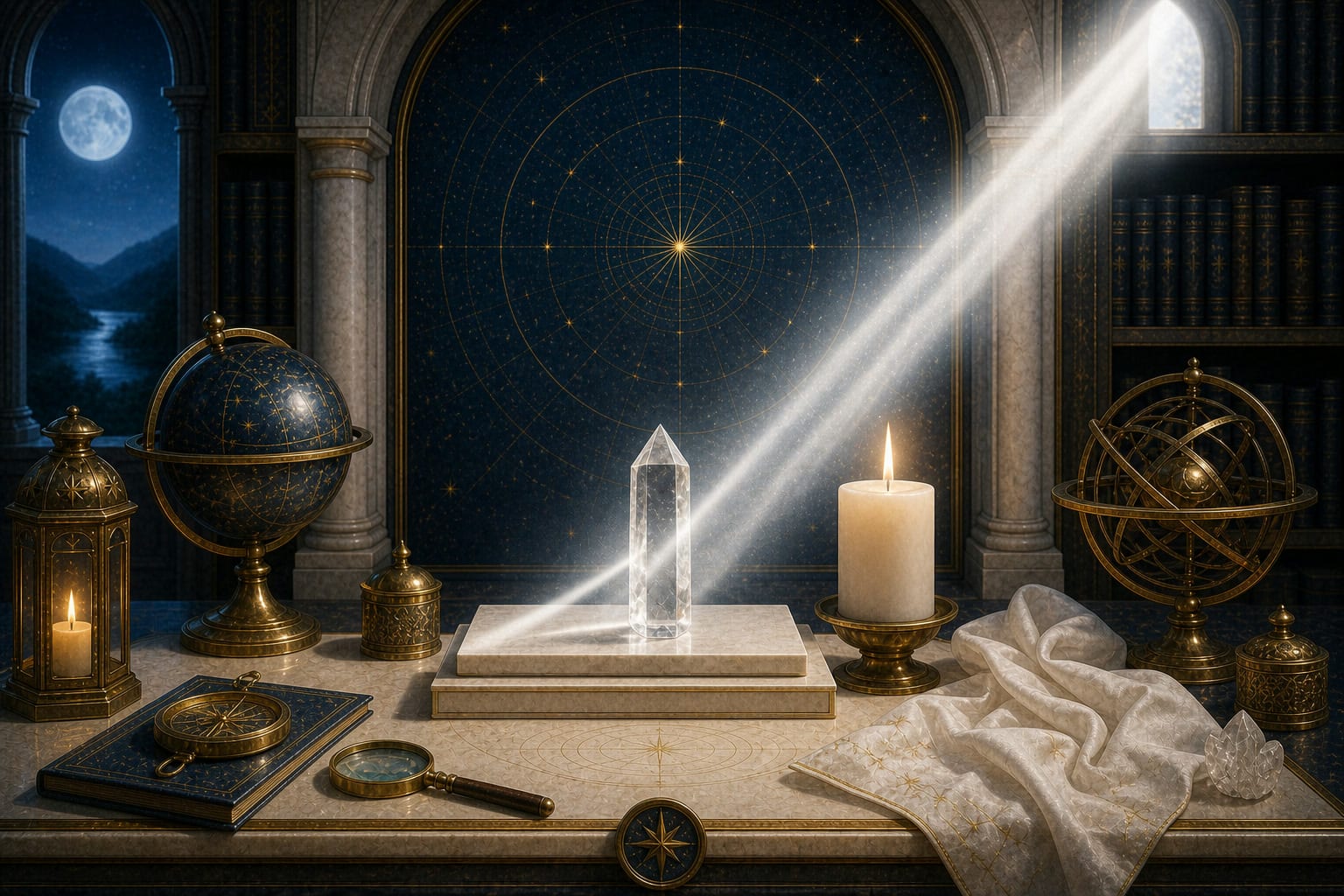
White light means different things depending on which source is speaking. In the Gospels, the figures at Jesus' empty tomb wear white, and Matthew 28:3 says the angel's clothing was "white as snow."
Churches carried that color into worship. A newly baptized Catholic receives a white garment, and priests wear white at Easter, at Christmas, and on the feasts of the angels.
Two newer meanings sit beside those older ones. People revived from cardiac arrest often report a brilliant light, and New Age teachers tell readers to surround themselves with white light for protection.
No tradition on this page treats a white light by itself as proof that an angel is present. A sudden flash inside your own vision belongs first to an eye doctor, and the last section explains when.
Quick Facts
- Angels in white
- Matthew 28:3, John 20:12, and Revelation 15:6 call the white-clothed figures angels
- Daniel 7:9
- The snow-white clothing belongs to the Ancient One, a figure for God, not to an angel
- Church color rule
- GIRM 346 sets white for Easter, Christmas, Mary, and the Holy Angels
- Near-death light
- 76% of coma survivors meeting NDE criteria reported a brilliant light (2014 study)
- White-light shield
- A modern New Age visualization, taught by Doreen Virtue among others
- Eye warning
- New flashes with floaters or a dark curtain need same-day eye care (NHS, NEI)
Why does the Bible describe angels in white?
Most of the picture of angels in white comes from the Easter morning scene at Jesus' empty tomb. Matthew 28:3 (NRSVUE) says the angel who rolled back the stone had an appearance "like lightning and his clothing white as snow."
The other Gospels are less direct about what the figures were. Mark 16:5 has "a young man dressed in a white robe," and Luke 24:4 has "two men in dazzling clothes," whom Luke 24:23 later calls "a vision of angels."
John 20:12 names them outright, as Mary Magdalene sees "two angels in white" where the body had been.
Acts 1:10 repeats the pattern at the Ascension, where "two men in white robes" stand by the disciples and explain what they have just seen.
| Passage | Figure | Wording (NRSVUE) | Called an angel in the text? |
|---|---|---|---|
| Daniel 7:9 | The Ancient One on the throne | clothing "white as snow" | No. The figure stands for God |
| Daniel 10:5 | A man in Daniel's vision | "clothed in linen" | Not named. Usually read as an angel |
| Matthew 28:2-3 | The figure who rolls back the stone | clothing "white as snow" | Yes |
| Mark 16:5 | Young man inside the tomb | "a white robe" | No. Readers debate it |
| Luke 24:4, 23 | Two men at the tomb | "dazzling clothes" | Later called "a vision of angels" |
| John 20:12 | Two figures where the body lay | "two angels in white" | Yes |
| Acts 1:10 | Two men at the Ascension | "white robes" | No. Traditionally read as angels |
| Revelation 15:6 | Seven angels from the temple | "pure bright linen" | Yes |
Daniel 7:9 is often quoted as an angel verse, but the one in snow-white clothing there is the Ancient One, a figure for God on the throne. Christian readers have long connected that whiteness with the tomb messengers, reading their white as a sign that they come from God's presence.
The detail matters when the verses are used as evidence. The white in Daniel's visions and the Gospels belongs to a throne vision, a resurrection, and an ascension, and no passage says angels in general look white or appear as white light in ordinary life.
The four tomb accounts also disagree on how many figures there were and where they sat.
That disagreement, and the ways the tomb angels have been harmonized, is a separate question from their white clothing.
What do the white robes in Revelation 7 mean?
In Revelation the white robes belong mostly to people.
Revelation 7:9 describes "a great multitude that no one could count, from every nation," standing before the throne "robed in white, with palm branches in their hands."
An elder asks who they are, and the answer in 7:14 rests on a paradox: "they have washed their robes and made them white in the blood of the Lamb." Blood does not whiten cloth, so the image works only as a claim about being made clean through Christ's death.
The promise appears earlier, in the letter to Sardis. Revelation 3:4-5 says the faithful "will walk with me, dressed in white," and whoever conquers "will be clothed like them in white robes."
Angels do wear bright clothing elsewhere in the book, since in 15:6 the seven angels come out of the temple "robed in pure bright linen." Revelation still spends far more words on the white clothing of the redeemed than on the clothing of angels.
Translations differ on the older washing image in Isaiah 1:18. The King James Version promises that sins "as scarlet" "shall be as white as snow," while the NRSVUE renders the line as a question: "will they become like snow?"
That difference matters because much devotional writing about white as forgiveness quotes the older promise wording.
In Revelation's own logic, white clothing marks a person made clean, and the church used the same logic for the baptismal garment.
Why do Christians wear white at baptism, Easter, and Christmas?
In Catholic teaching the white baptismal garment says something about the person, not about angels. The Catechism of the Catholic Church (no. 1243) says it "symbolizes that the person baptized has 'put on Christ,'" a phrase taken from Galatians 3:27.
The early church kept that garment in view for a full week.
Adults baptized at the Easter Vigil wore white until the next Sunday, whose old Latin name, Dominica in albis depositis, means the Sunday the white garments were laid aside.
White is also the main festive color of the Roman Rite. The General Instruction of the Roman Missal (GIRM), no. 346, assigns white to the Easter and Christmas seasons, to feasts of Christ other than his Passion, to feasts of Mary, and to celebrations "of the Holy Angels."
The same paragraph lets dioceses in the United States use white, violet, or black at funerals. White at a funeral points to the Easter hope of resurrection, while violet is the color GIRM 346 gives to Advent and Lent.
Angels share white with Mary and the saints who were not martyrs.
The rubric sets a vestment color for a feast and says nothing about angels appearing as white light.
Do Judaism and Islam also picture angels in white?
Yes, in specific texts, and each tradition gives the color its own reason.
In a note on the Shulchan Arukh (Orach Chayim 610:4), Rabbi Moses Isserles records the custom "to dress in clean, white clothes on Yom Kippur, analogous to the ministering angels."
He gives a second reason in the same note. The white kittel worn that day is also the clothing of the dead, so wearing it humbles the heart, and Jewish white carries death and repentance as well as angelic purity.
In Islam, the best-known white-clothed angel appears in the Hadith of Gabriel, recorded in Sahih Muslim 8. A stranger in very white clothes, with very black hair and no sign of travel on him, questions the Prophet about Islam, faith, and right conduct.
After he leaves, the Prophet tells his companions that the visitor was Jibril, who came to teach them their religion. The whiteness in this story marks a stranger who is more than he seems.
In both texts the white is worn by someone who looks human.
Neither describes a floating white light, and neither treats the color alone as a sign that an angel is near.
Is the white light in near-death experiences an angel?
Many people revived from cardiac arrest or coma report a brilliant light, and some of them call it an angel.
Research can record what people describe, but it has no way to check what the light was.
The idea reached a wide public through psychiatrist Raymond Moody's Life After Life (1975), built on interviews with about 150 people. Moody wrote that people named the "being of light" by their upbringing: most Christians called it Christ, while a Jewish man and woman called it an angel.
Later hospital studies measured how common such reports are. Pim van Lommel's team followed 344 cardiac-arrest survivors in ten Dutch hospitals, and 62 of them (18 percent) reported a near-death experience (The Lancet, 2001).
A 2014 study led by Vanessa Charland-Verville in Liège asked 190 people who met criteria on Bruce Greyson's near-death scale, "Did you see, or feel surrounded by, a brilliant light?" Of those who had been in a coma, 76 percent said yes.
The surprise was the comparison group.
Among 50 people whose experience came during sleep, fainting, meditation, or other moments with no threat to life, 84 percent reported the same light.
What near-death research can and cannot say about the light
The reports are well documented. Their meaning is not settled by the data.
What the evidence supports
- The light is common
About three in four coma survivors in the 2014 Liège sample reported a brilliant light.
- Dying is not required
84 percent of the group with no threat to life reported it too (Charland-Verville and colleagues, 2014).
- Names follow belief
Moody found that people identified the light according to their religious background.
What remains limited
- No outside check
No study can observe the light itself, only the account given afterward.
- Tiny brain samples
The 2023 gamma-surge finding comes from two of four dying patients.
- Models still disputed
Brain-based models and their critics both publish in the same journals, and neither side has settled the question.
Neuroscientists offer several physical explanations. Dean Mobbs and Caroline Watt (2011) argued that a falling blood supply to the retina can narrow vision from the edges inward, leaving a tunnel with a bright centre.
Kevin Nelson's team (Neurology, 2006) found that 60 percent of 55 people with near-death experiences also reported dreamlike REM-sleep intrusions into waking life, such as sleep paralysis, far more often than matched controls.
In 2023, Jimo Borjigin's group at the University of Michigan recorded a surge of gamma brain activity in two of four dying patients after ventilator withdrawal, centred where the temporal, parietal, and occipital lobes meet. In 2025, Charlotte Martial and colleagues built findings like these into a model of oxygen loss and neurotransmitter release in Nature Reviews Neurology.
These explanations have critics. Bruce Greyson, Janice Miner Holden, and Pim van Lommel replied in 2012 that Mobbs and Watt explained selected features and left out the ones experiencers treat as central, and Martial's model drew published objections as well.
A fair summary has three parts: the light is a well-documented report, its identity is a matter of belief, and the brain-based explanations are strong but still argued over.
Calling it an angel is a religious reading of the experience that research neither proves nor rules out.
What does "surround yourself with white light" mean?
It is a protection visualization from modern New Age practice, in which you picture a bubble or shield of white light around your body. Teachers present it as a barrier against harm or against other people's moods, and it has no source in the biblical white-robe texts.
Doreen Virtue, the best-selling angel author of the 1990s and 2000s, taught colored shields in her Hay House material. A 2010 excerpt tells readers to "imagine, think, or see yourself completely enveloped" in a chosen color and says white is "good for protection against crime or physical attack" and "invokes additional angels around you."
Her books also popularized white feathers as angel signs, a belief with a history of its own. Virtue later left the whole framework: after her 2017 conversion to Christianity she had her card royalties sent to charity and added disclaimers that her courses no longer taught angelic communication (The Wild Hunt, 2017).
The color scheme many angel books use comes from the same modern setting. Whitney Hopler's summary of the seven "angel light rays" for LearnReligions puts Archangel Gabriel in charge of the white ray, a pairing that comes from modern metaphysical teaching, not from scripture or the church calendar.
An older, prayer-shaped version comes from the Unity movement. James Dillet Freeman's "Prayer for Protection" (1941, final form 1943) begins "The light of God surrounds me," and Buzz Aldrin carried it aboard Apollo 11 in 1969.
Freeman's words ask God for protection, while the bubble exercise asks the person to build the barrier in the mind.
That difference is where Christian critics of New Age practice object, often citing 2 Corinthians 11:14, where Paul warns that "even Satan disguises himself as an angel of light."
We could not trace the white-light bubble to one first author, so this page names only the teachers who can be documented using it. Anyone who finds the picture calming before a hard conversation is using it as a guided visualization, and that is a fair way to hold it.
It cannot stop a crime or an attack.
If you feel unsafe, lock the door, leave, or call for help, and let protection prayer sit beside those steps rather than replace them.
When is a sudden flash of white light a warning sign for your eyes?
A flash of white light that appears inside your vision, rather than out in the room, is an eye-health question first. The NHS says flashes and floaters are common and usually harmless, especially when you have had them a long time and they are not getting worse.
The NHS also says to ask for an urgent opticians appointment or contact NHS 111 when the pattern changes. A new or suddenly worse flash can mean a problem at the back of the eye that could permanently affect sight if it is not treated quickly.
Get same-day eye care if flashes come with any of these
- Flashes for the first time
Or flashes that start suddenly, or suddenly become more frequent (NHS).
- A shower of new floaters
Many new dark dots, lines, or cobwebs drifting across your sight (NEI).
- A dark curtain or shadow
Part of your vision greys out at the side or in the middle (NHS, NEI).
- After eye surgery or an injury
Flashes or floaters that begin after either one need checking (NHS).
The US National Eye Institute lists the same signs for retinal detachment and says to go to an eye doctor or the emergency room right away. Treating a detached retina quickly lowers the risk of permanent vision loss.
Zigzag lines or flashing lights before a headache usually point to migraine aura, which the NHS says should not last longer than an hour.
Aura that lasts longer needs an urgent GP appointment or a call to NHS 111.
The same check applies to orbs seen without a camera, since the NHS lists dots, rings, and cobwebs among the shapes of floaters.
Prayer can come after the eye exam, never in place of it.
Frequently Asked Questions
What does white light mean spiritually?
It depends on the source. In the Gospels and Revelation, white clothing marks figures from God's presence and people made clean, and Catholic liturgy uses white for baptism, Easter, Christmas, and the feasts of the angels.
In modern New Age practice, white light is a protective visualization, and in near-death reports it is a brilliant light that people name according to their beliefs.
Is seeing a white light a sign that an angel is near?
Not by itself. The biblical angels in white are figures in clothing at the tomb and the Ascension, not lights in a room.
Check ordinary sources such as headlights, screens, and reflections first, and treat a flash inside your own vision as an eye question.
Why are angels painted in white robes?
Painters took the white from the Gospel tomb scenes, where Matthew 28:3 describes clothing "white as snow" and John 20:12 has "two angels in white." Revelation 15:6 adds seven angels "robed in pure bright linen," and later art repeated these scenes.
Is "white light protection" a Christian practice?
Not in its bubble form. The white-light shield is a modern New Age visualization taught by authors such as Doreen Virtue, who later renounced New Age practice.
The Unity "Prayer for Protection" ("The light of God surrounds me") is a prayer addressed to God, which is a different thing from building a shield in the mind.
Why is white worn at some funerals?
In the Roman Rite, GIRM 346 allows white, violet, or black at funerals in United States dioceses, and white points to the Easter hope of resurrection. In Ashkenazi Jewish custom, the white kittel worn on Yom Kippur is also the burial shroud, a reminder of death and repentance.
Is a white flash in my eye dangerous?
Usually not, according to the NHS, especially if the flashes are old and unchanged. New flashes, a sudden shower of floaters, or a dark curtain across your vision need same-day eye care because they can signal retinal detachment.
Sources
- (2021). Daniel 7:9; 10:5. Bible Gateway. Link
- (2021). Matthew 28:2-3; Mark 16:5; Luke 24:4, 23; John 20:12; Acts 1:10-11. Bible Gateway. Link
- (2021). Revelation 3:4-5; 7:9-14; 15:6; Isaiah 1:18; Galatians 3:27; 2 Corinthians 11:14. Bible Gateway. Link
- (1611). Isaiah 1:18. Bible Gateway. Link
- (1993). Catechism of the Catholic Church, no. 1243. Vatican. Link
- (2003). General Instruction of the Roman Missal, no. 346. Vatican. Link
- (1910). Low Sunday. New Advent. Link
- . Shulchan Arukh, Orach Chayim 610:4. Sefaria. Link
- . Sahih Muslim 8 (the Hadith of Gabriel). Sunnah.com. Link
- (2012). Man behind 'near-death experience' ponders the afterlife (on Raymond Moody, Life After Life, 1975). Religion News Service. Link
- (2001). Near-death experience in survivors of cardiac arrest: a prospective study in the Netherlands. The Lancet 358(9298):2039-2045. Link
- (2014). Near-death experiences in non-life-threatening events and coma of different etiologies. Frontiers in Human Neuroscience 8:203. Link
- (2011). There is nothing paranormal about near-death experiences. Trends in Cognitive Sciences 15(10):447-449. Link
- (2012). 'There is nothing paranormal about near-death experiences' revisited: comment on Mobbs and Watt. Trends in Cognitive Sciences 16(9):445. Link
- (2006). Does the arousal system contribute to near death experience?. Neurology 66(7):1003-1009. Link
- (2023). Surge of neurophysiological coupling and connectivity of gamma oscillations in the dying human brain. PNAS 120(19):e2216268120. Link
- (2025). A neuroscientific model of near-death experiences. Nature Reviews Neurology. Link
- (2010). Shielding and Psychic Protection. Hay House Australia blog. Link
- (2017). Doreen Virtue's conversion to Christianity sparks debate. The Wild Hunt. Link
- . Angel Colors: The White Light Ray. Learn Religions. Link
- . The Story of the "Prayer for Protection". Unity.org. Link
- . Floaters and flashes in the eyes. NHS website. Link
- . Retinal Detachment. National Institutes of Health. Link
- . Migraine: symptoms. NHS website. Link
About Our Editorial Process
Every KnowTheAngels guide separates calculation method, tradition context, and personal reflection. We cite where interpretations come from, present more than one view, and never present symbolic reading as prediction.
Read our editorial policy