How Do You Calculate Your Expression Number From Your Full Name?
Enter a full name in Pythagorean or Chaldean to see the all-letter Name Number and how the one-total method differs from Decoz’s name-by-name order
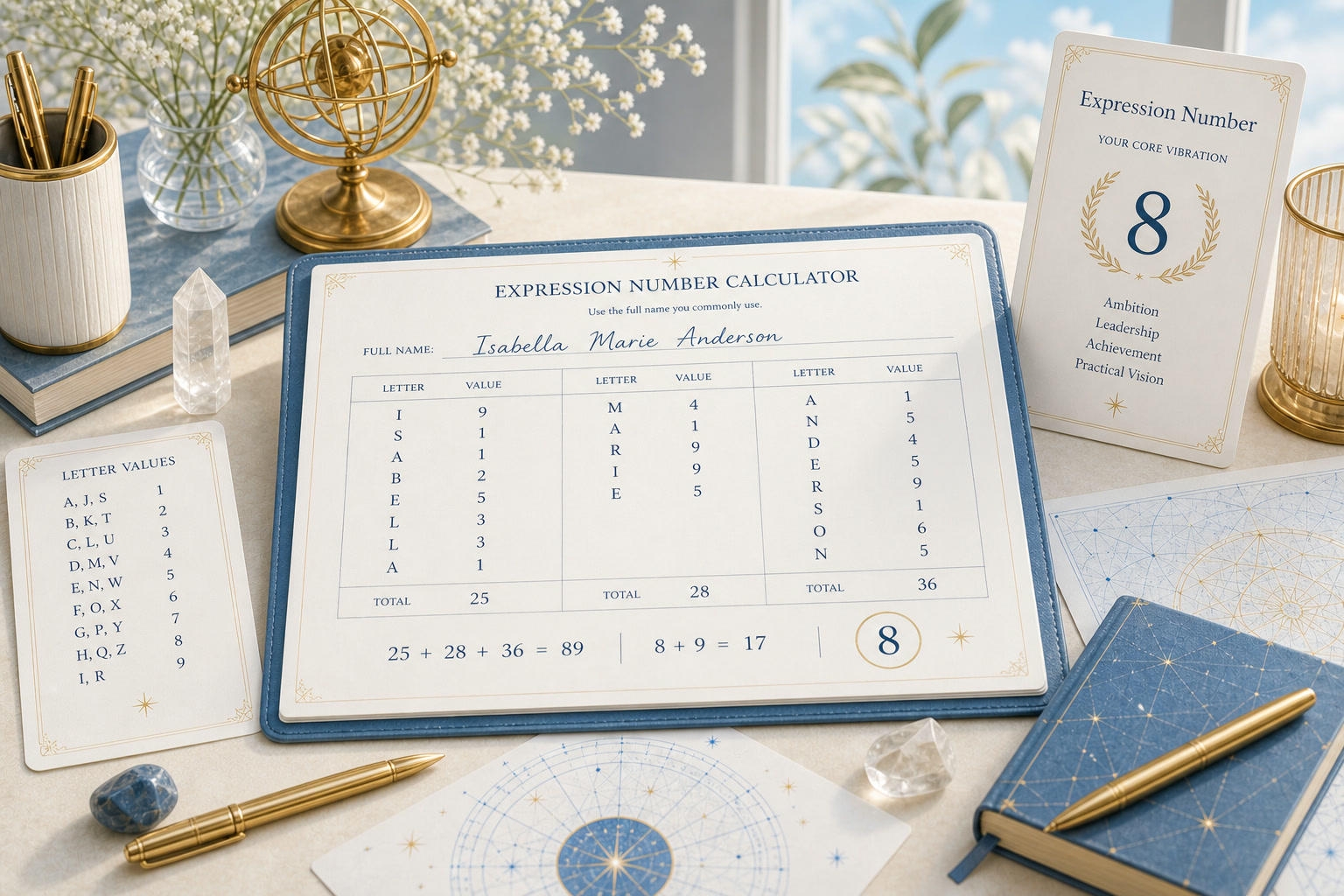
This tool organizes your input for reflection. It does not prove angel contact, predict an outcome, or replace your judgment.
This tool takes a full name and one system choice (Pythagorean or Chaldean). It adds every letter’s value in one total and reduces the result to a single digit or a master number (11, 22, or 33).
The result panel labels it Name Number, not Expression Number. Decoz calls the same calculation the Expression number and places it among the five core numbers in a numerology chart.
The tool adds all letters in one pass without reducing each name separately. Decoz describes a name-by-name order that can produce a different result when a master number is involved.
The result describes a traditional association between the final number and a set of qualities. It does not predict events or settle a person’s character.
Quick Facts
- Input
- One text field (full name) and two radio buttons (Pythagorean or Chaldean)
- Letters counted
- All A through Z letters, vowels and consonants together; accented letters, hyphens, and apostrophes are dropped
- Result label on screen
- Name Number (Pythagorean) or Name Number (Chaldean)
- Master numbers
- 11, 22, and 33 are always preserved during reduction
- Published name for this total
- Decoz calls it the Expression number, also known as the Destiny number
The result says Name Number, not Expression Number
This tool runs the same code as the site’s name number calculator. The inputs are identical: one text field (placeholder "Enter full name") and two radio buttons, Pythagorean (selected by default) and Chaldean.
The result panel shows "Name Number (Pythagorean)" or "Name Number (Chaldean)", followed by the reduced number. Below it: a reduction path, a list of every letter with its assigned value, a theme line, and a link.
In numerology sources, the all-letter total from the full birth name is called the Expression number. On World Numerology, Decoz writes that the Expression number is "Drawn from all the letters of your full birth name" and "reveals your natural talents and abilities, and the goal you work toward throughout life."
Decoz notes the Expression number "is sometimes called the Destiny number." Both labels refer to the same calculation: every letter of the full name, added and reduced.
The tool’s theme line and follow-up link use the Name Number label. The number itself is the same all-letter total Decoz calls the Expression number.
MARY ANN SMITH: where the addition order changes the result
The tool adds all letters in one pass without seeing word boundaries.
Decoz describes a different order: reduce each name to a single digit or master number first, then add the reduced results together.
MARY ANN SMITH in Pythagorean values shows where this difference matters. The 12 letters are M(4), A(1), R(9), Y(7), A(1), N(5), N(5), S(1), M(4), I(9), T(2), H(8).
MARY ANN SMITH: the tool’s one-total order (Pythagorean)
The tool adds all 12 letters before reducing.
- All letters
- Input
- M A R Y A N N S M I T H
- Action
- 4+1+9+7+1+5+5+1+4+9+2+8
- Result
- Sum = 56
- Reduce
- Input
- 56
- Action
- 5 + 6
- Result
- 11 (master number, preserved)
In the order Decoz describes, each name is reduced before the results are added. MARY: 4+1+9+7 = 21, reduced to 3.
ANN: 1+5+5 = 11, a master number, kept. SMITH: 1+4+9+2+8 = 24, reduced to 6.
Adding the three results: 3 + 11 + 6 = 20, reduced to 2. Same name, same letter values, but the result is 11 in one order and 2 in the other.
The difference comes from where the master number appears. In the one-total order, 56 reduces to 11 and stops.
In the name-by-name order, 11 appears inside ANN but the final sum of 20 does not hit a master number on its way to 2.
Neither order is wrong. They are two ways of adding the same letter values, and the results differ when a master-number stop falls at a different stage of the arithmetic.

JANICE MAY BARKER in Pythagorean and Chaldean
JANICE MAY BARKER has 15 letters. In the Pythagorean system, the tool adds them all: J(1)+A(1)+N(5)+I(9)+C(3)+E(5)+M(4)+A(1)+Y(7)+B(2)+A(1)+R(9)+K(2)+E(5)+R(9) = 64.
The reduction path is 64 → 10 → 1, giving a Name Number of 1.
In the name-by-name order: JANICE (24 → 6), MAY (12 → 3), BARKER (28 → 10 → 1); then 6 + 3 + 1 = 10 → 1. Both orders agree for this name.
In the Chaldean system, many letter values change. The total: J(1)+A(1)+N(5)+I(1)+C(3)+E(5)+M(4)+A(1)+Y(1)+B(2)+A(1)+R(2)+K(2)+E(5)+R(2) = 36, reduced 3 + 6 = 9.
| System | Letter-value total | Reduction path | Name Number |
|---|---|---|---|
| Pythagorean | 64 | 64 → 10 → 1 | 1 |
| Chaldean | 36 | 36 → 9 | 9 |
Andrews uses this name to compare both systems. Andrews writes that the Chaldean 9 "arrived through calculation rather than assignment," a distinction the Chaldean tradition treats as carrying extra weight.
For the complete letter tables and the reasons behind the value differences, see the name number calculator page and the systems comparison.
Where the Expression number sits in the chart
On World Numerology, Decoz lists five core numbers in the numerology chart: Life Path, Expression, Soul Urge, Personality, and Birthday. The Expression number uses all letters of the full birth name.
The Soul Urge uses vowels only, and Decoz writes that it "uncovers your inner motivations." The Personality number uses consonants and "describes the side of yourself you show the world."
The soul urge calculator isolates vowels. The personality number calculator isolates consonants.
This tool adds vowels and consonants in one total, combining the two letter sets that the Soul Urge and Personality calculators use separately.
Decoz also describes a Minor Expression, calculated from the name a person uses daily rather than the birth-certificate name. This tool has no separate field for that; typing a daily-use name into the same text field produces that number instead.
Frequently Asked Questions
Why does the tool show Name Number instead of Expression Number?
The tool and the site’s name calculator run the same code, which labels every all-letter result Name Number. Decoz and other sources call the same calculation the Expression number, sometimes the Destiny number.
Can the addition order change the result?
Yes, adding all letters in one total and reducing once can hit a master number that the name-by-name order misses. MARY ANN SMITH gives 11 in the one-total order and 2 in the name-by-name order.
Is the Expression number the same as the Destiny number?
Decoz states the Expression number "is sometimes called the Destiny number." Both refer to the all-letter total from the full birth name.
Sources
- . How to Do Your Own Numerology Reading. World Numerology, calculating the Expression number section. Link
- . The Numbers in Your Numerology Chart. World Numerology, core numbers section. Link
- (2020). Pythagorean vs Chaldean Numerology: How the Two Systems Differ. Numerologist.com, worked example section. Link
About Our Editorial Process
Every KnowTheAngels guide separates calculation method, tradition context, and personal reflection. We cite where interpretations come from, present more than one view, and never present symbolic reading as prediction.
Read our editorial policy