How Do You Practice an Archangel Michael Meditation?
A short seated practice that borrows one attribute from Michael's scriptural and artistic record, keeps judgment of other people out of the scene, and ends in one real act of courage
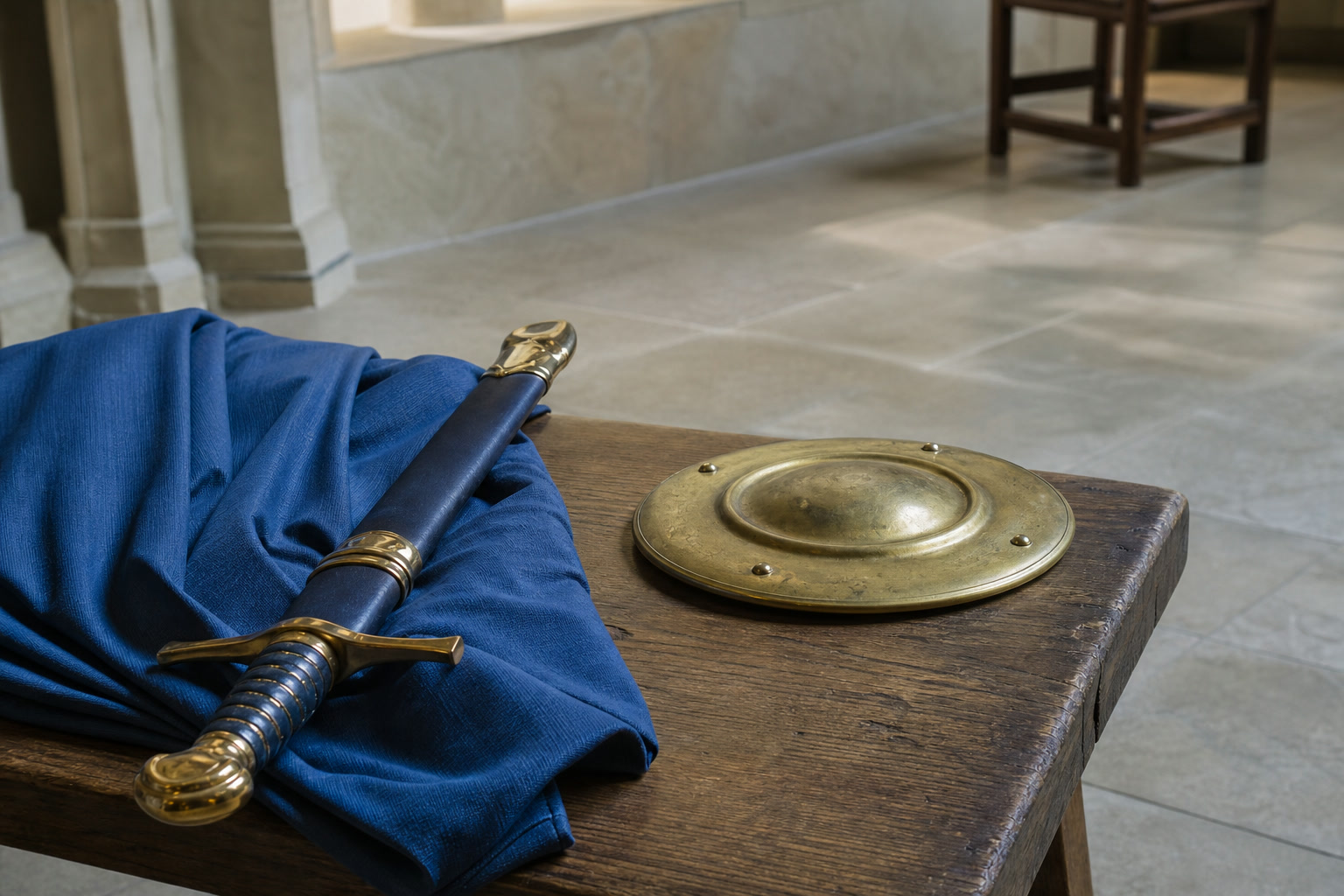
Archangel Michael meditation uses one image from Michael's tradition to rehearse a specific act of courage, such as a refusal, a hard phone call, or a request for help. His name comes from a Hebrew question, "Who is like God?", and that question sets the tone: you borrow Michael's steadiness without casting yourself as a warrior.
The practice described here draws on Christian tradition, but its steps also work for readers who hold the images as symbols only. Scripture names Michael in Daniel, Jude, and Revelation, while the sword, shield, scales, and blue color come from later art and modern devotion.
Quick Facts
- Length
- About five minutes for one concern
- One attribute
- A sheathed sword, a shield, or scales, held still
- Scripture
- Daniel 10:13, 10:21, and 12:1; Jude 9; Revelation 12:7
- Art, not scripture
- Scales and a blue color come from later art and modern devotion
- Ends with
- One spoken sentence naming an act you control, with a time attached
- Stop when
- Fear grows, an enemy appears in the scene, or you feel invulnerable
Which Michael Passages Can a Meditation Draw On?
Three books of the Bible name Michael, and each offers a meditation something different.
Daniel shows help that arrives after delay, Jude shows restraint, and Revelation shows a conflict whose victory the text credits to something other than Michael's strength.
In Daniel 10:13, a heavenly messenger says he was held back for twenty-one days until "Michael, one of the chief princes, came to help me." Daniel 12:1 then calls Michael "the great prince, guardian of your people," which is where the protector image most readers bring to meditation begins.
Jude 9 is the quieter passage and the most useful one for practice.
Disputing with the devil over the body of Moses, Michael "did not venture to pronounce a reviling judgment upon him but said, 'May the Lord rebuke you!'"
Revelation 12:7 describes war in heaven, with "Michael and his angels" fighting the dragon. Yet verse 11 says the faithful "conquered him by the blood of the Lamb and by the word of their testimony," so even the battle text does not rest victory on picturing a stronger warrior.
| Passage | What the text shows | What a meditation can borrow | What it should leave out |
|---|---|---|---|
| Daniel 10:13, 21 | Michael comes to help a messenger delayed for twenty-one days | Patience with a task that one sitting will not settle | Reading a delay in your own life as a hidden war between princes |
| Daniel 12:1 | Michael as guardian of a people in a time of distress | Courage that includes care for other people | A promise that no harm will reach you |
| Jude 9 | Michael declines to pronounce judgment and defers to God | Restraint in speech before a hard conversation | Picturing an opponent defeated or cursed |
| Revelation 12:7-11 | War in heaven, with victory credited to the Lamb and to testimony | Firmness in refusing what is wrong | A private battle scene with you as its hero |
Vatican News notes that the name appears five times in the Bible and derives from a Hebrew expression meaning "Who is like unto God?" Asked as a question rather than shouted as a slogan, the name turns attention away from your own power, and every later step depends on that posture.
How Do You Do a Five-Minute Archangel Michael Meditation?
Sit in a chair with both feet on the floor and choose one concern before any image enters. The concern should be an act within your control, such as "ask my manager to stop scheduling me every Sunday" or "tell my brother I cannot lend him more money."
The body comes first so the image lands on a steadier base.
A sword pictured while the heart is already racing is more likely to feed alarm than resolve.
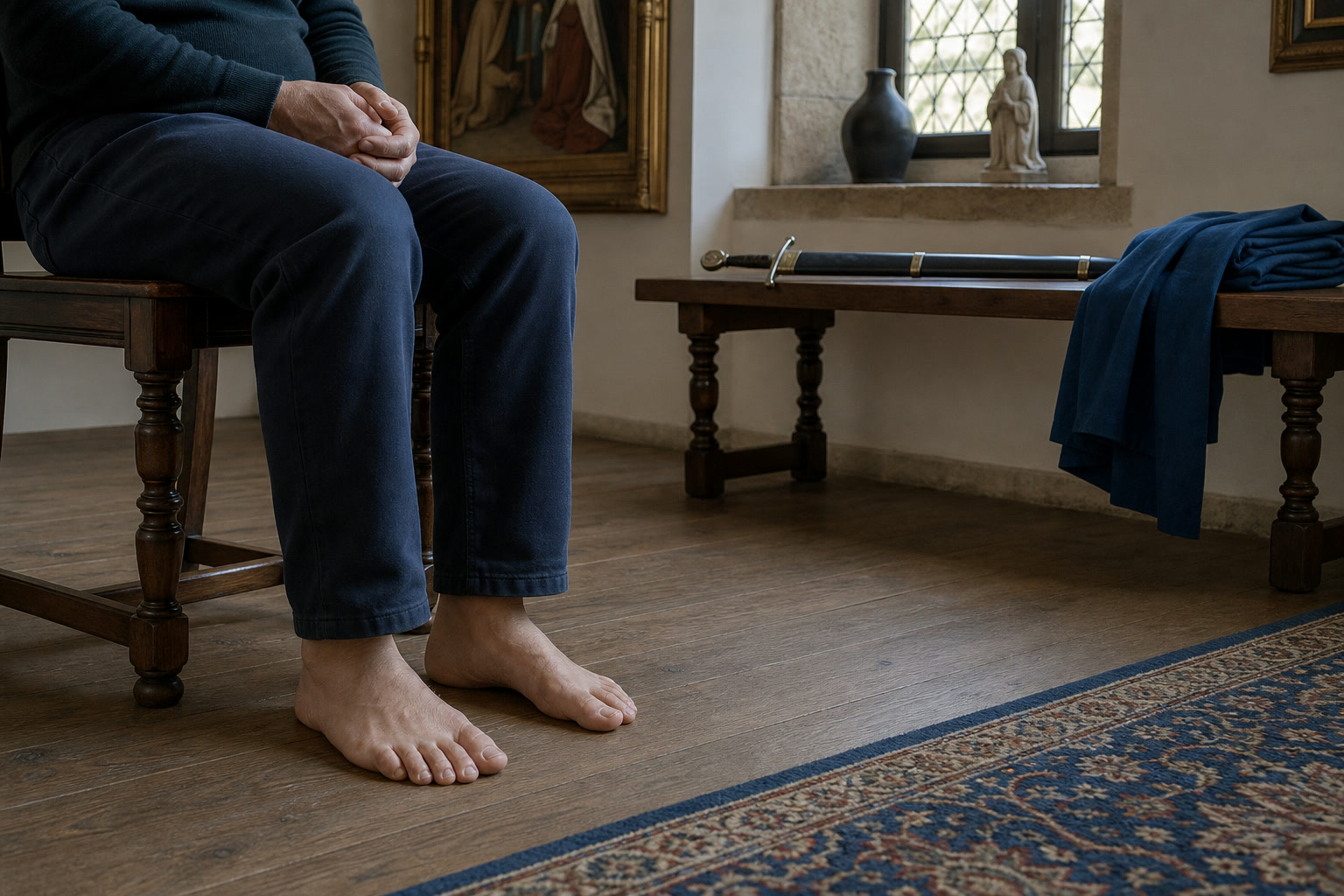
The sequence below keeps the image to two minutes and saves the last minute for the sentence you will act on.
Five minutes with one Michael attribute
Each minute has one job, and the image never gets the final word.
- Minute 1: settle
- Input
- Feet, chair, and a slower exhale
- Action
- Keep the eyes open or lowered and feel each point where the body meets the chair and floor.
- Result
- The room, not the image, is the first anchor.
- Minute 2: name
- Input
- One concern in ordinary words
- Action
- Say the act you are afraid to take without giving it a spiritual cause.
- Result
- The practice has one job.
- Minutes 3-4: hold
- Input
- One sheathed sword, shield, or pair of scales, kept still
- Action
- Let the object rest beside you and ask which quality it names: resolve, a limit, or fairness.
- Result
- The image serves a decision instead of growing into a story.
- Minute 5: return
- Input
- The question "Who is like God?" and one plain sentence
- Action
- Let the object fade, open the eyes, and say the act aloud with a day or time attached.
- Result
- Courage leaves the session in a form you can check later.
Consider one worked session. A nurse who dreads asking to stop covering extra night shifts settles for a minute, names the request, and pictures a still shield resting against her chair.
The shield prompts a single question: where is the edge of this limit? She opens her eyes with the sentence "I can cover one extra night a month, not four," and a plan to say it before Friday's rota is posted.
People who do not form mental pictures can use the same four minutes. Hold the word shield, rest a hand on a small object, or feel the chair back as the limit; none of these is a lesser version of the practice.
Spoken petitions, including the Saint Michael prayer attributed to Pope Leo XIII, fit best after the image has faded.
Kept outside the imagery, the words stay a prayer instead of becoming a tool for forcing a feeling.
Should You Picture Michael's Sword, Shield, or Scales?
Pick the attribute that matches the concern, and use only one.
A sword suits a decision you keep delaying, a shield suits a limit other people keep crossing, and scales suit a dispute where anger may be bending your judgment.
The three objects come from different sources. Revelation's war in heaven shaped the sword and the defeated dragon in Christian art, while the scales come from medieval Last Judgment scenes such as Rogier van der Weyden's Beaune Altarpiece, where Michael weighs souls beneath the figure of Christ.
No biblical passage places scales in Michael's hand. Holding them in meditation borrows an artistic convention for weighing, and it says nothing about how Michael judges anyone.
Match the attribute to the concern
Sheathed, it stands for resolve held in check, never for cutting a person out
Give it an edge: what stays outside, and what you still owe others
Weigh the facts you actually have before choosing your words
A modern devotional habit rather than a biblical color for Michael
Modern angel-healing writers often describe a blue ray or blue light around Michael, but scripture gives him no color, and a blue shape seen behind closed eyes cannot show whose presence is near.
Choosing two attributes at once usually weakens both. A sword and a shield together build a Michael-themed scene, while one object keeps the session tied to the single decision you came to make.
What Does Jude 9 Teach About Anger During the Meditation?
When the concern involves someone who hurt you, Jude 9 gives the clearest rule: do not place that person opposite the blade. Facing the devil himself, Michael left the verdict to God with "May the Lord rebuke you!"
A session that pictures a coworker or a former partner struck down rehearses contempt, and that rehearsal can carry into the next real conversation. The sheathed sword holds your own resolve, so it points at your decision rather than at another person.
The Catholic Directory on Popular Piety and the Liturgy, issued in 2001, warns against devotion that imagines "an incessant battle between good and evil spirits" in which people are left helpless. The same paragraph, number 217, cautions against ascribing every setback to the Devil and every success to guardian angels.
That warning comes from inside the tradition most devoted to Michael. It describes the real struggle as moral commitment, humility, and prayer, which is the kind of effort a five-minute session can actually support.
Anger therefore gets one move in this practice.
Name the specific act that hurt, name the boundary you want, and leave any rebuke that may be owed to someone other than yourself.
How Is This Different From Blue-Light and Cord-Cutting Michael Meditations?
Most guided Michael recordings online follow modern angel-healing scripts: calling Michael into the room, wrapping the body in blue light, or asking him to cut "energetic cords" with a sword of light. Those scripts come from contemporary spirituality rather than scripture or Catholic liturgy, and they make promises this practice does not make.
| Popular script | What it claims | Where it comes from | How this practice handles it |
|---|---|---|---|
| Blue-light shield | Light around the body blocks harm or negative energy | Modern angel-healing books and recordings | Blue stays an optional focus color, and protection comes from real steps |
| Cord cutting | Michael severs an invisible bond to a person or habit | Contemporary energy-work teaching | The sword stays sheathed, and the cut is a boundary you state and keep |
| Calling Michael in | Saying his name brings his presence into the room | Modern invocation scripts | Believers may pray, but the session makes no claim that anyone arrived |
| Merging with Michael | His energy joins yours and makes you stronger | Channeling-style guided recordings | Left out, so you and the symbol stay distinct and the decision stays yours |
The warmth or light people report during these sessions is real as an experience. The Vatican's 1989 letter on Christian meditation notes that some exercises "automatically produce a feeling of quiet and relaxation, pleasing sensations, perhaps even phenomena of light and of warmth."
The same letter calls it "a totally erroneous way" of understanding the spiritual life to take such feelings for the consolations of the Holy Spirit. A calm body is a good result on its own terms, and it needs no angelic explanation to be worth having.
Picturing a bond to a parent, an ex-partner, or a friend being severed can feel decisive, yet the relationship, any shared children or money, and the next conversation are all still there when the eyes open.
If a cord-cutting script appeals because a relationship feels unsafe or controlling, the useful cut is practical: blocking a number, changing a lock, or talking with an advocate. The image can rehearse that resolve, but it cannot do the blocking.
Can Picturing Michael's Shield Stand In for a Safety Plan?
No: the National Center for Complementary and Integrative Health advises against using meditation to replace conventional care or to postpone seeing a health care provider, and the same reasoning applies to police, legal, and workplace protections.
A shield pictured around a house does not lock its doors, and a sword pictured between you and an abusive partner does not create distance. Daniel 12:1 describes Michael guarding a people during great distress, which is a statement of faith about a community rather than a personal promise that an imagined barrier will hold.
Where danger is present now, leave, call emergency services or a crisis line, or follow the safety plan you already have, and save the meditation for a time when your body no longer has to manage the threat.

Where the risk is ongoing but not immediate, the meditation can help with the part that fear makes hard. The minute-five sentence names the call, report, or appointment, and a real person or service carries the protection.
- A hotline call: "I will call the domestic violence line from my car at lunch tomorrow."
- A written report: "I will email HR the three dates of the comments before Thursday."
- A postponed appointment: "I will book the scan I have been avoiding when the clinic opens at nine."
- A check-in: "I will tell my sister where I am going and when I expect to be back."
Each sentence still holds if the spiritual reading turns out to be wrong. That test separates courage the meditation prepared from protection it only pictured.
What If the Sword or Shield Increases Your Fear?
Stop the image and open your eyes.
Protective symbols can prime the mind for the threat they were meant to answer: a sword invites a search for an attacker, and a shield can leave the body braced for impact.
Bad sessions are not unusual: NCCIH summarizes a 2020 review in which about 8 percent of meditation participants had a negative effect, most often anxiety or depression, a rate similar to that reported for psychological therapies.
Watch which way the session moves. Courage makes your situation narrower and more specific, while fear makes danger broader, harder to test, and harder to put down.
Signs to end the imagery now
- The enemy multiplies
One difficult person becomes a crowd of attackers or a hidden force behind every setback.
- You feel invulnerable
The shield starts to feel like a reason to skip a real precaution.
- The light needs guarding
You feel responsible for keeping a blue light or barrier in place after the session.
- Commands appear
A voice or phrase tells you to act, confront someone, or keep the practice secret.
To come back, let the object fade without defeating anything, name five things you can see and today's date, and press your feet into the floor. Then use the plan you named, or call someone you trust.

Do not answer rising fear with stronger Michael prayer language or another round of the session. When each repetition brings only a brief drop in anxiety, the practice has turned into reassurance seeking.
Fear, intrusive images, voices, or lost sleep that continue after sessions deserve a conversation with a doctor or mental health professional. Stopping in that situation keeps you in charge of the method, which was the purpose of the practice all along.
Frequently Asked Questions
Is Archangel Michael meditation a Catholic practice?
The Catholic Church venerates Michael and keeps his feast on September 29, but it has no official Michael meditation. Its 1989 letter on Christian meditation allows bodily methods with cautions, so a Catholic reader can use this as preparation for prayer rather than a substitute for it.
Can I do a Michael meditation if I am not religious?
Yes. Treat the sword, shield, or scales as symbols of resolve, limits, and fairness; the steps work without any claim that Michael is present.
What color is Archangel Michael?
Scripture gives Michael no color. Blue comes from modern devotional and angel-healing writing, and in meditation it works as an optional focus rather than a sign of presence.
Does Archangel Michael cut cords?
Cord cutting is a modern energy-work practice, and no scripture or Catholic teaching describes Michael severing bonds between people. If a relationship needs distance, a stated boundary, a blocked number, or an advocate does the work the image only pictures.
How long should an Archangel Michael meditation last?
Five minutes is enough for one concern. A longer session gives the body more time to settle but does not bring closer contact, and extra minutes can let the image grow into a story.
Sources
- (2011). Daniel, Chapter 10. New American Bible, Revised Edition. Link
- (2011). Daniel, Chapter 12. New American Bible, Revised Edition. Link
- (2011). Jude, verse 9. New American Bible, Revised Edition. Link
- (2011). Revelation, Chapter 12. New American Bible, Revised Edition. Link
- . St. Michael, Archangel. Saint of the Day. Link
- (2001). Directory on Popular Piety and the Liturgy, paragraphs 213-217 (The Holy Angels). Holy See. Link
- (1989). Letter to the Bishops of the Catholic Church on Some Aspects of Christian Meditation (Orationis formas), paragraphs 27-28. Holy See. Link
- . The Beaune Altarpiece. Digitisation projects. Link
- (2026). Meditation and Mindfulness: Effectiveness and Safety. National Institutes of Health. Link
About Our Editorial Process
Every KnowTheAngels guide separates calculation method, tradition context, and personal reflection. We cite where interpretations come from, present more than one view, and never present symbolic reading as prediction.
Read our editorial policy