What Does Angel Number 27 Mean Beyond Completion and the 27 Club?
Root 9, intuition, the New Testament's book count and the evidence behind an ominous reputation
Twenty-seven can feel encouraging in an intuition reading and unsettling in a story about the 27 Club. Those reactions come from different sources, so they cannot be combined into one message about what happens next.
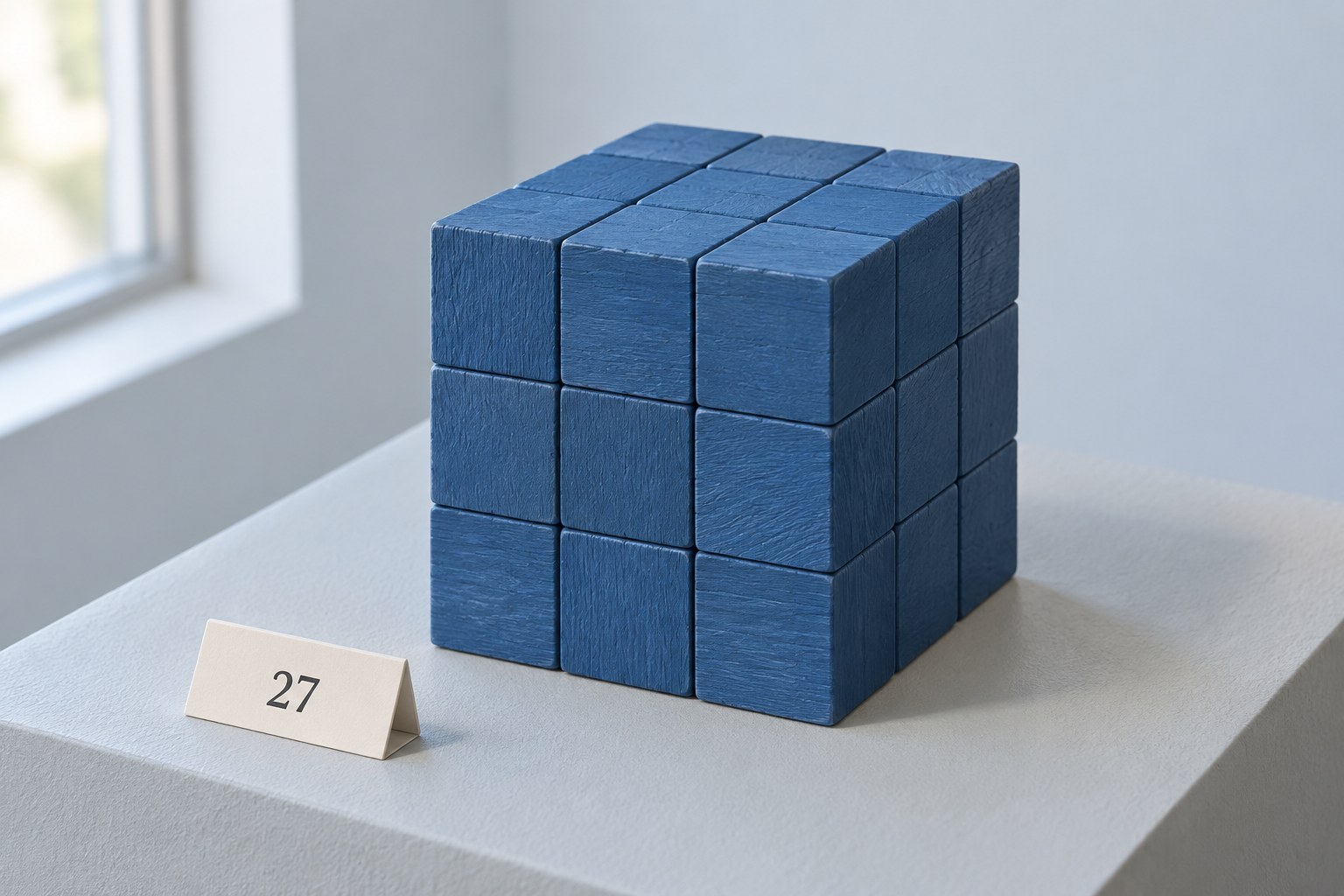
The arithmetic is straightforward: 2 + 7 = 9, while 3 × 3 × 3 = 27. The harder question is what each author, historical account or study actually establishes beyond that shared numeral.
Quick Facts
- Digit sum for 27
- 2 + 7 = 9
- Twenty-seven as a cube
- 3 × 3 × 3 = 27
- Decoz's master-number set
- 11, 22 and 33; not 27
- Athanasius's explicit list
- 27 New Testament books, 367 CE
- Musician cohort studied
- 1,046 UK number-one album musicians
- Finding about age 27
- No mortality peak in that cohort (BMJ, 2011)
How does 27 reach 9, and is it a master number?
Adding the digits of 27 gives 9 in one step. Multiplying three 3s gives 27, but that is a different operation: the cube describes how many units fit in a 3-by-3-by-3 arrangement, not the number's reduced root.
Hans Decoz calls 2 the most cooperative single digit in his World Numerology profile. His account of 7 emphasizes inquiry, solitude and dissatisfaction with surface explanations.
For 9, Decoz connects the completion of an era with a broader concern for others.
Together, these descriptions explain why contemporary readings of 27 discuss cooperation, insight and service. They do not demonstrate a sequence in which cooperation must come first, analysis second and a final decision immediately afterward.
| Displayed number | Digit addition | What differs |
|---|---|---|
| 27 | 2 + 7 = 9 | One step; visible digits 2 and 7 |
| 72 | 7 + 2 = 9 | Reversed digits, unchanged sum |
| 999 | 9 + 9 + 9 = 27; 2 + 7 = 9 | Three repeated 9s; 27 is an intermediate total |
The comparison separates equal roots from identical readings. Reversal does not change addition, while an author may still assign a different interpretation to the unreduced compound.
The intermediate 27 in 999's calculation also explains their mathematical connection without making one a stronger message. A repeated digit is a feature of the written number, not a measurement of spiritual intensity.
Decoz reserves master-number status for 11, 22 and 33, so 27 is not a master number in his system. Its exact cube form does not create another member of that set.
A Life Path 9 has a different input: a birth date reduced under a stated calculation method. Encountering 27 on an address or receipt does not calculate that chart position.
Intuition, love and career: what the named readings of 27 support
Joanne Sacred Scribes' 2011 entry connects angel number 27 with trust in intuition and inner promptings. Blair Andrews' Numerologist.com interpretation instead emphasizes a transition from receiving lessons to giving what has been learned.
These readings share an interest in insight but place it differently: Joanne emphasizes inner guidance, while Andrews emphasizes the use of acquired understanding. The latter adds a social consequence to the analytical 7 and the service-oriented 9; learning can become something another person receives.
Decoz's account of 7 also makes room for investigation, not simply certainty. Treating intuition as an answer that cannot be questioned would remove the inquiry that his digit description emphasizes.
In love readings, 2's cooperative association can frame a question about how two people understand an agreement. For example, one partner may believe a temporary separation has ended while the other still regards it as unresolved.
A sighting of 27 supplies neither person's answer.
The completion association therefore cannot decide whether that relationship is over, restored or ready for a new commitment; those are different states, each involving what the people involved actually agree to.
Twin-flame interpretations add a further claim about the identity of a bond. Neither the digit sum nor the cited intuition reading identifies another person's feelings or establishes that a reunion will occur.
At work, Andrews' learning-to-giving metaphor can describe a change in the use of expertise. A colleague who has learned a process may begin documenting it or teaching someone else, while remaining in the same role.
That example explains why the completion theme need not mean resignation. The phase that has ended may be initial training, rather than the job itself.
For a career change, a number does not establish that an offer exists, that its terms are suitable or that a decision deadline has arrived. Assigning 27 a fixed finish-by date would add an instruction absent from the cited interpretations.
Do the New Testament's 27 books give 27 a biblical meaning?
The familiar biblical association is the New Testament's collection of 27 books. That count concerns which texts belong in the collection; it does not by itself interpret a 27 noticed elsewhere.
Christian History Institute describes Athanasius's 39th Festal Letter, written in 367 CE, as an explicit list matching the 27-book New Testament. An explicit list is evidence that this collection was recognized by its author at that date.
The historical claim becomes less simple when 'first list' is used to mean 'first evidence of the same collection'. Michael Kruger argues that a passage in Origen's Homilies on Joshua, around 250 CE, can be reconstructed as referring to the same set of books.
Two kinds of evidence for the 27-book collection
- Around 250 CEKruger's reading of Origen
A modern scholarly argument reconstructs the collection from a passage in Homilies on Joshua.
- 367 CEAthanasius's 39th Festal Letter
An explicit list names the books matching the 27-book New Testament.
The difference is the kind of evidence, not merely which year is earlier. Kruger's argument about a passage and Athanasius's explicit enumeration do not justify treating 367 as the date when everyone first adopted the same canon.
Nor does either account show that the books were selected to reach a numerologically significant total. Explaining their selection would require evidence about the texts and their reception, rather than an inference from 2 + 7.
A devotional reader may connect the collection with Christian teaching, but the content comes from its individual books. A claim that seeing 27 predicts completion, angel contact or a relationship outcome needs a further interpretive source; the collection's size does not supply it.
Is the 27 Club real, and why can sightings of 27 feel ominous?
The 27 Club groups famous musicians who died at age 27. The deaths behind that label do not, by themselves, establish that musicians face an unusual mortality peak at that age.
A 2011 retrospective cohort study by Wolkewitz and colleagues in The BMJ tested the age claim in 1,046 musicians who had a number-one album in the United Kingdom between 1956 and 2007. The researchers found no evidence of a mortality peak at 27 in that selected cohort.
The cohort matters because it supplies musicians for comparison, rather than beginning and ending with memorable deaths at one age. A list selected because every person died at 27 cannot show how frequent those deaths were among musicians exposed to the different ages.

The illustrated age groups make the comparison question visible, but their sleeves do not represent participants or rates. The study's finding is about its defined album-chart cohort, not every musician or anyone who happens to be 27.
What the 27 Club study can answer
What the evidence supports
- A defined comparison
The 2011 study assessed an age-27 mortality peak in musicians selected by UK number-one album history.
- The reported result
That cohort did not provide evidence of an unusual peak at 27.
What remains limited
- A famous-name list
Cases chosen because they died at 27 cannot establish the age-specific rate by themselves.
- An individual's future
The study does not calculate a reader's personal risk or interpret a number sighting.
That boundary also separates an unsettling reputation from an omen. Neither membership in a cultural story nor noticing its number identifies a cause of future events.
For everyday sightings, 27 has ordinary recurring locations: each month has a date labelled 27, and a digital clock can show 27 as its minute value. Repeated access to the same locations can produce repeated encounters without any change in how often the number appears there.
The American Psychological Association defines selective attention as focusing on some stimuli while ignoring others. Once 27 acquires an emotional association, an instance of it may register more strongly than the surrounding nonmatching numbers.
Recurring numbers can therefore become conspicuous through both placement and attention. A collection of remembered matches leaves the missed nonmatches unknown, so it cannot establish either a supernatural cause or a personal warning.
Sources
- (n.d.). Numerology Meaning of number 2. World Numerology. Link
- (n.d.). Numerology Meaning of number 7. World Numerology. Link
- (n.d.). Numerology Meaning of number 9. World Numerology. Link
- (n.d.). Master Numbers 11, 22, 33. World Numerology. Link
- (n.d.). 367 Athanasius Defines the New Testament. Christian History Magazine. Link
- (2013). 10 Misconceptions about the NT Canon: #10: Athanasius' Festal Letter (367 A.D.) is the First Complete List of New Testament Books. Canon Fodder. Link
- (2011). Is 27 really a dangerous age for famous musicians? Retrospective cohort study. The BMJ 343:d7799. Link
- (2018). Selective attention. APA Dictionary of Psychology. Link
- (n.d.). Angel Number 27: The Number That Earned Its Wisdom. Numerologist.com. Link
- (2011). Angel Number 27. Sacred Scribes Angel Numbers. Link
About Our Editorial Process
Every KnowTheAngels guide separates calculation method, tradition context, and personal reflection. We cite where interpretations come from, present more than one view, and never present symbolic reading as prediction.
Read our editorial policy