What Does Angel Number 61 Mean, and Where Do Its Meanings Come From?
Care and initiative in modern readings, the sum of 7, and the difference between a biblical chapter and a number interpretation
The meaning of angel number 61 depends on which writer or method is being used. Its two visible digits supply one interpretation, their sum supplies another, and a search for its biblical meaning often leads to an entirely different use of the number: a chapter reference.
Andrews describes a beginning supported by care already given, rather than a prediction derived from addition. Walmsley's material-needs promise belongs to a spiritual message, with no amount, payer or payment date specified.
The reversal 16 introduces a further distinction because some numerologists classify that particular compound as karmic debt.
Quick Facts
- Digit sum
- 6 + 1 = 7
- Reversed numeral
- 16 also reduces to 7
- Decoz classification
- 16 appears in his karmic-debt list; 61 does not
- Biblical reference
- Isaiah 61:1-3, echoed in Luke 4:16-21
- Dated modern source
- Walmsley, July 12, 2011
What the 6, 1 and 7 contribute to an interpretation of 61
Numerology.com associates 6 with nurture and protection, 1 with independence and initiative, and 7 with analysis and introspection. Those are symbolic descriptions supplied by that source, rather than qualities discovered by adding the digits.
Two written digits and their sum
Andrews connects love with a new beginning in the interpretation titled When Love Becomes the Engine. That image gives care a motivating role: something a person has received or given can become part of the story they tell about beginning again.

A person returning to a long-postponed creative interest, for example, might connect that decision with encouragement from a partner. The example illustrates Andrews' idea without turning every appearance of 61 into evidence that this situation exists.
The position of 6 before 1 describes how the numeral is written.
It does not show that help came before a request, that an action succeeded, or that a review must now take place. Those details would need to come from the actual event and the people involved.
Why 61 and 16 share 7 but not every numerological label
Reversing 61 gives 16, and reversing the two terms of the addition leaves the result unchanged. Both calculations reach 7 directly, with no intermediate double-digit sum.
The shared result explains why writers can draw on the same description of 7 for several numbers. It does not establish opposite life stories, such as care leading to action in one case and an independently chosen duty in the other.
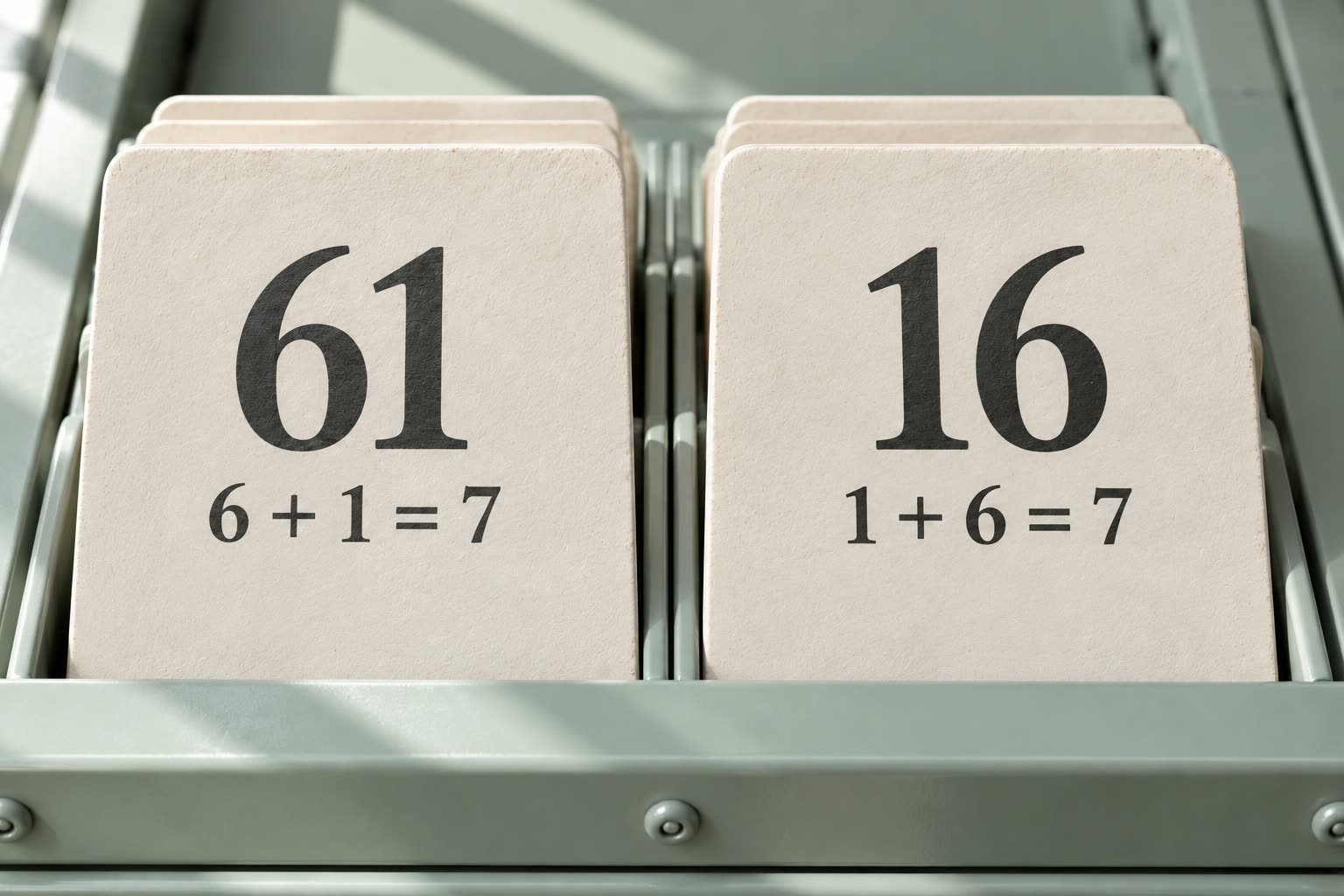
Hans Decoz's karmic-debt list names 13, 14, 16 and 19. The compound 16 is therefore included by name, whereas 61 is not.
A classification attached to the compound does not automatically move to every number that reduces to its root.
The Tower is numbered XVI in the tarot tradition cited here, which creates another specific association with 16. That card label does not describe 61 merely because the decimal digits can be reversed.
There is also a difference between a repeated numeral and Life Path 7, which is calculated from a birth date. A sighting of 61 supplies neither the date nor the calculation needed for that chart position.
Isaiah 61 in Luke 4: a passage reference, not a numerical message
Isaiah 61:1-3 describes good news, comfort and release, opening with "The Spirit of the Lord GOD is upon me" in the King James Version. Its subject is the speaker and the work being proclaimed, rather than a symbolic explanation of sixty-one.
Luke 4:16-21 places Jesus in the synagogue at Nazareth, reading from Isaiah and applying the passage to the listeners' present circumstances. The connection between these texts concerns their words and the claim made about their fulfillment.
| Element | What it does |
|---|---|
| Isaiah 61:1-3 | Describes the mission and those it addresses |
| Luke 4:16-21 | Narrates Jesus reading and interpreting the passage |
| The chapter label 61 | Locates the passage within the book |
Modern chapter divisions follow the system associated with Stephen Langton in the early thirteenth century. The label helps a reader find the text; it was not one of the numerical claims made by the prophetic speaker.
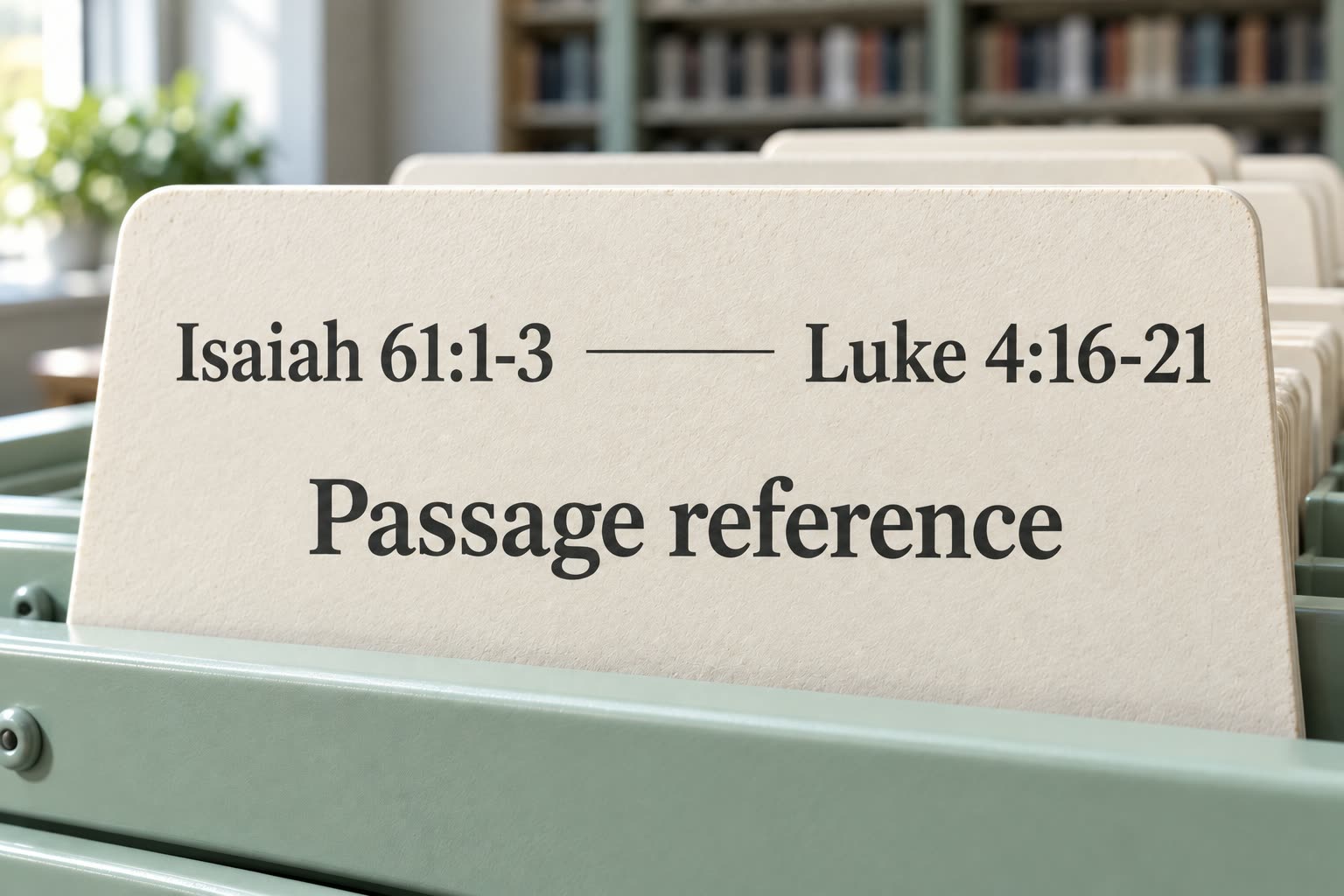
This matters when a search result connects 61 with care for the brokenhearted.
The theme can be discussed from the actual passage, but identifying that theme with the modern numerological meaning of 6 adds a separate interpretive step. It cannot be attributed to Isaiah simply because the chapter happens to have two familiar digits.
Bullinger's Number in Scripture moves from fifty-one to sixty-five in the relevant catalogue, without a separate entry for sixty-one. That catalogue boundary gives no support for citing Bullinger as the author of a 61 angel-number meaning.
It is a statement about one writer's selection, not a survey proving what every biblical interpreter has ever thought.
Where the promise that 61 meets material needs comes from
Walmsley's Sacred Scribes entry of July 12, 2011 tells readers to "trust that your material needs will be met". The entry associates 6 with providing for home and family and the material aspects of life.
Those two elements explain how a care-related number reading becomes a reassurance about provision. The promise comes from Walmsley's spiritual interpretation, rather than from the numerical result 7.
Reassurance and a particular expense
What the evidence supports
- An identifiable interpretation
Walmsley supplies the material-needs promise in a dated angel-number entry.
What remains limited
- No specified payment
The message identifies no payer, sum or due date for a particular bill.
- No demonstrated outcome
Reading or noticing 61 does not establish that an expense has been covered.
For a hypothetical shared expense, encouragement from a relative and an agreement to pay a stated amount are different kinds of information. The agreement answers who is contributing and what they have accepted; a general reassurance leaves those questions open.

Cheiro's compound-number list ends at 52, with his note that proceeding further is unnecessary for his practical purpose. There is no direct entry for 61 in that list.
The absence of that entry cannot prove Walmsley's promise false, but it does prevent presenting the promise as Cheiro's established interpretation of this compound.
Care and initiative in love or work still involve another person's choice
In Andrews' relationship reading, a partner's support can make a new beginning feel possible while the bond continues. That is different from assuming that caring intentions authorize decisions for the partner.
A surprise weekend trip makes the distinction concrete. The person arranging it may see a generous gift, while the recipient may already have plans or may be unable to take the time away.
| Example | What the initiator knows | What still depends on others |
|---|---|---|
| A surprise trip for a partner | What was booked and why | Whether the dates and commitment are welcome |
| A new spreadsheet for colleagues | How the author designed it | Whether it serves the people expected to use it |
The same care-and-initiative vocabulary can describe a workplace improvement without proving its value. A colleague's response supplies information about their work that the author's enthusiasm cannot supply.

A change that removes a repetitive task for one person might remove an exception another person needs to record. That difference is about the task and its users, not a special instruction hidden in 7.
For someone considering a career change, Andrews' new-beginning image may express a hope or a personal interpretation. The numeral contains no information about an offer, the terms of a role or another person's willingness to support the move.
The relationship question is therefore about an actual answer from the other person, including a refusal. A later sighting of 61 cannot stand in for that answer.
Repeated 61s: a familiar page and a new occurrence are different observations
A reader who returns to page 61 of a book encounters the same stable label each time. Seeing it on three evenings does not mean that three unrelated events have independently produced that number.

The APA defines selective attention as concentrating on some stimuli while overlooking others. Once 61 has become interesting, noticing it more readily is one possible explanation for its apparent prominence.
An address, a book reference and a receipt also create different opportunities to encounter a number.
A number journal can preserve those settings, including whether an entry records the same page or address again. A list of remembered sightings alone does not show how often other numbers appeared or how often 61 was absent.
That missing comparison prevents the list from establishing an unusual frequency. The circumstances can explain what was noticed without determining whether a spiritual interpretation is personally meaningful.
Frequently Asked Questions
Does the reversed 16 make 61 a karmic-debt number?
Decoz's cited list includes 16 specifically. Reversing its digits or sharing its sum does not add 61 to that list.
Can the chapter label Isaiah 61 confirm an angel-number reading?
The chapter reference locates a passage whose meaning comes from its words and context. Linking its label to digit meanings is an additional modern interpretation.
Is a sighting of 61 enough to identify a Life Path number?
A Life Path calculation uses a birth date. The number noticed on a page or receipt is a different input.
Sources
- (n.d.). Number 6 Meaning in Numerology. Numerology.com. Link
- (n.d.). Number 1 Meaning in Numerology. Numerology.com. Link
- (n.d.). Number 7 Meaning in Numerology. Numerology.com. Link
- (n.d.). Angel Number 61 Meaning: When Love Becomes the Engine. Numerologist.com. Link
- (2011). Angel Number 61 (posted July 12, 2011). Sacred Scribes Angel Numbers. Link
- (n.d.). Cheiro's Book of Numbers, revised edition: the compound numbers 10 to 52 and the note that closes the list. Herbert Jenkins; scanned text at Internet Archive. Link
- (n.d.). Karmic Debt Numbers. World Numerology. Link
- (2026). The Tower (tarot card). Wikipedia. Link
- (1921). Number in Scripture: Its Supernatural Design and Spiritual Significance, 4th edition, contents and part II entries for fifty-one and sixty-five. Eyre & Spottiswoode, London (public-domain text). Link
- (1611). Isaiah 61:1-3. BibleGateway. Link
- (1611). Luke 4:16-21. BibleGateway. Link
- (2026). Chapters and verses of the Bible (Stephen Langton's chapter divisions). Wikipedia. Link
- (2018). Selective attention. APA Dictionary of Psychology. Link
About Our Editorial Process
Every KnowTheAngels guide separates calculation method, tradition context, and personal reflection. We cite where interpretations come from, present more than one view, and never present symbolic reading as prediction.
Read our editorial policy