What Does Gold Light Mean Spiritually in Religious Art and Angel Beliefs?
Gold leaf behind icons, gold beside the angels of Exodus and Revelation, the modern Uriel and Christ-light teachings, and the everyday and medical reasons a light can look golden
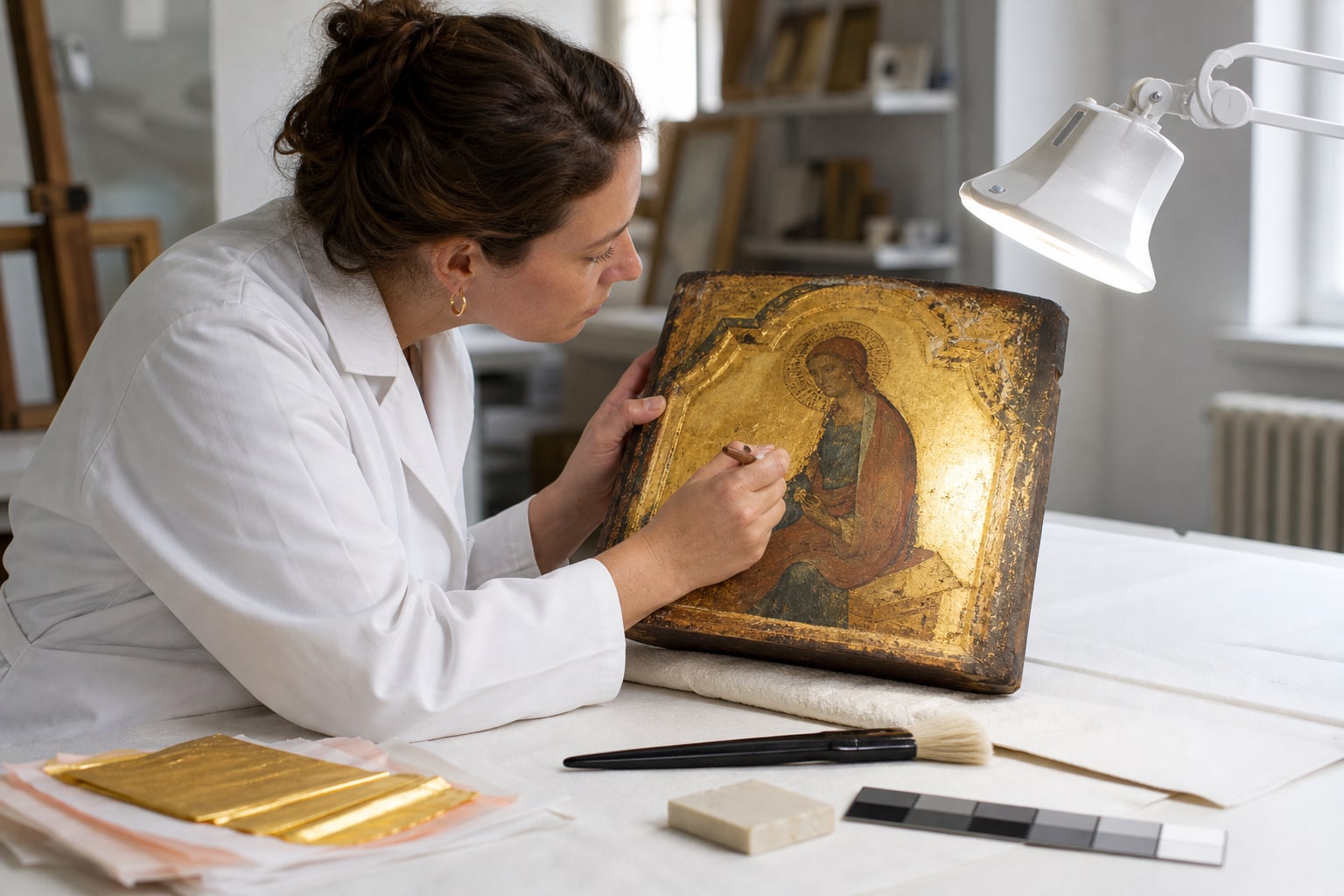
In Christian art and scripture, gold light marks the presence of God far more often than the color of any angel.
Icon painters set saints against burnished gold leaf, and the Byzantine and Christian Museum in Athens explains that gold ground as a way "to symbolize the divine light and the heavenly kingdom."
Scripture uses the metal in the same places. Exodus 25 covers the ark and its two cherubim in gold, and Revelation 21 describes a city of pure gold that needs no sun because God's glory lights it.
The idea that gold light points to one archangel is much newer. It comes from twentieth-century teachers such as the Summit Lighthouse, which puts Uriel on a purple-and-gold ray, and from angel writers like Diana Cooper.
A golden glow in a room is usually low evening sun, a warm lamp, or a camera setting. Rings of light around every lamp at night are a known cataract and glaucoma symptom, which is a reason to see an eye doctor before looking for meaning.
Quick Facts
- Gold in icons
- Stands for divine light and heaven, according to the Byzantine and Christian Museum in Athens
- Orthodox reading
- The uncreated light of the Transfiguration, defended by Gregory Palamas and upheld by councils in 1341, 1347, and 1351
- Gold beside angels in scripture
- Exodus 25:18, Daniel 10:5, Revelation 8:3, 15:6-7, and 21:15
- Gold and Uriel
- A modern pairing from the Summit Lighthouse's sixth ray and from Diana Cooper; no ancient text gives Uriel a color
- Eye check
- Halos around lights can signal cataract, and sudden rainbow rings with eye pain can signal acute glaucoma
Why do icons set saints on a gold background?
An icon's gold ground stands for light that does not come from the sun. The Byzantine and Christian Museum in Athens says gold was used behind scenes on portable icons, wall paintings, and manuscripts "to express the transcendental and to symbolize the divine light and the heavenly kingdom."
The museum ties that choice to what gold meant to Byzantine Christians: the "ultimate" good, the eternal Logos, perfection, and therefore Christ. For the same reason, gold went into chalices and priestly vestments.
Orthodox teaching later gave the gold a sharper name. In the fourteenth century Gregory Palamas, a monk of Mount Athos, defended hesychast monks who said their prayer let them see the uncreated light that shone around Christ at the Transfiguration on Mount Tabor.
Councils in Constantinople upheld his teaching in 1341, 1347, and 1351.
Orthodox writers since then often describe icon gold as a picture of that uncreated light, meaning God's own radiance rather than any light God made.
In icon tradition the gold belongs to God's presence in the picture, and no icon uses it to show which angel is nearby.
Catholic worship carries the same idea into cloth. The General Instruction of the Roman Missal, in paragraph 346, allows gold or silver vestments "on more solemn occasions" in the dioceses of the United States.
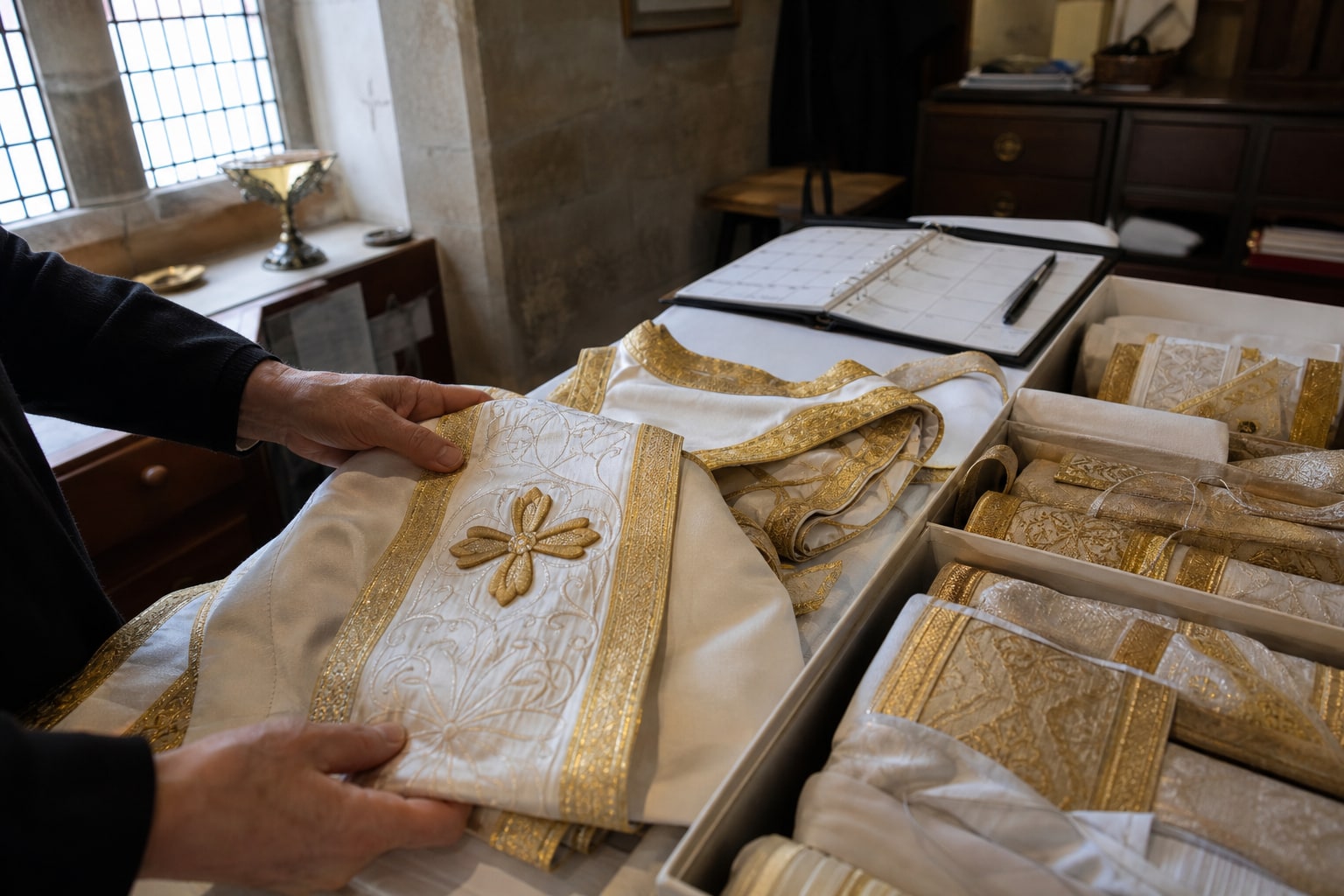
In both the icon and the vestment, people chose gold to show how holy a moment or a figure is. The gold says nothing about light that someone saw with their eyes.
How did painters lay gold leaf and tool a halo?
The glow of a gold-ground panel was built in layers, and each layer changes how the gold catches light. Jennifer Meagher's 2010 essay for the Metropolitan Museum of Art on later medieval Italian painting sets out the steps.
From bare panel to a punched gold halo
- Lay the bole
- Input
- A reddish clay called bole
- Action
- Brush it over the white ground wherever gold will go
- Result
- A tacky surface for the leaf; the National Gallery notes that without bole thin gold can look greenish
- Apply the leaf
- Input
- Gold pounded into very thin sheets
- Action
- Lift each sheet with a flat brush called a gilder's tip and lay it on the bole
- Result
- An unbroken skin of real metal across the background and halos
- Burnish
- Input
- A hard, smooth-tipped tool
- Action
- Rub the laid gold until it is smooth and polished
- Result
- A mirror-like surface that throws back candlelight
- Punch the halo
- Input
- Metal rods with a pattern cut into one end
- Action
- Stamp repeating patterns into the gold around each holy head
- Result
- Many small dents, each angled a little differently
Those punch marks explain the sparkle: when a candle flickers or a viewer steps sideways, each dent flashes at its own moment, which flat yellow paint cannot do.
So the "inner light" people notice in an old icon is candlelight thrown back by worked metal. Painters could not paint a light source, so they used a material that reflects one, so a halo could catch whatever candlelight a dark church had.
Where does gold appear beside angels in the Bible?
In the Bible, gold covers the places where God meets people, and angels stand beside those objects. Scripture almost never uses gold for the light of an angel's own body.
Exodus 25 is the clearest case. Moses is told to overlay the ark "with pure gold, inside and outside" (25:11) and to make "two cherubim of gold" in hammered work at the two ends of its cover (25:18).
The cherubim face each other with wings spread over the cover, and God says he will speak "from between the two cherubim" (25:22). The gold marks the meeting place, and the angels guard it.
| Passage | Gold object | Angel or heavenly figure | What the gold is doing |
|---|---|---|---|
| Exodus 25:10-22 | Ark and cover overlaid with pure gold | Two cherubim of hammered gold | Marks the place where God speaks to Moses |
| Daniel 10:5-6 | A belt of gold from Uphaz | A man clothed in linen, his face like lightning | Part of a heavenly messenger's clothing |
| Revelation 8:3-4 | A golden censer and the golden altar | Another angel | Carries incense with the prayers of the saints |
| Revelation 15:6-7 | Golden sashes and seven golden bowls | The seven angels with the seven plagues | Robes and vessels of angels sent from the temple |
| Revelation 21:15-23 | A measuring rod of gold and a city of pure gold | One of the seven angels | Shows a city lit by God's glory instead of the sun |
Revelation 8:3 puts an angel directly at the gold. "Another angel with a golden censer came and stood at the altar" and offered incense "with the prayers of all the saints on the golden altar that is before the throne."
That altar copies the tabernacle's incense altar, which Exodus 30:3 overlays with pure gold. The angels of John's visions serve at furniture a first reader would know from the Torah.
Revelation 21 then turns gold into light. The city is "pure gold, clear as glass" (21:18), its street is "pure gold, transparent as glass" (21:21), and it needs no sun or moon, "for the glory of God is its light" (21:23).
Read together, these passages give gold one steady job: it is the material of the holiest objects and of the city God lights, and angels who appear with it carry, guard, or measure something that belongs to God.
When scripture describes an angel's own look, it reaches for other words. Daniel 10:6 gives a face "like lightning," and Matthew 28:3 gives clothing "white as snow," which is the ground of white light in angel symbolism.
Does gold light mean Archangel Uriel is near?
No ancient text gives Uriel a color.
In 2 Esdras 4:1 Uriel is the angel sent to answer Ezra's questions, and 1 Enoch 20 lists him among the holy angels, yet neither describes gold light.
The pairing comes from his name and from modern teachers. Uriel is usually translated "God is my light," which made him an easy fit when twentieth-century groups began giving each archangel a color.
The Summit Lighthouse, founded by Mark Prophet in 1958 and later led by Elizabeth Clare Prophet, teaches seven color rays. It places Uriel and his counterpart Aurora on the sixth ray, which it says "has a frequency in the spectrum of purple and gold."
The same system gives the yellow ray of wisdom to Archangel Jophiel. Someone who sees a warm glow could be pointed to Uriel or to Jophiel, depending on whether a teacher calls the color gold or yellow.
British angel writer Diana Cooper uses the Uriel pairing in prayer. Her March 2024 newsletter includes the line "Archangel Uriel please stand by me in your gold and ruby light."
These color lists are teachings that disagree on details, and while they can shape how a person prays, a gold glow cannot show that Uriel, or any other named angel, is in the room.
Who teaches "Christ light" and golden healing light?
"Christ light" and golden healing light come from modern esoteric and New Age teachers, and each gives the gold its own meaning. Churches use the phrase differently: at the Easter Vigil the deacon carries the new paschal candle and sings "The Light of Christ," meaning a real flame that stands for the risen Christ.
Who gives gold light its modern meaning
Four teachers, four different claims about what the gold is.
In Man Visible and Invisible, yellow "becomes brilliantly golden" as the intellect turns to "higher and more unselfish objects"
The ray of service and peace, assigned to Uriel and Aurora
Her newsletter tells readers to "breathe gold light around you until you are in a golden cocoon"
SRF calls it the spiritual eye, at the "Christ (Kutastha) center" between the eyebrows
The word "Christ" does different work in each system. For Yogananda it names a universal consciousness present in all creation, the Summit Lighthouse means a Christhood each student can reach, and Christian critics say neither is the Christ of the creeds.
Most golden-light healing is a guided visualization: a person pictures warm light around the body and notices how they feel. Teachers present it as healing, but it is a prayer or imagery practice, so it belongs beside medical care and never in its place.
Golden light in a dream raises other questions, and there the useful reading starts from what the light showed, hid, or surrounded in the scene.
What ordinary light looks golden?
Most gold light people notice at home comes from a low sun, a warm lamp, a shiny surface, or a camera, and checking those first takes about a minute.
Near sunrise and sunset, sunlight crosses far more air before it reaches you. UCAR's Center for Science Education explains that the longer path scatters more light and fills the sky with yellow, orange, and red, which photographers call the golden hour.
- Low sun. Note the time and which way the window faces. Gold that arrives near sunset and fades with it is sunlight.
- Lamps and surfaces. Warm bulbs, candles, amber glass, brass, and gilt frames tint or bounce light gold. Turn one off or move a step and watch whether the gold moves too.
- Cameras. A phone can shift its color balance or flare its lens, so a gold streak or glowing orb appears only in the photo.
- Closed eyes. Rubbing or pressing the eyes produces phosphenes, which Cleveland Clinic describes as light seen with no light source, sometimes as glittery sparkles.
A gold ring seen during long meditation sits where these checks meet the teachings above. If the same ring appears with your eyes open, around lamps, or on ordinary nights, treat it as something to show an eye doctor.
When is a gold halo around lights an eye symptom?
Halos around lights are a recognized eye symptom and deserve a check before they are read as a sign. The National Eye Institute lists "You see a halo around lights" among cataract symptoms, along with faded colors and lamps or headlights that seem too bright.
Cataract halos usually build slowly over months, often showing up first as glare while driving at night, and they call for a routine eye exam.
Sudden halos are a different matter. The NHS says glaucoma that develops suddenly can cause "rainbow-coloured circles around bright lights" with intense eye pain, a red eye, blurred vision, headache, and nausea, and it advises calling 999 or going to A&E.
- Rings with eye pain. Colored or gold circles plus pain, redness, headache, or vomiting need emergency care the same day.
- Flashes with new floaters. A burst of floaters, flashes of light, or a shadow like a curtain can mean retinal detachment; the National Eye Institute says to see an eye doctor or go to the emergency room right away.
- Zigzag light before a headache. Shimmering or flashing light that spreads and fades can be migraine aura; the NHS advises urgent help if aura lasts longer than an hour.

An eye exam does not close the door on a spiritual reading; it makes sure a symptom that can cost someone their sight is treated first, and prayer or reflection can follow.
Does seeing gold mean money is coming?
None of the traditions on this page treats gold light as a money forecast. The wealth reading comes from gold's price, and some angel-sign websites add it as prosperity language.
Exodus gives a sharp warning about that shortcut. The people take off their gold earrings for Aaron, who "cast an image of a calf" (Exodus 32:4), and only three chapters later they bring gold as an offering for the tabernacle (35:22).
The same metal served both the idol and the sanctuary, depending on what people did with it.
A gold glint tells you nothing about a raise, a lottery ticket, or an investment, and those choices still rest on the price, the contract, and what you can afford to lose.
Frequently Asked Questions
What does gold light mean spiritually?
In Christian art, gold stands for divine light and heaven, which is why icons use gold backgrounds. Modern New Age teachers link gold light with wisdom, healing, or "Christ light," but neither reading makes a gold glow proof that an angel is present.
What does gold mean in sacred art and worship?
Gold marks holiness and festivity. The Byzantine and Christian Museum says Christians used it for icons, chalices, and vestments because it stood for perfection and for Christ, and Catholic rules in the United States allow gold vestments on more solemn occasions.
Why are halos in old paintings gold?
Painters laid real gold leaf over red clay, burnished it, and stamped patterns into the halo with metal punches. The worked gold reflects moving candlelight, so the halo seems to shine from within.
Is gold light the color of Archangel Uriel or Archangel Michael?
The Summit Lighthouse gives Uriel a purple-and-gold ray and gives Michael blue, and Diana Cooper prays to Uriel's "gold and ruby light." These are modern teachings; no ancient text gives either archangel a color.
What does it mean to see golden light in meditation?
Self-Realization Fellowship describes a ring of golden light around a blue sphere as the spiritual eye seen in deep meditation. Pressure on the eyes can also produce light with no source, so a ring that appears outside meditation is worth an eye check.
Why do I see halos around lights at night?
Cataract is a common cause, and the National Eye Institute lists halos around lights among its symptoms. Rainbow rings that come on suddenly with eye pain, a red eye, or nausea can mean acute glaucoma and need emergency care.
Is a gold aura the same as gold light?
No: an aura is a Theosophical and energy-healing claim about a field around a person, and C. W. Leadbeater wrote in 1902 that yellow in the aura turns golden when thought turns unselfish. Gold light here means light someone sees in a place or a picture.
Sources
- . Gold (thematic route). Byzantine and Christian Museum. Link
- (2010). Italian Painting of the Later Middle Ages. Heilbrunn Timeline of Art History, The Metropolitan Museum of Art. Link
- . Bole (glossary). The National Gallery. Link
- . Saint Gregory Palamas. Britannica. Link
- . Saint Gregory Palamas (The Orthodox Faith, Volume III, Church History). OCA. Link
- (2011). General Instruction of the Roman Missal, Chapter VI, no. 346. USCCB. Link
- (2021). Exodus 25:10-22; 30:3; 32:2-4; 35:22. Bible Gateway. Link
- (2021). Daniel 10:5-6; Matthew 28:3; Revelation 8:3-4; 15:6-7; 21:15-23. Bible Gateway. Link
- . Seven Paths to Wholeness (Inner Perspectives, chapter 19). The Summit Lighthouse. Link
- . Archangel Uriel and Aurora. The Summit Lighthouse. Link
- (2024). Diana Cooper's March 2024 Newsletter. dianacooper.com. Link
- (1902). Man Visible and Invisible, chapter 13, Colours and Their Meaning. Theosophical Publishing Society (Internet Archive). Link
- . Self-Realization Fellowship Glossary: spiritual eye; Christ (Kutastha) center. yogananda.org. Link
- . The Appearance of the Sky. University Corporation for Atmospheric Research. Link
- . Phosphenes: What They Are and Common Causes. Cleveland Clinic. Link
- . Cataracts. National Institutes of Health. Link
- . Glaucoma. nhs.uk. Link
- . Retinal Detachment. National Institutes of Health. Link
- . Migraine: Symptoms. nhs.uk. Link
About Our Editorial Process
Every KnowTheAngels guide separates calculation method, tradition context, and personal reflection. We cite where interpretations come from, present more than one view, and never present symbolic reading as prediction.
Read our editorial policy