What Are the Orbs in Your Photos, and Could They Be Angels?
How a flash lights dust and droplets near the lens, who reads orbs as angels, what the colors are said to mean, and when lights in your own vision need an eye doctor
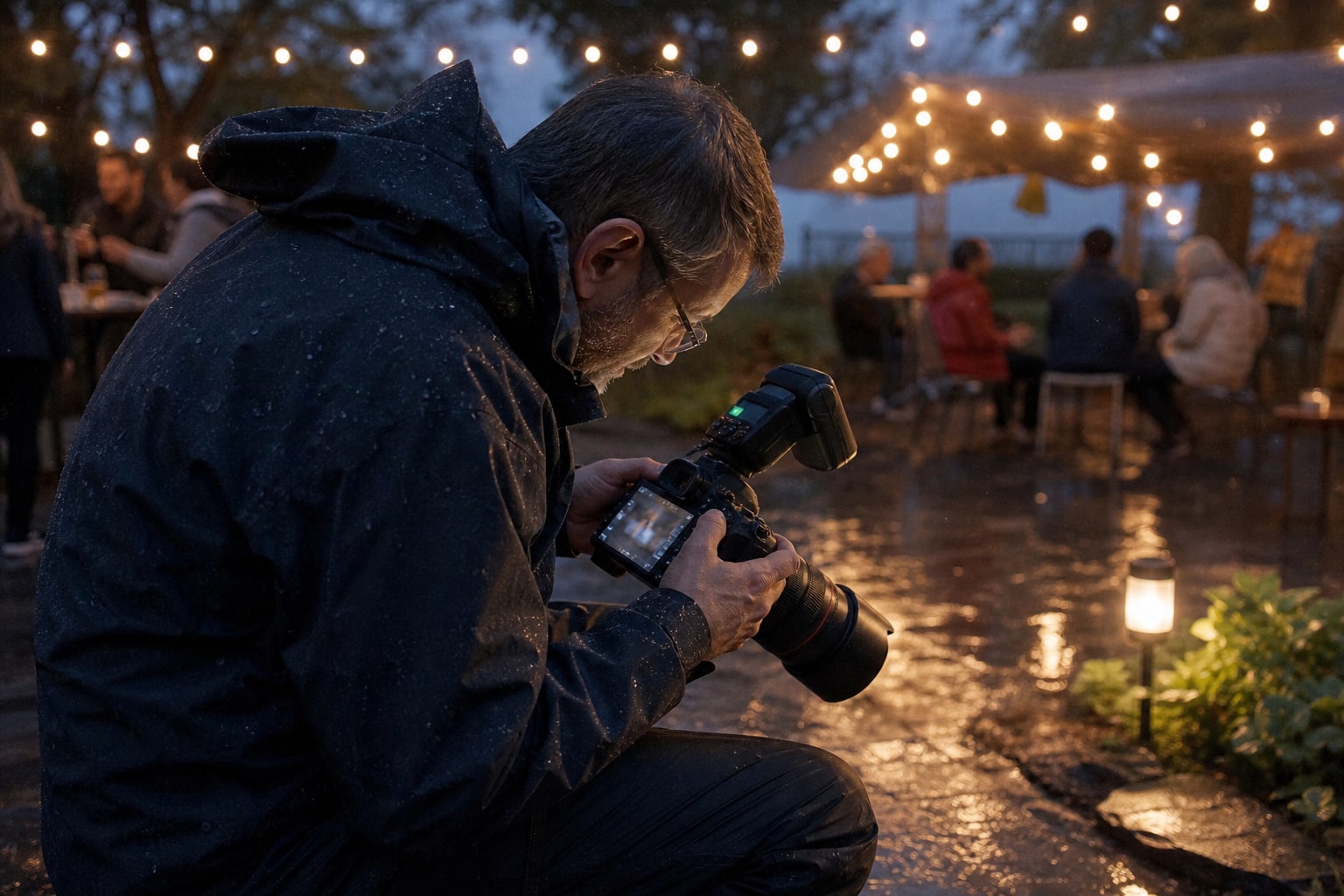
An orb in a photograph is almost always a speck of dust, pollen, or moisture floating close to the lens, lit by the camera's flash and recorded as a soft, out-of-focus disc. You usually cannot see the particle when you take the picture, which is why the circle seems to appear from nowhere.
Since cheap digital cameras spread in the late 1990s, some writers have argued that certain orbs are spirits or angels. This page sets out who says so, what the photographic evidence shows, what the popular color readings claim, and why a light you see with your own eyes belongs to an eye doctor before it belongs to symbolism.
Quick Facts
- Usual cause
- Flash light bouncing back from dust, pollen, rain, mist, or insects just in front of the lens
- Why phones and compacts
- The flash sits right next to the lens, so light reflected by nearby particles returns straight into it
- Main angel-orb authors
- Klaus Heinemann and Miceal Ledwith (2007), Klaus and Gundi Heinemann (2010), Diana Cooper and Kathy Crosswell (2009)
- Color readings
- Popular belief drawn from Theosophical seven-ray teaching; schools disagree on which color means what
- Orbs seen with the eyes
- Often floaters, the blue-sky dots of the blue field effect, or migraine aura; a sudden shower of floaters or flashes needs urgent eye care
What is an orb in a photo?
An orb is the picture a camera makes of a small bright object that sits far outside its focus. A dust mote two or three centimeters from the lens cannot be drawn sharply, so the lens spreads its light into a disc many times larger than the particle itself.
Photographers call that spread shape a circle of confusion. Its outline follows the lens opening, which is why some orbs are perfectly round and others show faint straight edges from the blades of the aperture.
Most orbs give themselves away in three ways: they look partly transparent because the particle only adds light to the scene behind it, they are brightest in flash pictures taken in the dark, and they move or vanish from one frame to the next as the air shifts.
Many orbs also show rings, speckles, or a brighter edge inside the disc. Enthusiasts sometimes read these as faces or structure, but the same patterns come from the particle's shape, from droplets acting as tiny lenses, and from marks or coatings on the glass itself.
Who says orbs are angels or spirits?
The best-known case for spirit orbs comes from Klaus Heinemann, who holds a PhD in experimental physics from the University of Tübingen and worked in materials research at NASA and Stanford. He first noticed bright orbs in pictures he took at a spiritual retreat, according to his publisher.
In The Orb Project (2007), Heinemann and Miceal Ledwith, a former president of Maynooth College in Ireland, argue that some orbs are emanations of spirit beings rather than dust. Ledwith came to the subject through the teachings of Ramtha's School of Enlightenment, and the book offers tips for separating what the authors call genuine orbs from particles.
Heinemann returned to the claim with his wife Gundi in Orbs: Their Mission and Messages of Hope (Hay House, 2010), which treats orbs as signs from spirit beings that carry healing and hope.
Angel writers took the idea further. Diana Cooper and Kathy Crosswell's Ascension Through Orbs (Findhorn Press, 2009) presents orbs as the physical presence of angels in digital photographs and pairs nearly fifty images with meditations on archangels, spirit guides, and ascended masters.
Ghost-hunting groups use the same word for a different belief, in which a spirit orb is the energy of a dead person caught on camera in old houses and at gravesides.
What the spirit-orb case rests on, and what tests found
The claims come from named writers. The tests come from photographers and researchers, including one open to afterlife questions.
What the evidence supports
- Orbs are common in flash photos
Everyone agrees on this. Schwartz and Creath recorded orbs in more than 200 of about 1,000 test photographs (2005).
- The effect can be made on purpose
Joe Nickell and Kenny Biddle note that flash orbs were understood by the 1980s and are easily produced by experiment (Skeptical Inquirer, 2020).
- Camera design changes the count
In the same 2005 study, a professional Olympus E-10 with its flash further from the lens recorded no orbs at all.
What remains limited
- Orbs show spirit presence
No test has shown an orb that remains when flash, particles, and stray reflections are removed.
- Some orbs behave with intent
When a paired stereo camera caught an orb in only one of two frames, Heinemann and Ledwith read it as a spirit steering its light. A particle close to one lens gives the same result.
- Orbs gather at spiritual events
Retreats, vigils, and old buildings are often dim, dusty, candle-lit, and photographed with flash.
One of the fullest tests came from a researcher open to afterlife questions. Gary Schwartz, a University of Arizona psychologist who has also run mediumship studies, worked with optical scientist Katherine Creath and concluded that stray reflections and nearby particles explained the orbs in their pictures.
Reviewing The Orb Project in 2021, the writer Tom Ruffles pointed out that the conditions the authors say attract orbs are exactly the conditions that make dust and moisture shine in a flash. A camera that needs dim air and a flash beside the lens to see a being is recording the air and the flash.
How does a flash turn dust into an orb?
The effect is called backscatter, and it needs three things at once: a light source very close to the lens, a small particle between the lens and the subject, and a dark scene where that particle outshines everything behind it.
When the flash fires, light travels outward and hits the particle almost head-on. Because the flash and lens sit side by side, the light bounces straight back into the lens, and the particle becomes the brightest point in the frame.
Compact cameras and phones make this more likely than larger cameras. Their flash sits right beside the lens, while a professional flash mounted on top of the camera, or held off to one side, sends the reflection away at an angle.
Common particles include house dust stirred up by people walking, pollen outdoors in spring, drizzle, fog, snow, and small insects. Rain and snow can fill a frame with dozens of orbs, while a single orb in a still room is often one dust fleck that drifted through at the moment of the shot.
You rarely see the particle yourself because your eye is not lit from beside your pupil and it focuses on the subject, not on the air a few centimeters away. The flash lasts a thousandth of a second or less, far too briefly to catch a speck in the air.
Home security and baby-monitor cameras show the same thing in video, because the infrared lights ringing their lenses turn drifting dust and moths into glowing orbs that seem to float and change direction.
How is an orb different from lens flare or bokeh?
Three different optical events produce bright circles, and each leaves its own clues. A backscatter orb needs a flash or light at the lens; lens flare needs a bright light in or near the frame; bokeh needs a light that sits in the scene but outside the focus.
| What you see | Backscatter orb | Lens flare | Bokeh |
|---|---|---|---|
| Where the light comes from | The camera's own flash or an infrared light next to the lens | A bright light such as the sun or a streetlamp shining into the lens | Real lights in the background or foreground |
| Where the circles sit | Anywhere in the frame, usually scattered at random | In a line running through the center of the frame from the light source | Exactly where the out-of-focus lights are |
| What happens when you move | Circles change or disappear between shots | Circles slide along the line as you tilt the camera | Circles stay tied to the lights |
| Simple test | Take the same picture with the flash off | Shade the lens with your hand or change the angle | Refocus on the lights and they shrink to points |
Lens flare comes from light bouncing between the glass elements inside a lens. Adobe's photography guides describe its ghosting as circles or rings that spread from the light source, and a lens hood or a different angle usually removes it.
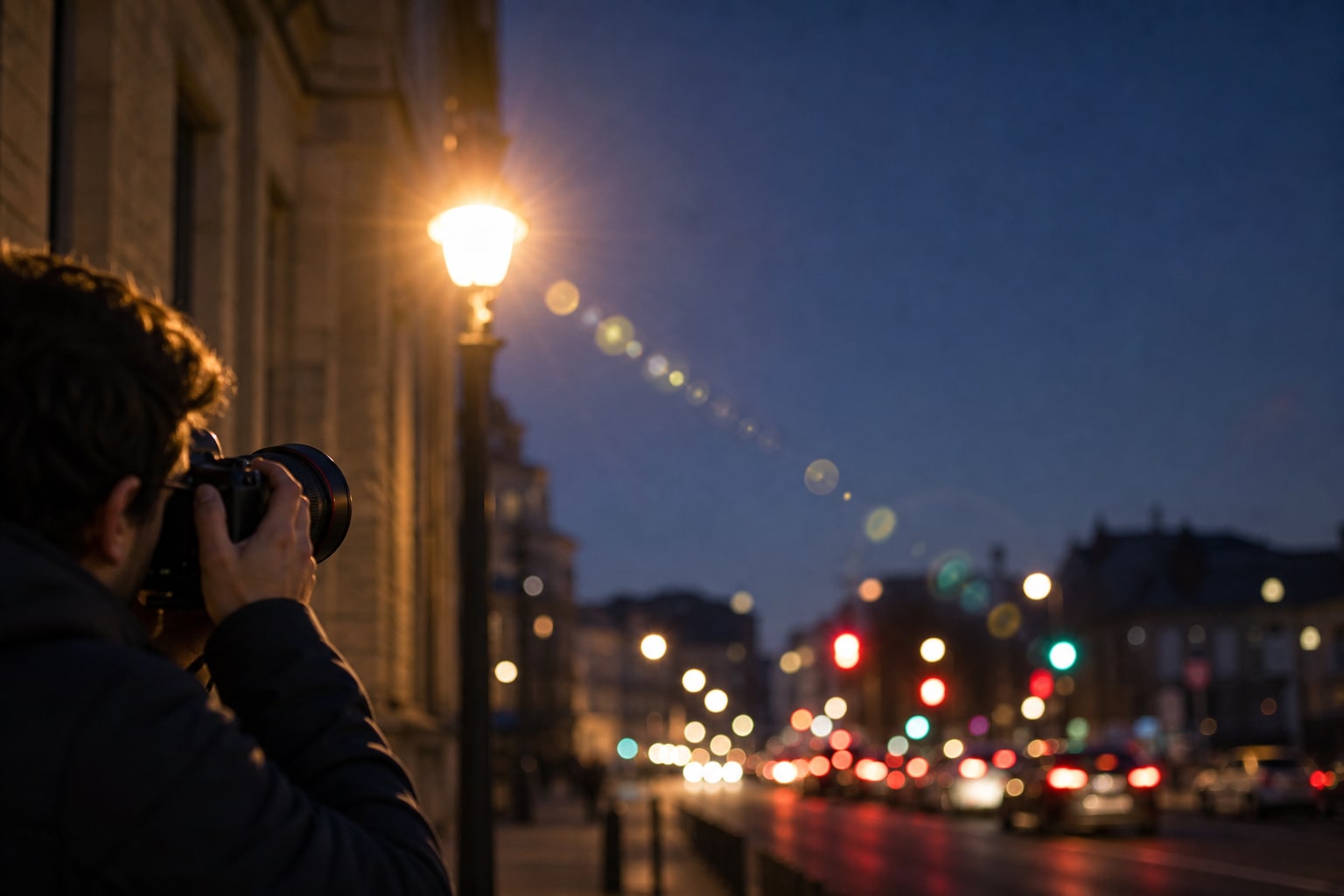
Bokeh is simply a light out of focus. Christmas lights, candles, and car headlights behind a portrait become round discs that sit where the lights really are, so the test is to look at the scene rather than the picture.
Editing apps add a fourth source, since filters, beauty modes, and flare overlays can paint circles that were never in the original capture.
How can you make an orb photo yourself?
You can make orbs at home in a few minutes with a phone, and the result shows what your own camera does without asking you to trust anyone's explanation.
Make and remove an orb
Use a dark room and change one thing at a time.
- Darken the room
- Input
- A dim room and a phone with the flash set to on
- Action
- Take one picture of a plain wall or doorway
- Result
- A baseline, usually with few or no orbs
- Add particles
- Input
- A dusty cloth, a pillow, or a plant mister
- Action
- Shake the cloth or mist the air between you and the wall, then shoot a burst
- Result
- Soft round orbs appear, many of them in each frame
- Turn the flash off
- Input
- The same room and the same air
- Action
- Repeat the burst with the flash off and a lamp switched on
- Result
- The orbs vanish, although the particles are still there
- Move the light
- Input
- A torch or a second phone's light
- Action
- Hold the light an arm's length to one side and shoot again
- Result
- Few or no orbs, because the reflection no longer returns to the lens
If the orb in your original photo looks like the ones you made, the camera has shown you its likely cause. Rain, snow, pollen, and breath on a cold night give the same result outdoors.
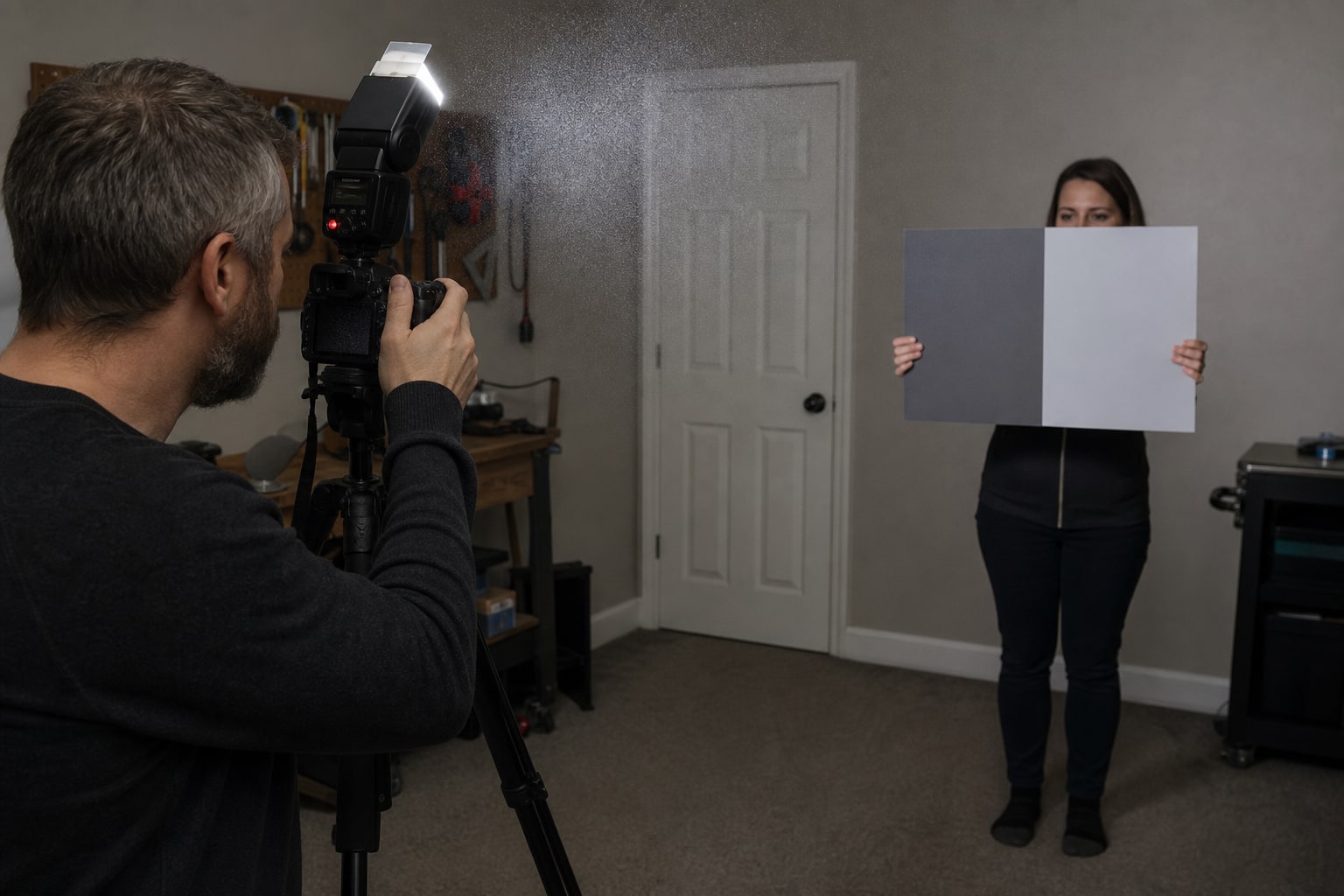
A test that fails to reproduce the orb does not show that a spirit made it. The dust, droplet, or reflection that caused it may simply have gone, so one unexplained frame leaves the question open.
What do orb colors mean?
Color readings for orbs are popular belief, and no scripture or church teaching assigns them. Most come from angel-color writing such as Whitney Hopler's Learn Religions series, which describes angels working through seven light rays of blue, yellow, pink, white, green, red, and purple.
That seven-ray scheme descends from Theosophy and the later Ascended Master movements of the twentieth century. Those schools disagree on which color belongs to which ray, so two orb guides can give the same color opposite meanings.
| Orb color | Popular angel-color reading | Common photographic cause |
|---|---|---|
| White or clear | Purity and holiness in white light readings | Dust or droplets lit by a white flash |
| Blue | Protection and faith, linked to Michael | Cool LED flash, blue ambient light, or a camera's white balance |
| Green | Healing, linked to Raphael | Color fringes from the lens, or green light from screens and signs |
| Gold, orange, or yellow | Wisdom and guidance | Candles, tungsten bulbs, and streetlamps coloring the particle |
| Purple or pink | Mercy or love, depending on the school | Mixed light sources and fringes at the orb's edge |
| Red | Service or wise action | Red light from exit signs, taillights, or the camera's focus-assist lamp |
The photographic column does not argue with anyone's faith. It shows that an orb's color is set by the light that hit it, the lens, and the camera's color processing, so a colored orb tells you about the lighting first.
If a color already carries meaning for you, it is yours to keep as a reflection. The link between blue light and Michael, for example, comes from later devotional writing rather than from scripture.
What if you see orbs with your own eyes?
A light you see without a camera is a question for your eyes before it is a question for symbolism. Three common causes produce floating spots or lights, and a few warning signs need care the same day.
Floaters are the most common. The National Eye Institute describes them as small dark shapes, spots, threads, or cobwebs that drift across your vision, usually caused by the gel inside the eye clumping with age.
The blue field entoptic phenomenon produces tiny bright dots that dart along curving paths when you look at a clear blue sky. They are white blood cells passing through the small blood vessels in front of your retina, and Charles Riva and Benno Petrig used them in 1980 to measure how fast blood moves there.
Migraine aura can bring flashing lights or zigzag lines before or without a headache. The NHS says aura usually settles within an hour, and aura lasting longer than 60 minutes needs an urgent call to NHS 111 or a GP.
When lights in your vision need urgent care
- A sudden shower of new floaters
Especially with flashes of light. The National Eye Institute warns this can mean a retinal tear or detachment.
- A dark shadow or curtain
Moving across your side or central vision. Go to an eye doctor or emergency room the same day.
- Floaters or flashes for the first time
Or after eye surgery or an eye injury, or with eye pain or blurred vision. The NHS advises an urgent optician visit or a call to 111.
- Loss of vision with other symptoms
Such as sudden severe headache, slurred speech, confusion, or weakness on one side. Call emergency services.
Long-standing floaters that have not changed are usually harmless, so the warning signs are all about change: new spots, more of them, flashes, or a shadow that was not there yesterday.
Lights seen outdoors at night have their own ordinary list, including aircraft, satellites, planets, reflections, and insects caught in a porch light. Light that appears inside a dream is a separate subject, covered under light and halos in dreams.
Can an orb photo still matter if it was dust?
Yes.
A picture taken at a memorial, a hospital bedside, or a family gathering keeps its meaning because of who was there, and a circle of lit dust does not take that away.
Some families will disagree about the same photo, with one person seeing a visitor and another a flash. Saying what you know in plain words helps both keep the picture: we were together, the flash was on, and the orb reminded me of the person we were missing.
If the orb came with a sense of someone near, the experience itself is common and well studied, and a felt presence has its own ordinary and religious explanations. The photograph cannot settle whether anyone was there, and it does not need to for the memory to stay.
Keep the original file, note when and where it was taken, and let the question stay open if you want it to. An orb can be a reminder without being a message.
Frequently Asked Questions
Are orbs in photos ghosts or angels?
Writers such as Klaus Heinemann and Diana Cooper say some are spirit beings or angels. Controlled tests keep finding flash light reflected from dust, droplets, or shiny surfaces, and no test has produced an orb that survives with the flash and particles removed.
Why do orbs show up on my phone but I could not see them?
The phone's flash sits right beside the lens, so light bounces back from dust or mist a few centimeters away. The flash lasts a fraction of a second and your eyes were focused on the scene, so the particle was never visible to you.
Why do orbs appear in photos at funerals and memorials?
Those events are often indoors, dim, candle-lit, and photographed with flash, which are the conditions that make dust shine. The timing gives the picture its emotional weight, while the lighting explains the circle.
Can orbs appear in videos?
Yes, especially on night-vision security and baby-monitor cameras. Their infrared lights sit around the lens, so drifting dust and insects glow and seem to float, turn, and fade.
Is it normal to see small lights or orbs in my vision?
Bright dots against a blue sky are usually the blue field entoptic phenomenon, and drifting specks are usually floaters. A sudden increase in floaters, new flashes, or a dark curtain across your vision needs urgent eye care the same day.
Do orb colors have fixed meanings?
No, color readings are popular belief drawn from seven-ray teachings, and different schools assign colors differently. In a photo, an orb's color usually comes from the light around it and the camera's processing.
Sources
- (2007). The Orb Project. Atria Books / Beyond Words. Link
- (2010). Orbs: Their Mission and Messages of Hope. Hay House. Link
- (2009). Ascension Through Orbs. Findhorn Press. Link
- (2021). The Orb Project, by Miceal Ledwith and Klaus Heinemann (review). The Joy of Mere Words. Link
- (2005). Anomalous Orbic "Spirit" Photographs? A Conventional Optical Explanation. Journal of Scientific Exploration 19(3): 343-358. Link
- (2020). So You Have a Ghost in Your Photo. Skeptical Inquirer 44(4). Link
- (2026). Backscatter (photography). Wikipedia. Link
- (2026). The Power of Lens Flare in Photography. Adobe Photography. Link
- (2024). Inside Lens Blur. Adobe Blog. Link
- . Angel Colors: The Light Rays of Archangels. Learn Religions. Link
- (2026). Seven rays. Wikipedia. Link
- (2024). Floaters. National Institutes of Health. Link
- . Floaters and flashes in the eyes. NHS. Link
- . Migraine: Symptoms. NHS. Link
- (1980). Blue field entoptic phenomenon and blood velocity in the retinal capillaries. Journal of the Optical Society of America 70(10): 1234-1238. Link
About Our Editorial Process
Every KnowTheAngels guide separates calculation method, tradition context, and personal reflection. We cite where interpretations come from, present more than one view, and never present symbolic reading as prediction.
Read our editorial policy