What Does a Rainbow Mean Spiritually, From Genesis to Grief?
The covenant bow of Genesis 9, the Jewish blessing on seeing one, how the colors form, and why grieving people read a rainbow as a sign
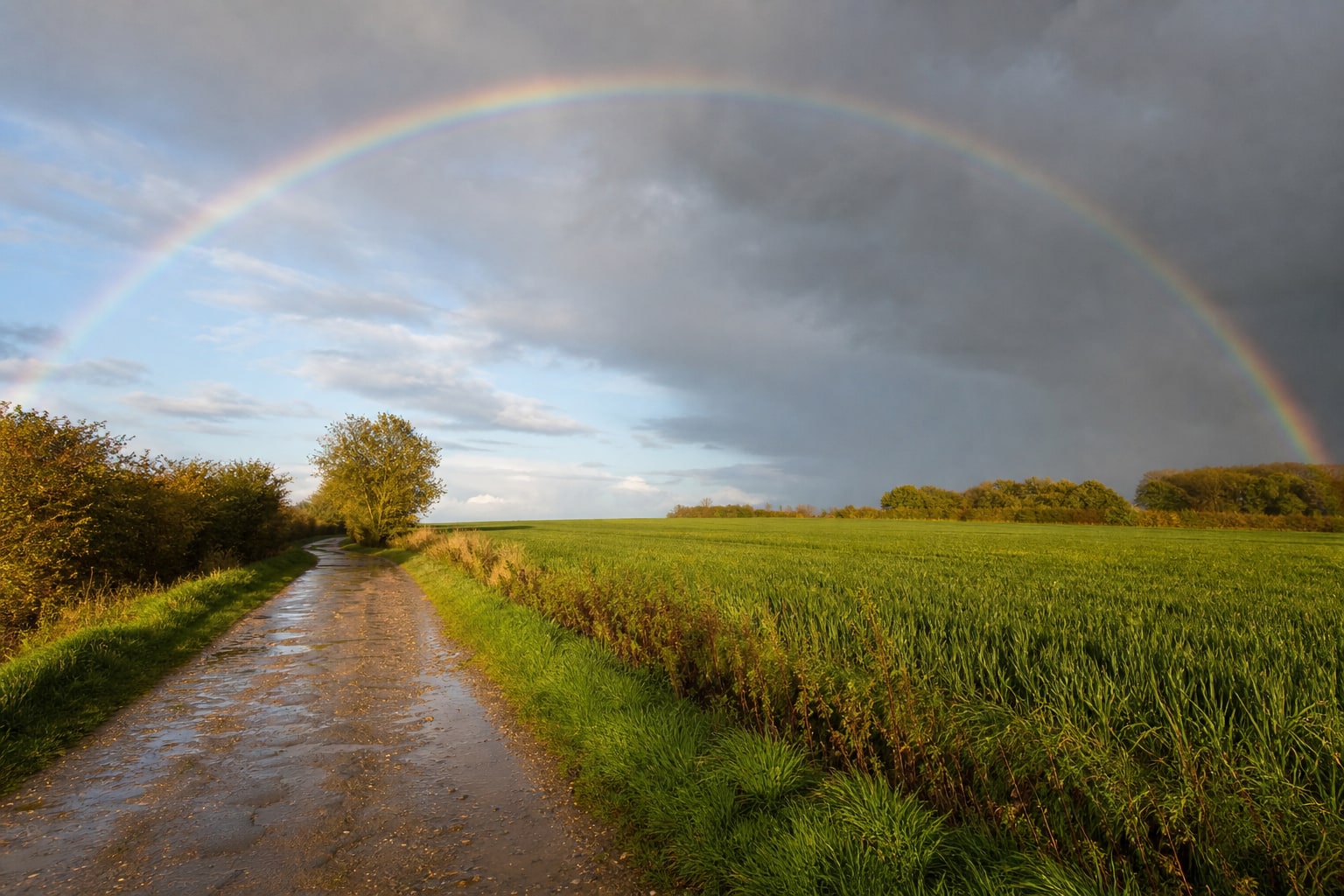
A rainbow is most often read, spiritually, as a sign of promise and of hope after hardship. That reading has a precise source: in Genesis 9:13 God says, "I have set my bow in the clouds, and it shall be a sign of the covenant between me and the earth."
Later layers belong to different owners. Rabbinic law gave Jews a blessing to say on seeing one, Greek myth made the rainbow a messenger goddess named Iris, and twentieth-century grief writing produced the pet "Rainbow Bridge" and the "rainbow baby."
The rainbow itself is sunlight bent and reflected inside drops of water, and you only see it with the sun behind you.
Knowing that does not settle what a particular rainbow means to you. It does rule out one claim: a rainbow cannot, by itself, prove that an angel or a loved one sent it.
Quick Facts
- Bible passages
- Genesis 9:12-17; Ezekiel 1:28; Revelation 4:3; Revelation 10:1
- Hebrew word
- Qeshet, the same word as an archer's bow
- Jewish blessing
- "Who remembers the covenant, is faithful to His covenant, and fulfills His word" (Berakhot 59a)
- How it forms
- Sunlight refracts, reflects once, and spreads into colors inside raindrops, about 42 degrees from the point opposite the sun
- Double rainbow
- A second reflection makes a fainter outer bow with reversed colors, about 50 to 51 degrees out
- Rainbow Bridge
- Written in 1959 by Scottish artist Edna Clyne-Rekhy after her dog Major died
Which traditions give the rainbow its meaning, and what does each claim?
The answer depends on whose meaning you are asking about, because the rainbow has at least five owners. Scripture treats it as a covenant sign, Jewish law as an occasion for a blessing, Greek myth as a messenger, and modern grief culture as a bridge or a promise after loss.
Hope after a storm is the meaning most readers already know, and it runs from the Genesis story to the grief readings.
What changes from one layer to the next is who made the promise, and to whom.
| Source | What the rainbow means there | What it does not claim |
|---|---|---|
| Genesis 9 (Hebrew Bible) | The sign of God's covenant never again to destroy all flesh by a flood | A promise to one person about one outcome |
| Ezekiel 1:28 and Revelation 4:3 | The likeness of the brightness around God's glory and throne | A sign sent to individual viewers today |
| Talmud, Berakhot 59a | An occasion to bless God, who remembers the covenant | Good luck; the same tradition discourages staring at it |
| Greek myth (Hesiod, Homer) | Iris, the swift messenger of the gods | A role in biblical angel lore |
| Modern grief culture | The Rainbow Bridge for pets; the rainbow baby after pregnancy loss | Evidence that the dead send rainbows |
None of these traditions treats a rainbow as a private message. Even the grief readings began as a poem and as words a community chose, which is why they can be held loosely.
What do Genesis 9, Ezekiel 1:28, and Revelation 10:1 say about the rainbow?
In the Bible the rainbow first appears at the end of the flood story, as the sign of a covenant God makes with Noah, his descendants, and "every living creature" (Genesis 9:12). In the NRSVUE, God says in verse 13: "I have set my bow in the clouds, and it shall be a sign of the covenant between me and the earth."
The promise is specific. When the bow is seen, God says, "I will remember my covenant," and "the waters shall never again become a flood to destroy all flesh" (Genesis 9:15).
Two details shape how the passage has been read. The sign is for God's remembering as much as for Noah's comfort (verse 16), and the covenant partner is the whole earth, animals included.
One chapter earlier, in Genesis 8:11, a dove brings Noah a freshly plucked olive leaf. The flood story therefore closes with two signs: the bird tells Noah the water is going down, and the bow tells him it will not come back.
The Hebrew word is qeshet, the ordinary word for a hunter's or a soldier's bow. The thirteenth-century commentator Nachmanides (Ramban) records an earlier reading that God set the bow with its ends turned down toward the earth and no string, the way warriors turn their weapons around to ask for peace.
Ramban also accepted the Greek natural explanation of rainbows, noting that a vessel of water standing in the sun shows one too.
He read "I have set my bow" as a bow that had existed since creation and received a new meaning after the flood, so for him the optics and the covenant did not compete.
The prophet Ezekiel uses the rainbow as a comparison rather than a sign. At the climax of his opening vision the brightness around the throne is "like the bow in a cloud on a rainy day," and "this was the appearance of the likeness of the glory of the Lord" (Ezekiel 1:28).
Revelation takes up Ezekiel's picture twice. Around God's throne "is a rainbow that looks like an emerald" (Revelation 4:3), and in Revelation 10:1 John sees "another mighty angel coming down from heaven, wrapped in a cloud, with a rainbow over his head."
That is the only angel in the Bible described with a rainbow.
Commentators disagree about whether the mighty angel of chapter 10 is a created angel or a veiled picture of Christ, since his face "like the sun" echoes the description of Christ in Revelation 1:16.
Read together, the passages give the rainbow two jobs. In Genesis it marks a promise to all living things, and in Ezekiel and Revelation it marks the edge of God's glory, so none of them presents a rainbow as a message addressed to one viewer.
What blessing do Jews say when they see a rainbow?
Jewish law answers a rainbow with a short blessing rather than an interpretation.
The Talmud (Berakhot 59a) records two wordings, "Who remembers the covenant" and Rabbi Yishmael son of Rabbi Yohanan ben Beroka's "Who is faithful to His covenant and fulfills His word," and Rav Pappa rules that both are said together.
The Shulchan Arukh (Orach Chayim 229:1) fixes the combined text. In the Sefaria community translation it reads: "Blessed are you, God our Lord, king of the world, who remembers the covenant, who is faithful to his covenant, and who fulfills his word."
The same Talmud page records a dispute about posture. Rabbi Yehoshua ben Levi taught that one who sees a rainbow should fall on his face, citing Ezekiel 1:28, while in the Land of Israel people cursed anyone who did, because it looked like bowing to the rainbow.
A second thread warns against gazing. Chagigah 16a counts looking at a rainbow as a lack of concern for God's honor, again because of Ezekiel's "likeness of the glory," and the Shulchan Arukh accordingly forbids looking at it beyond the blessing.
The Mishnah Berurah (229:1) adds that one should not tell a friend that a rainbow is out.
Its reason is sober: the covenant is a reminder that the world deserved destruction and was spared by mercy, so announcing a rainbow is like spreading a bad report.
In this tradition the response is brief and aimed at God, not at the sky. A person says the blessing once, looks away, and does not ask the rainbow for a personal meaning.
How does a rainbow form?
A rainbow forms when sunlight enters falling drops of water, bends (refracts), reflects once off the back of each drop, and bends again on the way out. Each color bends by a slightly different amount, so white sunlight spreads into bands, a process called dispersion.
According to the U.S. National Weather Service, the light leaves the drops most strongly at about 42 degrees from the point directly opposite the sun.
That fixed angle explains the shape: every drop sitting at 42 degrees from your eye lights up, and together they trace a circle around the shadow of your head.
Two practical rules follow. The sun has to be behind you and the rain in front of you, and the sun must be lower than 42 degrees above the horizon, which is why rainbows appear mostly in the early morning and late afternoon.
The Met Office points out that a rainbow is really a full circle, with the ground usually hiding the lower half.
The seven named colors are a convention, since the band holds a continuous range of hues.
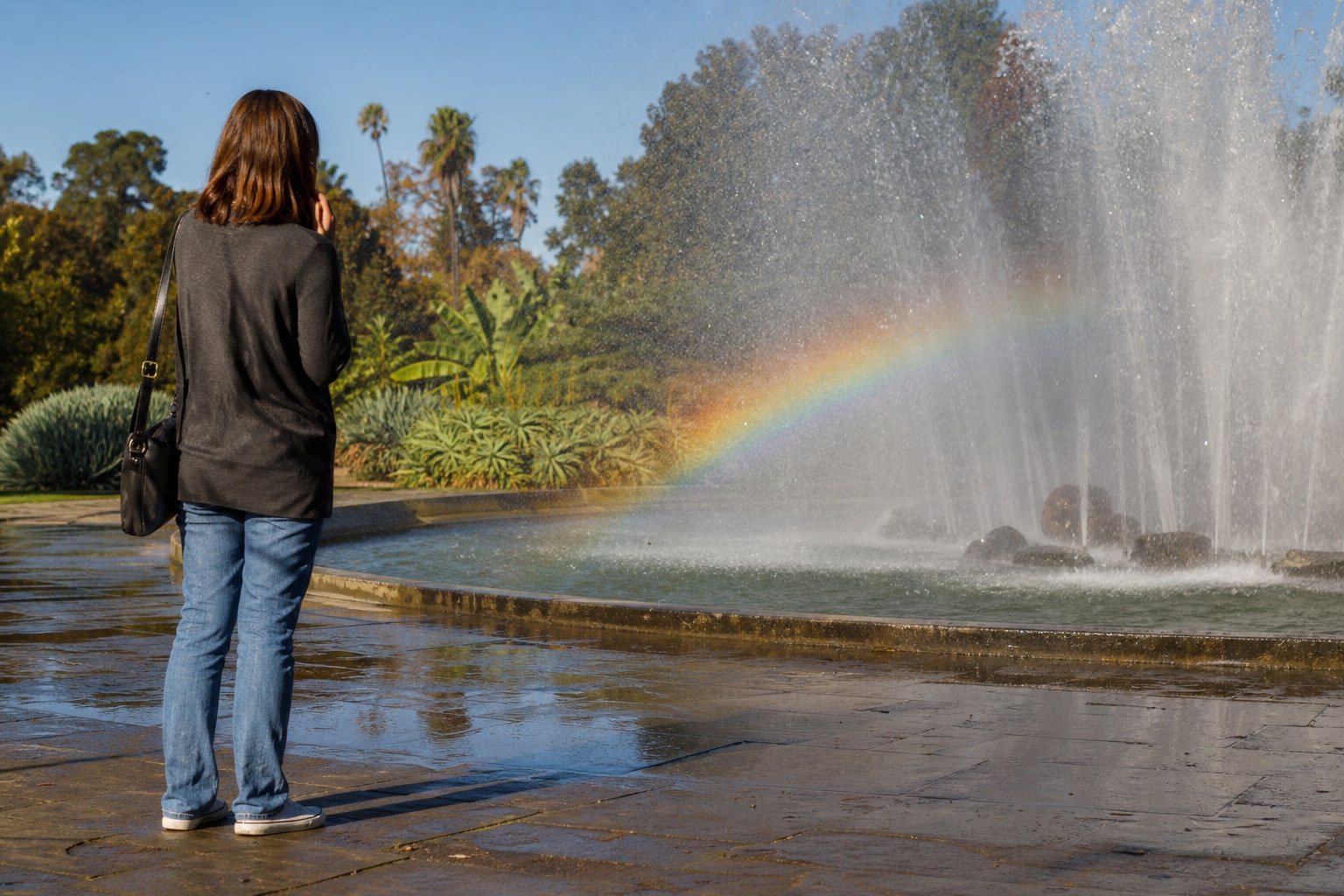
Moonlight can make a rainbow too.
A moonbow usually looks white to the eye because moonlight is too faint for our color vision, and a fogbow forms in mist, where the drops are so small that the colors blur into a pale arc.
None of these needs a storm, only water drops and a light source at the right angle. A rainbow over a garden sprinkler and one after a thunderstorm come from the same physics, which matters for anyone reading one as a sign.
Why does a double rainbow reverse its colors, and what is it said to mean?
Physically, a double rainbow means some of the light has reflected twice inside the drops instead of once.
The second reflection sends it out at about 50 to 51 degrees, so a fainter bow appears outside the first with its colors reversed: red on the inside, violet on the outside.
The sky between the two bows looks darker than the sky on either side. Atmospheric Optics names this Alexander's band, after Alexander of Aphrodisias, who described it around AD 200, and explains it simply: drops in that zone send light from neither bow to your eye.
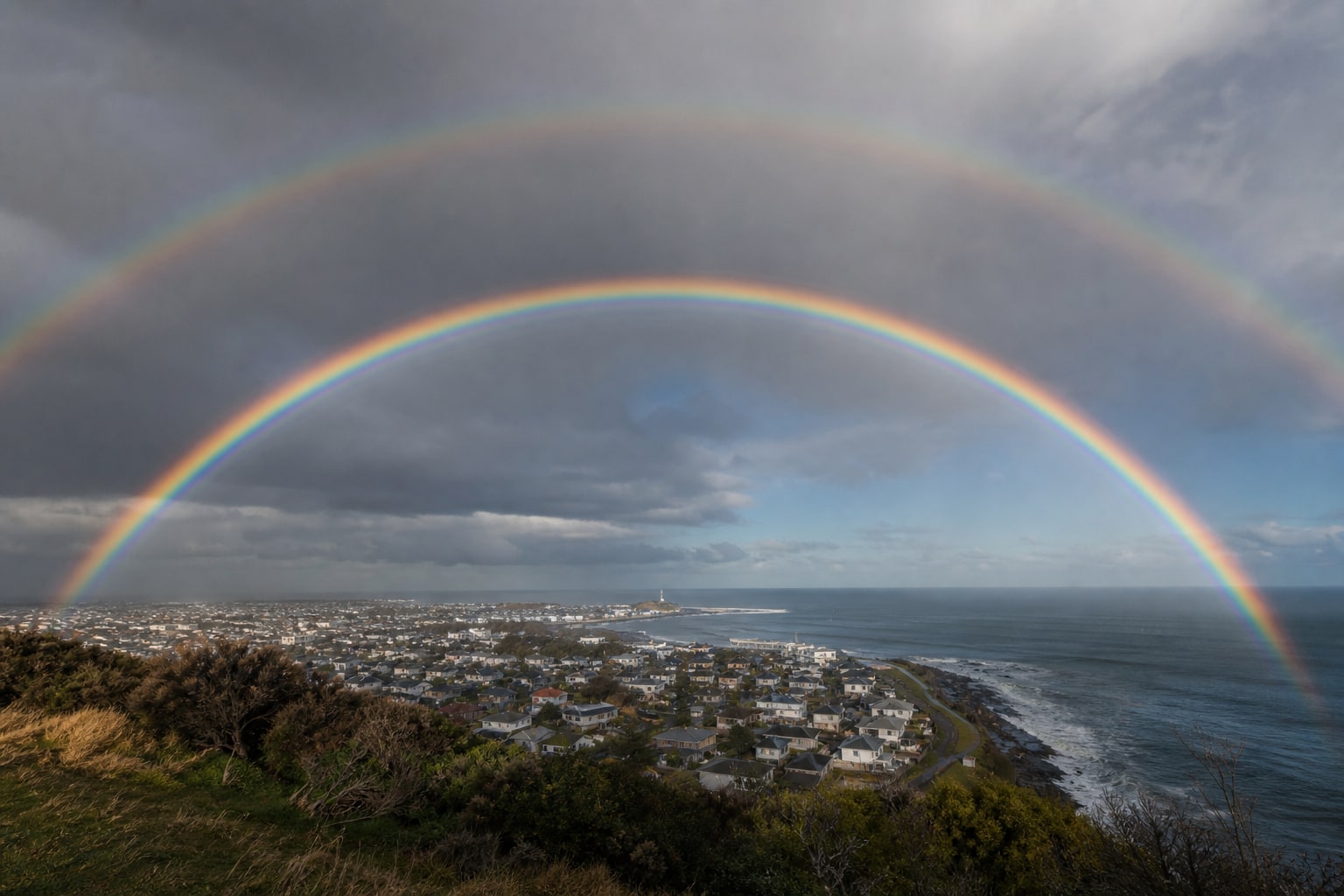
Spiritually, the double rainbow has no source in scripture or rabbinic law, which speak only of the bow.
Its popular meanings, such as a doubled blessing, a new start, or two loved ones sending one sign, come from modern sign writing and social media.
Those readings can stay personal associations. The optics give one reason for care: the second bow shows whenever the sunlight is strong enough for the weaker double reflection to be seen, so a double rainbow says more about that shower than about a doubled message.
Is a rainbow at a funeral or anniversary a sign from the person who died?
Many grieving people say a rainbow appeared at a funeral, on an anniversary, or while they were thinking of the person, and they take it as a sign that the person is at peace.
This is a popular belief rather than a teaching of the Bible or of Jewish law, and no evidence shows that the dead produce rainbows.
Grief researchers do not treat the experience as a problem. In Continuing Bonds (1996), Dennis Klass, Phyllis Silverman, and Steven Nickman gathered studies showing that an ongoing inner bond with someone who died is common and can be healthy.
That finding helps explain why a rainbow on the day of a burial can feel like contact. The moment gives an existing bond somewhere to land, whatever caused the light.
There is an ordinary side as well. Rainbows follow showers and low sun, and in the weeks after a loss people search their surroundings for the person, so rainbows they once ignored now stand out.
The same reading attaches to white feathers and butterflies, and the same pattern of attention explains part of it.
You can keep the comfort without settling the question.
Saying the person's name, or writing down the date and what you were doing, honors the moment whether you read it as a sign or as a coincidence you are glad of.
Grief that stays intense and blocks daily life for a long time is a health matter. The American Psychiatric Association describes prolonged grief disorder, diagnosed in adults when such grief persists at least 12 months after a death, and a doctor or grief counselor can help.
Where do the Rainbow Bridge and the rainbow baby come from?
The Rainbow Bridge is a short prose poem about a meadow where pets who have died wait, healthy again, until their owners arrive and they cross the bridge together.
For decades nobody knew who wrote it, and about 25 names were attached to it.
In 2023 the art historian Paul Koudounaris traced it to Edna Clyne-Rekhy, a Scottish artist who wrote it in 1959 after her Labrador, Major, died, as National Geographic reported that February.
She typed copies for friends without her name on them. The poem reached a mass audience when the Dear Abby column printed it in February 1994, and veterinary hospitals now hand it to grieving owners.
The poem draws on no scripture, and no church teaches the bridge as doctrine. Its use is the one its author gave it: a picture of reunion that helps a person say goodbye to an animal.
A rainbow baby is a baby born after a miscarriage, stillbirth, or the death of an infant.
The American Pregnancy Association explains the name by the rainbow's place after a storm, and notes that such a pregnancy can bring guilt, relief, excitement, and sadness at once.
The term does not suit every family, because a new child does not end grief for the one who died. Both phrases borrow the Genesis picture of light after a flood, but they are modern community language, and a family can use them or leave them.
Why is the rainbow a messenger in Greek myth?
In Greek myth the rainbow is Iris, the swift messenger of the gods.
Hesiod's Theogony (lines 265-266) makes her the daughter of Thaumas and the ocean nymph Electra, and in Homer's Iliad (2.786) she carries a message from Zeus to the Trojans.
Hesiod gives her one more duty. When the gods quarrel, Zeus sends Iris to fetch water from the river Styx for them to swear on (Theogony 780 and following), and Greek vase painters show her with golden wings and a herald's staff.
A winged messenger invites comparison with angels, whose Greek name, angelos, also means messenger. The likeness stops at the word, since Iris belongs to Greek religion and the biblical rainbow is a covenant sign, not a courier.
The Greek word did reach the Bible, though. The Septuagint translation of Genesis 9:13 calls the rainbow toxon, the archer's bow, while Revelation 4:3 and 10:1 use iris, the only two places it appears in the New Testament.
Why does a rainbow so often seem timed to a hard day?
Rainbows seem to arrive on cue partly because they are common.
They need only a passing shower and a low sun, conditions that recur often in showery weather, and each one fades within minutes.
Attention does the rest. The linguist Arnold Zwicky named the frequency illusion for the way something newly on your mind suddenly seems to be everywhere, and people who have started watching for signs notice rainbows they would once have missed.
A rainbow is also a different event from a shape in the sky. A cloud that looks like a wing or a face depends on pattern-finding, which makes cloud shapes a separate question, while a rainbow's form is fixed by optics and looks much the same to everyone nearby.
None of this makes a personal reading wrong.
It means the meaning comes from you and your tradition, whether that is the Genesis promise, the blessing in Berakhot, or the memory of someone you loved, and the rainbow itself carries no proof of who sent it.
Frequently Asked Questions
What does God say about the rainbow in the Bible?
In Genesis 9:13-16 God calls the bow in the clouds the sign of a covenant with the earth and every living creature. When it appears, God says, "I will remember my covenant," and promises never again to destroy all flesh by a flood.
Is a rainbow a sign of an angel?
Only one biblical angel is described with a rainbow: the mighty angel of Revelation 10:1, seen in John's vision with a rainbow over his head. No scripture or church teaching presents an ordinary rainbow as proof that an angel is near.
What does it mean when you see a rainbow after praying?
No tradition treats a rainbow as the answer to a particular prayer. Jewish practice responds with a blessing praising God for keeping the covenant, a way of giving thanks without reading the rainbow as a yes or a no.
Can you see a rainbow at night?
Yes. A moonbow forms from moonlight in the same way a rainbow forms from sunlight, but it usually looks white to the eye because the light is too faint for color vision.
Why can't you reach the end of a rainbow?
A rainbow is not an object in one place. It is light from whichever drops sit at about 42 degrees from your line of sight, so when you move, different drops form it and the rainbow moves with you.
What does a rainbow mean when a pet dies?
Many owners think of the Rainbow Bridge, a 1959 poem by Edna Clyne-Rekhy about pets waiting to be reunited with their people. It is a comforting picture from modern grief writing, not a religious teaching.
Sources
- (2021). Genesis 8:11 and 9:12-17. Bible Gateway. Link
- (2021). Ezekiel 1:28; Revelation 1:16, 4:3, and 10:1. Bible Gateway. Link
- . Berakhot 59a. Sefaria. Link
- . Chagigah 16a. Sefaria. Link
- . Shulchan Arukh, Orach Chayim 229:1. Sefaria (community translation). Link
- . Mishnah Berurah 229:1. Sefaria (community translation). Link
- (1971). Commentary on Genesis 9:12. Sefaria. Link
- . Genesis 9 (Greek text). Deutsche Bibelgesellschaft. Link
- . Greek-English Lexicon, entry 2463, iris. Bible Hub. Link
- . How Do Rainbows Form?. NOAA. Link
- . Rainbows. Met Office. Link
- . Alexander's Dark Band. Atmospheric Optics. Link
- (2023). The 'Rainbow Bridge' has comforted millions of pet parents. Its origin is revealed. National Geographic. Link
- . What Is a Rainbow Baby?. American Pregnancy Association. Link
- (1996). Continuing Bonds: New Understandings of Grief. Taylor & Francis. Link
- . Prolonged Grief Disorder. psychiatry.org. Link
- . Iris (Hesiod, Theogony 265-266 and 780 ff.; Homer, Iliad 2.786). Theoi Greek Mythology. Link
- . Iris (Greek mythology). Britannica. Link
- (2006). Why are we so illuded?. Stanford University. Link
About Our Editorial Process
Every KnowTheAngels guide separates calculation method, tradition context, and personal reflection. We cite where interpretations come from, present more than one view, and never present symbolic reading as prediction.
Read our editorial policy