What Does Green Angel Light Mean, and How Is It Connected With Raphael?
A layered reading of green light through Ordinary Time, Raphael healing traditions, slow recovery, and practical care

Green angel light is commonly read as healing, renewal, and life returning at a sustainable pace. That broad meaning comes from several sources that should stay separate.
Nature makes green familiar as a life color. Roman Catholic liturgy uses green in Ordinary Time.
The Book of Tobit gives Raphael a healing role, while the color link appears in later devotional systems.
Those layers point toward endurance more readily than instant cure. A green reflection in a hospital room may feel restorative because of the setting.
Green vestments carry a calendar meaning. A color noticed during prayer may help someone name a need for rest or care.
None of those events measures the body or predicts recovery.
Use green to ask which kind of repair is needed and what patient action supports it. Green can accompany healing work, but it cannot diagnose, identify an angel, or promise that healing will happen on demand.
Quick Facts
- Nature layer
- Plants and seasonal growth make green a strong cultural cue for life and renewal
- Liturgical layer
- The Roman Catholic Mass uses green during Ordinary Time
- Raphael layer
- Tobit names Raphael as a healing agent, while the green correspondence comes from later devotion
- Useful question
- Which form of care, pace, boundary, or support would make recovery more sustainable?
- Main limit
- Color cannot diagnose a condition or guarantee a cure
Green meaning comes from nature, liturgy, and later healing devotion
Green symbolism comes from nature, established liturgical use, and later healing devotion rather than one universal angel code. The visible color may come from leaves, fabric, a traffic signal, tinted glass, an LED, an interior image, or a color described around a person.
Nature supplies a life association because plants make green abundant. Worship supplies a calendar association.
Colored light supplies an optical event. When warmth or cold accompanies the color, the first checks belong to body and environment guidance.
Aura language supplies an interpretive framework that cannot be verified by hue alone.
| Green source | Useful first reading | First check |
|---|---|---|
| Plants or landscape | Life, season, rest, and environmental attention | Species, season, light, and why the place mattered |
| Church vestment or hanging | Liturgical season and sustained worship | Tradition, calendar, and local practice |
| Lamp, screen, glass, or reflection | A physical color source | Device, angle, surface, and repeatability |
| Interior prayer image | A personal healing or renewal association | Emotion, need, and the next grounded action |
| Green aura description | A modern interpretive claim | Consent, uncertainty, and whether the claim changes care |
This sorting prevents a common collapse. A green hospital wall, a green chasuble, and a green afterimage can all be described with the same color word without carrying one shared message.
Once the source is clear, the reader can keep the fitting meaning. Nature may support rest.
Liturgy may support steady practice.
Prayer imagery may name a need for repair.
Green seen as one band in a weather arc belongs first to rainbow optics and symbolism. This source match prevents green healing language from swallowing every ordinary use of the color.
The liturgical tradition gives green a basis in Ordinary Time
Roman Catholic liturgy uses green during Ordinary Time, giving the color an established ritual context. The word ordinary refers to counted or ordered time, not to a season with no spiritual importance.
That calendar use gives green a form of depth that differs from miracle language.
Much of spiritual life occurs through repeated worship, work, learning, and care rather than dramatic change.
Green therefore fits growth that is hard to photograph. A person keeps an appointment, takes medication correctly, asks for help, or practices a boundary again.
Green is well suited to growth that continues after the dramatic moment has passed.
Liturgical reading
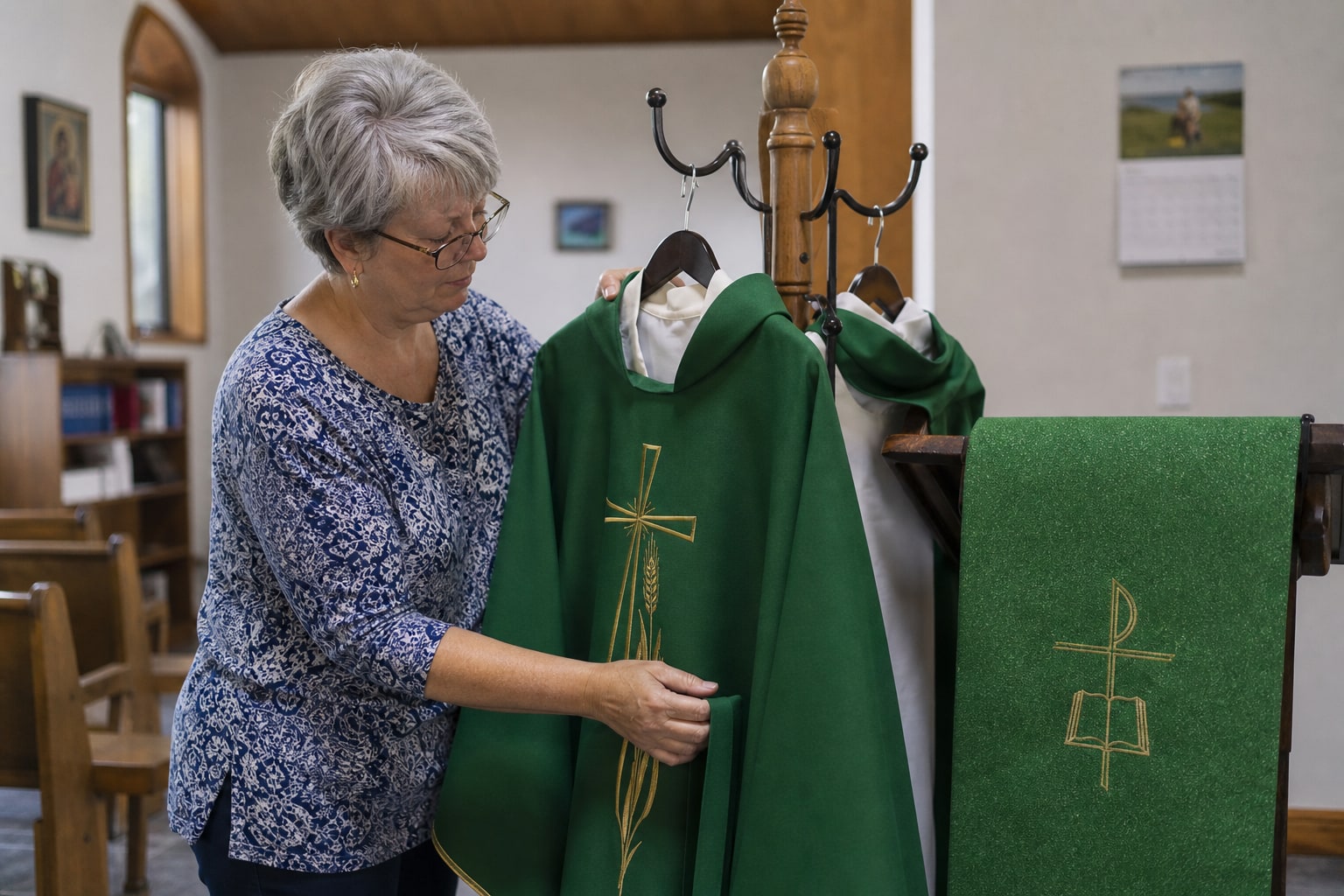
Readers outside Catholic practice can still understand the distinction without borrowing the rite as a private sign code. The liturgical fact shows one established tradition using green for sustained life.
This setting corrects the expectation of instant recovery. Green can hold ordinary faithfulness and slow repair without making either feel spiritually second-rate.
A dedicated devotional setting may include an altar practice, but an ordinary green object does not inherit that ritual role. Liturgical seasons also distinguish green from festive white uses.
The reader can therefore use Ordinary Time as a source for endurance, not as a claim that recovery is already complete.
Why Raphael is a healing source but not a green color proof
The Book of Tobit establishes a clear healing role for Raphael. He is sent in relation to Tobit and Sarah, travels with Tobias, and instructs him in the remedy used for Tobit's eyes.
The text supplies narrative actions, names, and healing outcomes. It does not provide a test that identifies Raphael whenever green light appears.
Green enters through later devotional color systems that pair angels with colors, virtues, or prayer intentions. Those systems can organize devotion, but their lists vary and should be labeled as later tradition.
Keep Raphael's source contexts separate
Each layer supports a different claim.
Strong source for a healing role
Supports healing language, not a color sighting test
Useful when clearly attributed
Cannot prove which source caused it
When healing is the real concern, a reader may choose a healing prayer.
The prayer follows the need and tradition rather than treating green as identification evidence.
This keeps the strongest part of the association. Raphael can support a healing devotion while green remains a symbolic aid with uncertain source.
What kind of healing does the situation require?
Healing is too broad until the reader names what is injured or depleted.
A body symptom, grief response, strained relationship, and exhausted schedule require different forms of help.
Green can serve as a sorting cue because it naturally evokes life and restoration. It cannot decide which intervention is appropriate.
- Body healing. Use symptoms, diagnosis, treatment, rest, and professional advice.
- Emotional healing. Name the feeling, trigger, support person, and coping plan.
- Relationship repair. Look for consent, safety, accountability, and changed behavior.
- Pace recovery. Remove one demand or restore one basic routine before adding a new practice.
A green cue that leads to the wrong category can cause harm. Rest does not repair every conflict, and prayer does not replace assessment for a worsening symptom.
The reader gains a practical question from the symbol.
What kind of repair is needed, and what evidence would show that the repair is helping?
Persistent body sensations belong with the health and context checks in tingling guidance. That boundary keeps the green section focused on choosing care, not diagnosing the body.
How can green become one care action?
A useful green practice ends in one action already supported by the situation. It does not ask the color to provide a treatment plan.
Choose an action small enough to complete today and concrete enough to review. The point is to translate renewal into care rather than to produce another green experience.
Turn renewal into visible care
Use the color as a prompt, then let ordinary evidence own the result.
- Name
- Input
- The area needing repair
- Action
- Choose body, emotion, relationship, or pace
- Result
- The healing question becomes specific
- Check
- Input
- Current evidence and support
- Action
- Identify the professional, person, plan, or boundary already relevant
- Result
- The response has a real owner
- Act
- Input
- One manageable step
- Action
- Complete the appointment, rest period, conversation, or request
- Result
- Renewal becomes observable
- Review
- Input
- What changed after the action
- Action
- Look for function, safety, or steadier capacity
- Result
- Feeling is tested against consequence

A healing prayer can accompany any step. It should make the action more honest and compassionate, not more certain than the evidence allows.
After the care action is complete, a brief review can sit inside evening meditation.
The color has served the reader when it supports care that can continue without another sign. If the action begins tomorrow, attach it to the first unavoidable cue used in morning meditation rather than waiting to see green again.
Green light does not prove healing or angelic presence
Green light does not prove that healing has begun or that Raphael is present. A reader may attach a feeling to a color, but that association cannot show whether recovery is occurring.
The source contexts explain why. Tobit supports Raphael's healing role, liturgy supports green during Ordinary Time, and nature supports a broad life association.
None of those sources turns one green sighting into evidence of an intervention.
Avoid measuring spiritual success by whether green returns. That turns a supportive cue into a test and can pull attention away from the care plan.
Let green remind you to care for life. Let evidence show whether the care is working.
Grounded healing boundary
A proportionate reading can remain devotional. Encouragement may be recorded through gratitude, while ordinary questions still track progress.
Questions about warm sacred value belong with the separate tradition of gold illumination. Green remains useful when it sends attention back to patient care rather than presence proof.
Frequently Asked Questions
What does green angel light mean?
Green is often used for healing, renewal, steady growth, and restored capacity. Name whether the color came from nature, worship, a physical light source, imagination, or vision before applying that meaning.
Is green the color of Archangel Raphael?
Green is a popular later devotional association for Raphael. The Book of Tobit supports Raphael's healing role, but it does not assign him a universal green light.
What does green mean in Christian worship?
In the Roman Catholic calendar, green is used during Ordinary Time. That setting emphasizes sustained life and faithful practice more naturally than a dramatic healing event.
Can green light confirm that healing is happening?
No. A green cue may support patience or remind someone to follow a care plan, but symptoms and recovery need ordinary medical, emotional, and practical evidence.
Sources
About Our Editorial Process
Every KnowTheAngels guide separates calculation method, tradition context, and personal reflection. We cite where interpretations come from, present more than one view, and never present symbolic reading as prediction.
Read our editorial policy