What Does Tingling Mean Spiritually, and Is It an Angel Sign?
How prayer, attention, posture, breathing, and nerve pressure can shape tingling without turning a body sensation into proof

Tingling has no single spiritual meaning. During prayer or meditation, you may experience it as a cue to notice a thought, emotion, or sense of closeness, but the feeling does not reveal who or what caused it.
Medicine uses the term paresthesia for sensations such as tingling, prickling, burning, or numbness. A cramped position, pressure on a nerve, or breathing too quickly can produce the same physical event that a spiritual reader later interprets.
The experience can still carry meaning when you keep the physical sensation separate from the interpretation you give it.
If tingling is constant, keeps returning, or comes with sudden one-sided weakness or numbness, speech trouble, vision changes, loss of balance, or a severe unexplained headache, medical care comes before symbolic reflection.
Quick Facts
- Direct answer
- Tingling may be used as a personal reflection cue, but it is not proof of an angel or message
- Medical term
- Paresthesia describes tingling, prickling, burning, or numbness
- Common short-term trigger
- Pressure from sitting or sleeping on part of the body can temporarily affect the nerves
- Prayer context
- Posture, breathing, expectation, and focused attention can all change what you notice
- Safety boundary
- Recurring symptoms need assessment, while sudden stroke signs need emergency help
What Does Tingling Mean Spiritually?
In spiritual reflection, tingling can prompt you to notice what held your attention without establishing that an angel, deceased person, energy field, or future event caused the sensation.
Paresthesia names the sensation, while an angel sign is an interpretation placed on that sensation after it occurs.
A personally meaningful interpretation may help you identify grief, hope, fear, or a line of prayer that deserves further thought because its value comes from reflection, not certainty about an invisible sender.
What tingling can and cannot support
Hold the physical event and the personal interpretation separately.
What the evidence supports
- A real sensation
Tingling is a genuine sensory event even when its immediate cause is unclear.
- A useful context cue
Timing can show which thought, prayer, posture, or emotion was active when you noticed it.
- Personal significance
You may choose to remember the moment as spiritually meaningful without claiming proof.
What remains limited
- No sender identification
The sensation does not identify an angel, spirit, or other external cause.
- No fixed message
Tingling does not supply a reliable yes, no, warning, or prediction.
- No medical conclusion
A spiritual interpretation cannot diagnose or rule out a physical cause.
This two-layer reading answers the spiritual question without asking the body to prove a metaphysical claim. It also leaves room to change your interpretation when new physical or emotional context appears.
Is Tingling an Angel Sign or a Biblical Sign?
The Bible does not present tingling as a test for identifying an angel. Treating the sensation as a personal reflection cue remains an individual choice, not a rule supplied by scripture.
Acts 2 describes a noise like a strong wind, tongues as of fire, and speech in other languages at Pentecost. Those details have shaped later devotional imagery, yet the passage does not teach readers to use skin sensations as confirmation.
Daniel 10 offers a closer bodily comparison because Daniel reports loss of strength, trembling, silence, and touch during a vision, but the narrative names its own setting and messenger rather than asking a sensation to identify them.
| Layer | What it can establish | What it cannot establish |
|---|---|---|
| Acts 2 | The passage records wind-like sound, fire-like appearances, and speech | It does not define tingling as a divine or angelic sign |
| Daniel 10 | The passage records strong bodily reactions inside a named vision | It does not turn those reactions into a general identification method |
| Modern angel interpretation | A reader may use tingling as a prompt for reflection | The interpretation does not become biblical evidence or proof of contact |
A Christian reader can pray about the experience without calling it a biblical sign, preserving the distinction between a scriptural scene, a later devotional habit, and one person's bodily response.
Why Can Tingling Happen During Prayer or Meditation?
Prayer and meditation change posture, breathing, expectation, and attention, so several ordinary mechanisms may become active at once. Kneeling, sitting cross-legged, resting an arm against a chair, or holding the hands still can place pressure on nerves.
The NHS notes that temporary pins and needles often occurs after sitting or sleeping on part of the body and usually eases after the pressure is removed. That pattern is useful evidence: a sensation that stops after you shift position has a clear physical clue.
Cambridge University Hospitals lists pins and needles in the hands, arms, or around the mouth among possible effects of over-breathing, so an intense breathing pattern deserves attention before a spiritual explanation is expanded.
Focused attention can also make background sensations easier to notice. A review of tingling research indexed by PubMed describes attention as one process that may disclose sensory information that was already present but not yet prominent.
A quiet, concentrated setting can make a bodily event feel unusually vivid without reducing prayer to physiology or proving that the setting created an external message.

If the moment still carries personal significance after you have checked posture and breathing, name that significance in modest terms. You might write that the sensation made you pause during a prayer about forgiveness, not that it proved a particular answer.
Do Tingling Locations Have Fixed Spiritual Meanings?
Neither Acts 2 nor Daniel 10 assigns a fixed message to tingling in the crown, face, hands, spine, or one side of the body. A location-based symbolic meaning can serve as optional personal reflection, not anatomy or biblical teaching.
Location helps describe where the event occurred, while sensory quality distinguishes prickling or numbness from warmth, chills, and other temperature changes, even when they occur together.
Head or face tingling does not establish crown activation or intuition, and it cannot confirm a nearby presence. Instead, record the pattern: which area was involved, whether it affected one or both sides, how long it lasted, and whether movement changed it.
- Fleeting sensation: Note a brief, one-time episode without treating its intensity as evidence of an external cause.
- Position or breathing clue: If tingling follows pressure, a held posture, or rapid breathing and eases when that changes, an ordinary trigger becomes more plausible.
- Recurring, nonurgent pattern: If tingling lingers or keeps returning without sudden neurological warning signs, contact a clinician rather than relying on a symbolic body map.
- Sudden warning signs: If it begins with one-sided weakness, speech or vision trouble, loss of balance, or another sudden loss of function, seek emergency help instead of running a self-check.
- Symbolic interpretation: After recording the physical context, you can note the thought, prayer, or emotion that made the moment personally meaningful without claiming a fixed message.
A brief ripple along the spine associated with emotion differs from persistent numbness, pain, weakness, or a sensation that follows an injury.

You can still use a location as a reflective prompt. Tingling in your hands while considering an action might lead you to examine tension, readiness, or fear, but it does not make the action correct.
How Can You Test a Body Trigger Without Dismissing Personal Meaning?
This self-check is only for mild, brief tingling without sudden neurological warning signs such as one-sided weakness, speech trouble, or loss of balance. Change one observable variable before deciding what the sensation means so the body gets a fair check without erasing the prayer or meditation context.
A four-step tingling check
Describe first, test one likely trigger, and choose care or reflection from the result.
- Describe
- Input
- Location, side, onset, duration, and accompanying symptoms
- Action
- Write one factual sentence without assigning a cause
- Result
- You preserve the event before interpretation changes the memory
- Change
- Input
- Posture, pressure point, or breathing pace
- Action
- Shift position, release pressure, and return to comfortable breathing
- Result
- A sensation that eases now has an observable physical clue
- Observe
- Input
- Recurrence and pattern over time
- Action
- Note whether it returns in the same place or outside the spiritual setting
- Result
- The pattern becomes more useful for reflection or medical history
- Choose
- Input
- What the evidence supports
- Action
- Use medical guidance for persistent or urgent symptoms, or keep a modest personal reflection when the event passes
- Result
- Meaning does not displace care or become a command
A record reveals posture, breathing, timing, and symptom patterns that memory can blur, but similar entries do not make a supernatural explanation more likely.
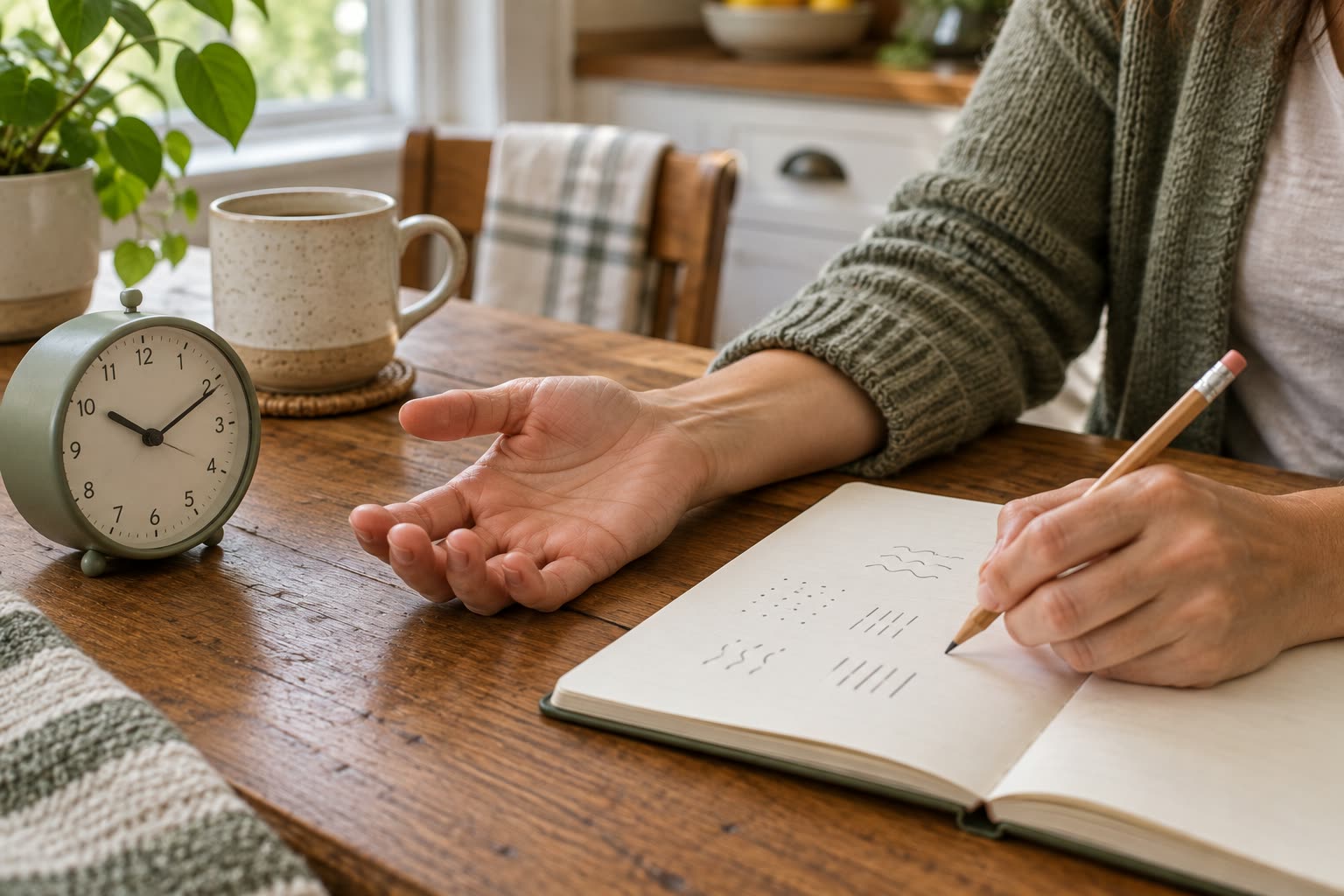
For a spiritual note, keep observation and interpretation on separate lines. Write what you felt first, then what the moment invited you to consider, and leave the cause open.
When Does Tingling Need Medical Attention?
Contact a clinician when pins and needles is constant, keeps returning, or worries you. The NHS also advises against self-diagnosing because treatment depends on the cause.
Seek emergency help for sudden numbness or weakness in the face, arm, or leg, especially on one side. The CDC also lists sudden speech difficulty, confusion, vision trouble, balance loss, and a severe headache with no known cause as stroke warning signs.
A brief sensation after leaning on an arm and a sudden neurological change are not the same situation. Duration, one-sidedness, loss of function, and other symptoms determine how quickly ordinary care should replace reflection.
Ruling out one physical trigger only shows that the first explanation did not settle the event and never proves an angelic cause, so uncertainty remains the honest conclusion.
Frequently Asked Questions
Is tingling a sign of spiritual awakening?
Tingling alone cannot establish a spiritual awakening or chakra change. You may treat the moment as a personal reflection cue after checking posture, breathing, duration, and other symptoms.
What does tingling on top of the head mean?
There is no fixed spiritual meaning for tingling on the scalp or crown. Note the exact location, how long it lasts, what you were doing, and whether it recurs before drawing a symbolic conclusion.
What does tingling in the hands mean spiritually?
A reflective reading might connect hand tingling with action, hesitation, or attention, but that association is not a universal rule. Pressure, position, and over-breathing can also produce tingling in the hands.
Does tingling while thinking of someone mean they are thinking of me?
The sensation cannot show what another person is thinking. It may reveal your own emotional response to the memory, which can still be worth noticing without turning it into evidence about them.
Is tingling the same as goosebumps or chills?
Tingling is a prickling or numb sensation, while goosebumps are visible raised skin and chills often involve feeling cold or shivering. They can occur together, but they describe different body events.
Sources
- (2024). Pins and needles. NHS. Link
- (n.d.). Numbness and tingling. U.S. National Library of Medicine. Link
- (2024). Hyperventilation. NHS Foundation Trust. Link
- (2026). Signs and Symptoms of Stroke. CDC. Link
- (2018). The neuropsychophysiology of tingling. Consciousness and Cognition. Link
- (n.d.). Acts 2. New American Bible. Link
- (n.d.). Daniel 10. New American Bible. Link
About Our Editorial Process
Every KnowTheAngels guide separates calculation method, tradition context, and personal reflection. We cite where interpretations come from, present more than one view, and never present symbolic reading as prediction.
Read our editorial policy