What Are Powers Angels, and How Do Scripture and Later Traditions Differ?
Paul's word exousiai, the sixth of the nine choirs, and why Orthodox lists call this rank the Authorities
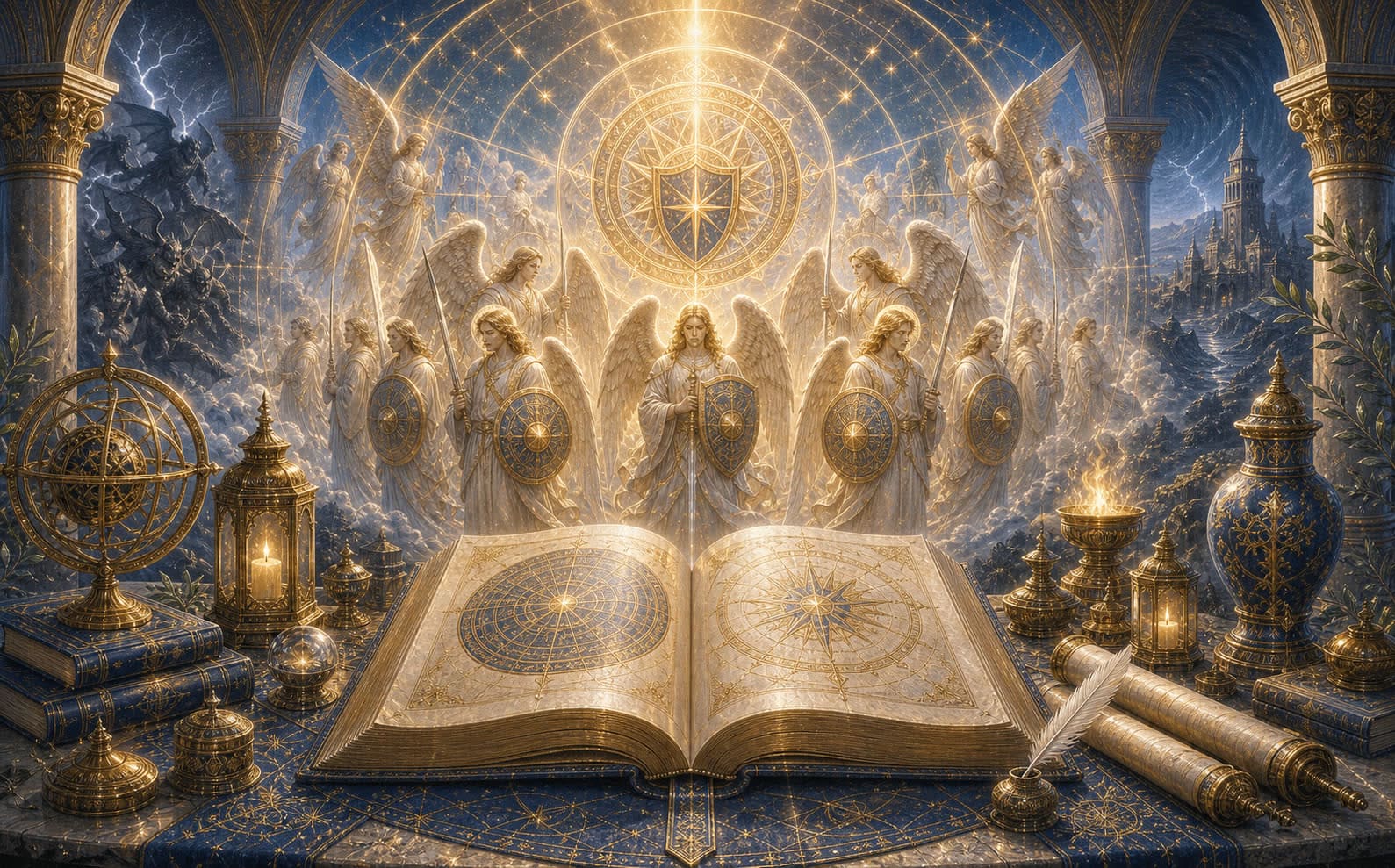
Powers are the sixth of the nine choirs of angels in Christian tradition, placed below the dominions and virtues and above the principalities in the order Pseudo-Dionysius set out around 500 CE. The name comes from exousiai, a Greek plural meaning "authorities," which Colossians 1:16 lists among the things "in heaven and on earth" created through Christ.
Scripture never describes a powers angel. The same word names hostile forces in Colossians 2:15 and Ephesians 6:12 and human officials in Romans 13:1, so the idea of a faithful choir with its own work comes from later readers: Pseudo-Dionysius gave the rank its place, and Gregory the Great gave it demons to restrain.
Quick Facts
- Greek name
- Exousiai, "authorities" (singular exousia)
- Rank
- Sixth of nine, last of the middle triad (Celestial Hierarchy 6 and 8)
- Named as beings in
- Colossians 1:16, 2:10, 2:15; Ephesians 1:21, 3:10, 6:12; 1 Corinthians 15:24; 1 Peter 3:22
- Traditional task
- Holding back evil spirits (Gregory the Great; Aquinas, Summa I q.108 a.6)
- Other name
- Authorities, in Parker's Pseudo-Dionysius and in Orthodox usage
- Often confused with
- Dynameis, the "powers" of Romans 8:38, which Catholic lists call Virtues
Which Greek word does "powers" translate?
Two different Greek words, and the one a verse uses decides which choir it can support.
Exousia means authority, the right to act or to command, and its plural exousiai names the choir called Powers in Catholic tradition. Dynamis means might or ability, and its plural dynameis names a different choir, the one Gregory the Great and Thomas Aquinas call the Virtues.
Other traditions use the English names the other way round. John Parker's 1897 translation of Pseudo-Dionysius titles chapter 8 "Concerning Lordships and Powers and Authorities," and the Orthodox Church in America lists the middle ranks as "Dominions, Powers, and Authorities." In both, the Powers are the dynameis and the exousiai are the Authorities.
| Greek word | Catholic name | Name in Parker and Orthodox usage | Place among the nine |
|---|---|---|---|
| exousiai, "authorities" | Powers | Authorities | Sixth, in both Pseudo-Dionysius and Gregory |
| dynameis, "powers" or "mighty ones" | Virtues | Powers | Fifth in Pseudo-Dionysius, seventh in Gregory |
The difference changes what Romans 8:38 can prove. Its "nor powers" translates dynameis, so the verse is evidence for the virtues and never uses exousiai at all.
Which Bible verses name the powers as beings?
Exousiai appear as unseen beings in eight verses, all in the letters attributed to Paul and in 1 Peter, and none of them says what the beings look like or what they do.
| Verse | NRSVUE wording | Where the authorities stand |
|---|---|---|
| Colossians 1:16 | "thrones or dominions or rulers or powers" | Created through Christ and for him |
| Colossians 2:10 | "the head of every ruler and authority" | Under Christ as their head |
| Ephesians 1:21 | "far above all rule and authority and power and dominion" | Below the risen Christ |
| Ephesians 3:10 | "the rulers and authorities in the heavenly places" | Learning God's wisdom through the church |
| 1 Peter 3:22 | "angels, authorities, and powers made subject to him" | Listed with angels, under Christ |
| Colossians 2:15 | "He disarmed the rulers and authorities" | Defeated at the cross |
| Ephesians 6:12 | "against the rulers, against the authorities" | Opponents in the believer's struggle |
| 1 Corinthians 15:24 | "destroyed every ruler and every authority and power" | Destroyed at the end |
Read in that order, the verses move from creation to defeat: made through Christ, placed under him, disarmed at the cross, and destroyed at the end. 1 Peter 3:22 comes nearest to calling them angels, because it names "angels, authorities, and powers" as one group made subject to the risen Christ.
Exousiai was also ordinary Greek for officials. Romans 13:1 tells believers to "be subject to the governing authorities," Titus 3:1 to be subject "to rulers and authorities," and Luke 12:11 warns of being brought "before the synagogues, the rulers, and the authorities," all with the same word and all about human government. A verse needs a heavenly setting, such as the "heavenly places" of Ephesians 3:10, before its authorities can be read as spirits.
Are the powers good angels or hostile forces?
Paul uses the word both ways, sometimes in the same letter. Colossians 1:16 says the authorities were created through Christ and for him, and Colossians 2:15 says Christ "disarmed the rulers and authorities and made a public example of them."
Origen, writing in the early third century, treated this as a rule about the names themselves. In On First Principles 1.5 he says scripture gives "numerous names of certain orders and offices, not only of holy beings, but also of those of an opposite description," and he argues that every rational being can rise or fall, so a title such as power does not show which side its bearer is on.
The nine-choir lists describe only a faithful rank. In Gregory the Great's account the powers hold hostile forces in check, so the enemies of Colossians 2:15 and Ephesians 6:12 become the choir's opponents rather than its members.
What do powers angels do in the hierarchy?
Scripture gives them no task. Holding back demons, the job Aquinas and Orthodox teaching assign them, comes from Gregory the Great.
Pseudo-Dionysius, writing around 500, explained the name without mentioning demons. In Celestial Hierarchy 8.1 the Authorities stand for "beautiful and unconfused good order," authority held "not using the authoritative powers imperiously for base purposes" and leading the ranks below "benignly." For him the choir shows how authority is rightly held.
Gregory, in his 34th homily on the Gospels in the early 590s, gave the rank its combat role: the powers receive enough strength that hostile forces are subject to them and cannot tempt human hearts as much as they want. Aquinas repeats it in Summa Theologiae I, q.108, a.6, where the powers are those "who coerce the evil spirits; even as evil-doers are coerced by earthly powers," and he cites Romans 13:3-4 for the comparison.
Aquinas keeps the Dionysian sense as well. In article 5 he says that to the powers "it belongs to regulate what is to be done by those who are subject to them," so the choir sets the order that the ranks below it carry out.
Orthodox teaching joins both ideas. The Orthodox Church in America's account of the November 8 feast of the bodiless powers says the Authorities "have authority over the devil" and "prevent demons from harming people as they would wish."
The two main orders agree on the rank. Pseudo-Dionysius runs the middle of the list dominions, virtues, powers, then principalities, and Gregory runs it dominations, principalities, powers, then virtues, so both make the powers sixth of nine. In Pseudo-Dionysius they close the middle triad that begins with the dominions, and Aquinas notes that the two orders differ only over the principalities and virtues.
How are powers different from principalities?
In Paul they are a pair more than two ranks. "Rulers and authorities," archai and exousiai, appear together in Ephesians 3:10 and 6:12 and Colossians 2:10 and 2:15, and the same pair names human officials in Titus 3:1 and Luke 12:11.
The hierarchy pulled the pair apart. Pseudo-Dionysius puts the powers last in the middle triad and the principalities first in the lowest, while Gregory, matching the order of Colossians 1:16, places the principalities directly above the powers.
Aquinas explains the difference by task. The powers "impose order on those subject to them," and the principalities, "presiding over the government of peoples and kingdoms," are the first to carry that order out; in Gregory's arrangement the principalities "rule even over good spirits" while the powers coerce the evil ones. The principalities therefore inherit the nations and Daniel's prince of Persia, and the powers inherit the restraint of demons.
Does Ephesians 6:12 describe the powers choir?
It uses the choir's Greek word for an enemy, and it ranks nothing. The NRSVUE reads: "our struggle is not against blood and flesh but against the rulers, against the authorities, against the cosmic powers of this present darkness, against the spiritual forces of evil in the heavenly places."
English versions place the word powers at different points in that list. The KJV uses "powers" for exousias, the second item, while the NRSVUE calls that item "authorities" and uses "cosmic powers" for kosmokratores, "world-rulers," a word found nowhere else in the New Testament.
The enemy reading is old. Origen quotes the verse in On First Principles 3.2 as showing "that there are certain invisible enemies that fight against us," and Walter Wink's Naming the Powers (1984) proposed a different subject altogether: the powers as the inner, spiritual side of institutions, whose outer side is their officials, laws, and systems.
Both readings ask what Paul's authorities were. The faithful sixth choir comes from Pseudo-Dionysius and Gregory, so Ephesians 6:12 shows that exousiai could be hostile but says nothing about what the choir does.
Frequently Asked Questions
Are powers the same as virtues?
No. In Catholic lists the powers are the exousiai, sixth of nine, and the virtues are the dynameis, fifth in Pseudo-Dionysius and seventh in Gregory the Great. Parker's translation of Pseudo-Dionysius and Orthodox usage call the dynameis "Powers," which is why the two names get crossed.
Which archangel leads the powers?
Scripture and the church fathers name no leader. The pairing with Camael appears in Heinrich Cornelius Agrippa's Three Books of Occult Philosophy (1533), whose table of the nine choirs sets Camael on the Powers row and Raphael on the Virtues row.
Are the governing authorities in Romans 13 angels?
Romans 13 describes civil government: its authorities are "instituted by God," receive taxes (13:6), and bear "the sword." The Greek word is exousiai, the same as in the choir's verses, which is why Aquinas borrows Romans 13:3-4 to explain how the powers restrain evil spirits.
Does the Bible call Satan a power?
Ephesians 2:2 calls him "the ruler of the power of the air," where power translates exousia in the singular. The phrase names the domain he rules, and no verse places him in a choir of powers.
Sources
- (2021). Colossians 1:16; 2:10; 2:15 and Ephesians 1:21; 2:2; 3:10; 6:12. Bible Gateway. Link
- (2021). Romans 8:38; 13:1-6; 1 Corinthians 15:24; Titus 3:1; Luke 12:11; 1 Peter 3:22. Bible Gateway. Link
- (1611). Ephesians 6:12 and Romans 8:38. Bible Gateway. Link
- (1904). Ephesians 6:12 (Romans 8:38 and 1 Peter 3:22 at the same site). Bible Hub. Link
- (1897). The Celestial Hierarchy, chapters 6 and 8. tertullian.org. Link
- (c. 1265-1268). Summa Theologiae I, q.108, aa.5-6. New Advent. Link
- (1907). Angels (quoting Gregory the Great, Homily 34 on the Gospels). The Catholic Encyclopedia, vol. 1. Link
- . Synaxis of the Archangel Michael and the Other Bodiless Powers (November 8). oca.org. Link
- (c. 220-230). On First Principles (De Principiis), Book 1, chapter 5. New Advent. Link
- (c. 220-230). On First Principles (De Principiis), Book 3, chapter 2. New Advent. Link
- (1984). Naming the Powers: The Language of Power in the New Testament. Fortress Press (Internet Archive). Link
- (1533). Three Books of Occult Philosophy, Book II, chapter 12 (Scale of the Number Nine). Esoteric Archives. Link
About Our Editorial Process
Every KnowTheAngels guide separates calculation method, tradition context, and personal reflection. We cite where interpretations come from, present more than one view, and never present symbolic reading as prediction.
Read our editorial policy