What Do Principalities Rule Over in Biblical Tradition?
Paul's archai, Daniel's princes of Persia and Greece, and how later theology gave one choir the government of nations
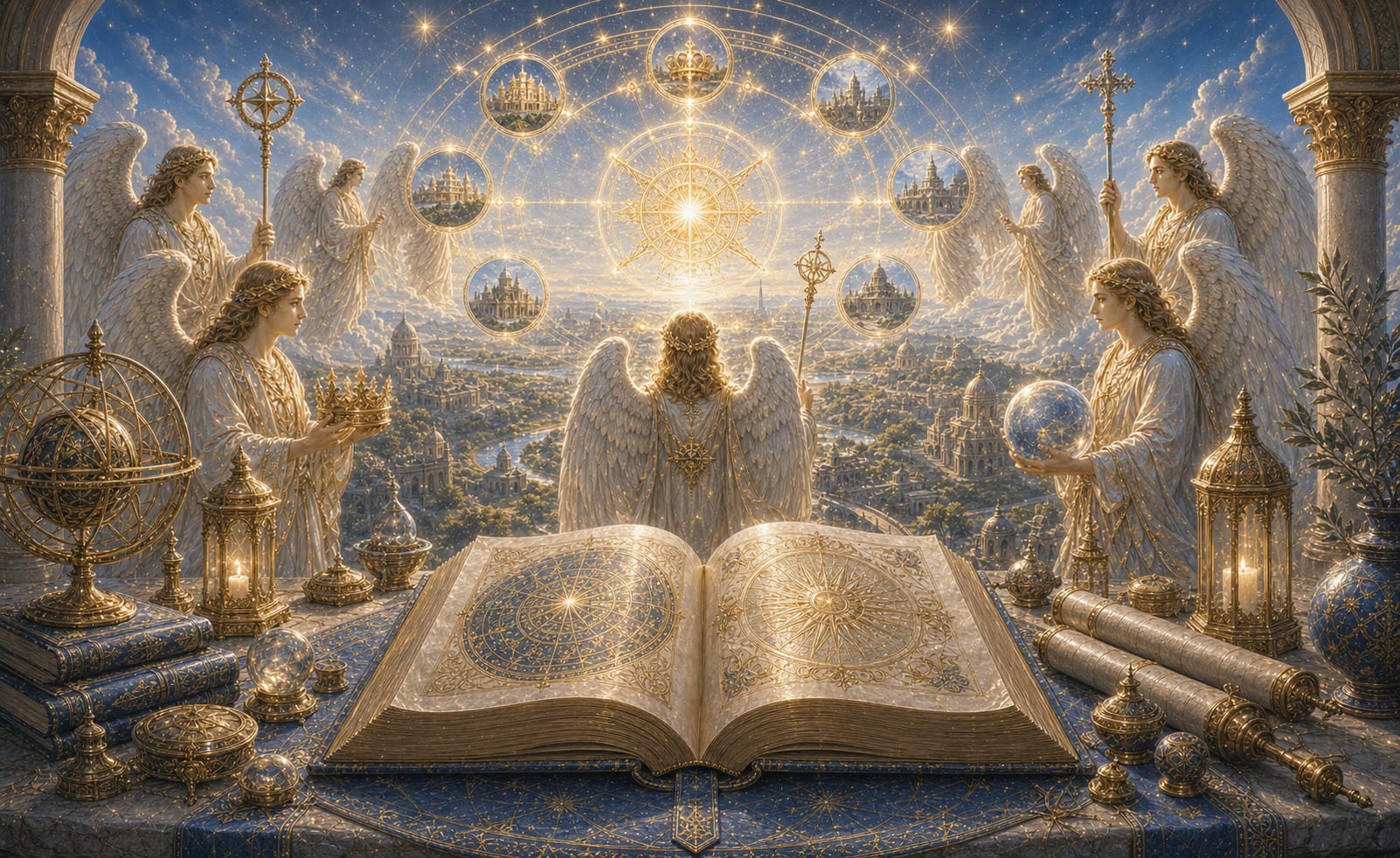
Principalities are an order of angels named from Paul's Greek archai, "rulers" or "first ones," which Colossians 1:16 lists among the things in heaven and on earth created through Christ. In Pseudo-Dionysius's list of nine choirs they open the lowest triad, just above the archangels.
Paul never says what principalities do. Their best-known task, governing nations, joins his word to the "prince of Persia" in Daniel 10, a link Pseudo-Dionysius prepared around 500 and Thomas Aquinas made explicit in the thirteenth century.
Quick Facts
- Greek name
- Archai, "rulers" or "beginnings" (singular arche)
- Rank
- Seventh of nine in Pseudo-Dionysius, first of the lowest triad; fifth in Gregory the Great
- Named as beings in
- Romans 8:38; 1 Corinthians 15:24; Ephesians 1:21, 3:10, 6:12; Colossians 1:16, 2:10, 2:15
- Daniel's word
- Hebrew sar, "prince" or "commander," for the princes of Persia and Greece and for Michael
- Traditional task
- Government of peoples and kingdoms (Aquinas, Summa I q.108 a.6)
- Named leader
- Haniel, in Agrippa's 1533 table; no biblical source
Where does scripture name principalities, and when does it mean human rulers?
Archai appear as unseen beings in Romans 8:38, 1 Corinthians 15:24, Ephesians 1:21, 3:10 and 6:12, and Colossians 1:16, 2:10 and 2:15. The KJV translates the word "principalities," while the NRSVUE and most modern versions say "rulers," so a reader comparing translations may not see the choir's name at all.
The same word covers very different subjects, and the words around it decide which.
| Verse | Who the archai are | Clue in the text (NRSVUE) |
|---|---|---|
| Titus 3:1 | Civil officials | "be subject to rulers and authorities, to be obedient" |
| Luke 12:11 | Officials who put the disciples on trial | "before the synagogues, the rulers, and the authorities" |
| Romans 8:38 | Unseen beings, listed next to angels | "nor angels, nor rulers" |
| Ephesians 3:10 | Heavenly beings who learn from the church | "the rulers and authorities in the heavenly places" |
| Colossians 2:15 | Hostile beings defeated at the cross | "He disarmed the rulers and authorities" |
| Jude 6 | No being at all: the rank fallen angels gave up | "the angels who did not keep their own position" |
The choir rests on the middle rows, where the rulers stand beside angels or in the heavenly places. Titus and Luke show that archai was ordinary vocabulary for human government, and Jude 6 uses the singular for a position in an order rather than for the one who holds it.
Why does archai mean both beginning and rule?
Arche has two main senses, beginning and first place. John 1:1 opens with it ("In the beginning"), and Colossians 1:18 uses it of Christ, "he is the beginning," two verses after the archai are listed among the things he created.
The ruling sense grows from the second meaning: whoever comes first leads the rest. Latin translated archai as principatus, the source of the English principality, and Gregory the Great defined presiding (principari) as "to be first among others," a line Aquinas quotes in Summa Theologiae I, q.108, a.5. Pseudo-Dionysius reads the name the same way, as showing the choir's "princely and leading function" (Celestial Hierarchy 9.1).
Leading is therefore the whole content of the name. It says the principalities go first, and it leaves open whom they lead, which is why later writers could give them other angels or whole peoples.
What do principalities rule over in the angelic hierarchy?
Peoples and kingdoms, in Thomas Aquinas's account. Pseudo-Dionysius gave that care to the whole lowest triad, and Gregory the Great gave the principalities other angels to lead.
Pseudo-Dionysius says in Celestial Hierarchy 9.2 that "the revealing order of the Principalities, Archangels, and Angels, presides, through each other, over the Hierarchies amongst men." His proof joins Daniel to Deuteronomy: scripture names "Michael as Ruler of the Jewish people, and others over other nations," because "the Most High established borders of nations according to number of Angels of God."
Aquinas narrows that care to one choir. In Summa Theologiae I, q.108, a.6 the principalities are those "presiding over the government of peoples and kingdoms," which he ranks first among angelic tasks because "the good of a nation is more divine than the good of one man," a line from Aristotle's Ethics. His scriptural proof is Daniel 10:13: "The prince of the kingdom of the Persians resisted me."
Gregory's order gives them a different charge. Aquinas explains that in it the principalities come straight after the dominations and "rule even over good spirits," so their first charge is other angels. The Orthodox Church in America's account of the November 8 feast holds both ideas: principalities "have command over the lower angels" and "protect lands, nations and peoples."
The rank changes with the list. Pseudo-Dionysius makes the principalities seventh, directly above the archangels. Gregory puts them fifth, above the powers and below the dominations. Aquinas notes that each order can claim Paul, since Ephesians 1:21 fits Pseudo-Dionysius and Colossians 1:16, "thrones or dominions or rulers or powers," fits Gregory.
How did Daniel's prince of Persia become a principality?
The Hebrew of Daniel has no word for principality. Its term is sar, "prince" or "commander," used for "the prince of the kingdom of Persia" who "opposed" God's messenger for twenty-one days (10:13), for "the prince of Greece" who will follow (10:20), and for Michael, "one of the chief princes" (10:13) and later "the great prince, the protector of your people" (12:1).
Behind these princes lies an older belief that each nation has a heavenly patron. In the Greek Septuagint and a Dead Sea Scroll copy of Deuteronomy 32:8, God fixes the boundaries of the peoples by the number of heavenly beings (the NRSVUE says "the gods"), and Sirach 17:17 says "He appointed a ruler for every nation, but Israel is the Lord's own portion." The Jewish Encyclopedia notes that later rabbinic sources count seventy such princes, one for each nation of Genesis 10, with Michael as Israel's.
Christian writers joined these princes to Paul's archai in steps. Origen, in On First Principles 3.3, read the princes of Persia and Greece as "not human beings, but certain powers" set over nations. Pseudo-Dionysius put the rulers of nations in the lowest triad, and Aquinas, quoting Daniel 10:13, made them the work of the principalities in particular.
Paul never connects his archai to Daniel, and none of the verses that name them mentions a nation.
Was the prince of Persia a good angel or a demon?
Christian readers have given both answers since the third century, and Daniel 10 does not settle it: the prince "opposed" God's messenger until Michael came to help, and the text says nothing about his character.
| Reader | Date | Reading |
|---|---|---|
| Origen, On First Principles 3.3 | Early 3rd century | A hostile power set over Persia, one of the princes of nations who, each with a wisdom of its own, laid a snare for Christ |
| Pseudo-Dionysius, Celestial Hierarchy 9.3 | c. 500 | Speaking of nations' angels in general: they led their peoples toward God, and the nations strayed "by their own declension" |
| Jerome, as reported by Aquinas | Early 5th century | The angel who opposed Israel's release, a delay that may have come from the captives' sins, into which a demon had led them |
| Gregory the Great, Moralia 17, as reported by Aquinas | Late 6th century | A good angel appointed to guard the kingdom of Persia |
| Thomas Aquinas, Summa I, q.113, a.8 | 1260s | A good angel; angels "resist" one another only while consulting God about nations with opposing merits |
| C. Peter Wagner (ed.), Engaging the Enemy | 1991 | A demonic territorial spirit, the model for spirits said to rule cities and regions |
The split follows from what each reader was explaining. Origen was accounting for the hostile powers in Paul, so the princes of nations joined them. Gregory and Aquinas were describing a choir of faithful angels, so the prince became a guardian whose resistance needed another cause.
The territorial-spirit reading has its own critics. Chuck Lowe's Territorial Spirits and World Evangelisation (1998) is a book-length critique of it on biblical, historical, and missiological grounds.
Can principalities be matched to nations or institutions today?
No early source gives a roster. Daniel names only the princes of Persia and Greece and Israel's Michael, and the rabbinic sources the Jewish Encyclopedia surveys add princes of Egypt, Babylon, Media, and Edom, which stood for Rome, while naming none of them except Michael and Samael.
Twentieth-century theologians moved the question from nations to institutions. Hendrik Berkhof's Christ and the Powers, written in the Netherlands in 1953 and translated into English by John Howard Yoder in 1962, read Paul's rulers and authorities as forces working through the structures of political and social life.
That reading applies Paul's word, which never names a nation, to present-day structures, and the territorial-spirit reading applies Daniel's prince to present-day places. Both are theological arguments built on the texts, and no biblical or patristic source identifies the principality of a modern country, city, or party.
Frequently Asked Questions
Is Michael a principality?
Daniel calls Michael "one of the chief princes" and "the great prince," using the same word, sar, as for the princes of Persia and Greece, and Pseudo-Dionysius calls him "Ruler of the Jewish people." The nine-choir lists still place him with the archangels, following Jude 9, which calls him "the archangel Michael."
Which archangel leads the principalities?
Scripture names none. Heinrich Cornelius Agrippa's Three Books of Occult Philosophy (1533) sets Haniel on the Principalities row of its table of the nine choirs, and that table is the earliest source given here for the pairing.
What is the difference between principalities and powers?
Paul uses archai and exousiai as a pair, "rulers and authorities," in Ephesians 3:10 and 6:12 and Colossians 2:10 and 2:15. The hierarchy separates them: Pseudo-Dionysius makes the powers sixth and the principalities seventh, and Aquinas gives the powers the setting of order and the principalities its first execution among peoples and kingdoms.
Are principalities always evil in the Bible?
No. Colossians 1:16 lists them among the things created through Christ, and Ephesians 3:10 has God's wisdom made known to them "in the heavenly places" through the church. Colossians 2:15 and Ephesians 6:12 are the verses that make them opponents.
Sources
- (2021). Romans 8:38; 1 Corinthians 15:24; Ephesians 1:21; 3:10; 6:12; Colossians 1:16-18; 2:10; 2:15. Bible Gateway. Link
- (2021). Titus 3:1; Luke 12:11; Jude 6; John 1:1. Bible Gateway. Link
- (2021). Daniel 10:13, 20-21; 12:1; Deuteronomy 32:8; Sirach 17:17. Bible Gateway. Link
- (1904). Romans 8:38 (Jude 6 and Titus 3:1 at the same site). Bible Hub. Link
- (1897). The Celestial Hierarchy, chapters 6 and 9. tertullian.org. Link
- (c. 1265-1268). Summa Theologiae I, q.108, aa.5-6. New Advent. Link
- (c. 1265-1268). Summa Theologiae I, q.113, a.8 (reporting Jerome and Gregory the Great, Moralia 17). New Advent. Link
- (c. 220-230). On First Principles (De Principiis), Book 3, chapter 3. New Advent. Link
- (1906). Angelology (angels of the nations; Daniel 10; seventy princes). The Jewish Encyclopedia. Link
- . Synaxis of the Archangel Michael and the Other Bodiless Powers (November 8). oca.org. Link
- (1991). Engaging the Enemy: How to Fight and Defeat Territorial Spirits. Regal Books (Internet Archive). Link
- (1998). Territorial Spirits and World Evangelisation: A Biblical, Historical and Missiological Critique of Strategic-Level Spiritual Warfare. Mentor/OMF (Internet Archive). Link
- (1953; English 1962). Christ and the Powers. Herald Press (Internet Archive). Link
- (1533). Three Books of Occult Philosophy, Book II, chapter 12 (Scale of the Number Nine). Esoteric Archives. Link
About Our Editorial Process
Every KnowTheAngels guide separates calculation method, tradition context, and personal reflection. We cite where interpretations come from, present more than one view, and never present symbolic reading as prediction.
Read our editorial policy