How Do You Calculate a Personality Number From Consonants?
Enter a name, choose Pythagorean or Chaldean, and this calculator extracts the consonants, adds their values, and reduces to a single digit or master number
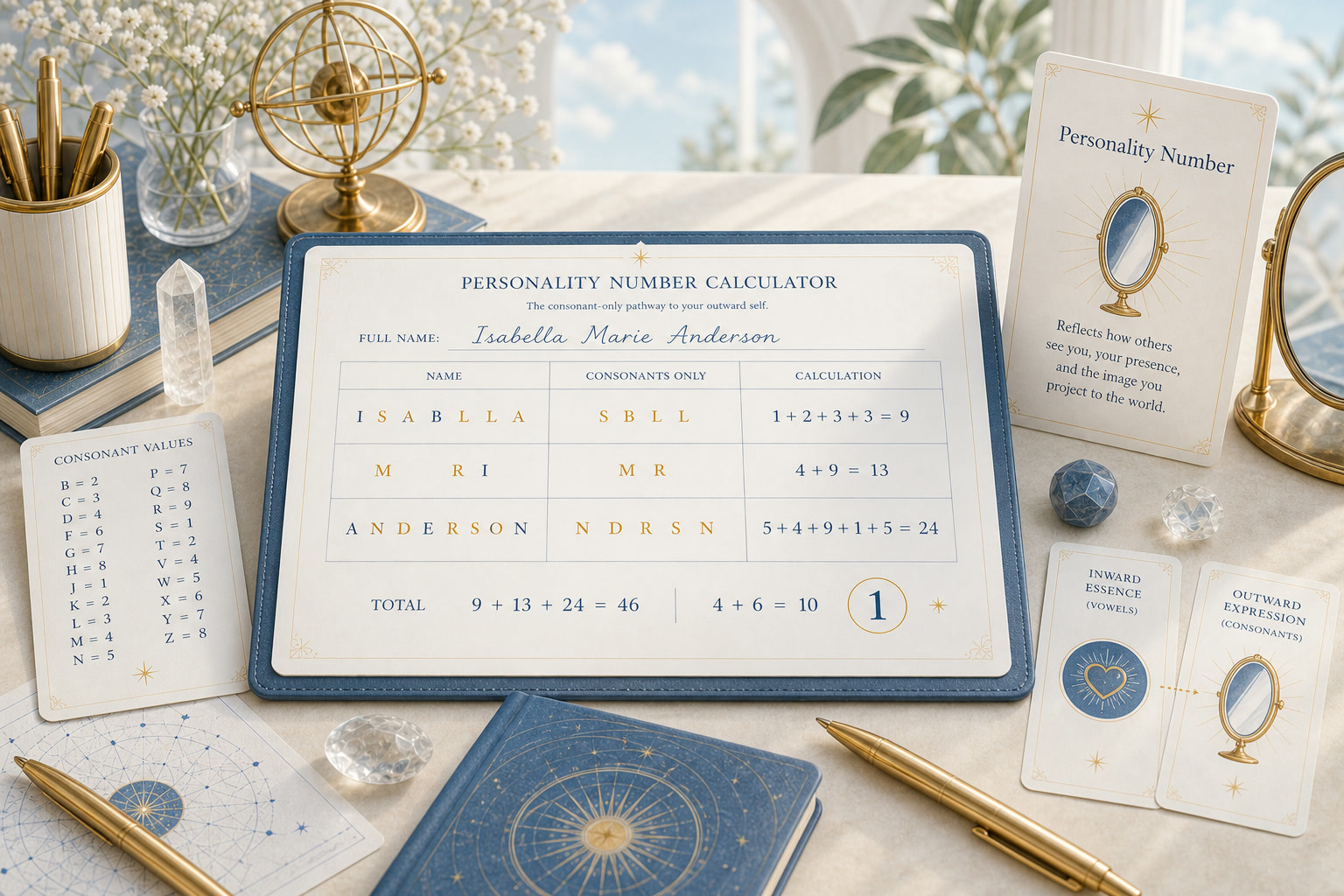
This tool organizes your input for reflection. It does not prove angel contact, predict an outcome, or replace your judgment.
The personality number is the chart role built from consonants alone. Hans Decoz defines it as the role based on consonants, describing “the side of yourself you show the world and the first impression others form of you.”
This tool takes one name and one system choice (Pythagorean or Chaldean), extracts the consonants, adds their assigned values, and reduces the total to a single digit or a master number (11, 22, or 33). Vowels are A, E, I, O, and U only; every other letter, including Y and W, is always a consonant.
Decoz writes that Y “can be a vowel or a consonant, depending on the adjacent letters.” This tool does not check adjacency, so Y is always counted as a consonant, which can change the result for names containing Y.
Quick Facts
- Input
- One name in Latin letters plus a system choice (Pythagorean or Chaldean)
- Letters counted
- Consonants only (every letter except A, E, I, O, U); Y and W are always consonants
- Reduction
- Digit sum, stopping at a single digit or master number (11, 22, 33)
- Result display
- Personality number, consonant list with values, and reduction path
- Text handling
- Characters outside A through Z are dropped, including accented letters
What the tool calculates from consonants
The input is one text field (labelled ‘Enter full name’) and two radio buttons: Pythagorean (selected by default) and Chaldean. The tool converts the entered text to capitals, removes every character outside A through Z, then counts only the consonants.
Consonants here are every letter except A, E, I, O, and U. Y is always a consonant, and so is W.
The result panel shows a label (‘Personality Number (Pythagorean)’ or ‘(Chaldean)’), the reduced number, and a path line such as ‘Consonants sum = 42 → 4 + 2 = 6.’ It also lists every counted consonant with its assigned value.
When the total reduces to 11, 22, or 33, the tool keeps it as a master number and shows a ‘Master Number’ badge. There is no option to reduce further.
Below the number, the panel shows a one-line theme from the site’s Life Path theme list and a link labelled ‘Learn about Personality Number N.’ The theme line is the site’s own wording, not a quotation from a named publisher.
SARAH LOUISE DAVIS in Pythagorean consonants
SARAH LOUISE DAVIS has eight consonants when vowels are defined as A, E, I, O, and U. The tool extracts S, R, and H from SARAH; L and S from LOUISE; and D, V, and S from DAVIS.
SARAH LOUISE DAVIS: Pythagorean consonant calculation
Each group’s consonant values are added, then the grand total is reduced.
- SARAH
- Input
- S, R, H
- Action
- S = 1, R = 9, H = 8
- Result
- 18
- LOUISE
- Input
- L, S
- Action
- L = 3, S = 1
- Result
- 4
- DAVIS
- Input
- D, V, S
- Action
- D = 4, V = 4, S = 1
- Result
- 9
- Total
- Input
- 18 + 4 + 9
- Action
- Sum = 31, then 3 + 1
- Result
- Personality number 4
The path line reads ‘Consonants sum = 31 → 3 + 1 = 4,’ followed by the full consonant list: S=1, R=9, H=8, L=3, S=1, D=4, V=4, S=1.
This name has no Y, so the Y classification does not affect the result. For a name that does contain Y, the effect can be large: JANICE MAY BARKER’s Pythagorean consonants total 42 (reducing to 6) with Y counted as a consonant, but only 35 (reducing to 8) if Y were reclassified as a vowel.
Two ways to add: all consonants at once versus one name at a time
Decoz describes reducing each name’s consonants to a single digit or master number before combining the results. The tool does not do this: it adds every consonant value in one total and reduces only at the end.
For SARAH LOUISE DAVIS, the two approaches produce different results. The tool adds 18 + 4 + 9 = 31 and reduces to 4.
In the method Decoz describes, SARAH’s consonant total of 18 reduces to 9 first. LOUISE stays at 4, and DAVIS stays at 9.
The three reduced totals then add to 9 + 4 + 9 = 22, a master number that is preserved.
| Method | SARAH | LOUISE | DAVIS | Combining step | Result |
|---|---|---|---|---|---|
| Tool (all at once) | 18 | 4 | 9 | 18 + 4 + 9 = 31 | 4 |
| Decoz (per name first) | 18 -> 9 | 4 | 9 | 9 + 4 + 9 = 22 (master) | 22 |
The difference appears when a single name’s consonant total is a two-digit number that is not a master number. The tool carries SARAH’s 18 into the grand sum, while the Decoz method reduces it to 9 before combining, and the combining step then reaches 22.
Not every name diverges. JANICE MAY BARKER gives 6 either way, because MAY’s consonant total (11, a master number) and BARKER’s (22, also a master number) are both preserved before combining, so both methods reach the same grand total of 42.
JANICE MAY BARKER: Pythagorean 6, Chaldean 22
Andrews lists the Pythagorean consonants for JANICE MAY BARKER as J, N, C, M, Y, B, R, K, and R. Their values add to 1 + 5 + 3 + 4 + 7 + 2 + 9 + 2 + 9 = 42, reducing to 6.
In the Chaldean system, the same nine consonants carry different values. Andrews gives J(1), N(5), C(3), M(4), Y(1), B(2), R(2), K(2), R(2), totalling 22, a master number that is kept.
| System | Consonant total | Result |
|---|---|---|
| Pythagorean | 42 | 6 |
| Chaldean | 22 | 22 (master) |
Two letters account for the entire difference. Y carries 7 in Pythagorean but 1 in Chaldean, and R carries 9 versus 2; BARKER has two R’s, which doubles the shift from R alone.
The result panel labels these ‘Personality Number (Pythagorean)’ and ‘Personality Number (Chaldean),’ so the system is always visible beside the number.
What the tool drops before it counts
The tool converts the input to capitals and removes every character outside A through Z before counting. Spaces, hyphens, apostrophes, and digits disappear without any message.
Accented letters are also dropped. An e with an acute accent, an n with a tilde, and letters from non-Latin alphabets are all removed before the calculation starts, with no transliteration step.
For a name typed as O’Brien-Smith, the tool strips the apostrophe and hyphen and works with OBRIENSMITH. The consonants are B, R, N, S, M, T, and H, totalling 2 + 9 + 5 + 1 + 4 + 2 + 8 = 31, reducing to 4.
The tool does not warn when characters are removed. If a name includes accented or non-Latin characters, the personality number will be based on fewer letters than the full name contains.
Where the consonant total stops
Decoz defines the personality number as the consonant-based role that “describes the side of yourself you show the world and the first impression others form of you.” That definition belongs to one chart position, not the full chart.
The tool shows one reduced number and a theme line. Other chart roles use different inputs: the expression number uses all letters, the soul urge uses vowels, and the life path uses the birth date.
A personality number describes a traditional association between consonants and one aspect of presentation. The result does not determine how others actually perceive the person behind the name.
Frequently Asked Questions
Is Y a vowel or a consonant in this calculator?
Y is always a consonant. Decoz writes that Y “can be a vowel or a consonant, depending on the adjacent letters,” but this tool does not check adjacency.
For JANICE MAY BARKER, the difference changes the Pythagorean personality number from 6 to 8.
Can the tool give a different result from the method in numerology books?
Yes. The tool adds all consonants in one total and reduces, while Decoz describes reducing each name’s consonants separately before combining.
For SARAH LOUISE DAVIS, the tool gives 4 and the Decoz method gives 22.
What happens to accented letters in a name?
The tool drops them without a warning. Only plain A through Z characters are counted, so a name must be typed in unaccented Latin letters for every consonant to be included.
Sources
- . How to Do Your Own Numerology Reading. World Numerology, Calculating the Personality number section. Link
- . The Numbers in Your Numerology Chart. World Numerology, Core Numbers section. Link
- (2020). Pythagorean vs Chaldean Numerology: How the Two Systems Differ. Numerologist.com, Pythagorean and Chaldean calculation sections. Link
About Our Editorial Process
Every KnowTheAngels guide separates calculation method, tradition context, and personal reflection. We cite where interpretations come from, present more than one view, and never present symbolic reading as prediction.
Read our editorial policy